The digital transformation of the real estate industry is clearly visible in the integration of home buying and selling, commercial real estate management and leasing, and modern property management platforms. PropTech in real estate represents specialized technology that combines property expertise with advanced information systems from multiple industries. By improving speed, accuracy, and operational efficiency, PropTech solutions are reshaping how real estate businesses manage assets, transactions, and customer experiences.
The modern experience of searching for real estate properties, smart buildings, and real estate app development. Real estate sectors of all types are rapidly adopting PropTech. This guide will focus on the definition and impact of PropTech on the modern real estate industry. It will justify its role as a support system for the contemporary real estate value chain.
Key Takeaways
- PropTech integrates advanced technologies like AI, IoT, and data analytics to transform traditional real estate processes into efficient digital systems.
- Rapid market growth and rising investments highlight PropTech as a key driver of digital transformation across global real estate ecosystems.
- Real estate has evolved from manual processes to automated, data-driven platforms that enable faster transactions, greater accuracy, and better decision-making.
- Innovations such as virtual tours, smart pricing, digital contracts, and intelligent property management significantly redefine the user experience and operational efficiency.
- AI-powered insights, predictive analytics, and smart automation are shaping future real estate trends with personalized, scalable, and intelligent platforms.
- PropTech improves transparency, reduces costs, enhances customer experience, and enables faster, data-driven decisions for buyers, sellers, and investors.
- Despite challenges such as costs, legacy systems, and security concerns, strategic adoption of PropTech delivers long-term efficiency, scalability, and a competitive advantage.
Market Overview of the PropTech Industry
Due to the drive for optimized operational efficiency across the business landscape, PropTech is attracting even more attention as its adoption into the global Real Estate Industry deepens.
- According to Fortuin Business Insights, the global PropTech market valuation was $36.55 billion in 2024. The valuation is expected to grow by approximately $52 billion to exceed $88.37 billion by 2032, reflecting a 11.9% CAGR.
- In the U.S.A. PropTech encompasses software, marketplaces, and digital solutions. The valuation was approximately $ 10.55 billion in 2024. Forecasts project PropTech’s market size at $57.5 billion by 2035. This translates to a 16.6 % CAGR.
- PropTech adoption is evident. Real Estate market data indicate that more than 30% of Real Estate Market investors have invested in / collaborated with PropTech.
- In 2024, PropTech Investment increased by 32.5%, with the average deal size up 12%, indicating improved investor confidence.
- The global real estate market is estimated at USD 4,130.01 billion in 2024. Forecasted valuation is USD 5,852.02 billion for the period 2025 to 2030, reflecting a CAGR of 6.2%.
- Grand View Research reports that the global PropTech market was valued at USD 25.15 billion in 2021 and is projected to reach USD 94.20 billion by 2030, with a 15.8% CAGR. The main driver of this growth is the growing demand for real estate software, innovative building solutions, and digital transaction platforms.
PropTech has become the primary driver of digital transformation in the global real estate ecosystem, driven by steady investment, rapid innovation, and growing adoption across residential and commercial segments. These innovations are driving the continued growth in demand for flexible PropTech solutions.
What Is PropTech?
Searching for PropTech yields several definitions, but at its core, PropTech (Property Technology) derives value from integrating technology into the purchase, sale, management, financing, and use of property. It answers one big question: what is PropTech in real estate, and why is it reshaping everything?
PropTech is the integration of software, automation, data analysis, AI, IoT, and digital platforms to eliminate outdated processes and deliver real efficiency in the real estate industry. Hence, PropTech in real estate is the move from manual, analogue processes to smart, automated, insight-driven processes.
How Has PropTech Changed the Real Estate Industry?
When you search for the impact of automation on the real estate industry, you will see how automation is impacting PropTech and real estate transactions. From manual, tedious, and time-consuming processes (signing step-by-step contractual obligations, data and document analysis, and negotiations) to simple automation, information and decisions are now at the user’s fingertips.
How PropTech is changing real estate is evident through innovations such as virtual property tours, smart pricing models, digital contracts, intelligent property management, and end-to-end automation. These advancements have transformed the industry into a more transparent, efficient, and user-driven ecosystem. From small brokerages to major real estate firms, users rely solely on real estate technology to conduct real estate transactions at an unprecedented pace and with a user-oriented experience. PropTech Innovations has not simply improved the real estate industry; it has redefined how users find, evaluate, purchase, sell, and manage the overwhelming number of real estate transactions.
Evolution of Real Estate Technology
If you search for the roots of real estate technology, you’ll discover a surprisingly dramatic evolution. Real Estate used to rely on Newspaper classifieds, manual entry and bookkeeping, and in-person open houses, and has now shifted to an automated, intelligent digital ecosystem. In the early 2000s, the PropTech industry entered the market, introducing online listings, followed by mobile apps and cloud-based CRMs that simplified property discovery and management.
With the rise of data analytics, IoT, AI, and immersive virtual experiences, PropTech in real estate has reshaped the property journey at every stage, from discovery and valuation to transactions and ongoing management. The evolution is more than continuous improvement and innovative technology. The industry as a whole has reinvented the mechanisms by which real estate operates.
Key PropTech Categories Transforming the Industry
You can find critical PropTech solutions for real estate businesses across several key segments. Each addresses a persistent challenge in the sector and provides more intelligent, data-driven strategies to streamline real estate operations. These solutions are central to PropTech in real estate app development, encompassing automated property listings, smart home technologies, IoT-enabled buildings, AI-powered real estate valuation tools, digital and automated payment systems, and immersive AR/VR virtual tour experiences.
Maintenance management is simplified with PropTech for real estate automation. PropTech also automates and streamlines investment financing and investment management. This combination of segments creates a cohesive digital marketplace where agents, buyers, investors, and property developers can operate faster, more intelligently, and with greater transparency, propelling the sector to a new level of efficiency.
PropTech and AI: Real Estate Trends to Watch in 2026
Looking ahead, the real estate app trend in PropTech is being driven by the convergence of PropTech and AI. What began as basic automation has evolved into predictive intelligence, autonomous property management, and hyper-personalized user experiences that are redefining how real estate platforms operate. These are the key indicators of real estate trends in 2026.
AI-enabled property valuations, recommendations, intelligent building automation, predictive maintenance, and tenant engagement through chatbots are new standards. Immersive AR and VR tours are also upgrading engagement with real estate tenants. AI advancements in real estate are having an even greater impact by streamlining processes, enhancing decision-making, mitigating risks, increasing operational efficiency, managing complexity, and improving ROI.
Commercial Real Estate PropTech: Innovations Reshaping CRE
Active transformation is evident in commercial real estate PropTech, which is reinventing the design, management, and optimization of business space. Today, Generative AI in commercial real estate accelerates planning, improves asset modeling, and supports data-driven decision-making like never before. Technology boosts efficiency and reduces operational costs, improving tenant satisfaction and experience in smart, automated commercial spaces, such as offices and warehouses.
Occupancy, energy use, and building performance metrics are tracked in real-time by IoT sensors. Property owners can view digital twins of their building layouts and predict unscheduled maintenance. AI systems streamline leasing processes, mortgages, and asset management. Developers gain access to critical data for risk assessment and strategic insights through PropTech in commercial real estate. These solutions also empower tenants with flexible design options, improved productivity, enhanced safety measures, and sustainability-focused, technology-enabled spaces.
Is PropTech the Future of Real Estate?
In the commercial real estate sector, PropTech is the new transformative technology. Is PropTech the future of real estate? Yes. PropTech is the future of real estate. In an environment where speed, convenience, and transparency are paramount, PropTech becomes the central backbone of operational real estate.
Today’s world relies on technology as a necessity rather than an optional tool, enabling data-driven decisions, automated building management, virtual property tours for clients, analytical reports to satisfy investors, and myriad digital construction and development tools. With the ever-evolving landscape of smart cities, increasing automation, and the demand for PropTech sustainability, the future of the global real estate market depends on PropTech for the foreseeable future. PropTech will revolutionize the way the international real estate market works.
Benefits of Using PropTech in Real Estate
It doesn’t take long to understand where PropTech adds value throughout the industry. It streamlines decision-making, improves productivity, and elevates the customer experience. PropTech in real estate has many industry participants, including developers, agents, and investors, who can remove obstacles and operate more intelligently.
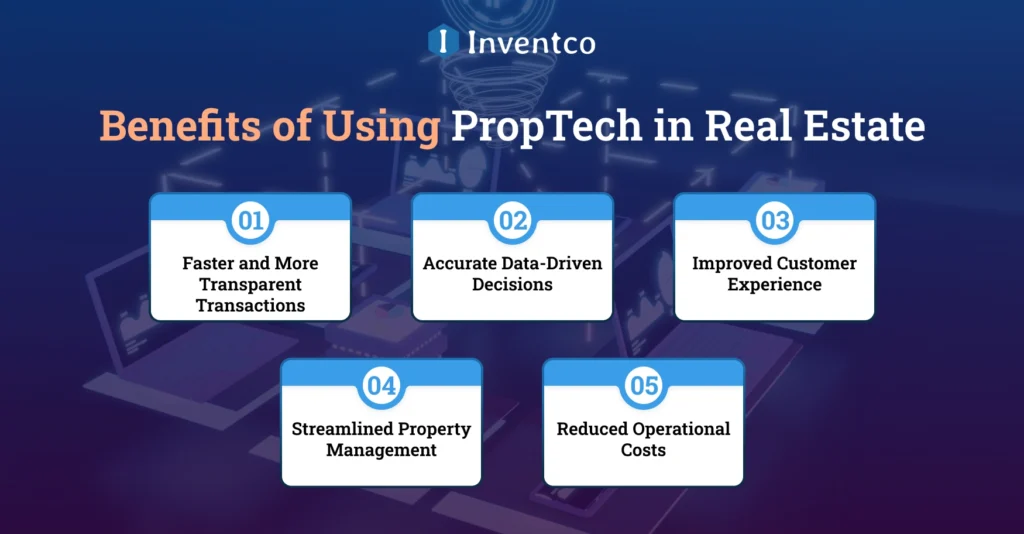
Here are the key benefits of transforming the real estate sector:
1. Faster and More Transparent Transactions
Digital documents, e-signatures, and automated workflows work together to improve efficiency in the transaction-closing cycle. Clients receive real-time communication, ensuring minimal delays and complete transparency, thereby increasing ease and safety in real estate transactions.
2. Accurate Data-Driven Decisions
Advanced analytics provide real-time insights around pricing, trends, demand, and investment performance. This empowers buyers, sellers, and developers to make more informed decisions, thereby reducing risk and improving long-term profitability.
3. Improved Customer Experience
Users are guided through seamless processes, allowing them to spend more time and effort exploring real estate opportunities. A virtual tour of the offering, fluent, intelligent, and personalized support, and recommendations lead to deep engagement, improving customer satisfaction and strengthening real estate companies’ ability to convert customers.
4. Streamlined Property Management
Automated systems, including IoT sensors, organizing dashboards, and communication tools, facilitate maintenance, scheduling, and energy-monitoring workflows. These features are essential for those who want to build a real estate app like Property Finder, as integrated communication tools streamline interactions with tenants and mitigate operational issues. Property Managers then have complete control and oversight of the building’s performance and operational efficiencies. Based on building systems performance, custodians are relieved of maintenance and communication responsibilities.
5. Reduced Operational Costs
Smart systems built on workflow automation enable businesses to minimize unnecessary spending through expenditure control algorithms and workflow error prevention. Over time, PropTech results in cost savings from real estate apps and mobile app efficiencies, improved outcomes, and sustainable business practices. Operational productivity and financial outcomes improve for property managers.
PropTech Apps: Must-Have Features for the Modern Market
Risk becomes omnipresent for modern property consumers buying real estate without PropTech apps. Decisions become time-sensitive. PropTech can minimize and control risk through mobile app features that are now standard, providing great convenience for users and enabling the completion of property transactions, including comparisons with confidence.
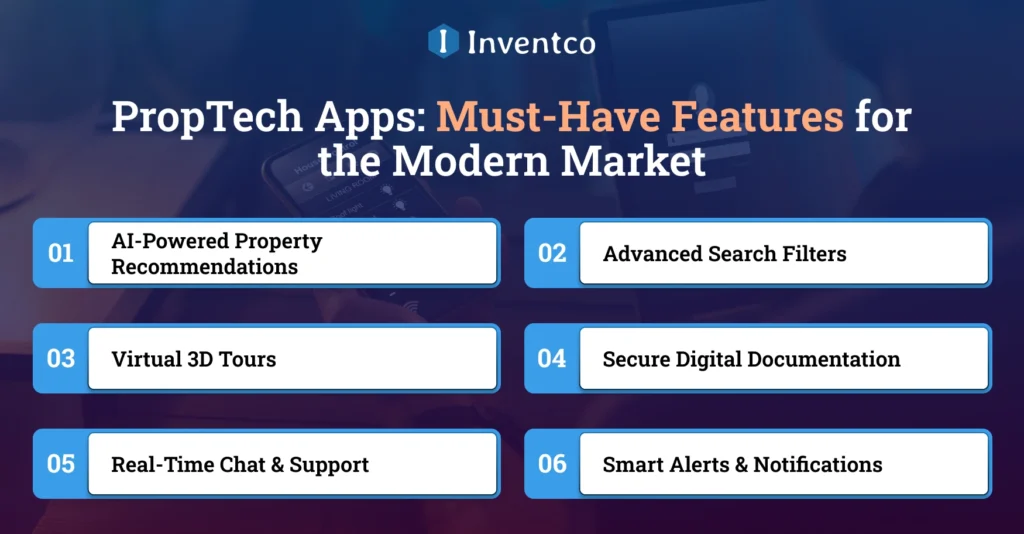
1. AI-Powered Property Recommendations
AI in the real estate mobile app is an essential feature in the modern real estate industry. In real estate, AI analyzes user behavior, budgets, location preferences, and market trends to deliver personalized property recommendations. AI in real estate improves search accuracy, reduces browsing time, and helps users discover the right listings through smart automation, one of the most impactful PropTech AI real estate trends shaping modern property platforms.
2. Advanced Search Filters
Reduction of search time is driven by automation. Property attributes may include price, location, amenities, and type. Enhanced personalization is facilitated for property consumers using PropTech.
3. Virtual 3D Tours
Immersive 3D and AR VR-based tours let users explore properties remotely with realistic visuals, room-by-room navigation, and spatial understanding. They allow users to evaluate a property quickly and with complete information, eliminating the need to schedule many in-person visits for decision-making.
4. Secure Digital Documentation
Secure digital documentation in a real estate app enables users to sign agreements via e-signature and store them securely in the cloud. As PropTech evolves, workflows will be automated through a Web3 real estate app solution, where blockchain in real estate ensures seamless transactions and protects sensitive data with unmatched transparency and security.
5. Real-Time Chat & Support
One of the most popular features in PropTech real estate apps is real-time chat and support, enabling instant messaging between users and property professionals. Enhanced communication, often powered by a chatbot in real estate app solutions, automates responses, speeds up interactions, and provides round-the-clock assistance for smoother decision-making.
6. Smart Alerts & Notifications
The PropTech app like Dubai Rest provides users with smart alerts when a property’s price drops, a new listing becomes available, an offer is made, or there is an appointment or status change. These features ensure users remain engaged with the application, make decisions quickly, and are consistently notified of opportunities.
The integration of these real estate app features while developing a real estate app offers users an experience no other PropTech application can match, while allowing real estate companies to compete through automation and technology.
Challenges in PropTech Adoption & How to Overcome Them
Understanding what hinders the adoption of PropTech requires recognizing that real estate businesses struggling to shift to digital operations face multiple challenges. These common mobile app development challenges slow down transformation, especially for companies still dependent on manual processes.
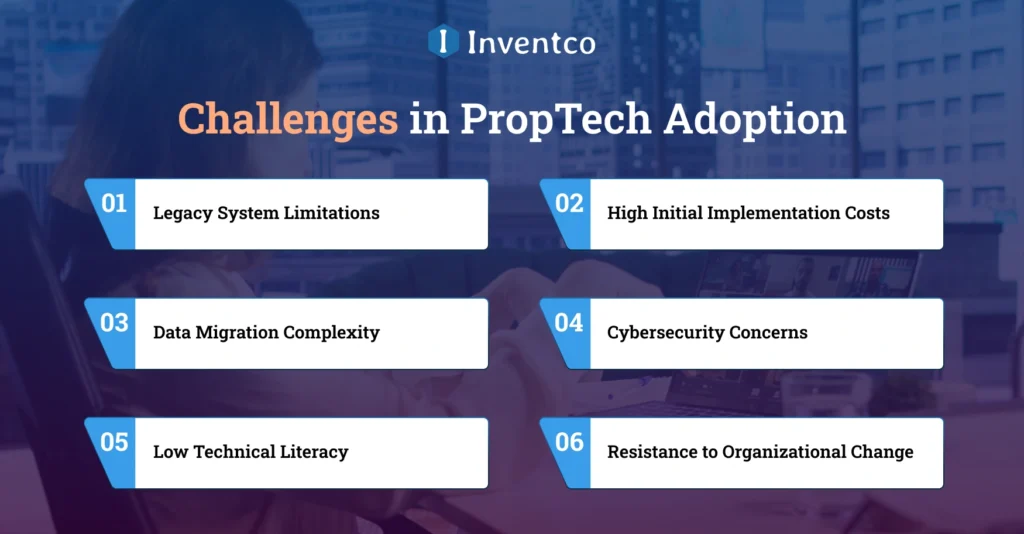
Here are the top real estate app development challenges:
1. Legacy System Limitations
Challenge: The presence of legacy systems impedes PropTech’s digital adoption by limiting the ability to incorporate modernization, integrations, API flexibility, scalability, and automation support.
Solution: Real estate businesses are forced to further entrench themselves in inefficient processes, and their reliance on them inhibits the adoption of PropTech.
2. High Initial Implementation Costs
Challenge: Adopting PropTech requires significant investment in software, hardware, staff training, and infrastructure upgrades to support the digital transformation. Many organizations hesitate because these needs seem resource-intensive and complex to integrate into existing workflows.
Solution: Resistance and delays often stem from the misconception that the real estate app development cost will be too high. In reality, long-term automation, reduced labor, and improved efficiency significantly outweigh the initial investment, making PropTech adoption a strategic and profitable upgrade.
3. Data Migration Complexity
Challenge: Onboarding new systems while migrating years of property records, contracts, transaction history, and client data.
Solution: It is time-consuming, and organizations must ensure that the data being transferred is accurate, secure, and not compromised in any way while also being compatible with the new systems being onboarded.
4. Cybersecurity Concerns
Challenge: The nature of real estate systems, with numerous documents, financial records, personal information, and transaction details, makes them obvious targets for cyberattacks.
Solution: Overall, poor security practices regarding constituents’ and clients’ data lead to financial losses, data theft, regulatory breaches, and loss of trust.
5. Low Technical Literacy
Challenge: Many teams lack the digital competencies to use newly implemented PropTech systems.
Solution: Insufficient training, unfamiliar systems, and reluctance to use new advanced tools harm both productivity and the timely adoption of new systems within the company.
6. Resistance to Organizational Change
Challenge: Staff members find it particularly challenging to move from established manual systems to automated PropTech systems.
Solution: Lack of engagement, sponsorship from leadership, and insufficient structured onboarding make it difficult for organizations to secure the internal support needed to ensure a seamless digital transformation.
To mitigate the effects of these challenges, organizations should adopt modular, scalable technology, allocate sufficient resources for training, enhance their technological security, and implement transformation in a stepwise manner.
Case Study: MLS Agent Hub by Inventco
MLS Agent Hub is a powerful real estate platform developed by Inventco to streamline property discovery for agents. It provides centralized access to MLS databases, enabling agents to efficiently search, filter, and present property options tailored to client requirements.
Challenge
Real estate agents often struggle with fragmented listing systems, outdated data, and inefficient search processes. This leads to delays in property discovery, reduced client satisfaction, and difficulty in delivering personalized recommendations at scale.
Solution
Inventco delivered a full-stack solution covering backend, frontend, software testing, strategy, and UX/UI. The platform was built with an advanced search architecture, enabling agents to filter listings by location, price, amenities, and lifestyle preferences. Real-time MLS integration ensures accurate, up-to-date property data.
Key Features & Execution
MLS Agent Hub offers robust filtering, detailed property insights, high-quality media, and virtual tours. The intuitive interface simplifies navigation, while a scalable backend supports large data volumes and fast query processing, ensuring seamless performance.
Impact
The platform significantly improved agent productivity, reduced property search time, and enhanced client experiences. By delivering accurate insights and personalized listings, Inventco enabled agents to close deals faster while building trust and long-term client relationships.
Why Inventco Is the Right Choice for Real Estate Mobile App Development?
Search for a trusted technology partner, and you’ll see why Inventco stands out as a leading mobile app development company. We combine deep industry expertise, advanced PropTech capabilities, and future-ready engineering to build apps that are fast, scalable, and business-focused. Our team understands real estate workflows, customer expectations, and market demands, allowing us to deliver custom PropTech solutions that improve efficiency and maximize ROI. From concept to deployment, Inventco ensures seamless execution, strong security, and long-term support for real estate businesses of all sizes.

Conclusion
Given the current state of the real estate sector, PropTech is no longer on the periphery; it is at the core of growth, efficiency, and customer satisfaction. Whether it is AI recommendations, digital transaction completion, or automated digital buildings, PropTech has automated and streamlined every real estate function.
Early adopters who embed automated systems gain a strong first-mover advantage in PropTech in real estate. As the pace of technological change accelerates, organizations must continue to evolve by integrating automation across every level of their real estate operations. The opportunity for every organization to embed PropTech, whether to optimize business processes or to create a new digital asset product, has never been greater.
FAQs
Q1. What is PropTech in real estate?
Ans. PropTech refers to the use of digital tools, software, AI, automation, and smart technologies to modernize how properties are bought, sold, managed, financed, and experienced. It streamlines operations and improves customer convenience.
Q2. How is PropTech changing the real estate industry?
Ans. PropTech is transforming real estate by enabling virtual tours, AI-powered valuations, automated workflows, digital payments, smart buildings, and data-driven decisions. It makes transactions faster, more accurate, and far more transparent.
Q3. Is PropTech the future of real estate?
Ans. Yes. With growing demand for automation, transparency, sustainability, and better customer experiences, PropTech has become essential. It’s shaping the future of property buying, selling, and management worldwide.
Q4. What are the main types of PropTech solutions?
Ans. Key categories include property listing platforms, smart home technologies, IoT-based building management, digital payment solutions, AI analytics, fintech-driven tools, and virtual or AR-enabled property experiences.
Q5. How can a business start implementing PropTech?
Ans. Begin by identifying operational gaps, choosing scalable technologies, training your team, and partnering with an experienced development provider. A phased digital transformation strategy ensures smoother adoption and long-term success.
{
“@context”: “https://schema.org”,
“@type”: “FAQPage”,
“mainEntity”: [{
“@type”: “Question”,
“name”: “What is PropTech in real estate?”,
“acceptedAnswer”: {
“@type”: “Answer”,
“text”: “PropTech refers to the use of digital tools, software, AI, automation, and smart technologies to modernize how properties are bought, sold, managed, financed, and experienced. It streamlines operations and improves customer convenience.”
}
},{
“@type”: “Question”,
“name”: “How is PropTech changing the real estate industry?”,
“acceptedAnswer”: {
“@type”: “Answer”,
“text”: “PropTech is transforming real estate by enabling virtual tours, AI-powered valuations, automated workflows, digital payments, smart buildings, and data-driven decisions. It makes transactions faster, more accurate, and far more transparent.”
}
},{
“@type”: “Question”,
“name”: “Is PropTech the future of real estate?”,
“acceptedAnswer”: {
“@type”: “Answer”,
“text”: “Yes. With growing demand for automation, transparency, sustainability, and better customer experiences, PropTech has become essential. It’s shaping the future of property buying, selling, and management worldwide.”
}
},{
“@type”: “Question”,
“name”: “What are the main types of PropTech solutions?”,
“acceptedAnswer”: {
“@type”: “Answer”,
“text”: “Key categories include property listing platforms, smart home technologies, IoT-based building management, digital payment solutions, AI analytics, fintech-driven tools, and virtual or AR-enabled property experiences.”
}
},{
“@type”: “Question”,
“name”: “How can a business start implementing PropTech?”,
“acceptedAnswer”: {
“@type”: “Answer”,
“text”: “Begin by identifying operational gaps, choosing scalable technologies, training your team, and partnering with an experienced development provider. A phased digital transformation strategy ensures smoother adoption and long-term success.”
}
}]
}

Ajay Bhal
He is an on-demand app solutions expert with 11+ years of experience in business consulting and building scalable, user-centric digital products. He specializes in robust on-demand platforms across industries, combining technical expertise with business-focused strategy to deliver efficient, top notch solutions that drive growth and enhance user experience. You can connect with him on LinkedIn to follow insights.