
The rapid advances in technology have made an innovative technology marketplace a reality.
Homes with smart devices connected to the IoT ecosystem, ranging from bright lights to smart thermostats, enable automation and environmental adjustment for residents, effectively creating a new way to live in a home.
The real estate app development with IoT technology offers the opportunity to automate and provide complete control of home devices, and to offer their clients the customization and control they desire over their home and overall environment.
Real estate developers can offer customers smart home options and a fully connected environment.
This post discusses connected devices, the benefits of a smart home, and how real estate developers are improving the living experience with smart home options.
How IoT Works in Smart Home Ecosystems?
IoT within smart homes acts as a private assistant; it’s calm, competent, and always looking out for you.
Every smart device, from sensors and switches to appliances, gets data via Wi-Fi, Bluetooth, or Zigbee, and stores data for immediate recall.
These devices connect to a central hub or a mobile app, allowing homeowners to oversee, automate, and adjust their surroundings from anywhere.
Motion sensors, smart locks, and appliances respond and adjust according to intelligent preferences. Cloud platforms process data to deliver tailored automation, predictive insights, and enhanced security.
The combination of these devices provides a brilliant, responsive, and convenient in-home experience.
Key Benefits of IoT in Smart Homes
IoT systems in homes are truly revolutionary. They make it appear as though your home has developed its own consciousness.
Some of the primary benefits driving this revolution are:
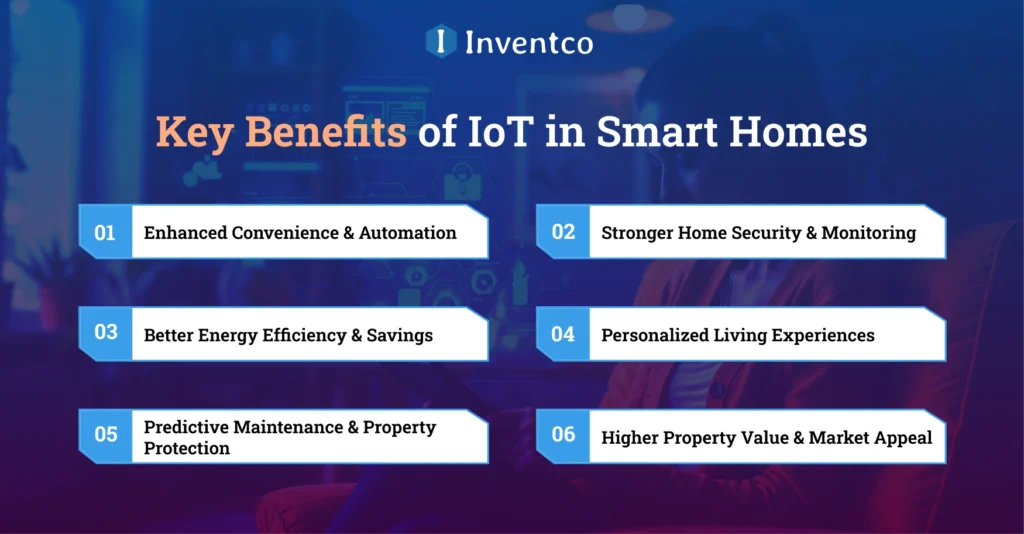
1. Enhanced Convenience & Automation
The IoT within a home’s smart ecosystem enables seamless automation and control, reducing the hassle of manually operating appliances, lights, temperature settings, and other smart home functions.
2. Stronger Home Security & Monitoring
One of the key benefits of using IoT in real estate apps is that it enables home monitors, motion detectors, digital alarms, and intelligent locking systems, which permit surveillance and notifications, and remote security management. This allows home protection and peace of mind for householders, even when they are away for extended periods.
3. Better Energy Efficiency & Savings
Wasteful behaviors and suboptimal energy use are smoothed out and even eliminated.
This is performed automatically by smart home systems connected to energy-consuming devices such as thermostats and other appliances, thereby optimizing energy use and demand.
Homeowners with a sustainability focus establish a long-term eco-balance, together with reduced energy consumption and positive savings.
4. Personalized Living Experiences
Personalization and comfort are achieved through home systems that intelligently learn individual behavioral routines.
Over time, IoT is embedded in the home’s infrastructure to automatically detect and adjust predefined preferences for systems such as lighting, temperature, and entertainment.
5. Predictive Maintenance & Property Protection
IoT systems prevent failures by issuing intelligent warnings before key infrastructure and devices fail.
Potential damage, repair costs, and the depreciation of the physical home are avoided through these proactive risk management measures.
6. Higher Property Value & Market Appeal
The desire for smart homes attracts a significant number of prospective buyers.
As smart homes integrated with modern IoT systems offer greater value, energy and time savings, and lower expenditures, automation and self-management systems become high-demand real estate features.
In combination, these benefits demonstrate why smart homes are not luxury add-ons; they are becoming the standard.
As IoT app development continues to evolve, the comfort, control, and intelligence of the system will only increase.
IoT in Real Estate: A Growing Digital Transformation
Significant shifts are happening in the property market, with the Internet of Things in real estate among the most impactful.
From connected homes to fully automated neighborhoods, the IoT is changing the way homes are constructed, marketed, managed, and lived in.
To create homes that are marketable to tech-savvy buyers, real estate developers build homes with smart sensors, automated energy systems, and connected security systems that promote ease of use and operational efficiency.
IoT in real estate provides investors and stakeholders with accurate information to calculate operational efficiencies, asset maintenance, and the property’s overall energy consumption.
Mobile app developers are not simply changing the homes they build with IoT. They are creating entire ecosystems of houses designed and built with the future in mind, built to last.
Real-World IoT Applications in Smart Homes
The IoT enhances real-life experiences, making homes smarter, safer, and more user-centric.
Some of the most notable real-world use cases that are improving the quality of modern life include:
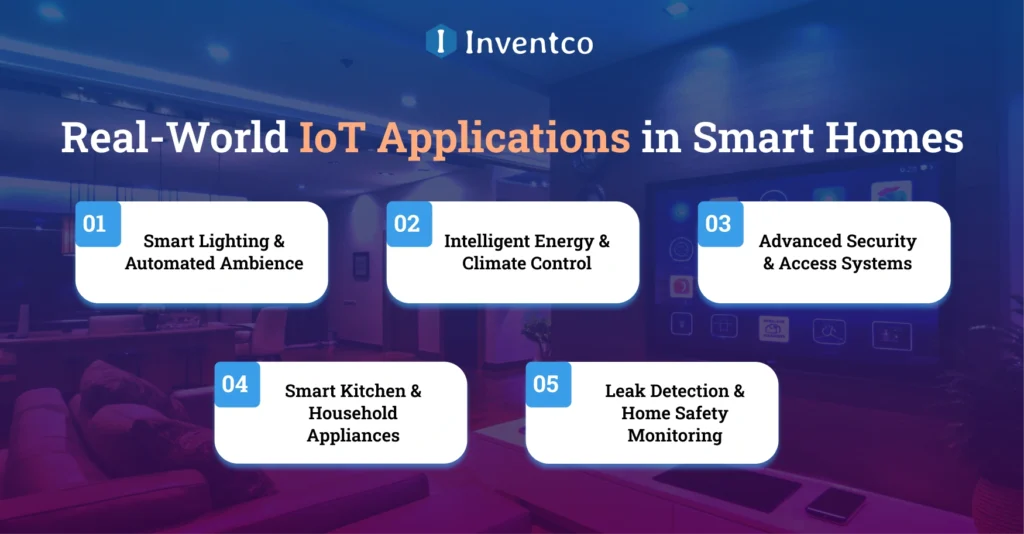
1. Smart Lighting & Automated Ambience
IoT enables smart networks of automated lighting that personalize a home’s ambiance by adjusting brightness, color, and warmth in real time and across historical conditions, such as time of day, detected movement, and energy consumption patterns.
2. Intelligent Energy & Climate Control
Smart thermostats, HVAC sensors, and energy monitors learn occupants’ behavior and usage patterns over time, tracking changes in weather and energy use to optimize temperature settings, reduce energy waste, maintain comfort, and lower long-term energy costs.
3. Advanced Security & Access Systems
Families and property owners can feel secure and have peace of mind while connected cameras, door sensors, and fingerprint locks sit on the property, paired with real-time alert technology designed for remote monitoring, immediate access control, and automated responses to threats.
4. Smart Kitchen & Household Appliances
Homeowners can enjoy more convenience and effortless control over their chores with smart, connected hand driers, ovens, and refrigerators.
These appliances track food and adapt to users’ preferences to achieve energy efficiency and streamline task management without real-time supervision.
5. Leak Detection & Home Safety Monitoring
Smart sensors monitor utility use, water, gas, and smoke, helping smart homes avoid hazards by providing early alerts for unusual use patterns, detecting leaks early, and reducing repair costs from damage.
Smart homes are no longer futuristic, as more homeowners adopt connected technology. The smart-living experience will only get more automated and intelligent.
IoT in Property Management
The Internet of Things is revolutionizing the property management industry by enabling firms to adopt a proactive, data-driven approach.
Sensors can monitor energy consumption, detect water leaks, and determine the HVAC system’s operating status.
They can also turn lights and access systems on and off and automate their regulation. This reduces the need for costly oversight and automated maintenance, helping avoid surprise expenses.
Real-time data availability supports field decision-making, improves tenant satisfaction, and drives overall operational cost savings.
The incorporation of IoT functionalities such as automated feedback systems, predictive maintenance, remote access, and system intercommunication provides a real estate management app with unprecedented levels of streamlined efficiency.
Innovative property management is thus faster, wiser, and more effective.
Top Trends Shaping IoT in Smart Homes
Technological advances in IoT, especially in smart homes, are improving systems and residential living, creating more integrated, faster homes. The following are the most notable real estate tech trends.
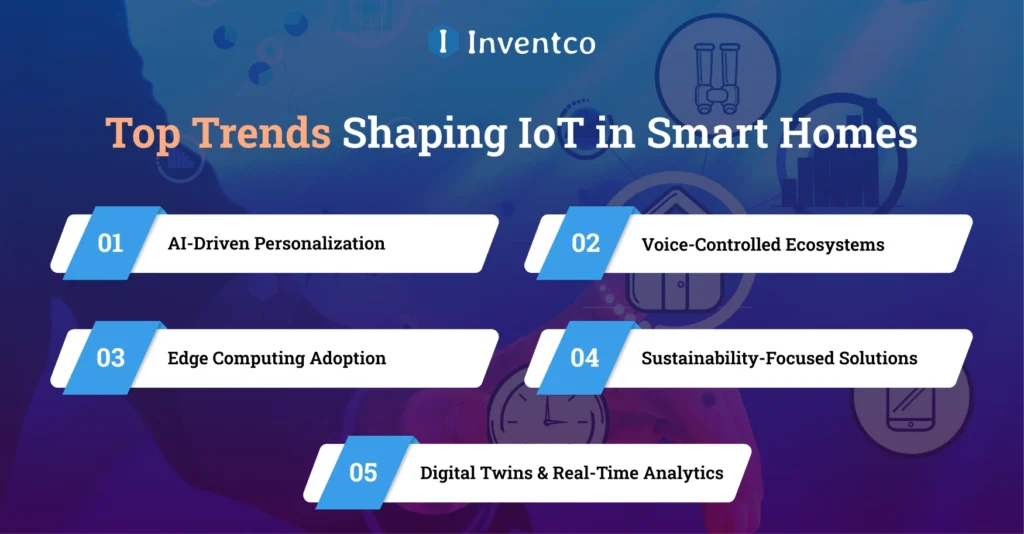
1. AI-Driven Personalization
The automation of lighting, temperature, and other home systems in real estate is a key trend, especially for those who are planning to build a real estate app with smart home integration.
Homes are becoming more personalized as tech devices learn to adapt to the habits of the people living there, programming systems in the house to operate on a self-directed, automated cycle without continuous compulsion.
2. Voice-Controlled Ecosystems
Voice assistants are becoming the norm for home automation, allowing household members to control appliances and security, as well as turn off entertainment systems without their hands.
This enables a more seamless, integrated home experience and more intuitive control of smart devices.
3. Edge Computing Adoption
Unlike traditional cloud servers, edge computing delivers faster response times and real-time automated responses by performing processing tasks closer to the data source. This is particularly advantageous in the current context of smart homes and IoT.
4. Sustainability-Focused Solutions
With the implementation of Green IoT technologies, energy consumption is optimally reduced as the overall system automatically controls lighting, tracks water flow, and enhances appliance efficiency, allowing the residence to enjoy a cost-effective, innovative living experience with a diminished environmental footprint.
5. Digital Twins & Real-Time Analytics
With the aid of digital twins, homes can be simulated in a virtual environment to perform real-time maintenance, condition assessment, and performance analysis on the system with IoT, creating an environment that is safe and convenient for long-term asset management and residence.
Challenges & Considerations in IoT Smart Home Adoption
The IoT offers users exceptional levels of ease and automation in their everyday life; however, there are significant mobile app development challenges to consider within smart homes that all homeowners and companies must comprehend, including:
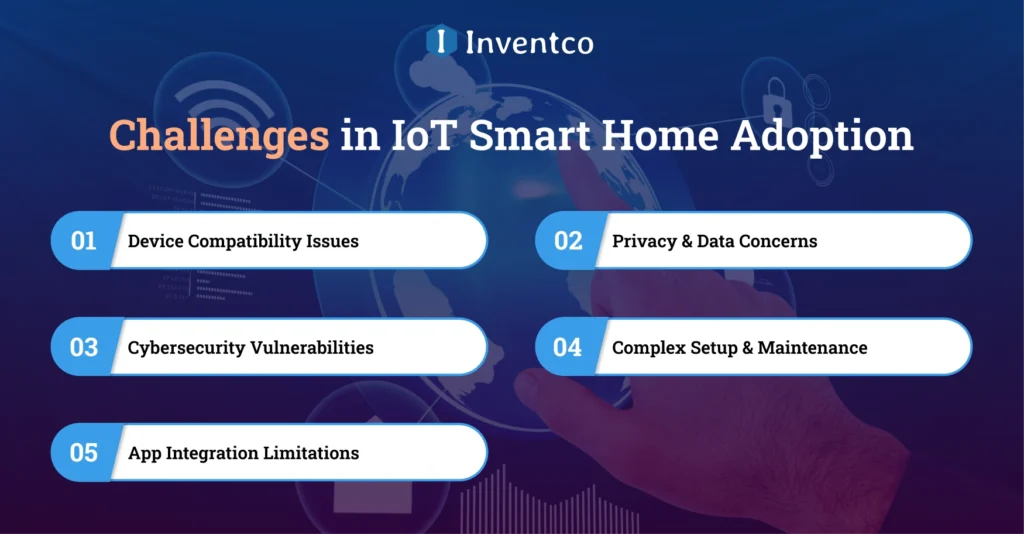
1. Device Compatibility Issues
Automated smart home systems require devices from different brands to be compatible with one another, and not all brands are compatible. Due to a lack of integration, automation functionalities and systems become limited.
2. Privacy & Data Concerns
The IoT ecosystem requires users to share their data in real time, raising concerns about unauthorized surveillance and exposure of one’s private information.
3. Cybersecurity Vulnerabilities
The use of weak passwords, the lack of firmware updates, and the presence of unprotected Wi-Fi make systems more vulnerable to hacking attempts and unauthorized access.
4. Complex Setup & Maintenance
Users are required to link multiple devices to a single system, which can be a daunting and stressful task that adds complexity to the interface.
5. App Integration Limitations
Mobile application development to control multiple smart devices through a single system can be a real obstacle for developers designing IoT for smart homes.
Future of IoT and Smart Home Automation
The future of IoT in smart homes is heading toward deeper automation, stronger intelligence, and near-zero manual effort.
AI-powered assistants will predict and automatically adjust lighting, climate control, and security before homeowners make requests.
Devices in homes will be hyper-connected with AI-enabled automation, resulting in complete synchronization of the living environment.
When combined with edge computing, smart homes will be able to overcome latency and respond in real time to user queries and requests by processing data locally.
For developers evaluating the cost to build a real estate app, integrating IoT will soon become standard rather than optional.
Smart homes will advance sustainability through next-generation home systems, digital twins, and sensors, making homes more intelligent.
Why Choose Inventco for Real Estate App Development?
As a leading mobile app development company, Inventco has earned the trust of real estate companies to provide innovative, scalable, and forward-looking solutions.
Our team specializes in building automation, analytics, and IoT property apps with seamless connectivity. In smart home control and property advanced surveillance, we deliver a better user experience and increased operational efficiency.
With deep domain expertise in real estate tech, robust security, and modern end-to-end development, Inventco guarantees that each app will be contemporary, reliable, and designed to connect ecosystems for future adaptability.
Conclusion
IoT technology is changing the way individuals live and how their places and spaces operate. Automated intelligence technology enables individuals living and working in connected spaces to interact efficiently.
Predictive technology and automated intelligence allow people to live and work efficiently. The adoption of Internet of Things technology enables automated, connected systems that predict and guide people in living and working more efficiently.
Predictive technology, combined with automated living intelligence, enables places to operate without restrictions.
Internet of Things technology predicts innovations that will be adopted, and connected technology guides people in living and working efficiently.
Predictive technology, combined with automated living intelligence, enables places to operate without restrictions.
FAQ’s
Q1. What is IoT in smart homes?
Ans. IoT in smart homes refers to connected devices, sensors, appliances, and systems that communicate through the internet to automate lighting, climate control, security, and everyday home functions.
Q2. How does IoT improve home security?
Ans. IoT security devices, such as smart locks, cameras, and motion sensors, provide real-time alerts, remote access, and automated threat detection to enhance overall safety.
Q3. How is IoT used in real estate?
Ans. IoT supports energy management, predictive maintenance, smart building controls, tenant comfort, and data-driven property monitoring in residential and commercial real estate.
Q4. Are IoT smart homes expensive to set up?
Ans. Costs vary depending on device type, integration level, and connectivity needs. Starting with small lighting, sensors, or smart plugs keeps the initial investment affordable.
Q5. What technologies power IoT smart homes?
Ans. IoT systems rely on sensors, cloud platforms, automation hubs, Wi-Fi, Bluetooth, Zigbee, AI, and mobile apps for seamless monitoring and control.

Jitendra Jain
Jitendra Jain is the CEO and Co-founder of Inventcolabs. He is among the most endeavoring leaders in the space of advanced computing and information technology. He has been at the forefront of the tech innovation taking place at Inventcolabs, and his domain insights, ideas, and viewpoints on the latest IT trends and traits impact change through his words and works in motion.


