The construction industry has spent the last decade watching every other sector race ahead on digital maturity while it stayed anchored to spreadsheets, paper blueprints, and site visits to track progress.
That gap is closing fast. Across the United States, Europe, and the Middle East, construction firms are now allocating dedicated technology budgets, hiring digital leads, and rethinking how projects move from bid to handover. The catalyst is simple: margins in construction remain among the thinnest in any major industry, and digital transformation in construction has become the clearest lever to protect them.
For founders and investors evaluating this space, the opportunity is twofold. First, construction companies themselves are underserved by modern software, creating real demand for purpose-built platforms. Second, the firms that adopt digital transformation in the construction industry early are outperforming peers on schedule adherence, cost predictability, and safety outcomes, which makes them attractive acquisition or investment targets.
For founders and investors interested in the construction industry, the advantage is twofold. To begin with, construction companies are lacking modern and current construction software, thus creating demand for new and updated construction software. Furthermore, companies that are the first to embrace digital transformation in construction are much more successful than their competitors in meeting deadlines, cost and budget estimates, and achieving safe completion of construction, making these companies very appealing for investment or acquisition.
This blog explains the current state of digital transformation in construction, the reasons the construction industry needs digital transformation, the technologies used in the transformation, the costs and expected benefits, and a guide for developing a mobile application to aid in the digital transformation process.
Decoding Digital Transformation in Construction
Construction digital transformation is not the same as digitizing project documents or storing spreadsheets in the cloud. Digital transformation re-engineers the construction business’s approach to project planning, execution, and post-project analysis. It is the integration of real-time project data into the digital workspace of all project participants, from architects and engineers to subcontractors and procurement professionals.
Three things separate genuine digital transformation in the construction industry from cosmetic digitization. The first is real-time visibility: project leaders can see costs, schedules, and risks as they happen rather than waiting for weekly status meetings. The second is interoperability: building information modeling (BIM) files, scheduling tools, accounting systems, and field apps all speak to each other instead of operating as isolated silos. The third is predictive capability: instead of just recording what happened, modern platforms use historical and live data to flag delays, cost overruns, and safety risks before they materialize.
For construction technology entrepreneurs, the differentiation has value. A construction digital platform that integrates a digital form is easily replicated and addresses a narrow market need. A construction digital platform that integrates all project data and provides predictive analytics is highly differentiated and provides a competitive advantage and market protection.
Why the Construction Industry Needs Digital Transformation Now
The construction industry is under growing pressure to improve efficiency, control costs, and complete projects on schedule. Increasing costs for raw materials and other resources, along with regulations that are constantly changing, are making it harder to work using traditional, labor-intensive, manual methods.
Digital transformation integrates innovative technology such as construction management software, Building Information Modeling, and even Artificial Intelligence to orchestrate more agile and faster construction processes. Digital construction can be analyzed, adjusted, and improved at real-time speeds and optimally incorporates tools such as cloud computing, mobile devices and the Internet of Things.
Even more, technology is critically in-demand by the modern labor force. More and more projects are delivering better results and profits as construction firms rapidly modernize their practices. Firms using innovative construction practices more readily claim and sustain their market share.
Key Technologies Driving Digital Transformation in Construction
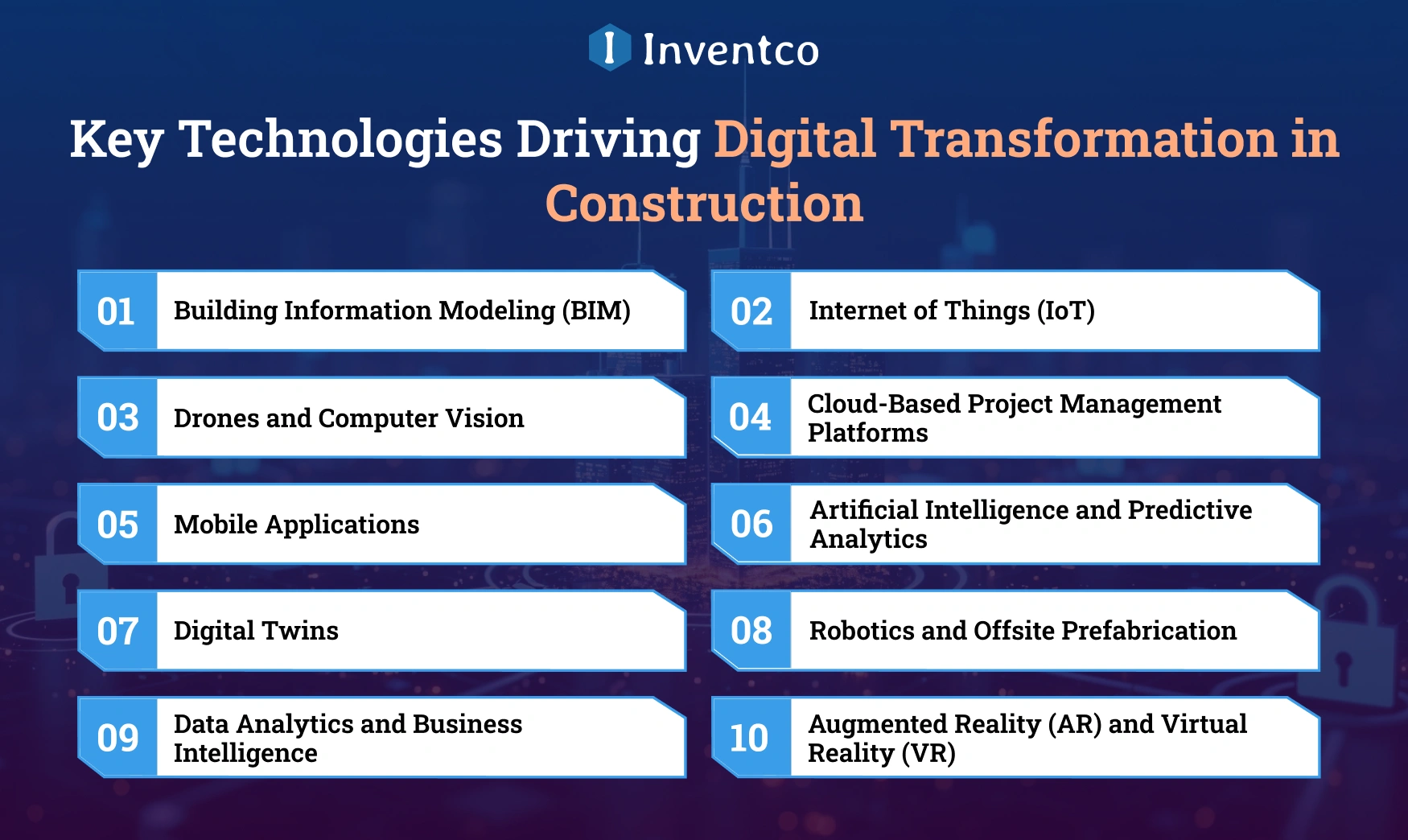
Digital transformation in construction focuses on improving planning, organizing, and communicating for better decision making. This transformation leverages several technologies, each geared toward a specific issue in construction.
1. Building Information Modeling (BIM)
Building Information Modeling (BIM) is the core of modern digitized construction. It creates a 3-dimensional image of the construction project that is accessible by the construction project’s architects, engineers, and contractors at every stage of the work. BIM promotes the best construction practices by increasing cooperation and minimizing costly construction conflicts and conflicts after the construction starts.
2. Internet of Things (IoT)
IoT creates the possibility for construction project managers to monitor, in real time, equipment, materials, and the workforce through an extensive network of connected sensors and devices. Construction project managers can monitor the use and performance of construction equipment, the safety of construction workers, and the performance of the construction site and its surroundings.
3. Drones and Computer Vision
Drones and advanced computer vision systems have completely streamlined construction project site inspections and the progress that has been made on the construction project. Aerial data and photos of construction sites, when augmented with project plans, can quickly identify and assess discrepancies between planned and actual construction site conditions and can generate thorough project status reports.
4. Cloud-Based Project Management Platforms
Cloud-Based Solutions are a single, centralized system for documenting a project, including RFIs, Change Orders, Project schedules, and approvals. This centralization is especially important for controlling the edits made to project documents.
5. Mobile Applications
Digital workflows are made possible on-site through construction-specific mobile applications. Field crews can complete their daily reports, manage punch lists and inspections, and check safety compliance. They can also manage equipment and materials with mobile applications. Mobile technology enhances communication between construction staff in the office and those in the field, as it provides real-time updates for everyone.
6. Artificial Intelligence and Predictive Analytics
AI and predictive analytics assist construction firms in making informed decisions in a timely manner. This is made possible by the ability to analyze an extensive amount of project-related information. Predictive tools can identify delays, value challenges associated with a project, assist in optimal allocation of project resources, and even predict the likelihood of failure and the need for maintenance of construction equipment.
7. Digital Twins
Digital twins are a constantly updated digital model of a physical asset. Digital twins are used in construction for the management of a facility’s digital assets, construction, and maintenance, as well as the ongoing monitoring and optimization of digital assets throughout a facility’s lifecycle.
8. Robotics and Offsite Prefabrication
Robotics aids construction in the form of robotic bricklaying and the automated placement of prefabricated, modular components. Offsite manufacturing and digital construction aid and optimize processes and workflow for construction. Modular construction decreases the time needed to complete a project and raises quality control and overall construction efficiency.
9. Data Analytics and Business Intelligence
The advanced analytics solutions construction companies are adopting help them gain insights from project data. This empowers the construction firms to manage performance better, identify productivity constraints, and measure the profitability of their projects.
10. Augmented Reality (AR) and Virtual Reality (VR)
AR and VR allow for new ways to visualize and interact with construction projects by virtualizing design and construction. Teams can navigate the project virtually, pinpoint potential issues, and enhance and facilitate communication with stakeholders using VR.
Digital Transformation in Home Construction Industry
The Digital Transformation has reached the Home Construction industry. Builders are able to rapidly increase efficiency, communication, and customer experience. Home construction is much different from building large commercial projects. Builders must manage many concurrent projects. Homeowners demand transparency and regular communication.
New technologies are streamlining the process and removing much of the tedious manual work for builders. These include: cloud-based estimating, mobile task scheduling, digital client portals, and automated material management. Homeowners are able to see work in progress and get updated in real time. Homeowners also have the ability to digitally approve change orders. These advancements have improved customer experience and strengthened trust.
Residential builders have used these technologies to improve productivity, reduce delays, and remain competitive with other rapidly evolving markets.
Cost of Digital Transformation in Construction Industry
One of the first questions founders and construction business owners ask is what this actually costs. The honest answer is that it depends heavily on scope, but the market generally breaks into three tiers.
| Tier | Scope | Estimated Cost Range |
| Foundational | Cloud document management, basic mobile app for daily logs and punch lists, single-project dashboard | $10,000 – $25,000 |
| Mid-Market | Multi-project management platform, BIM integration, custom mobile app with offline sync, role-based access | $25,000 – $60,000 |
| Enterprise | Full digital twin integration, IoT sensor networks, AI-driven predictive analytics, ERP and accounting integrations | $60,000 – $100,000+ |
A few variables consistently move a project from the lower end of this range to the upper end. The complexity of integrations with existing accounting, ERP, or scheduling software adds development time, as does building for offline-first use, which is non-negotiable for job sites with unreliable connectivity.
Security requirements, particularly for firms handling government or enterprise contracts, also add cost, since rigorous mobile app security practices around data encryption, access control, and compliance audits are not optional line items in this industry.
Finally, the breadth of the mobile app technology stack you choose, whether you build native iOS and Android apps, a single cross-platform codebase, or a progressive web app, has a direct and sometimes underestimated impact on both the initial cost to build mobile app solutions and the ongoing maintenance budget.
It is worth noting that this range reflects platform development, not enterprise-wide digital transformation spend, which can run considerably higher once you factor in hardware (sensors, drones, tablets), staff training, and change management across a large workforce.
ROI of Digital Transformation in Construction Industry
The return on investment (ROI) of digital transformation in construction is typically realized through several measurable benefits:
- Reduced Rework and Design Conflicts: BIM-enabled workflows help identify design clashes before construction begins, reducing costly rework and minimizing on-site coordination issues between different trades.
- Improved Schedule Performance: Real-time dashboards, mobile reporting, and project tracking tools enable faster issue resolution, helping teams reduce delays and maintain project timelines.
- Lower Administrative Costs: Digital tools automate daily logs, inspections, approvals, and reporting processes, reducing paperwork and freeing employees to focus on project execution.
- Enhanced Productivity and Resource Utilization: Better visibility into project progress allows teams to allocate labor, equipment, and materials more efficiently across multiple projects.
- Stronger Client Satisfaction and Retention: Features such as real-time progress updates, digital approvals, and transparent communication improve client experience and increase the likelihood of repeat business and referrals.
- Faster Recovery of Technology Investments: Many mid-sized construction companies recover their initial digital transformation investment within 12 to 18 months through operational efficiencies and cost savings.
- Improved Safety Management: Digital monitoring, reporting, and compliance tools help reduce workplace incidents, lowering associated costs and project disruptions.
- More Accurate Cost Estimation and Bidding: Data-driven insights improve forecasting accuracy, helping firms submit more competitive and profitable project bids.
- Reduced Risk and Dispute Costs: Better documentation, subcontractor accountability, and project transparency help minimize disputes, claims, and potential litigation expenses.
- Long-Term Competitive Advantage: As productivity gains, client retention, and operational efficiencies accumulate over multiple projects, the long-term ROI continues to grow beyond the initial investment.
Building the Right Mobile App for Construction: A Practical Roadmap
To ensure the success of a construction mobile app, the right strategy, practical mobile app features, and emphasis on the user of the app in the construction field must be prioritized. The following roadmap can help construction businesses move from concept to implementation effectively.
1. Define Core Workflows First
Identify the field processes that, if automated, would provide the highest operational impact. Many construction companies that are adopting mobile apps for the first time focus on daily logs, a punch list, safety inspections, equipment tracking, and material management. High-value focuses are the best way to keep the initial mobile app development concise, simple, and fast.
2. Select the Right Technology Stack
When building a construction app, choose technologies based on job-site requirements rather than market trends. Features like offline access, battery saving, and sync options are pretty important. Construction apps often need heavy machinery integrations, so native builds are preferred. Cross-platform builds are fine for less heavy integrations.
3. Prioritize Security from Day One
Construction apps contain highly sensitive data like budgets and employee data. Mobile app security measures like role-based access, the right authentication, and security audits are good practices to keep sensitive data safe and ensure compliance.
4. Test in Real Job-Site Conditions
Standard mobile app testing is not enough for an app that will be used in construction. You should test the app in the same environments that it will be used. For construction, that means testing in bright sunlight and under dusty conditions, as well as testing the app with limitations, like poor connectivity and when the user is wearing gloves.
5. Build for Seamless Integration
Data integration should be designed to connect the construction app to the systems that the construction company uses, such as accounting, ERP, project management systems, and BIM. Without data integration, construction companies are forced to do manual data entry, which disrupts their operations.
6. Plan for Future Scalability
Construction companies constantly grow and build in new locations, so the app used to support them should be scalable. An app with the ability to grow and change based upon the requirements of the construction company should have a scalable design from the start. This keeps the costs to a minimum for development in the future.
Common Challenges in Construction Digital Transformation
Although digital transformation provides notable advantages, construction firms struggle with challenges during implementations, and knowledge of these barriers assists the firms in building plans for improvement and increasing the likelihood of adoption. Some of these challenges include:
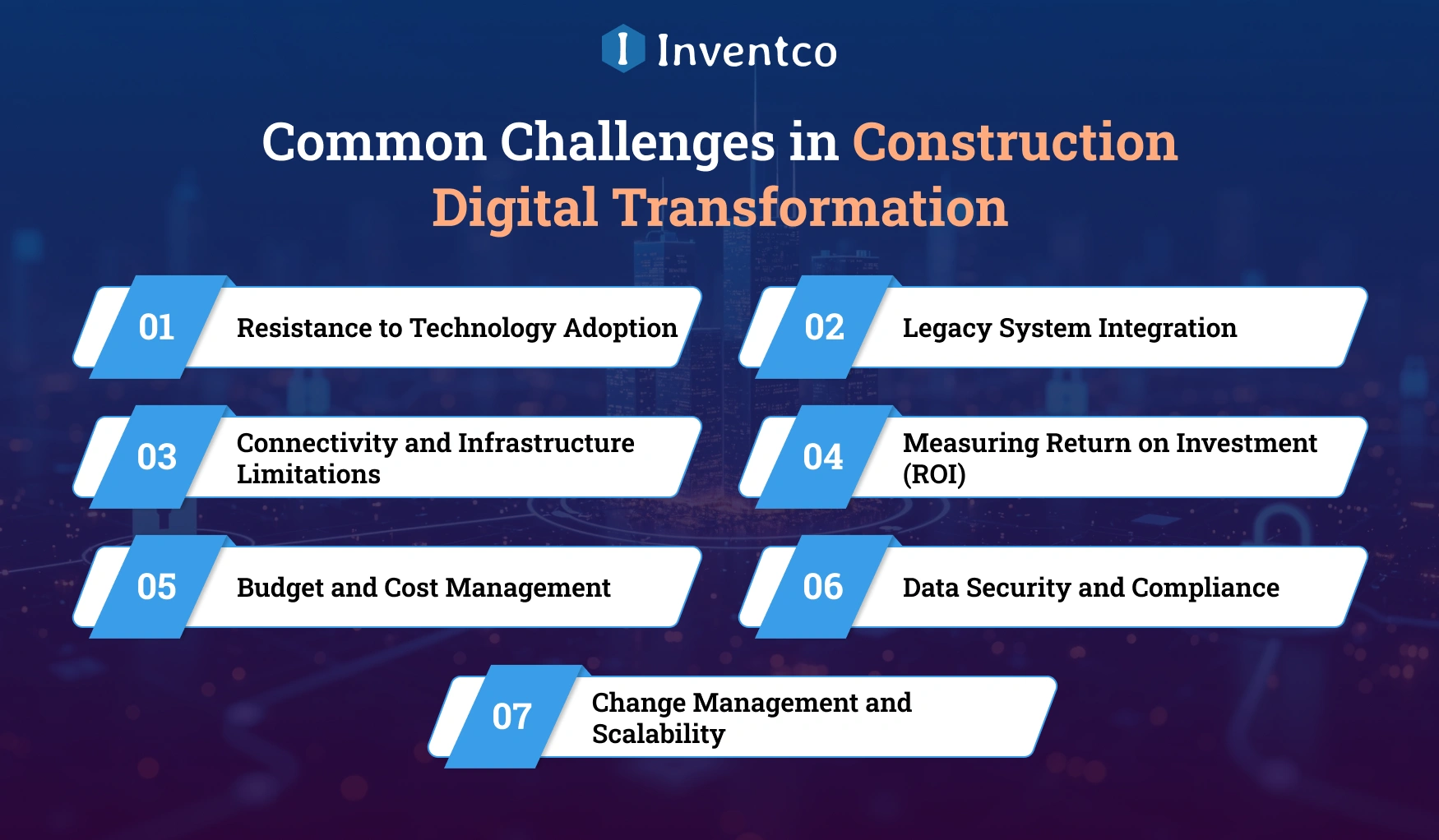
1. Resistance to Technology Adoption
Field workers and project teams can resist the onboarding of technologies when new tools are seen as imposing add-ons and more complexity to existing processes. Proper training and onboarding, and simplifying tools, can lessen complaints and improve tool utilization.
2. Legacy System Integration
Many construction companies use multiple software and apps for accounting, scheduling, estimating, and project management systems. Integrating new digital solutions to seamlessly connect construction operations with already existing systems is often expensive and time-intensive when appropriate budgeting and planning are not done.
3. Connectivity and Infrastructure Limitations
Construction projects routinely take place in remote locations, causing construction staff to face inadequate internet connectivity on-site. Without uninterrupted work in the field, new tools need to serve and support offline mode with automatic data syncing.
4. Measuring Return on Investment (ROI)
Construction projects can take a long time and have many different variables. Because of this, the effects of digital adoption and transformation are often hard to quantify. To help deal with this issue, companies should create measurable goals for digital adoption and transformation.
5. Budget and Cost Management
A lot of construction companies underestimate the amount of time and resources that the construction digital transformation would need. For construction digital transformation to be a success, significant investments are required for many years after the first tool is adopted and implemented.
6. Data Security and Compliance
Digital platforms frequently keep sensitive project data, financial information, and employee records. Strong cybersecurity practices, controls on access, and compliance measures are crucial to the integrity of operations and the protection of client data.
7. Change Management and Scalability
The success of a pilot project does not mean automatic company-wide adoption. Companies must have a clearly defined change management and scalable implementation strategy for adequate and sustained adoption.
How Inventco Approaches Digital Transformation for Construction Businesses
Construction technology is not a generic software category, and treating it like one is where many digital transformation initiatives fall short. At Inventco, we approach construction app development the way a long-term technology partner should: starting with the specific operational bottlenecks a contractor or homebuilder is facing, then building toward a platform that fits their existing workflows rather than forcing them to adapt to ours.
That means field-tested offline architecture, security built around the realities of handling sensitive project and client data, and a technology stack chosen for the conditions of an actual job site rather than a conference room demo. Whether you are a founder building a vertical SaaS product for the construction industry or a contracting firm ready to modernize internal operations, the goal is the same: a platform your teams will actually use, and one that pays for itself well within its first year of deployment.

Final Words
Digital transformation in construction is no longer a question of if, but how fast and how well it is executed. The firms gaining ground today are not necessarily the ones spending the most on technology, but the ones choosing the right scope, the right mobile app foundation, and the right mobile app development partner for their specific operating conditions.
Given the combination of practical scope, defensible technology, and measurable ROI, construction technology investors can differentiate a scalable investment from one that supports construction technology initiatives that stall during pilot.
If you are looking for a starting point, be it a mobile app for field workers or a fully integrated platform of BIM, IoT, Predictive Analytics, and more, the best next step is a more focused approach that supports your specific project and budget, not a generic feature set.
FAQ’s
Q1. What is digital transformation in construction?
Ans. Digital transformation in construction refers to integrating connected technologies, such as BIM, IoT, mobile apps, and AI-driven analytics, into every stage of a project to improve real-time visibility, coordination, and predictive decision-making across the entire lifecycle.
Q2. How much does digital transformation cost for a construction business?
Ans. Costs typically range from $10,000 for foundational tools like cloud document management and basic field apps, up to $100,000+ for enterprise-grade platforms with IoT integration, digital twins, and predictive AI analytics.
Q3. What is the ROI of digital transformation in the construction industry?
Ans. Most mid-market firms recover their technology investment within twelve to eighteen months through reduced rework, faster issue resolution, lower administrative overhead, and improved client retention.
Q4. How is digital transformation different for home construction versus commercial construction?
Ans. Home construction digital transformation focuses more on client-facing transparency, such as progress portals and digital change orders, and lightweight, affordable tools. In contrast, commercial construction tends to prioritize large-scale BIM coordination and enterprise integrations.
Q5. What should founders prioritize when building a construction mobile app?
Ans. Offline-first architecture, strong field-level security, and rigorous testing under real job-site conditions consistently matter more to adoption and ROI than additional features.

Jitendra Jain
He is the CEO and Co-founder of Inventco, driving innovation in advanced computing and digital transformation. With deep expertise in modern IT ecosystems, he leads scalable, secure, future-ready solutions. His strategic leadership helps businesses accelerate growth, adopt innovation, and achieve success. You can connect with him on LinkedIn to follow his technology insights.