Uber has transformed how people move around the world and earn a living through real-time mobility. What started as a simple ride-hailing app evolved into a highly digital ecosystem for taxi, food delivery, logistics, and hyperlocal services across various global markets. In fact, the global ride-sharing market was valued at USD 144.10 billion in 2025 and is projected to exceed USD 170 billion in 2026, reflecting rapid expansion and increasing consumer demand.
Startups and businesses are continuing to rush to develop Uber-like applications as the demand for app-driven services increases. Yet, the development of a successful app requires much more than just replicating Uber’s features, copious amounts of time and complexity are required to develop a scalable architecture, create a secure, proprietary system, and ensure regulatory compliance. In addition, the app should be designed for long-term cost efficiency.
This guide is designed to help businesses understand the components of Uber-like app development by providing insight into the app’s core features, the development process, the technologies involved, the development timeline, and potential challenges. The guide is particularly beneficial for taxi booking app development services seeking to build reliable, forward-thinking platforms for the highly competitive 2026 market and to meet the needs of evolving global consumers.
Key Takeaways
- A taxi mobile app like Uber connects riders and drivers using GPS and provides real-time tracking and a secure payment infrastructure.
- Successful taxi apps require separate rider, driver, and admin panels for smooth platform management.
- Advanced features like AI route optimization significantly improve scalability, safety, and long-term user engagement.
- Building an Uber-like app requires a robust backend architecture, compliance with security standards, and scalable cloud infrastructure.
- MVP taxi applications reduce initial investment while helping businesses validate market demand and user behavior.
- Development costs vary based on feature complexity, integrations, technology stack, and post-launch maintenance requirements.
- Custom Uber-like app development delivers stronger scalability, branding flexibility, and higher long-term business profitability.
Global Market Statistics for Taxi Apps
Global demand for Uber-like apps is rising rapidly, driven by digital mobility, real-time convenience, and scalable on-demand transportation services.
- The Taxi Market size was valued at USD 236.36 billion in 2025 and is estimated to grow from USD 254.36 billion in 2026 to reach USD 366.91 billion by 2031, at a CAGR of 7.62% during the forecast period (2026-2031).
- The global ride-sharing market size was valued at USD 144.10 billion in 2025 and is projected to grow from USD 170.32 billion in 2026 to USD 659.39 billion by 2034, exhibiting a CAGR of 18.40% during the forecast period.
- The global ride-hailing services market size was estimated at USD 47.61 billion in 2025 and is projected to reach USD 181.54 billion by 2033, growing at a CAGR of 18.6% from 2026 to 2033.
- The ride-hailing market size has grown strongly in recent years. It will grow from $163.55 billion in 2025 to $178.53 billion in 2026 at a compound annual growth rate (CAGR) of 9.2%.
What Is an Uber-Like App? How It Works
Uber-like apps are digital, on-demand platforms that connect service providers (e.g., drivers) and consumers in real time by integrating GPS, mobile apps, and cloud systems. This app is ideal for any mobility or service-driven business.
While the Uber-like taxi app works seamlessly, there is always an underlying complexity that makes the workflows across its components integrate properly. The app captures the user’s ride requests. Then, using GPS, it tracks the available drivers. The app relays a ride request to drivers so they know about it. Drivers can accept or refuse requests. The app facilitates real-time tracking so drivers and customers can see the status of rides. Subsequently, the app automatically processes payments and provides customers with rating and feedback options to assess ride quality.
While the flexibility of this workflow applies to any industry, the workflow’s core components and the app can be moved to other verticals and used in food delivery, logistics, courier, and home services. The flexibility is an asset in Uber-like app development, extending the target market and the business models.
Key Features Required to Develop an App Like Uber
Developing an Uber-like app involves creating three main systems: the User App, the Driver App, and the Admin Panel, which help streamline operations, ensure scalability, and drive profitability.
1. User App
- User Registration & Profile: Offers secure signup, profile and preference management, and rapid bookings tied to verified accounts and customized ride offers.
- Ride Booking & Scheduling: Provides immediate ride requests and future scheduling. Offers flexibility to set pickup points.
- Real-Time Driver Tracking: Enhances ride trust by providing detailed tracking for each driver, showing their location on the map. This feature improves the user experience by mitigating the anxiety of waiting.
- Fare Estimation: Provides users with fare estimates based on the distance to be traveled, local demand, and time of day, helping potential passengers decide before making a request.
- Multiple Payment Options: Payment through cards, digital wallets, and UPI, and through cash offers users a multitude of secure, flexible payment options to enhance the user experience.
- Ratings & Reviews: Provides users with the opportunity to rate drivers and to leave comments. This feedback increases accountability, improves driver service quality, and increases users’ trust in the platform.
- Ride History: Keeps a record of all previous rides, invoices, and routes to help users track and flag rides for future reference.
2. Driver App
- Driver Onboarding & KYC: Verifying documents speeds up registration and keeps the platform safe from noncompliant or untrustworthy service providers.
- Ride Request Alerts: Drivers are notified of ride requests in real time, reducing idling time while increasing the rate at which bookings are accepted.
- Navigation & Route Optimization: Smart maps and traffic data are integrated to provide better directions, which saves time and reduces fuel costs.
- Earnings Dashboard: Drivers can view their real-time earnings, the number of trips they’ve completed, their bonuses, and their payouts, which keeps them motivated and financially up to date.
- Availability Toggle: Allows drivers to go online or offline at any time, giving them control and flexibility over their hours.
- In-App Chat/Call: Drivers and riders can communicate without disclosing their personal contact information.
3. Admin Panel
- User & Driver Management: Admins can fully control user accounts, approve or suspend drivers, and monitor their activity from a single place.
- Commission & Pricing Control: Admins can set fares, surge pricing, and commission to increase profit margins.
- Analytics & Reports: Admins can receive ride, revenue, user activity, and overall performance reports for better decision-making.
- Dispute Management: Swing rides, complaints, and refunds can be handled quickly to keep the platform’s reputation.
- Promotional Campaigns: Admins can create referral programs, coupons, and offer promotions to improve user retention and acquisition.
These mobile app features provide a strong foundation for Uber-like app development, ensuring scalability, reliability, and sustained business growth over the years.
Advanced & Competitive Features of Taxi Apps
To build a truly scalable, future-ready Uber-like platform, advanced features are essential for improving performance, safety, and the user experience. These functionalities go beyond basic ride-hailing and help platforms stay competitive in fast-evolving on-demand markets.
| Feature | Purpose |
| AI-Based Route Optimization | Leverages real-time traffic data to suggest faster routes, reduce delays, and lower fuel consumption for drivers. |
| Surge Pricing Engine | Adjusts fares dynamically based on demand, location, and availability to maintain service balance and revenue efficiency. |
| In-App Wallet | Enables secure, cashless payments, refunds, and promotional credits for seamless transactions. |
| Multi-Stop Rides | Allows users to add multiple destinations within a single trip, offering greater travel flexibility. |
| SOS & Emergency Support | Provides instant emergency assistance to enhance rider and driver safety during trips. |
| Voice Command Booking | Supports hands-free ride requests, improving accessibility and convenience for users. |
| Smart Driver Matching | Automatically assigns the nearest suitable driver to reduce wait times and improve ride fulfillment. |
| Carbon Footprint Tracking | Helps monitor emissions and promotes environmentally conscious travel choices. |
These advanced features are what set Uber-like clone app development apart, shaping the future of taxi booking app solutions into scalable, high-performance platforms designed for long-term growth, operational efficiency, and evolving user expectations.
Step-by-Step Process To Build a Taxi Booking App Like Uber
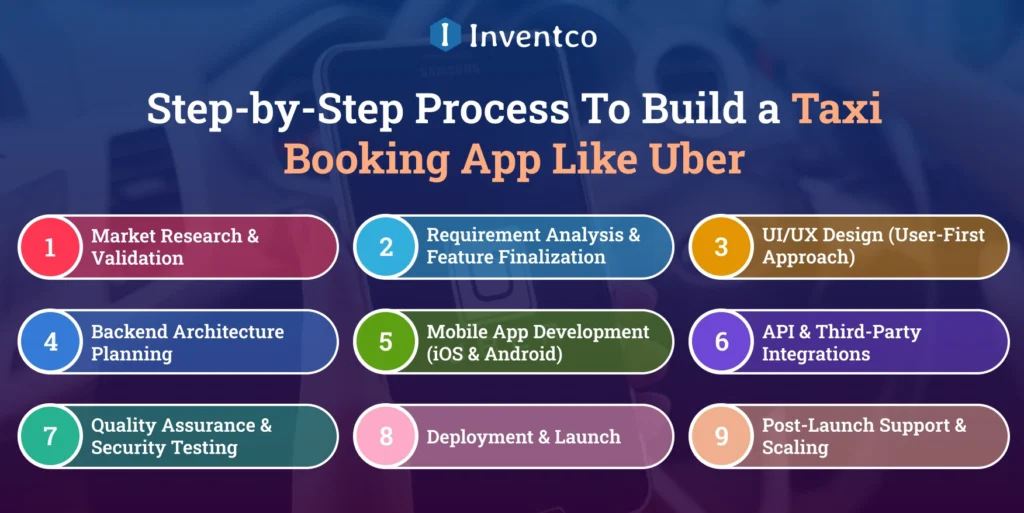
When planning to develop an Uber-like app, an efficient, organised workflow is crucial to success. Every stage of the mobile app development process influences how the app performs, how scalable it is, how secure it is, and how much it costs to develop an app like Uber. Below is a guide to the app development process, considering the standards for the year 2026 and the expectations of end users.
1. Market Research & Validation
Before developing an app like Uber, it is crucial to analyze the market to determine how to segment it, with a focus on identifying target users, service gaps, competitors, and the app’s availability in the target region. This helps to justify whether the business idea is valid, scalable, and profitable. Since the region has varying jurisdictional guidelines, local laws, and business regulations, understanding these structures can help avoid costly mistakes, and strong validation is likely to increase the business’s value. Ensuring that the Uber-like app development process is targeted to meet global needs and aligned with the intended business outcome is likely to reduce the risk of failure and increase the value of the Uber-like app.
2. Requirement Analysis & Feature Finalization
This stage involves analyzing technical requirements, user journeys, and prioritizing app features. Proper documentation is likely to help teams determine which features are essential for the MVP and which can be added later. Suitable requirements analysis is likely to avoid scope creep, manage the costs of developing an app like Uber, and ensure effective collaboration among app designers, developers, and stakeholders throughout the app development process.
3. UI/UX Design (User-First Approach)
User experience is of primary importance when developing any on-demand service. User-first UI/UX design helps facilitate navigation, improve booking speed, and reduce friction. Elements of design such as clear layouts, user-friendly interactions, and design that meets accessibility standards improve engagement as well as retention. A solid design fosters trust and reduces churn. This is particularly important to businesses developing applications similar to Uber in highly competitive markets.
4. Backend Architecture Planning
Supporting technology for real-time tracking, payments, notifications, and data storage is the backend architecture. A scalable, secure backend can accommodate current user traffic and handle future increases. Poor backend architecture increases both downtime and operational costs. Proper planning for this layer is critical for developing apps like Uber and for ensuring performance longevity across different geographical areas, including during peak times.
5. Mobile App Development (iOS & Android)
This phase involves building apps for drivers and riders that deliver consistent performance across all platforms. Using modern frameworks and clean coding practices will minimize development time while maintaining quality. The choice between cross-platform and native development (iOS and Android) will directly affect app development timelines and associated costs. The primary objective is to develop apps that are fast and responsive and will reliably support real-time operations.
6. API & Third-Party Integrations
Integrations with payment processing, mapping, analytics, and push notification services can be achieved using specific APIs. Functional Third-Party Integrations not only reduce app development complexity but also improve the user experience. With the Integration of quality APIs, the data used within the system is guaranteed to be stable and accurate. This greatly impacts optimizing the development costs for an app like Uber while also improving the performance and security of the system.
7. Quality Assurance & Security Testing
Mobile app testing is the only way to ensure the app under development is fully functional. Various types of mobile app testing, such as functional testing, load testing, and mobile app security audits, are intended to identify gaps that need to be addressed before the app is launched. With the right app development practices, compliance and data protection are taken seriously in an on-demand app that includes payment and location features. Well-defined QA practices will mitigate issues that arise after the app goes live, protect the brand, and ensure the sustainability of driver app development.
8. Deployment & Launch
This is the stage in mobile app development for taxi booking where the app goes live. This stage also includes preparing cloud services, allocating monitoring tools, and configuring the app’s cloud services. A soft launch or a phased launch is used to ensure system stability and identify gaps within the system. Effective launch and deployment techniques lead to a positive perception of the app and affect its overall success, shaping how well you build an app like Uber.
9. Post-Launch Support & Scaling
Post-Launch involves support activities such as monitoring performance, fixing bugs, maintaining and adjusting features, and scaling infrastructure. User feedback is used to refine features, thereby improving user engagement. Scaling keeps platform performance and cost efficiency as demand increases. Continuous optimization is essential for managing costs effectively over time when developing an app like Uber and achieving long-term business growth.
Disciplined development processes lead to increased platform instability, higher user churn, higher costs, and significant long-term scalability issues. Having a development process is a must when building an app like Uber.
Note: If you’re interested in understanding how to build an app like Bolt, explore this detailed guide for a complete overview.
Technology Stack To Build an App Like Uber
The technology stack defines how efficiently your platform performs, scales, and stays secure when you develop an app like Uber. A well-chosen tech stack reduces mobile app maintenance overhead, supports real-time operations, and keeps Uber-like app development costs under control as usage grows.
| Layer | Technologies |
| Frontend | React Native, Flutter to deliver smooth, cross-platform user experiences |
| Backend | Node.js and Python for handling high traffic and real-time requests |
| Database | PostgreSQL and MongoDB for structured and flexible data storage |
| Cloud Infrastructure | AWS and Google Cloud for scalability and uptime |
| Maps & Location | Google Maps API for live tracking and navigation |
| Payment Processing | Stripe, Razorpay for secure, global transactions |
| Push Notifications | Firebase for real-time alerts and updates |
| Security Layer | OAuth 2.0, JWT for authentication and data protection |
The right technology stack ensures performance stability, faster development cycles, and seamless scalability for long-term success with an Uber-like app.
How Much Does It Cost To Build An App Like Uber?
Developing an app similar to Uber can cost you anywhere between $10,000 to $100,000+. Cost variations depend on the product stage you want to target, whether it’s an MVP, a mid-level solution, or a full-scale enterprise platform. These different variations serve distinct business objectives, audience sizes, and growth plans. Knowing this information can help a company make a smart investment to scale without incurring unnecessary financial stress.
MVP Version (Minimum Viable Product)
Developing an Uber-like app MVP is the most cost-effective way to begin. This version typically ranges from $10,000 to $25,000 and focuses solely on the critical features needed to validate the business idea. These crucial features include user registration, driver booking, GPS-integrated driver matching, payment integration, ride tracking, and an admin panel.
The main objective of an MVP is to demonstrate the business idea and validate it. This allows startups to capture market demand and observe user interactions and responses to adapt their business plans before making large investments. MVP’s are highly recommended for founders in their early stages to keep risks to a minimum while developing the buck app.
Mid-Level App
When a business scales its operations, developing a mid-level Uber-like application becomes a necessity. At this stage, the cost of developing Uber-like apps ranges between $25,000 to $55,000. In addition to core ride-hailing functionalities, this version offers surge pricing, driver-earnings dashboards, advanced administrative controls, analytics, admin-driven notifications, and additional security features.
Mid-level Uber-like apps can sustain moderate user traffic while providing the operator with sufficient operational control. Hence, this level of Uber-like app development is most appropriate for regional rollouts or niche market segments where competition is present but an enterprise-level app is not yet warranted. These types of mid-level Uber-like apps offer an optimal mix of cost, performance, and features.
Enterprise-Grade App
The most advanced level of Uber-like app development is enterprise-grade apps. These apps are designed for high user traffic and operations spanning multiple cities and countries while ensuring long-term scalability potential. At this level, the cost to develop Uber-like applications ranges from $55,000 to $100,000+, depending on complexity.
These apps come with fully integrated features of advanced artificial intelligence route optimization, real-time analytics, security compliance at a highly sophisticated level, support for more than one language, cloud infrastructure geared for dynamic pricing, and other premium services.
Enterprise solutions prioritise reliability, peak-load performance, and seamless scalability. They demand sophisticated backend frameworks, consistent monitoring, and ongoing upkeep. Businesses opting for this route target market leadership and sustainable long-term profitability in high-stakes competition.
To summarize, the taxi app development cost for an Uber-like platform depends entirely on the project’s scope, scale, and long-term business vision. Choosing the right version, whether MVP, mid-level, or enterprise, ensures efficient budget utilization while enabling sustainable growth, scalability, and future-ready expansion.
Factors That Influence The Cost To Build a Taxi Booking App Like Uber
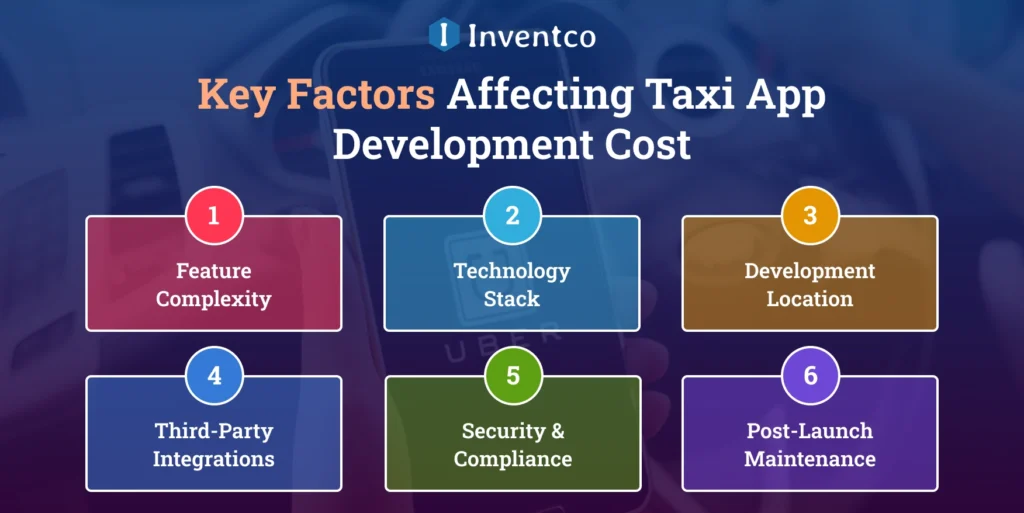
A business should evaluate the factors that affect the cost of developing an app like Uber to plan effectively.
1. Feature Complexity
Development costs are heavily influenced by the number and complexity of app features being developed. Basic features around ride-hailing functionality can be developed at low cost, whereas features that include AI for optimized routing, dynamic pricing, real-time analytics, etc. can significantly drive up the costs. Prioritizing features can help control costs.
2. Technology Stack
Choosing the right combination of cloud services, front-end technologies, and back-end technologies is crucial for optimally managing the costs of an app like Uber. A modern, scalable technology stack can have high upfront costs, but in the long run, it can save the company from maintenance and other performance-related costs.
3. Development Location
Depending on where the development team is located, costs can vary widely. Development teams in North America and Europe charge the most, whereas teams in Asia charge significantly less for the same level of quality and experience. The location of the development teams will affect the cost of developing an app like Uber.
4. Third-Party Integrations
Licensing costs, API usage costs, and pay-per-call agreements can drive up the cost of integrating services such as mapping, payment processors, SMS services, push notifications, and analytics.
5. Security & Compliance
Apps like On-Demand collect and process customer-sensitive information, track customer locations, and process payments. Once an app has been developed, additional investments in security and compliance can be avoided by building customer trust and avoiding potential legal challenges.
6. Post-Launch Maintenance
The expenses of an app extend far beyond its launch. Ongoing bug fixes, server optimization, feature updates, and performance improvements significantly impact mobile app maintenance costs. Ignoring post-launch objectives can result in unstable performance, security risks, and dissatisfied users, ultimately affecting long-term app success and user retention.
How to Reduce the Cost of Developing an App Like Uber?
From the start, significant time and effort must be invested in planning the project to allow for the successful and cost-efficient development of the Uber app.
- Start with an MVP: Launching an app at its most basic version, which prioritizes the core features, presents the opportunity to obtain constructive criticism and attract initial users for value. A minimum viable product is often the most effective way to improve the app with the objectives of real users.
- Use Cross-Platform Frameworks: Cost-efficient development can be achieved by using frameworks such as Flutter and React Native, which enable simultaneous development for both iOS and Android.
- Prioritize Must-Have Features: Top priority at the start of development must be given to the fundamental, core features of the app. Once the system has gained enough market traction, additional features can be incorporated within the app.
- Scale Gradually: Building a system and app with an advanced level of features is not cost-efficient; therefore, scaling capabilities in features, infrastructure, and geographical areas over time must be practiced in order to optimize for cost and promote steady overall growth.
Knowing how much it would take to create an app like Uber would enable more realistic budgets, better decision-making, and the potential for future financial savings.
Note: Curious about how to build fleet management software? Check out this in-depth guide to get started.
Uber Clone App Development vs Custom App Development
Choosing between an Uber clone solution and a fully custom-built platform is a critical decision when planning to develop an app like Uber. Each approach serves different business goals, budgets, and growth strategies.
| Parameter | Uber Clone App Development | Custom App Development |
| Time to Market | Faster launch using pre-built modules | Moderate timeline due to tailored development |
| Flexibility | Limited customization options | High flexibility for features and workflows |
| Scalability | Restricted as user base grows | Built for enterprise-level scaling |
| Branding | Generic design and structure | Fully custom branding and UI/UX |
| Long-Term ROI | Lower due to limitations | Higher with long-term growth potential |
Uber clone solutions are suitable for quickly testing ideas or entering niche markets. However, for businesses aiming for scalability, differentiation, and sustainable growth, custom app development like Uber proves to be the stronger long-term investment.
How Long Does It Take to Develop an Uber Like App?
The business model Uber-like apps implement depends on various factors, including the depth of features, level of technical scalability, how complex the app will be, and more, meaning that the development time would be different for each app. With that information, here is a breakdown of development time through the stages of maturity.
MVP (3–4 Months)
A minimal viable product (MVP) is what you would start with. An MVP is the simplest iteration of your app with the most essential features, including user registration, ride booking, GPS tracking, payment systems and an admin panel. This time frame is ideal for gaining market presence and validating your business idea with little risk.
Mid-Scale App (5–7 Months)
A mid-scale version would include features such as surge pricing, analytics, and a more refined user experience, along with advanced app security and improved dashboards for driver earnings and notifications.
Enterprise-Grade App (8–12 Months)
An enterprise-level app would be the last to develop and would have a more intricate app construction with multiple back-end systems integration, geo-dispersing, regulatory compliance, and advanced integration. Because of the complexity, time highly depends on the depth of features, the size of the team, compression testing, and testing time.
How Uber Like Apps Make Money?
Uber-like platforms use a combination of business models to cover operational costs and drive profitability. This multi-model approach, commonly adopted by the top taxi booking apps in the USA, helps balance revenue streams, support safe growth, and enable the development of more cost-effective, scalable ride-hailing solutions.
- Commission per Ride: The more rides the user does, the more money the app makes, earning a percentage of every completed ride. This would be the core revenue model for the app because it directly relates to ride traffic and user activity, which greatly influence revenue scale.
- Surge Pricing Margins: During peak hours or high-demand instances, dynamic pricing boosts fares to help balance supply and optimize earnings for the platform.
- Subscription Plans: Tiers with benefits like lower commissions, priority requests, and discounted fares are available via monthly or annual subscriptions for drivers or users.
- Advertising & Promotions: An additional revenue stream is created through partnerships with brands and local businesses to serve in-app promotions and advertisements to users for targeting purposes.
- Cancellation Fees: Last-minute cancellation fees are charged to compensate drivers and to minimize abuse of the platform.
These mobile app monetization strategies are invaluable for creating long-term, sustainable, and profitable development roadmaps for apps like Uber.
Real-World Challenges Faced While Developing an Uber Like App
When businesses consider creating an app like Uber, they face unavoidable app development challenges, including technical, operational, and regulatory issues that, if unresolved, will critically harm performance, trust, and scalability.
- Real-Time GPS Accuracy: Due to issues such as network latency and device and location inconsistencies, balancing accurate GPS tracking is an issue. Problems with matching rides and estimating arrival times arise, which, in turn, decrease users’ reliance on the service.
- Payment Failures & Refunds: Users’ frustrations, delays in payment, loss of trust, and higher customer support operational overheads are all consequences of insufficient payment gateways that are unable to support on-the-fly changes and transaction reversals.
- Driver Onboarding Fraud: Uncovering fake accounts and cross-country service fraud requires the implementation of more stringent customer background checks, including KYC and continuous document validation and monitoring, which lowers the risk associated with fraud and fulfills the service.
- Regulatory Compliance: New operational and expansion hurdles result from rule-based adherence to a country’s specific transport, labor, tax, and data privacy laws, and vary by location and a country’s operational and expansion plans.
- Scaling During Peak Demand: Maintaining seamless service in the absence of crashing or lagging systems when demand increases suddenly.
- Data Privacy & Security: Data privacy and security can be ensured by employing breach protection and long-term trust-maintaining methods such as encryption, secure authentication, audits, and compliance with policies.
From a developmental standpoint, addressing these issues is of utmost importance, as it will greatly improve the platform’s longevity and stability and strengthen users’ confidence.
Conclusion
For an app to be developed successfully, like Uber, it is imperative that companies possess more than a simple clone script or mere duplication of base functions. Planning on a strategic level, ‘user-first’ design, architecture that is scalable, security that is robust, and an efficient level of execution that is budget-conscious and supports growth on a longitudinal level will be the determining factors of success.
When assessing the cost to develop an app like Uber, deciding on a clone vs. a custom-developed app, or when advanced features are in the pipeline, selecting the right technology partner is crucial. An experienced team brings performance stability, compliance readiness, and superior adaptability to the market.
Inventco epitomizes scaled engineering, profound domain specialization, and a business-centered perspective to on-demand solutions. As one of the leading mobile app development companies, Inventco assists startups and enterprises in building custom Uber-like applications that are reliable and aligned with digital norms and user expectations for the year 2026.
FAQ’s
Q1. How much does it cost to develop an app like Uber?
Ans. The cost to develop an app like Uber typically ranges from $10,000 to $100,000+, depending on features, platform complexity, development approach, and scalability requirements.
Q2. How long does it take to develop an Uber-like app?
Ans. Development timelines usually range from 3–4 months for an MVP, 5–7 months for a mid-level app, and up to 12 months for enterprise-grade platforms.
Q3. Is Uber clone app development a good option for startups?
Ans. Uber clone app development works well for idea validation and quick launches, but custom development offers better scalability, branding flexibility, and higher long-term ROI.
Q4. Which industries can use Uber-like app solutions?
Ans. Uber-like apps are widely used in taxi booking, food delivery, logistics, courier services, healthcare mobility, and on-demand home services across global markets.
Q5. Why choose a professional mobile app development company?
Ans. A professional mobile app development company ensures secure architecture, scalability, regulatory compliance, optimized costs, and long-term support when building Uber-like applications.

Jitendra Jain
He is the CEO and Co-founder of Inventco, driving innovation in advanced computing and digital transformation. With deep expertise in modern IT ecosystems, he leads scalable, secure, future-ready solutions. His strategic leadership helps businesses accelerate growth, adopt innovation, and achieve success. You can connect with him on LinkedIn to follow his technology insights.