The cash registers of the past no longer apply in today’s tech-driven world. Instead, they will be considered cash-flow-critical revenue engines. Whether building for retail, food and beverage, hospitality, or omnichannel commerce, one of the first things a builder needs to know before spending venture capital or starting construction is how much POS (point-of-sale) software will cost.
The cost to build POS software in 2026 will depend heavily on the scope, features, integrations, compliance, security, and scalability. The cost to build POS software ranges from $10,000 to $100,000+. Businesses requiring complex, secure systems will need to choose custom software, which means working with high-budget POS software development companies.
In this guide, we will cover POS system development costs, market trends, feature complexity breakdowns, timelines, hidden costs, cost optimization, and other fundamentals from an expert’s perspective to serve investors and founders.
Market Stats & Industry Context
As we enter 2026, global POS adoption continues to surge thanks to digital transformation, seamless omnichannel experiences, and consumer expectations for fast, secure transactions:
- The global POS software market continues to grow strongly, with an expected value of around $18.04 billion in 2026 and reaching $32.33 billion by 2031, expanding at a CAGR of ~12.38%.
- The cloud POS market is expanding quickly, projected to grow from about $7.73 billion in 2025 toward $45.20 billion by 2033 as businesses favor scalable, remotely managed deployments.
- The point of sale software market is forecast to grow from roughly $14.42 billion in 2025 to $15.98 billion in 2026, reflecting steady digitization across the retail and hospitality sectors.
These trends reinforce why understanding POS software development cost is not just a budgeting exercise, it’s a strategic investment in competitive advantage.
How Much Does POS Software Development Cost?
There are numerous factors that determine the cost of custom POS software development when businesses plan to create a POS software solution. These factors are: platform (Web, iOS, or Android) development, integrations with other services (payment gateways, ERP), security and compliance requirements, custom specifications, and maintenance needs. Below, we provide cost forecasts by POS system type for the expected development ranges in 2026. Need the keyword “create a pos software”
1. Basic POS (Single Store) — $10,000 to $30,000
A basic POS system is suitable for small businesses with a single location and simple operational needs. Some of the included features may include sales processing, product management, issuing receipts, basic inventory management, and basic reports. This system is ideal for startup businesses and small retail stores that need a basic system and do not want to invest in integrations or complex systems.
2. Mid-Tier POS (Multi-Location, Basic Integrations) — $30,000 to $60,000
A mid-tier system can support more than two stores. Other features to be included are inventory management and adjustable user roles. This system helps growing businesses achieve operational control across various locations. From a costing perspective, this system will focus on greater operational control and become more complex.
3. Enterprise POS (Custom, Secure, Omnichannel) — $60,000 to $100,000+
Enterprise POS systems serve corporate businesses that need custom solutions with the features to address security, omnichannel capabilities, and more. These systems integrate with ERP, CRM, loyalty programs, and offline analytics to handle high transaction volume. In addition to meeting regulatory requirements, Enterprise POS systems offer high scalability, strong performance, and intelligent data processing to ensure a good ROI over the system’s lifespan.
POS Software Development Cost Breakdown (2026)
| Type of POS System | Best Suited For | Key Capabilities Included | Typical Development Cost (USD) |
| Basic POS (Single Store) | Small retailers, startups | Sales processing, product catalog, receipts, basic inventory tracking, standard reports | $10,000 – $30,000 |
| Mid-Tier POS (Multi-Location) | Growing businesses, retail chains | Multi-store management, centralized inventory, payment gateway integration, role-based access, reporting dashboards | $30,000 – $60,000 |
| Enterprise POS (Custom & Omnichannel) | Enterprises, franchises, large retailers | ERP & CRM integration, omnichannel sales, AI analytics, loyalty programs, offline mode, advanced security & compliance | $60,000 – $100,000+ |
This table clearly communicates POS software costs, helping founders and investors quickly align budgets with business scale and complexity, especially when evaluating cloud vs. traditional POS solutions.
POS Software Cost Breakdown by System Type
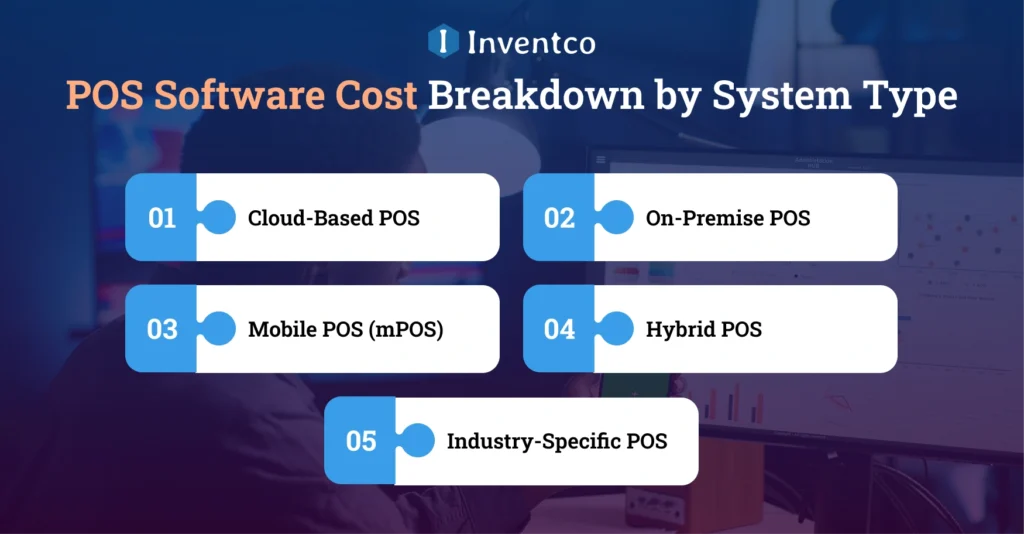
The software costs associated with building a POS system are largely determined by the deployment type, hosting model, scalability considerations, and compliance requirements. Each type of POS system will incur different software development costs based on the infrastructure, integrations, and operational considerations.
1. Cloud-Based POS
Estimated cost: $25,000 – $80,000+
With cloud-based point-of-sale systems, the software runs on remote servers. This allows for real-time access, scalability, and the ability to manage multiple locations. Development costs result from cloud infrastructure setup, real-time data synchronisation, mobile accessibility, and PCI DSS compliance. While the initial development costs fall in the mid to high range, businesses will incur ongoing costs such as hosting, maintenance, and subscription fees.
2. On-Premise POS
Estimated cost: $30,000 – $90,000+
On-premises POS systems are installed on a business’s local servers. This results in more data control and less reliance on the internet. However, software development costs increase due to infrastructure investments, hardware requirements, and a longer implementation timeline. This model is best suited for companies that have strict data governance or regulatory constraints.
3. Mobile POS (mPOS)
Estimated cost: $15,000 – $50,000+
mPOS solutions are mobile Point of Sale systems designed for tablets or smartphones, so they are ideal for retail stores, food trucks, pop-up shops, and any mobile or service-based businesses. Development costs are likely to be higher due to cross-platform compatibility, secure payment processing, offline capabilities, and support for UI customization. mPOS systems usually have lower entry costs but can scale to more advanced, costly features.
4. Hybrid POS
Estimated cost: $40,000 – $100,000+
Hybrid POS systems use on-premises POS alongside cloud-based POS. Cloud-based Hybrid POS systems offer greater development and operational efficiency, however, they rely on uninterrupted internet connectivity for cloud-based features to work. Development time tends to be longer and more costly due to dual systems, offline storage, integration synchronization, and complex security features. Resultantly, they are more cost-prohibitive to more operational resiliency and cost of scalability.
5. Industry-Specific POS
Estimated cost: $50,000 – $150,000+
Industry-specific POS systems are designed to be integrated into one of the branches of a company’s vertical or horizontal structure, be it retail, restaurants, hospitality, or even healthcare, and to form a large enterprise of integrated systems. More Industry-specific POS systems are designed around a company’s regulatory compliance, reporting, and third-party integration needs. This individually tailored approach to industry-specific systems also centers around cost-effective, highly efficient systems and a sustainable ROI.
POS Software Cost vs ROI Comparison
| POS System Type | Estimated Development Cost (USD) | Ideal Business Size | ROI Potential | Key Revenue & Efficiency Gains |
| Cloud-Based POS | $25,000 – $80,000+ | SMBs to growing chains | High | Faster deployment, multi-location control, real-time reporting, lower upfront infrastructure cost |
| On-Premise POS | $30,000 – $90,000+ | Medium to large enterprises | Medium–High | Data ownership, stable performance, reduced dependency on internet, long-term cost control |
| Mobile POS (mPOS) | $15,000 – $50,000Startups | PS, retail, F&B, pop-ups | High (Short-Term) | Low entry cost, faster transactions, improved customer experience, mobility-driven sales growth |
| Hybrid POS | $40,000 – $100,000+ | Multi-location businesses | Very High | Business continuity, offline sales protection, scalability, reduced downtime losses |
| Industry-Specific POS | $50,000 – $150,000+ | Enterprise & regulated sectors | Very High (Long-Term) | Workflow automation, compliance efficiency, operational accuracy, higher lifetime customer value |
Although cost is important, ROI is primarily driven by transaction speed, operational efficiency, intelligent data processing, and software scalability. More expensive software development, from an operational standpoint, for a single location leads to fewer operational errors, improves margins, and results in shorter payback periods, especially for multi-location operations and deployments in specific industries.
Feature-Based Cost Breakdown of POS Software
The more advanced the POS software, the more it will cost to develop. While transactional reliability loss costs much more, more advanced POS systems require an even higher cost: intelligent, automated systems, real-time systems, and interconnected systems.
Below is an overview of app development costs related to the requested POS features and systems.
Core & Advanced POS Features and Cost Impact
| POS Feature Module | Impact on Development Cost | Why It Affects Cost |
| Basic Checkout & Transactions | Low–Medium | Requires stable transaction logic, tax calculations, and receipt handling |
| Inventory & Product Management | Medium | Involves real-time stock updates, SKU management, and reporting logic |
| Customer Loyalty & CRM | Medium–High | Adds customer profiles, reward engines, data storage, and analytics |
| Payment Gateway Integration | Medium | Requires secure APIs, PCI DSS compliance, and multi-payment support |
| Mobile POS Support | High | Demands cross-device compatibility, UI optimization, and performance tuning |
| Offline Transactions | High | Requires local data storage, sync mechanisms, and conflict resolution |
| AI Reports & Analytics | Very High | Involves data pipelines, predictive insights, and advanced dashboards |
| Omnichannel Synchronization | Very High | Ensures seamless data flow across online, offline, and third-party platforms |
Cost Consideration for Advanced Features
Additional features including Artificial Intelligence (AI) analytics, machine learning insights, and additional industry-specific modules (kitchen display systems for restaurants, compliance workflows for healthcare) can raise costs by as much as 50%, ranging as low as 20% on the development budget base costs.
Factors That Affect POS Software Development Cost
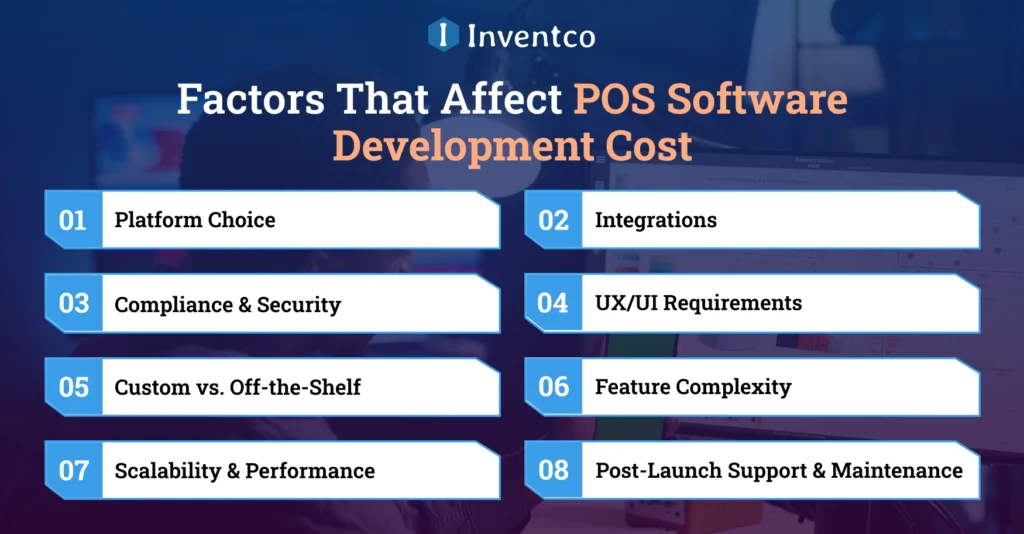
To develop a realistic budget, avoid overspending, and ensure the project meets the business’s vision, a founder and investor should recognize the estimated development costs and the factors that affect them. Below are the variables for 2026.
1. Platform Choice
The choice of platform affects the development efforts and costs of the POS software. Native builds, whether for iOS, Android, web, or cross-platform, will have different development and testing requirements and their own maintenance and update strategies, all of which will affect costs.
2. Integrations
The costs associated with the development of the POS software will increase due to the need to integrate with other systems. To connect ERPs, payment systems, inventory, CRM, and analytics systems, a high level of secure APIs, logic for data synchronization, error handling, and data mapping, along with updates to reflect changes in the other systems, will be needed. All of which will be a necessary part of the integration.
3. Compliance & Security
Certain compliance and security measures can affect development costs. There are multiple standards, such as PCI DSS and EMV, that require businesses to provide secure transaction methods, secure authentication methods, audit trails, and documentation to facilitate continuous monitoring of payment data. Businesses that do not meet the compliance standards put themselves at risk.
4. UX/UI Requirements
UX and UI Requirements can affect the design and development of the software, as they can increase costs. This can happen when several designers are needed to facilitate a project, including activities such as user research, prototype development, usability testing, and multiple iteration cycles. While this may level software development costs in the short term, it reduces overall design costs in the long term.
5. Custom vs. Off-the-Shelf
Custom POS software allows businesses to design their systems around their operations, but this approach comes with a high cost to develop. Off-the-shelf POS software (also called proprietary software) may appear cheaper in the short term. Still, it can leave businesses with a loss of competitive edge over time, as custom software ultimately provides a greater long-term ROI.
6. Feature Complexity
More complex software can reduce POS development costs. This is because if a module is advanced (for example, an AI analytics module, or a module that facilitates offline payment), there are more development resources that need to be allocated to the advanced module. This can require significant additional time, which increases overall costs.
7. Scalability & Performance
The demands to ensure that your business can grow and expand in the future can also affect costs. Businesses may require complex systems capable of managing multiple locations and high transaction volumes. These systems need to be built with advanced architecture in order to help businesses avoid a bottleneck in their growth.
8. Post-Launch Support & Maintenance
Support after launch and app maintenance costs can affect POS software costs due to the need to fix issues, update security, optimize performance, and enhance features. Other compliance maintenance and technical support are needed to keep the system running, secure, and aligned with business needs.
While the initial software development cost is important, the POS software’s long-term factors are more important, such as ongoing development costs for scalability, security, and adaptability. Planning in these areas helps the business control costs and increase ROI with a POS system that supports development rather than constrains growth.
Cost of POS Software Development by Complexity
The additional features a Point of Sale software system has, the greater the expense. The inclusion of myriad features, such as integrations, security, customizations, and scalability, will further increase the cost of a POS system. The impact of POS system complexity helps founders and investors align their budgets with their business objectives and avoid the trap of underestimating the costs associated with developing these software systems.
POS Software Development Cost by Complexity Level
| Complexity Level | Description | Estimated Development Cost (USD) |
| Level 1 – Basic | Single-store setup with core checkout, billing, product catalog, and basic reporting | $10,000 – $25,000 |
| Level 2 – Intermediate | Multi-location support, inventory management, user roles, and standard integrations | $25,000 – $50,000 |
| Level 3 – Advanced | Loyalty programs, analytics dashboards, mobile POS support, and enhanced security | $50,000 – $80,000 |
| Level 4 – Enterprise | AI-driven insights, omnichannel sales, ERP/CRM integrations, and custom workflows | $80,000 – $150,000+ |
What Drives Higher Costs at Advanced Levels?
The increasing complexity calls for more advanced/healthier systems, which require additional development personnel to build robust system architectures. This will increase the time for Quality Assurance (QA) and testing cycles. In addition, more time will have to be allocated for advanced security engineering. Compliance validation, performance optimization, and planning for future scalability will be required for these advanced systems, which will increase both development and long-term costs.
Finding the correct level of complexity does not mean constructing everything all at once. It means aligning the system’s features with the business’s maturity. A thoughtfully designed POS system has the potential to scale over time, helping businesses manage their expenses and optimize efficiency and ROI (return on investment) over extended periods.
Hidden & Ongoing Costs of POS Software
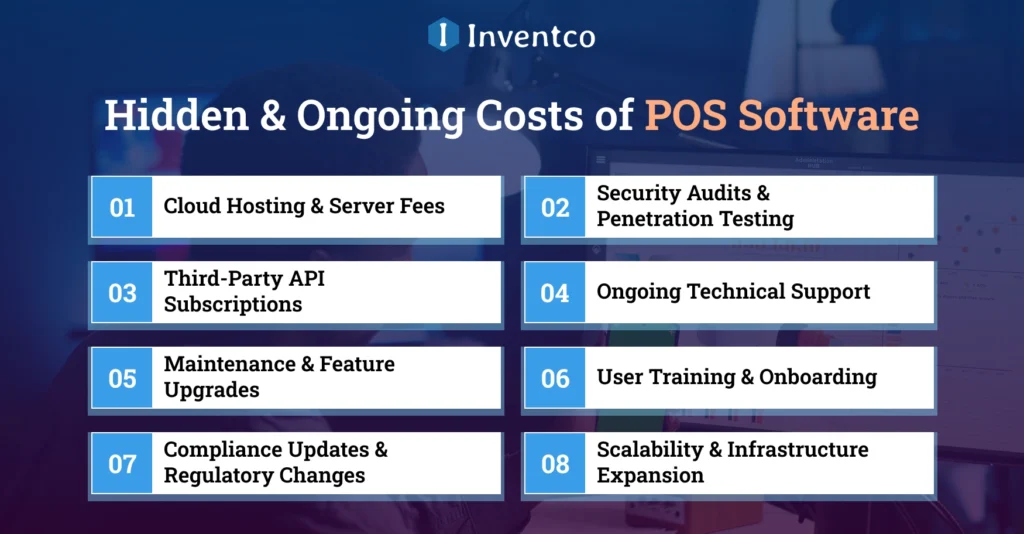
Your investment should consider development costs as a single expense. Subsequent operational expenses will be ongoing and will define the development costs of POS software and will also determine its future scalability, security, and reliability in the system.
1. Cloud Hosting & Server Fees
Your operational costs, which will affect POS Software development costs, include infrastructure, security updates, and backups, which support the use of cloud and server resources for data storage, bandwidth, and uptime guarantees.
2. Security Audits & Penetration Testing
Involves expenditures for specialized security measures and tools throughout the life cycle of the position software.
3. Third-Party API Subscriptions
Exploitation of third-party APIs will result in ongoing expenditures, as systems will incur fees for payments, analytics, accounting, and CRM, which are usage-dependent and enable integration of subscription payments.
4. Ongoing Technical Support
Your operational costs for Extensive Technical Backing will ensure the uninterrupted operation of all of your systems.
5. Maintenance & Feature Upgrades
Upgrades and app maintenance are crucial to keep a POS system secure and competitive. Continuous development resources are needed to accomplish this. Feature enhancements, performance optimization, compatibility updates, and bug fixes are needed to keep a system aligned with business needs.
6. User Training & Onboarding
The costs associated with user training and onboarding include support materials, training resources, and onboarding assistance. These resources are needed to promote staff adoption, reduce operational errors, and improve productivity, especially in multi-location or high-turnover environments.
7. Compliance Updates & Regulatory Changes
Changes in regulations may require modifying how transactions are processed, how data is stored, and how reporting or security workflows are updated. As businesses focus on evolving payment standards and new regional regulations, development costs continue to grow.
8. Scalability & Infrastructure Expansion
The costs associated with scalability grow as a business expands. Infrastructure improvements, load balancing, performance tuning, and database optimization are all necessary to ensure a POS system can handle more transactions in a given time without negatively impacting the customer experience or causing downtime.
The aforementioned factors can each account for an additional 15 to 30% each year of the costs associated with developing new POS software. Noting these costs is vital for long-term financial planning on the part of the founders and investors who are interested in a system with ongoing and predictable costs.
How Long Does POS Software Development Take?
The time it takes to develop POS systems varies based on system features, complexity, integrations, security, and the scope of app testing. Investors and founders should view development time as a strategic planning factor rather than a technical milestone.
Typical POS Software Development Timeline
- Basic POS systems: ~3–4 months
- Mid-level POS solutions: ~4–6 months
- Advanced or enterprise POS: ~6–9+ months
Each phase includes design, development, integration, quality assurance, and deployment.
Key Factors Influencing Development Time
Development duration increases with multi-platform support, third-party integrations, compliance testing, performance optimization, and post-launch readiness. Agile development models can accelerate delivery while maintaining quality and scalability.
Investing time to define development scope will help create an app development process that is efficient (aligned to the highest value business outcomes), create a budget that is more stable (less variability), and have a launch that is less chaotic (more operationally reliable). Long-term growth and operational reliability will come from a secure and scalable POS system.
How to Reduce POS Software Development Cost Without Cutting Quality?
Building POS systems at lower costs revolves around strategic thinking rather than eliminating features and complexity. With the methods below, business systems remain budget-friendly, maintaining high performance, scalability, and app security.
1. Prioritize Core MVP Features
Prioritizing necessary app features first helps reduce development time, lower costs, speed up time to market, enable founders to test workflows, capture user feedback, and build additional features based on business needs.
2. Use Cross-Platform Frameworks
A cross-platform development framework will allow for a single codebase for web and mobile POS applications. It will reduce engineering, testing, and maintenance costs while providing a consistent user experience and functionality across all devices.
3. Plan Integrations Strategically
Good integration planning helps you avoid unnecessary work by using only the most essential payment gateways, inventory systems, and analytics tools. This reduces the number of APIs, keeps costs down, improves system performance, and is easier to maintain.
4. Adopt Modular System Architecture
Using modular systems makes it easier and more cost-effective to develop, launch, and grow features. Advanced modules can be added later without affecting the overall POS system or requiring a rebuild.
5. Leverage Third-Party Tools Wisely
Using high-quality third-party vendors for payments, analytics, and alerts can reduce the amount of development work required, shortening timelines and reducing costs. This is only true if the vendors are integrated into the systems and meet all business goals.
6. Define Clear Technical Requirements Early
Setting technical requirements and having documentation may eliminate rework and miscommunication among stakeholders and developers. This keeps the development timeline predictable, reducing unforeseen costs and aligning with the company’s goals from the start.
7. Invest in Scalable Infrastructure Planning
Planning your system’s infrastructure early will save you from costly re-architectures later. Systems can be designed to accommodate growth, increased transaction volumes, and new locations without major redevelopment or operational downtime.
8. Partner With Experienced Development Teams
Collaboration with seasoned POS development teams helps avoid costly mistakes, improve technical decision-making, speed up systems delivery, and ensure that compliance, security, and scalability are done right the first time, protecting the long-term ROI and the reliability of the system.
Why Choose Inventco for POS Software Development?
Inventco is a leading mobile app development company that is mobile-focused, with POS solution development tailored to your business needs. We understand that POS systems are no longer merely transactional systems. They are scalable systems that help businesses drive additional growth and efficiency.
When building our POS systems, we aim for them to be scalable, secure, and to have the best possible user experience. We understand that our customers operate businesses with high transaction volumes and multiple locations (retail, hospitality, etc.), and we’ve built our systems to help your staff provide efficient, smooth interactions and accurately record customer transactions.
Inventco’s systems are built to be integrable and adaptable. Understanding customer needs sets us apart. We understand that your company may be using legacy systems, and that is ok. We will provide you with a POS solution that will integrate with your legacy systems, modern cloud systems, data analytics, AI, and omnichannel platforms. Inventco will provide high-quality engineering and systems for a budgetable price and a value based on your unique business needs.

Conclusion
When looking for cost justification for a POS, you cannot look at the initial cost alone. POS systems are an investment for the future. They provide long-term gains in addition to short-term expectations for any business. POS systems will allow your business to operate efficiently. They will increase your revenue and profits while ensuring you comply with any regulations.
The costs of developing POS software range from $10,000+ for basic systems to $100,000+ for enterprise-level systems. Costs depend on the system’s complexity, integration, and future readiness. The right cost level aligns with the enterprise’s vision and growth strategy.
With a proven development roadmap and the right technology partner, POS software development can take a transformative turn. It not only empowers the processing of transactions, but also strategically augments decision-making, optimizes scalable functionalities, and provides sustainable returns on investment.
FAQ’s
Q1. How much does POS software cost for a small retail store?
Ans. For small retail stores, a basic POS software typically costs between $10,000 and $25,000, depending on required features, integrations, platform choice, security needs, and whether the system is cloud-based or on-premise with future scalability planned.
Q2. Is cloud POS more expensive than on-premise?
Ans. Cloud POS systems often have lower upfront development costs, but ongoing subscription, hosting, and maintenance fees can make them more expensive over the long term than on-premises systems, especially for high-volume businesses that require advanced features and integrations.
Q3. What hidden costs should I prepare for?
Ans. Hidden POS software costs may include cloud hosting, payment gateway charges, third-party API fees, security compliance audits, ongoing maintenance, feature upgrades, technical support, staff training, and infrastructure scaling as transaction volumes and business operations grow.
Q4. How long does it take to build POS software?
Ans. POS software development timelines typically range from three to nine months, depending on system complexity, number of features, integrations, security requirements, compliance standards, testing scope, and whether the solution is custom-built or semi-custom architecture needs.
Q5. Can I start with a basic POS and scale later?
Ans. Yes, starting with a basic POS is a smart strategy, as modular architecture allows businesses to launch quickly, validate operations, and gradually scale features, integrations, and performance as transaction volume, locations, and customer demand increase.
Q6. Is custom POS software worth the investment?
Ans. A custom POS system improves operational efficiency, reduces errors, centralizes data, and supports scalability, helping founders and investors achieve stronger ROI through faster transactions, better inventory control, improved customer insights, and long-term flexibility in planning, execution, and execution.
Q7. How does security affect POS software development cost?
Ans. Security and compliance significantly affect POS software development costs, as requirements such as PCI DSS, encryption, secure authentication, and regular audits demand specialized architecture, rigorous testing, and experienced developers to ensure secure transactions and regulatory compliance.
Q8. How should investors budget for POS software development?
Ans. Investors should budget beyond initial development by accounting for maintenance, hosting, upgrades, security compliance, and scaling costs, ensuring the POS software remains reliable, competitive, and capable of supporting business growth over multiple years sustainably in the long term.

Sandeep Agrawal
Sandeep Agrawal is the visionary CTO at Inventco, bringing innovation to life through his technical expertise. With a passion for cutting-edge technologies, Sandeep leads the team in developing robust solutions. His dedication and continous efforts to pushing the boundaries of what’s possible defines his role as a transformative and innovative force in the tech industry. You can connect with him on LinkedIn to follow insights.