If you work in real estate, you already know the three golden rules: location, timing, and connections. Today, success also depends on effectively leveraging AI in real estate.
Across the sector, AI in the real estate industry enables more accurate property value predictions, enhances compliance management, and automates customer interactions at scale.
As market complexity increases and customer expectations rise, AI has moved from a competitive advantage to a core operational necessity for modern real estate businesses.
No matter if you are a real estate agent who is looking for intelligent lead management, an investor who is looking to build a real estate platform, or a buyer who is looking for personalized property suggestions, AI is revolutionizing every avenue of the industry.
If you’ve been wondering how to use AI in real estate and what precisely the potential of AI is in the real estate app development, then you’re in the perfect place to explore it.
How to Use AI in Real Estate
Building a real estate app is the best idea for your real estate business, and integrating AI is not just about fancy chatbots; it’s about leveraging data-driven tools that free up time, reduce costs, and create seamless experiences for your clients.
Here’s how real estate professionals are using AI now:
1. Automated CRM Systems
- AI-driven CRMs monitor and capture leads on their own.
- Send personalized follow-ups on time.
- Monitor how your customers respond to drive better engagement & conversion.
- Saves agents’ time and allows them to focus on closing deals.
2. AI-Powered Real Estate Websites
- Move beyond static listings and collect property recommendations.
- Recommend homes based on a buyer’s preferences and lifestyle data, as well as search history.
- Acts like a virtual property advisor available 24/7.
3. Scheduling Tools
- No more phone tag when it comes to scheduling viewings.
- AI automatically schedules property tours.
- Keeps agents and buyers organized and in order.
4. Data Validation Tools
- Clean and analyze humongous real estate data sets.
- Make sure property records, pricing, and listings are correct.
- Establish credibility with accurate, data-driven reports.
AI Applications in the Real Estate Industry
The use of AI in real estate is growing rapidly, providing smarter tools that change the way agents, buyers, and developers interact. So, where are the most impactful areas where AI is making a real difference?
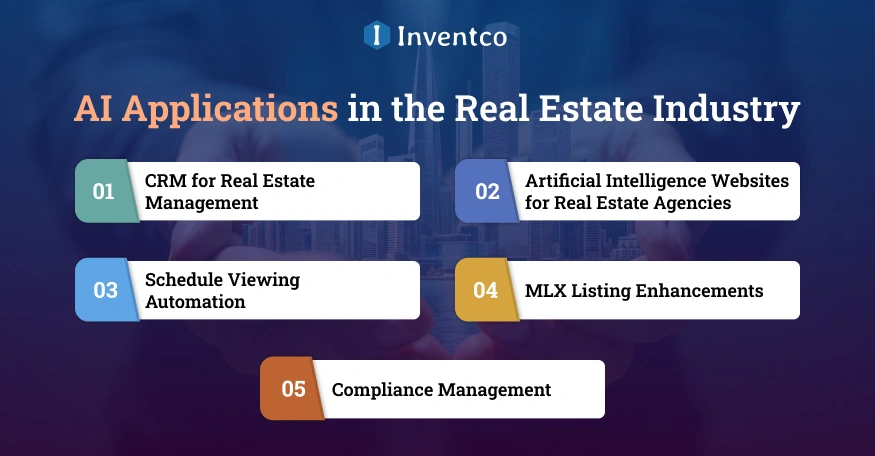
1. CRM for Real Estate Management
AI-powered CRMs automate the process of client communication by automatically sending reminders or follow-ups, and sometimes even customized updates. This cuts down on manual effort and prevents any leads from falling through the cracks.
2. Artificial Intelligence Websites for Real Estate Agencies
Website are now at as digital real estate advisers, with the help of buyer preferences and search behaviour, AI in real estate website suggest personalized property recommendations that meet lifestyle requirements as well as budget constraints.
3. Schedule Viewing Automation
Cutting complaints is easier than it may first appear: Instead of juggling countless phone calls or email chains, AI systems in real estate mobile apps can schedule property tours in seconds.
4. MLX Listing Enhancements
Listings are enhanced with AI-optimized images, keyword-rich descriptions, and dynamic pricing recommendations, all to increase visibility and engagement.
5. Compliance Management
AI-enabled tools make sure that every property transaction is compliant with regulations, thus reducing the potential risk while being transparent.
With these use cases, AI isn’t just enhancing processes; it’s reimagining the real estate experience for everyone.
AI Use Cases in Real Estate
When discussing AI use cases in real estate, it’s essential to look at real-world examples of using AI in real estate to deliver measurable value expressed in real financial gains for agents, buyers, and investors. These AI applications go beyond theory and are already reshaping how the market operates today.
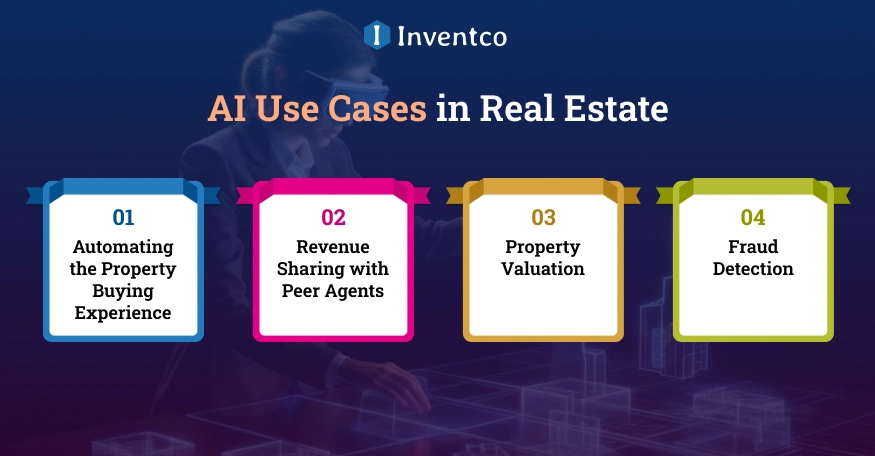
1. Automating the Property Buying Experience
Property buying and selling are now faster and smoother, thanks to virtual assistants and AI chatbots in real estate. From searching to comparing lists to even assisting with documentation, users can enhance the experience of an assisted, personalized journey, making the real estate process easier, faster, and less stressful.
2. Revenue Sharing with Peer Agents
Revenue management is still confusing, but with the help of AI in real estate, this gap is filled with the help of AI-powered real estate platforms that orchestrate transparent revenue-sharing models between agents and ensure reliability at every exchange.
3. Property Valuation
The guessing days are gone, now you can generate exact valuations of property. This is one of the key use cases of AI in real estate. With the help of AI and ML models, you can now easily analyze the accurate value of property by analyze massive datasets like demand, location, and market history, so that both buyers and sellers can leverage this to make informed decisions.
4. Fraud Detection
The real estate sector is susceptible to fraudulent activities, but with the AI system now alerting us to out-of-the-ordinary transactions, validating documents and spotting red flags all too early – reducing risk and making for safer deals.
Collectively, these examples demonstrate how AI use cases in real estate are actively transforming the industry into a smarter, more efficient, and more transparent ecosystem.
AI in Real Estate Development & Management
Artificial intelligence isn’t only helping real estate agents—it is also a game-changer for developers and property managers.
As AI becomes more widely used in development and property management, we’re seeing significant shifts in how properties are planned, maintained, and monetized. These advancements are also reshaping modern real estate app monetization models by enabling smarter optimization and data-driven revenue strategies.
1. Predictive Analytics
A hand-picked selection of products, deals, and ways to save money. AI-powered predictive models analyse historical data & local demand trends, combined with macroeconomic factors, to predict future rental demand & prices for your house.
Predictive Analytics is a key feature in real estate. This empowers investors and organizations to make better investment decisions, strategically plan new projects with confidence, and foresee market trends before they emerge.
2. Smart Facility Management
Have a hard time managing larger properties or complexes? Generative AI in real estate apps can improve energy efficiency, schedule preventive maintenance, and enhance the tenant experience through automated processes. Whether it’s smart lighting and HVAC controls or predictive maintenance alerts, AI helps reduce operational costs while pleasing tenants.
3. Real Estate Investment
Investing in real estate always has risks attached to it. With the help of AI in a real estate mobile app, you can manage this risk by evaluating possible investments by assessing ROI, market volatility and risk factors. Investors make investment decisions while looking at hard facts and great performers by minimizing losses, transforming complex investment planning into a simpler process.
By integration of AI in real estate development and management, the end-user, whether it is tenants, buyers, or investors, takes advantage of enhanced efficiency, reduces costs, and gets a better experience of real estate services.
How AI Is Changing The Real Estate Market?
How is AI technology in real estate changing the market? The effects are widespread, for buyers, sellers and agents. AI is one of the best tech trends in real estate.
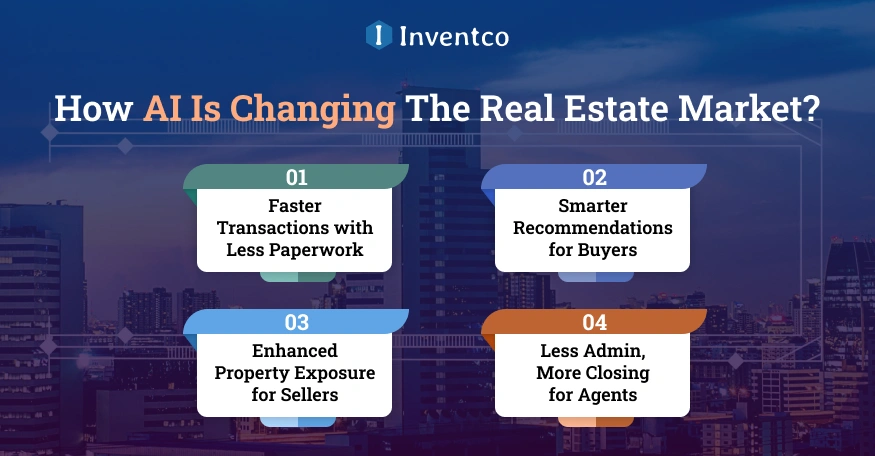
1. Faster Transactions with Less Paperwork
Using AI in real estate automates document management, approvals and compliance checks, saving companies time in closing deals. That also means buyers and sellers can receive funds faster, without the traditional settlement period.
2. Smarter Recommendations for Buyers
With the help of AI in a real estate platform, analyze buyer preferences, previous searches and lifestyle data to provide personalized property suggestions. Buyers save time and effort by looking only at the properties that fit their unique needs.
3. Enhanced Property Exposure for Sellers
Sellers appreciate the powerful AI-based real estate tools for marketing, which help in organizing ads, emphasizing features and reaching out to potential buyers. This boosts visibility, and it could result in a faster sale at the best price.
4. Less Admin, More Closing for Agents
Agents are no longer weighed down by repetitive tasks such as lead tracking, follow-ups, or scheduling. By leveraging AI in real estate, routine operations are automated, allowing agents to focus on high-value activities such as negotiations and deal closings.
Within an AI in real estate app, this automation enables smarter workflows, data-driven decision-making, and more personalized customer interactions. The result is a more efficient, secure, and customer-centric real estate ecosystem in which buyers, sellers, and agents benefit from faster, more intelligent outcomes.
Benefits of AI in the Real Estate Industry
The benefits of using AI in real estate apps are huge and quickly becoming indispensable for agents, investors, organizations, and property managers all at the same time.
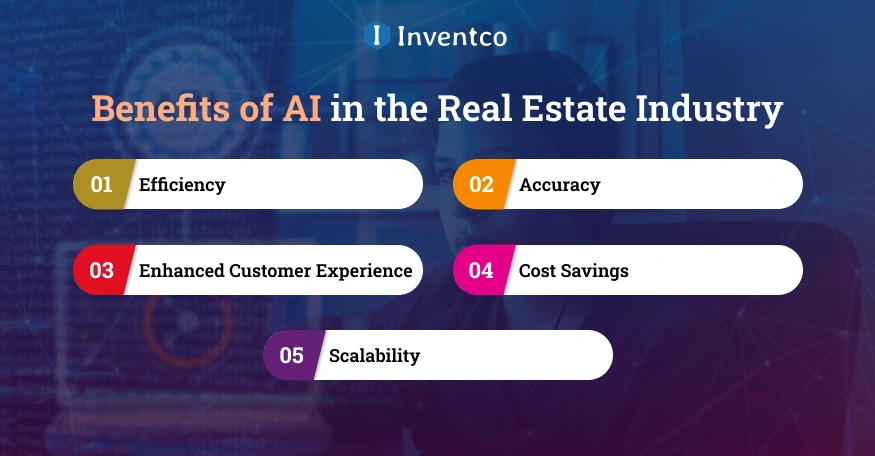
1. Efficiency
With the help of AI in a real estate app, it automates repetitive tasks, such as tracking leads, follow-ups and scheduling viewings. By automating these detailed but laborious tasks, agents and managers are able to spend more time on higher-value activities like closing deals or providing personalized service.
2. Accuracy
AI analytics eliminate mistakes in pricing, listings and property valuations. Through large dataset and market trend analysis, AI ensures that decisions are based on systemic insight, which could avoid mistakes that cost time or money.
3. Enhanced Customer Experience
AI chatbots, virtual assistants and personalized recommendations help streamline and accelerate property searches. Get instant advice from the Pros. Buyers and tenants can stay ahead of the competition by getting instant counsel on demand. Hundreds of thousands are serviced with comprehensive advice through our various services.
4. Cost Savings
Streamlined processes reduce operational overhead. AI lowers manual labor, optimizes resource allocation, and helps agencies operate leaner yet more effectively—directly influencing the overall cost to build real estate app solutions by reducing unnecessary development and operational expenses.
5. Scalability
By leveraging AI in real estate to manage workflows and client interactions, organizations can serve a larger client base without resorting to armies of hires. This provides real estate firms with the flexibility to scale operations while maintaining service quality.
In other words, AI in the real estate industry enables organizations to work smarter, faster, and more efficiently across every stage of the property lifecycle.
Future of AI in Real Estate 2026 and Beyond
Looking ahead to AI’s impact on real estate in 2026, the industry will be increasingly disrupted. Technology isn’t only going to help, it is going to fundamentally change the way properties are bought, sold, and managed.
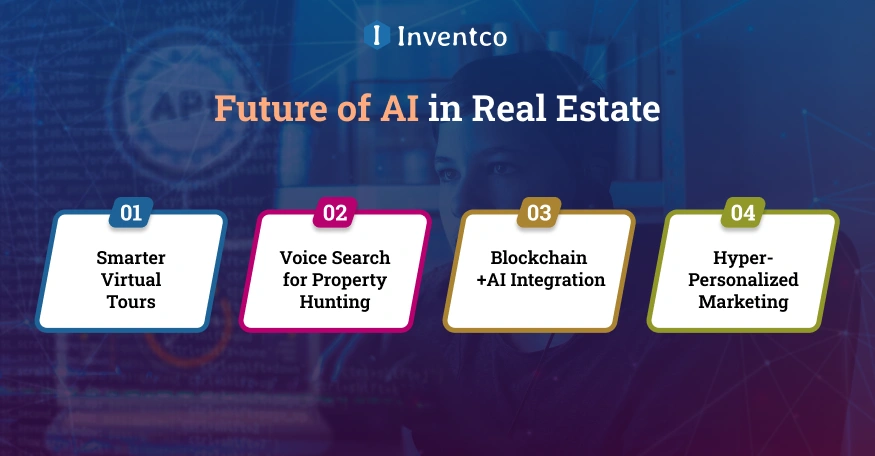
1. Smarter Virtual Tours
By integrating AI with VR in real estate mobile applications, property tours become far more immersive and interactive. This level of innovation, often found in top real estate apps, allows buyers to explore highly accurate virtual simulations without travelling, helping them make smarter, faster purchase decisions.
2. Voice Search for Property Hunting
Think about doing a home search just by your voice command: ‘Find me a 3BHK apartment under ₹50 lakh in Dubai’. AI voice search is set to revolutionize property discovery, making it quick, hands-free and tailored to personal preferences.
3. Blockchain + AI Integration
Decentralized and transparent transactions are the future. With AI and blockchain in real estate apps, the process has become more secure and streamlined. It not only makes property deals more efficient but also tamper-proof, reducing fraud and enhancing trust among buyers, sellers, and agents.
4. Hyper-Personalized Marketing
AI in a real estate app analyzes user behavior, preferences, and market trends to match buyers with the right homes before they actively begin searching, enabling highly targeted campaigns that accelerate engagement and increase conversions.
The future of AI in the real estate industry is centered on speed, personalization, and trust, creating a smarter, safer, and more efficient market for everyone. These innovations also inspire next-gen real estate app ideas that deliver more value to both buyers and developers.
Why Partner with Inventco for AI in Real Estate?
Adopting AI in real estate can seem overwhelming, but Inventco makes it simple. As a leading mobile app development company, we specialize in AI-powered solutions for the industry, including CRM integrations, property listing enhancements, compliance management, and automated buying experiences.
Our team understands the unique challenges faced by agents, developers, and brokers, delivering tailored solutions that show how to use AI in real estate effectively. Through proven AI use cases in real estate, we help businesses scale smarter, operate faster, and make data-driven decisions.
By partnering with Inventco, you’re not just adopting AI you’re gaining a competitive edge and ensuring your real estate business stays ahead in an increasingly competitive and rapidly evolving market.

Conclusion
AI isn’t the future of real estate, it’s the present. From intelligent scheduling and CRM management to automated buying experiences and fraud detection, AI in a real estate app is rapidly transforming how the industry operates.
By 2026 and beyond, the real estate market will be dominated by businesses that embrace AI. The question is: Will you be one of them?
FAQ’s
Q1. How can AI be used in real estate?
Ans. AI can be used for property valuation, CRM automation, fraud detection, virtual tours, and personalized listings.
Q2. What are the benefits of AI in the real estate industry?
Ans. It improves efficiency, saves costs, enhances customer experiences, and helps businesses scale operations.
Q3. What is the future of AI in real estate in 2026?
Ans. Expect smarter virtual tours, AI-driven marketing, blockchain integrations, and predictive analytics for investments.
Q4. How does AI help real estate developers?
Ans. AI supports predictive analytics, investment analysis, facility management, and compliance automation.
Q5. Why should I choose Inventco for AI in real estate?
Ans. Inventco offers tailored AI solutions for CRM, automation, compliance, and growth—helping you scale with confidence.

Jitendra Jain
He is the CEO and Co-founder of Inventco, driving innovation in advanced computing and digital transformation. With deep expertise in modern IT ecosystems, he leads scalable, secure, future-ready solutions. His strategic leadership helps businesses accelerate growth, adopt innovation, and achieve success. You can connect with him on LinkedIn to follow his technology insights.