
In today’s world, the mobile app industry is booming, and so is the real estate industry. In this digital-first property market, real estate app development has transformed how people buy, sell, and rent their property.
Whether you are an agency, startup, or entrepreneur, investing in property tech is one of the best moves in 2026.
Users want instant listings, sellers wish for more visibility online, and real estate agents want automation. With the help of a real estate app, you can solve all these problems and confidently lead the market.
With the rise of next-gen technologies such as AI-driven property insights, virtual home tours, smart filters, and secure in-app communication, on-demand real estate apps are becoming the backbone of modern property transactions.
If you are inquisitive about how to build a real estate app, then this guide will walk you through everything in detail.
Real Estate App Market Stats You Should Know
Mobile Applications have greatly enhanced the ways users can manage and search for properties. Significant advancements have been made in real estate software and the Proptech market. According to The Business Research Company, digital solutions in property management and transactions have rapidly grown the PropTech market, valued at USD 36.1 billion in 2024 and expected to expand to USD 72.03 billion by 2029.
Real estate software and mobile applications have changed the ways in which people buy, rent, and manage real estate. The adoption of digital platforms has rapidly influenced the property industry. The global real estate software market has continued to grow, with a USD 12.2 billion market value in 2024, which is expected to rise to USD 28.2 billion by 2033, with a projected CAGR of 9.27% from 2025 to 2033.
As per PS Market Research, in 2026, the real estate technology market for the UAE is expected to reach USD 837.5 million. Rapid digital adoption in major Middle Eastern cities such as Dubai, where mobile applications allow users to search and manage properties, has largely influenced this. Increased Investor demand for supportive government digital transformation and tech-enhanced, transparent property services has accelerated growth in this market.
Understanding Real Estate Apps
One of the most commonly asked questions on the internet is what a real estate application is. The simple answer is that real estate apps are digital platforms that simplify the property journey from listing to closing.
Whether you are a buyer, seller, renter, or an agent, with the help of a real estate mobile app, you can have instant access to properties, pricing trends, neighborhood insights, and verify property details.
The latest real estate mobile apps offer advanced features such as smart search filters, mortgage calculators, virtual tours, AI-driven recommendations, and real-time chat with agents.
For real estate businesses, these advanced real estate mobile apps can help automate lead generation, property management, and customer communication. For users, they deliver transparency and convenience.
How Real Estate Apps Work
The real estate mobile app works by connecting property data, user preferences, and agent services into one seamless platform.
How does it work?
- When the user opens the real estate mobile app, the backend fetches listings, filters, prices, photos, and location data from the database.
- Users can search for properties, compare, save favourite properties, chat with the owner or agent, and book a visit instantly from the app.
- The agent or property owner gets a notification for the visit.
With an advanced, feature-rich PropTech real estate app, agents and property owners can automate lead capture, accelerate conversions, and streamline communication, making property discovery easier for everyone.
Steps to Create a Real Estate App
Creating a successful property platform needs a well-structured development process. Whether you are planning to build a real estate app, the journey involves strategic planning, innovative design, and the right tech team.
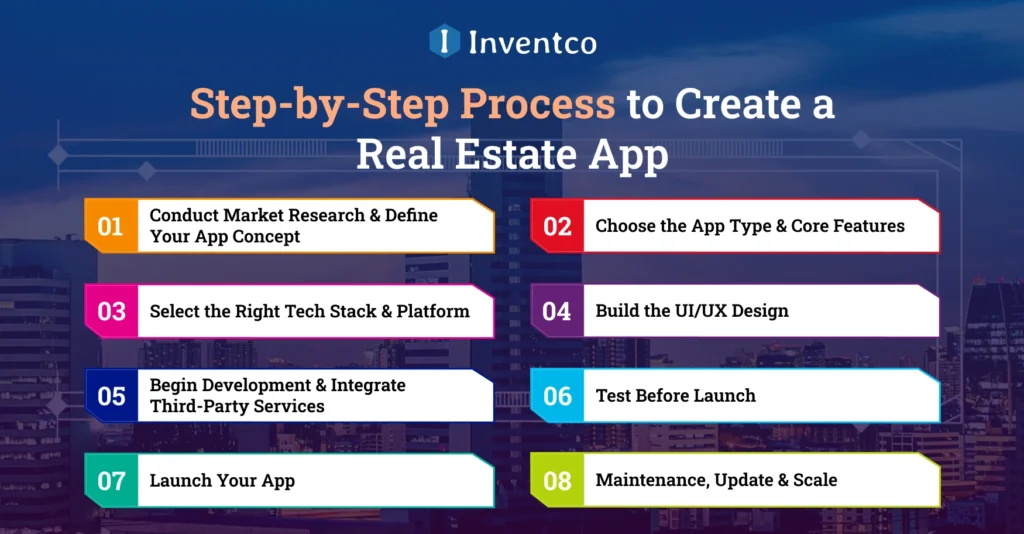
Here is the step-by-step process to create a real estate app:
1. Conduct Market Research & Define Your App Concept
Market research is the starting step in mobile app development. To build a real estate app, you need to study top apps like Dubai REST, Property Finder, Zillow, and Bayut to understand how these real estate mobile apps work.
Moreover, you need to identify your target audience, the behaviour of your buyers, sellers, renters, and agents. Need to analyze the current market gaps and decide what unique values your real estate mobile app will give to users.
2. Choose the App Type & Core Features
The second step in your real estate mobile app development is to choose the type of real estate app you build.
Select whether you want a real estate listing app, a property management tool, a real estate rental marketplace, or an agent finder platform.
Choose the best features for your real estate mobile app development and create a detailed list that includes search filters, virtual tours, maps, price history, and chat support.
You can ask your mobile app development team to create an early-stage mobile app wireframe to help you visualize the layout and user journey.
3. Select the Right Tech Stack & Platform
Selecting the tech stack and platform for your real estate mobile app cannot be understated. Decide if you want your mobile app to be Android, iOS, or cross-platform.
Select a mobile app tech stack for frontend, backend, APIs, and cloud storage to ensure the optimal user experience.
Competent app developers with experience in real estate mobile app development will guarantee your mobile app functions optimally, loads in a timely manner, and is able to manage thousands of listings effortlessly.
4. Build the UI/UX Design
UI and UX architecture of the app is to be the most important part of mobile app development as it is the very heart of your real estate app.
Design the mobile app screen to be simple and seamless. Make it easy for users to navigate.
Users of real estate mobile apps wish for a simple experience, with a but clean UX. This is one of the most important things to remember.
5. Begin Development & Integrate Third-Party Services
The next stage in designing your app involves starting front-end and back-end development.
During the development of the Front-End and Back-End of your mobile app, you may now introduce third-party integration, i.e. APIs, such as MLS/IDX, Google Maps, AI, Payment Gateways, Chat Applications, Calendar Booking Systems, AI chatbot in your real estate app.
Other APIs can be integrated as well, such as Geolocation APIs, Virtual Reality, Augmented Reality for Virtual Tours, and CRMs, for your mobile app development.
6. Test Before Launch
Before launching your real estate mobile app, you need to perform mobile app testing to fix bugs, improve performance, and ensure a smooth user experience.
Make sure you test every part of your app’s flow. This ensures users have a seamless experience.
7. Launch Your App
Publishing the mobile app to all users of the app is the final step. Distributing your mobile app is limited to the App Store and Google Play Store.
You list items and provide information, including screenshots and keywords, to enhance your application’s attractiveness to potential users. You need to focus on the app store optimization to attract users.
8. Maintenance, Update & Scale
Ignoring updates and mobile app maintenance after the launch is common in the real estate mobile app industry.
Post-launch maintenance of your real estate mobile application is needed to stay relevant in regards to the latest real estate app trends and what users expect.
Post-launch maintenance is repairing issues and bugs, updating security, and developing additional features to retain your audience.
If you adhere to these guidelines and collaborate with professionals in real estate app development, your app in the competitive real estate industry will be innovative, easy to use, and monetization focused.
Types of Real Estate Apps
The need for new and innovative solutions has resulted in the development of different types of real estate applications, each catering to specific requirements in the field. Whether you’re a professional or broker, agent or property developer, or startup founder, knowing the different types of apps can help you select the best solution for your needs.
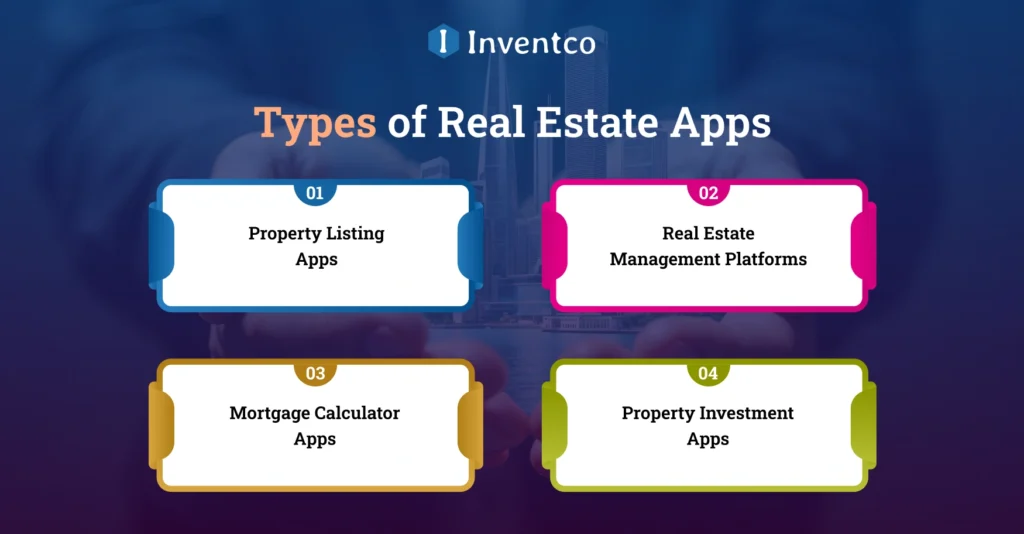
1. Property Listing Apps
Designed for brokers and real estate agents, Property listing apps function as digital platforms for showcasing available properties. The real estate apps for agents allow allow professionals to build detailed listings that include specifications for the property, high-quality photos, and other pertinent information. Users can easily browse various properties, simplifying the renting or buying process.
2. Real Estate Management Platforms
Ideal for property developers and management companies, Real estate management platforms are focused on improving day-to-day activities. They often incorporate features like portfolio management, tools for communication with tenants, and financial monitoring. The objective is to increase efficiency in property management, from rent collection to maintenance demands.
3. Mortgage Calculator Apps
Attaining real estate professionals and prospective buyers, these mortgage calculators simplify the complicated job of financial planning. Users can input information about the property, including interest rates, property details, and loan terms, to calculate the estimated mortgage payment. These applications allow buyers to make educated financial decisions and aid professionals in guiding their clients in the financial aspects of real estate transactions.
4. Property Investment Apps
Designed for property developers, investors, and others interested in real estate investments, Property investment apps concentrate on studying market trends and identifying lucrative opportunities. They typically include tools like estimation of property values, market analysis tools, and investment calculators, which allow users to make strategic choices based on data-driven insight.
Key Features of a Real Estate App
Every application, even listing apps, includes fundamental features that act as the skeleton and further features that increase users’ options and enhance the app.
Here are some must have mobile app features for real estate app:
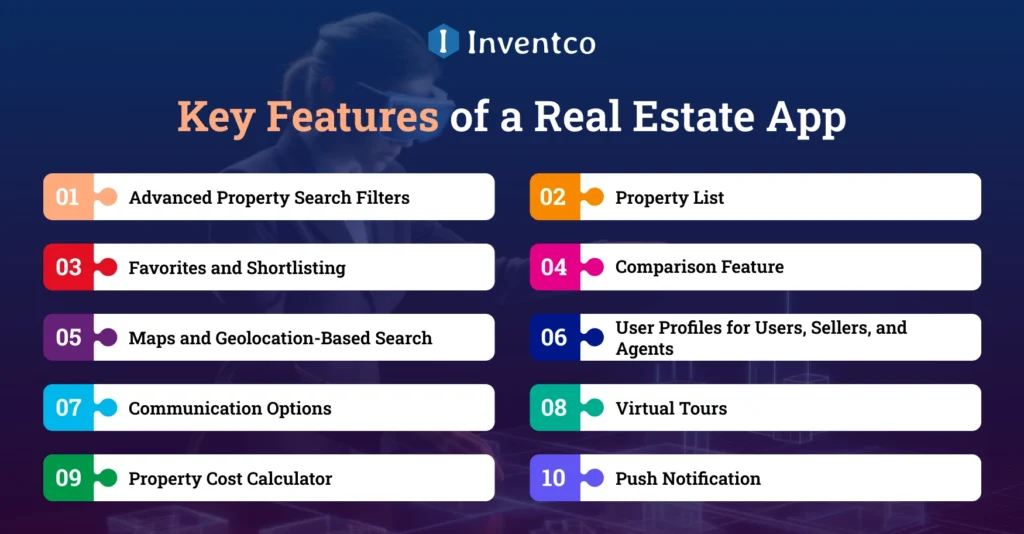
▶ Advanced Property Search Filters
A real estate app helps users find ideal homes or offices using advanced filters, offering insights into neighborhoods, safety, traffic, amenities, infrastructure, and local living conditions for confident decision-making.
▶ Property List
The design of the property catalog must be as simple and appealing as possible. In general, the catalog consists of object cards. Each profile has images, a short text description, and various components.
▶ Favorites and Shortlisting
This is a chance to limit the variety of choices to a few. Users won’t need to hunt for the best alternatives, for instance, look them up and compare them.
▶ Comparison Feature
Comparing options based on specific parameters greatly simplifies and speeds up property selection.
▶ Maps and Geolocation-Based Search
Many buyers and sellers favor homes in specific areas. This feature lets them determine their current location and the distance to the structure of their interest is, for example.
▶ User Profiles for Users, Sellers, and Agents
This real estate app feature lets you access information on any registered user. It allows them to view their rating, feedback, and also offers. It can help determine how trustworthy an individual or company is.
▶ Communication Options
Users might need to contact each other to discuss issues not mentioned in the description on the first page. Additionally, it’s about getting rapid support from the client support service. The more options you have, the more effective they are (direct messages, live chat, phone, and Social media).
▶ Virtual Tours
Sometimes, videos and images alone aren’t enough to properly introduce an area. Many people want to take a virtual property tour to experience the ambiance. This feature can significantly impact their final choice.
▶ Property Cost Calculator
Prices matter for most users. Some people find that the cost of creating a real estate app is a major factor because they have a limited budget. Therefore, it is essential to allow users to estimate based on various parameters to plan their budgets better.
▶ Push Notification
Push notifications are a great way to stay in contact with users and remind them about the company’s services. They help improve retention rates, as they are delivered to users even when they aren’t in the application.
Advanced Features of the Real Estate App
To gain a competitive edge in the evolving property market, today’s real estate applications require integrating AI, AR, IoT, and Web3 solutions. With these advanced features, it enhances user experience, boost engagement, and outperforms competitors.

▶AI-Powered Property Recommendations
Modern real estate apps use AI and machine learning to analyze user behavior, preferences, budgets, and searches, delivering personalized property recommendations that increase engagement, accuracy, and conversion rates.
▶Intelligent Chatbots & Virtual Assistants
Real estate chatbots are automated to work in the real estate sector, and answer questions from users. They are especially efficient for guiding users in buying/renting, and in scheduling appointments. They are designed to lessen the workload of real estate agents.
▶3D Virtual Tours & AR Home Visualization
AR and 3D virtual tours allow users to explore properties remotely, visualize interiors and renovations, reduce physical visits, and improve buyer confidence, especially for international and remote property seekers.
▶Mortgage & Affordability Calculators
Integrated mortgage calculators use real-time financial data to estimate EMIs, down payments, and loan eligibility, helping buyers assess affordability and make informed decisions early in their property journey
▶IoT Integration for Smart Homes
Real-time home monitoring, smart locks, smart lighting, and other home automation tools integrated with the Internet of Things, enhance the daily living experience of buyers with seamless smart home experiences.
▶Advanced Lead Management System for Agents
Real estate automated lead management systems, for example, tell agents when to follow up with someone, which helps agents increase their productivity by making the sales cycles shorter, improving the overall revenue and consistency of the company’s growth.
▶Blockchain-Based Property Verification
Blockchain in real estate integration verifies ownership, identities, and document histories, ensures tamper-proof records, improves traceability, reduces fraud, and builds lasting trust between buyers, sellers, agents, and platforms globally at scale.
▶Predictive Market Analytics & Price Trends
Artificial intelligence predicts the trends of demand, rental returns, the appreciation of real estate, and growth of neighborhoods which empowers real estate investors to assess and mitigate risks, optimize portfolios, and time their investments.
▶Smart Map Search & Geo-Fencing Alerts
Fenced Geo alerts provide real estate listings in proximity, while neighborhood insights provide intelligence for schools, transport, hospitals, and amenities, and analyze crime improving stake, relevance, convenience, engagement, and premium monetization of localized revenue.
▶Web3-Powered Real Estate Transactions
Transactions using blockchain technology and web3 provide digital contracts and decentralized identity verification, which enhances transparency, security, and trust while reducing fraud in a global network of real estate transactions.
Best Real Estate Apps & Their Standout Features
When you create a real estate mobile app, understanding the most successful property mobile app worldwide can give you powerful insights across features, innovation, and user experience.
The global real estate market is skyrocketing, and millions of users, whether they are sellers, buyers, renters, or investors, are highly dependent on real estate mobile apps and software to explore properties, check locations, compare prices, and connect with real estate agents.
Understanding the top real estate apps helps you understand market needs, user expectations, speed, accuracy, transparency, and convenience.
Here are some of the top real estate apps having unique features and strengths that boost user engagement, retention, and trust.
1. Zillow
Zillow is one of the most popular services in the U.S. real estate market. Zillow makes buying, selling, and renting homes easy for all users, whether they are new to the market or experienced. The platform integrates home/real estate discovery, pricing, and agent connections into one mobile and easy experience.
With Zillow, users can look through property listings and market trends so they can make confident decisions about real estate. Because of Zillow’s data-driven approach, users receive accurate, transparent, and real-time listings from the Multiple Listing Service (MLS) throughout the entire lifecycle of each property.
Key Features of the real estate app Zillow:
- Zestimate Home Value: Zillow provides an estimated home value using an AI-based, proprietary algorithm.
- Advanced Map Search: The User can draw a custom area to view relevant listings for the preferred location.
- 3D Home Tours: With AR/VR app development, these features let buyers explore properties virtually without scheduling visits.
- MLS Integration: Updated listings, price changes, and availability in real time.
- Favourites & Alerts: This is one of the app’s most valuable features. By this feature, the user can save the property and receive instant notifications about changes.
Key Takeaway: Zillow’s accuracy, MLS-backed data, and powerful pricing tools make it the go-to choice for users searching for reliable real estate information across the U.S.
2. Bayut
Bayut is one of the most trusted and widely used real estate mobile apps worldwide. Bayut is known for its verified listings and smooth user experience, which help buyers, renters, and investors make confident property decisions.
The app supports searches for apartments, villas, commercial spaces, and off-plan projects.
Key Features of Bayut:
- TruCheck Verified Listings: This is one of the most used features of the Bayut real estate mobile app, ensuring the authenticity of properties that are actually available.
- Lifestyle Search: This is a real estate mobile app feature that helps users search for properties by filtering by community, amenities, and local attractions.
- Interactive Maps: With this feature, you can see and explore neighbourhoods, landmarks, and commute routes.
- Photo-rich Listings: This is one of the most helpful features in real estate apps like Bayut. With this feature, owners and agents can showcase premium visuals of their property interiors, exteriors, and community vibes.
- Agent Directory: With these real estate app features, buyers can connect with trusted, verified real estate agents and sellers instantly.
Key Takeaway: Bayut is one of the most widely used real estate apps worldwide, especially in Dubai, thanks to its insights-focused approach, making it the best choice for users seeking transparency in the real estate market.
3. Property Finder
Property Finder is one of the largest real estate apps in the UAE. Real estate apps like Property Finder offer a highly polished, user-friendly platform for buying, renting, and investing in property across Dubai, Abu Dhabi, and other Emirates.
Property Finder is known for its powerful search experience and extensive verified listings across the global real estate market. One of the primary factors that makes Property Finder known across the Globe is that it caters perfectly to both residents and international investors.
Key Features of Property Finder App:
- Verified Listings: This is one of the key features of the Property Finder app that lets buyers see only authentic, verified, up-to-date properties.
- Super Agent Program: With this feature, it highlights the top agents with their ratings so buyers can make a wise and informed decision.
- Smart Search Filters: This is one of the most common yet useful features in the real estate app; with it, users can search for properties using filters like price, community, amenities, furnishing, and even view type.
- Saved Searches & Alerts: Notifies users instantly when new properties match their criteria.
- Detailed Neighborhood Guides: This feature helps users understand what things are nearby their properties, like schools, amenities, commutes, and lifestyles.
Key Takeaway: The real estate app, Property Finder, offers a clean UI, verified listings, and strong agent networks, making it one of the most reliable real estate platforms in the UAE. This real estate app is ideal for users seeking accuracy, transparency, and personalized property recommendations.
Should You Build a Real Estate App in 2026?
Yes, you should build a real estate app in 2026, as this is the ideal time to invest in real estate app development.
As buyers shift heavily toward digital property exploration, real estate agents are automating their workflows, driving a surge in demand for modern real estate platforms.
Users now expect instant listing access, virtual tours, neighborhood insights, and seamless communication, which only the best real estate apps can provide.
For a real estate agency or business, a customized real estate app can boost conversions, improve lead generation, and build brand authority.
With the rise of AI in real estate apps, they can add AI-driven search, real-time updates, and secure digital transactions.
Organizations that invest in mobile app development for real estate need to perform outstandingly to make their mark and long-term customer loyalty.
Cost to Develop a Real Estate App
Curious about how much it costs to create a real estate app? Developing a real estate app costs between $10,000 to $100,000+, depending on the scope of the app, the features, and the complexity of the development.
For example, a basic real estate app can cost anywhere between $10,000 and $25,000 and would typically include features like property listings, search filters, and user profiles.
If you go for the mid-range app, it would have advanced functionality such as in-app chat, smart filters, mortgage calculators and admin dashboards. This would typically range from $25,000 to $60,000.
At the higher end of the scale, more specialized apps would range $60,000 to $1,00,000. This would include 3D virtual tours, AI recommendations, MLS/IDX integration, and additional layers of security.
Other variables that impact cost would include design complexity, app distribution (iOS, Android, cross-platform), 3rd party integrations, and how you plan on scaling features in the future.
Case Study: Naqera Apartment Finder App
Naqera is an innovative platform that handles the complexities of renting modern apartments and short-term rentals. Naqera’s platform prioritizes mobile use and tabulates the complexities associated with listing rentals along with user journeys as fast as possible. Naqera’s mobile solution is tailored for Travellers, Tenants, and Property Managers.
The Problems
Naqera’s initial use case is the issues users face when renting certain apartments. These issues include the listing of properties across numerous sites, the availability of properties not being updated consistently, and the rental process being tiring and dry for all users involved. Property owners and managers who are listing and experiencing ownership fragmentation, ineffective booking, and the overall lack of transparency
The Solution
Naqera is able to provide real-time updates regarding listings and streamlined user apartments. Apply smart filters for search, and all from a single assister portal. Naqera’s solution has undoubtedly been able to reduce user search time and has also been able to increase the rate, along with decisions pertaining to rents.
Role of Inventco
Along with Naqera, Inventco designed and built the first version of an application with the potential to be both scalable and high-performing in the area of real estate. Inventco concentrated on developing the UI/UX, backend architecture, and data flow for speed, accuracy, and scalability. By optimally integrating real user requirements with technology, Inventco transformed Naqera into an engagement-centric, listing-performance powerhouse that sustained disruptive real estate ecosystem growth.
Real Estate App Development Challenges & Their Solutions
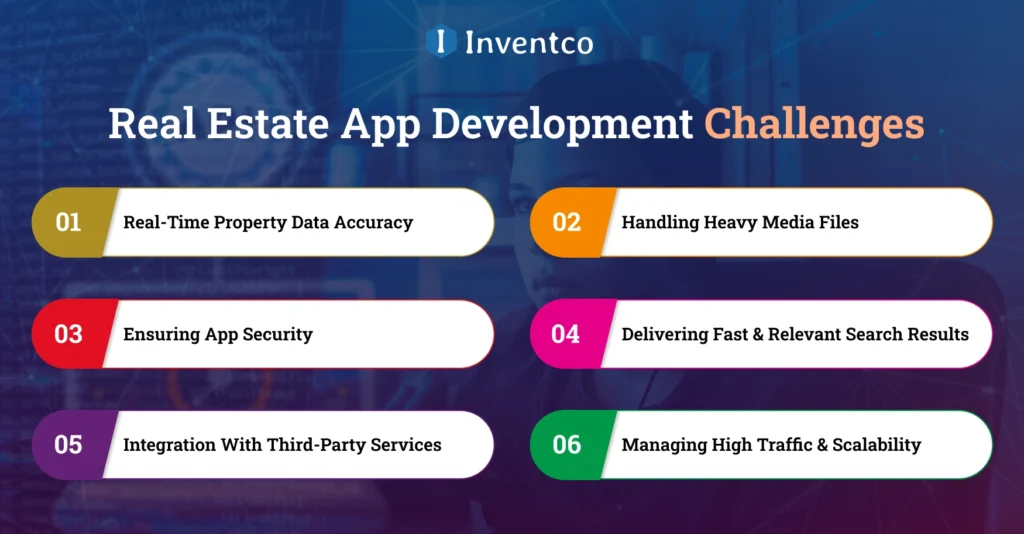
Creating a real estate app comes with unique challenges, both operationally and technically. Some specific challenges include:
1. Real-Time Property Data Accuracy
Challenge: Real estate data comes from a multitude of developers and real estate agencies, and that information is perpetually in flux. Users who encounter comparisons of properties that are stale or mismatched will become dissatisfied and eventually disengage. As the number of listings climbs, the difficulty of managing accurate, real-time property data becomes magnified.
Solution: One way to address this pain point in a real estate mobile app is to incorporate reliable MLS/IDX feeds, automate property data syncing, and use verified listing badges. With this, your real estate app users will see only active verified listings. This increases the credibility of your app and your users will appreciate seeing only active verified listings.
2. Handling Heavy Media Files
Challenge: In real estate mobile app development, one of the most time-consuming challenges is working with large media files. Real estate mobile applications need to include high-quality images, videos, and 3D tours and these files are large. If the app is unable to support large files, processing, and rendering time, users will become dissatisfied and disengage. This is all the more an issue in slow-bandwidth environments.
Solution: To overcome this mobile app development challenge, you need a robust strategy to address issues caused by slow content delivery. Implement a CDN to enhance responsiveness, along with compressed image delivery and adaptive streaming for virtual property tours. Overall, responsiveness and fluidity of virtual tours will be enhanced and delivered at a reasonable pace.
3. Ensuring App Security
Challenge: The security of the apps in question is arguably the biggest challenge in the app’s development. Collecting personal data, documents, IDs, and banking information, is a risk to the profit of the business and app developers. Shoddy security, however, will only serve to mar the app’s credibility, and provide a clear path for data breaches and theft. Access can be restricted to only the documents and information that the user has.
Solution: To start putting user information to good use mobile app data encryption, secure authentication, and multi-factor login can help build trust with users.
4. Delivering Fast & Relevant Search Results
Challenge: Users may search for certain properties and expect the system to respond immediately. In unoptimized large data sets, this can become a problem, especially with varying filters and multiple search parameters.
Solution: When there is a combination of more relevant user search results and shorter loading times for seamless property discovery, it can be attributed to the use of optimized search algorithms and personalized recommendation systems with optimized query logic.
5. Integration With Third-Party Services
Challenge: Real estate applications and their systems rely on outside services like mapping software, payment systems, analytics tools, chat systems, CRM Software, mortgage calculators, etc., and can cause performance degradation, system conflicts, and unexpected system crashes.
Solution: With the use of stable and documented systems, and modular service integration, separate testing can be performed for each individual service. Smooth integration and minimal downtime are the result of a professional developer with experience in real estate applications.
6. Managing High Traffic & Scalability
Challenge: High server and system loads can occur at peak times like launching new projects, special holiday deals, etc. When in high demand, property seekers may submit applications simultaneously, and the systems may become laggy or unresponsive.
Solution: Fast and reliable performance is maintained through cloud-based infrastructure, load balancing, and caching. These systems help ensure your app can manage high demand at any time.
How to Monetize a Real Estate App in 2026?
Passive income in your real estate app comes from employed transactional capabilities and virtual tools for property management and on-demand services available in real estate apps in 2026.
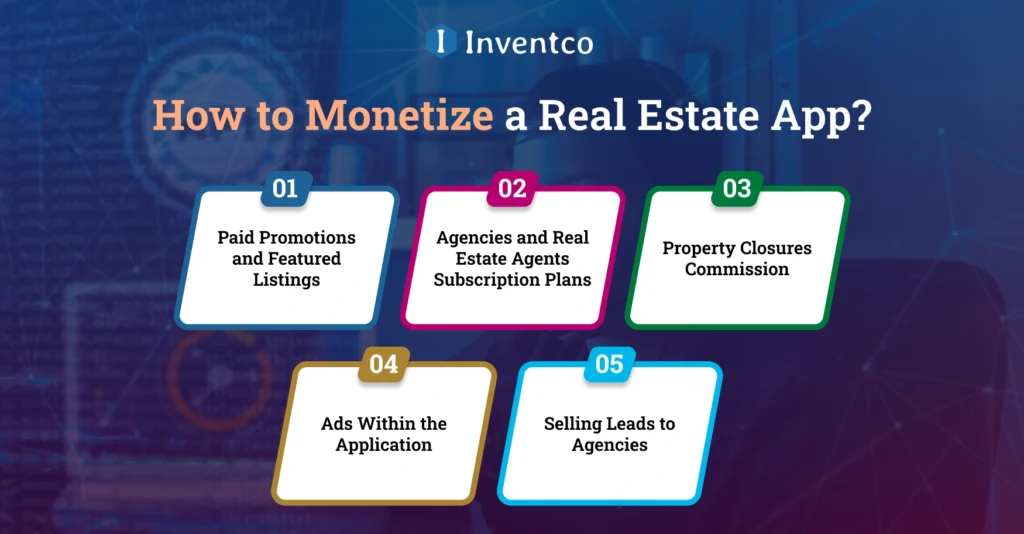
Here are some top mobile app monetization models:
1. Paid Promotions and Featured Listings
Seller, real estate agent, and property developer advertisers can receive greater visibility, sponsorship, and premium placements. Most users that pay to list their property auctions are real estate professionals that are serious about their property.
2. Agencies and Real Estate Agents Subscription Plans
A mobile app strategy to monetize real estate apps that should be considered are subscription plans for real estate agents. These CRM, dashboard, strategy, analytics, and lead synopsis services can be offered by agents as premium subscriptions. In professional users’ services, subscriptions, annual and monthly would provide constant revenue.
3. Property Closures Commission
A minor fee could be charged through the app for a transaction involving a buyer and seller. Users interested in serious leads and verified listings would benefit from this revenue model. It is ideal for marketplace apps.
4. Ads Within the Application
Your platform can provide advertising slots for banks, mortgage companies, insurance agents, interior designers, and professional job marketers. These users are typically property searchers. This particular business module can guarantee a reasonably steady income stream.
5. Selling Leads to Agencies
Selling real and verified leads to real estate companies and agents can help you earn a steady income. With high intent, leads help agencies close deals quicker. Therefore, this income generating strategy can be labeled as one of the most lucrative ones in real estate applications.
Why Inventco is Your Go-To Real Estate App Development Company?
Inventco is the leading mobile app development company trusted by startups, agencies, and global leaders. Inventco is distinguished by in-depth experience in real estate mobile app development and provides scalable, high-performance applications with MLS integration, AI-based search, virtual tours, and sophisticated user access management.
Our mobile app development team includes expert strategists, UI/UX designers, backend engineers, and dedicated real estate app developers who understand the industry inside out. From consultation to deployment and ongoing maintenance, Inventco provides comprehensive real estate apps with a high degree of customisation in the property marketplace.
“This guide is written by Jitendra Jain, a real estate app development expert with hands-on experience building AI-powered, MLS-integrated property platforms for global markets.”

Conclusion
If you are considering having a real estate app built in 2025, you are making a shrewd decision, as it will allow you to grow alongside an expanding real estate market. With a clearly defined approach, advanced functionality, robust safety, and dependable property app development, you can build a transcendent software product that will attract buyers, assist agents, and streamline real estate transaction workflows. Whether you want to develop a real estate app, this guide will help you build with confidence and turn your idea into a successful app that leverages the scalability of the digital market.
FAQs
Q1. How much does it cost to develop a real estate app?
Ans. The cost to develop a real estate app ranges from $20,000 to $250,000+, depending on features, platforms, design complexity, and integrations like MLS/IDX, maps, and virtual tours.
Q2. How long does it take to build a real estate app?
Ans. A basic real estate app takes 3–5 months, while advanced apps with AI recommendations, 3D tours, and CRM features may take 6–10 months.
Q3. Do I need MLS/IDX integration for my real estate app?
Ans. Yes. MLS/IDX integration ensures real-time, accurate listings, which improves user trust and makes your app competitive with major platforms.
Q4. Which features are essential for a real estate app?
Ans. Must-have features include advanced search filters, map view, virtual tours, price insights, agent chat, push notifications, wishlists, and secure login.
Q5. Can I monetize my real estate app?
Ans. Absolutely. Popular models include featured listings, subscriptions, in-app ads, lead selling, and commissions on closed deals.
Q6. What tech stack is best for real estate app development?
Ans. React Native or Flutter for mobile, Node.js or Python for backend, and cloud platforms like AWS or Google Cloud for scalable performance.
Q7. Why should I hire a real estate app development company?
Ans. A specialized team brings industry knowledge, MLS/IDX expertise, secure architecture, and scalable solutions — ensuring your app performs smoothly and stands out.
Q8. Can I build a real estate app for both the USA and Dubai markets?
Ans. Yes! You’ll just follow region-specific regulations such as MLS rules in the U.S. and RERA compliance in Dubai.

Jitendra Jain
He is the CEO and Co-founder of Inventco, driving innovation in advanced computing and digital transformation. With deep expertise in modern IT ecosystems, he leads scalable, secure, future-ready solutions. His strategic leadership helps businesses accelerate growth, adopt innovation, and achieve success. You can connect with him on LinkedIn to follow his technology insights.