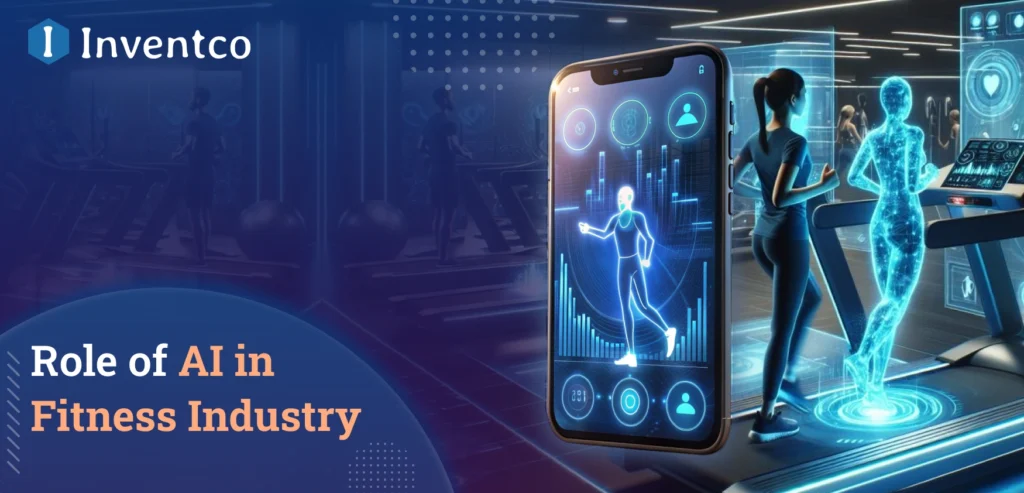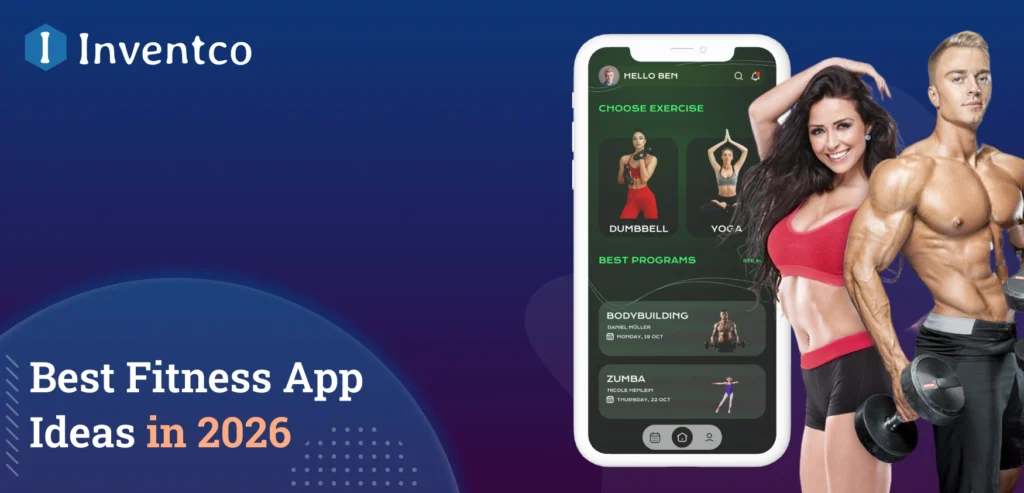
Fitness app ideas have changed as people have become more sedentary, gainfully employed, digital, and health conscious. Increased concerns about weight, stress, and overall health have made mobile tech and fitness apps ideal solutions for building healthier habits. A well-thought-out fitness app business idea today supports wellness and aids in the ever-growing digitization of the health and fitness industry.
Modern fitness apps focus on customer retention by offering a broader range of services. Everything from AI-enhanced, personalised workouts to detailed nutrition plans and whole-person mental wellness apps is now offered to cater to customers’ evolving needs. Fueling innovation are entrepreneurs, small businesses, and corporations who, in addition to meeting demand, are constructing monetizable, digital resources of great value.
As a trusted fitness app development company, we have compiled a list of fitness app ideas with the highest likelihood of success, helping businesses capture the most value in this competitive environment. If you are assessing a new idea or looking to grow an existing business, this guide will show you which ideas to focus on before you begin developing your product.
As we explore fitness app development ideas, we will review key industry data and emerging trends shaping the global market for fitness app development services.
Key Online Fitness Industry Statistics Shaping App Development in 2026
It is crucial to start with the scope, potential growth, and user engagement in the online fitness industry before diving into potential fitness application concepts. Recent market analytics indicate that digital fitness is no longer a passing phenomenon. It is a business and investment opportunity that continues to be realized at an increasing rate.
Below are fitness industry statistics from reputable market research firms pertaining to 2025 and beyond.
- The global fitness app market is projected to reach USD 28.7 billion in 2026, growing at about 14.3 % annually, with sustained demand for personalized health solutions.
- According to the Market Data Forecast, the market could exceed USD 35 billion–USD 75 billion by 2033, depending on growth scenarios and segment definitions.
- Global health & fitness app downloads hit a new high of around 3.6 billion across iOS and Google Play in 2025, showing continued strong consumer engagement.
- In the United States alone, demand for fitness apps is projected to grow from USD 2.6 billion in 2025 to USD 7.9 billion by 2035, at a CAGR of 11.9%, driven by personal health tracking and digital fitness adoption.
Top Fitness App Development Ideas
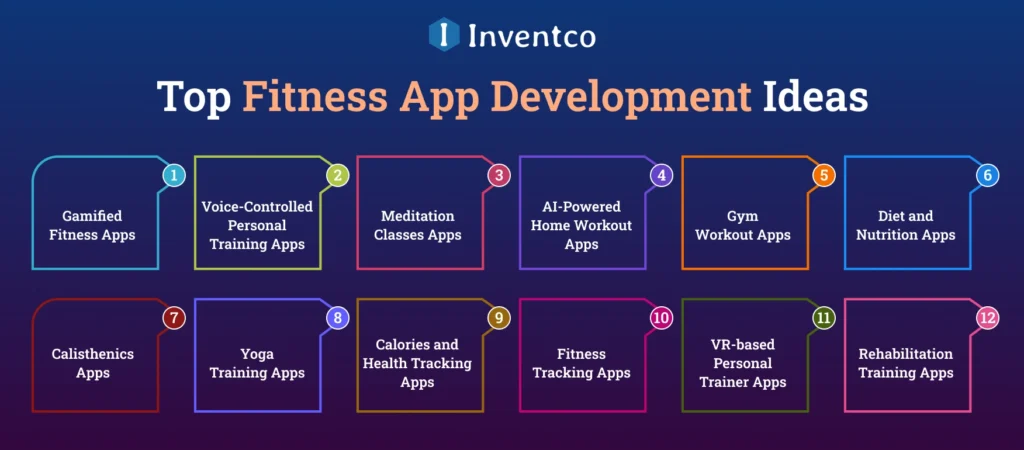
When entering the digital health industry, determining the best path to follow is essential. Rapid technological advances and evolving user demands lead to the most successful health and wellness app designs being centered on user engagement, personalization, and user retention for long-term value. As a startup founder, fitness professional, or enterprise brand, focusing on a fitness app idea will help you differentiate yourself from competitors.
To provide guidance, we present current and promising fitness app concepts aligned with user interests and projected market needs. These ideas can be targeted to the individual fitness enthusiast, the personal trainer, the gym, or the large fitness business.
Here, we discuss fitness app concepts to help you create a fitness app and successfully enter the health and fitness industry.
1. Gamified Fitness Apps
Gamified apps have been proven to be the most effective app ideas within the fitness ecosystem. Gamified fitness apps integrate game mechanics and challenge users to improve consistency, motivation, and a wide range of behavioral outcomes. Ultimately, these fitness apps transform workouts from a monotonous task to a more interactive and enjoyable experience.
Gamification motivates people to strive for their best by emphasising accomplishments and progress rather than repetition. Take, for example, the indoor cycling prescriptive metrics which display real-time performance data on power outputs in watts. This creates an environment that is both competitive and fun, keeping people engaged in their workouts.
Gamification is particularly effective for long-term retention in fitness apps. Users feel empowered and psychologically rewarded to return to the app to improve their personal achievements, beat previous bests, or unlock additional goals. This concept works best for users who tend to get bored very easily, especially with their workout routines, and who prefer to focus more on goals.
2. Voice-Controlled Personal Training Apps
Another option is creating fitness apps that function via voice control. One of the most frustrating aspects users experience with fitness and health apps is being forced to interrupt their flow. When users are forced to stop exercising in order to tap a screen, reset a timer, or manually adjust their work, the system collapses, and when this friction occurs, users are lost forever.
Voice-controlled personal training apps address this challenge by using voice commands to control the app in its entire function. Like smart assistant apps, users have the ability to start and end workouts, switch to the next exercise, change the work intensity, and adjust the volume of the training music, and all without disrupting their workout.
As a viable fitness app business model, voice-enabled training apps offer enhanced user experience and retention through profile customization, voice encouragement, personalized audio cues, and motivation quotes, that help users stay focused and push through challenges making workouts more immersive and repeatable.
3. Meditation Classes Apps
Digital Solutions focused on mental wellness and meditation integrate seamlessly with fitness apps and help providers address heightened stress and promote greater emotional health awareness among users. Stress and emotional health have been prevalent among many users, and meditation apps provide an effective way for them to access an important aspect of Integrated Fitness Solutions.
Apps Offering Meditation Classes help users address anxiety, stress, and emotional fatigue through guided sessions, instructor-led programs and audio calm experiences. These mobile app features give users access to guided meditation whenever and wherever they want and help them foster a daily mindfulness practice.
In recent years, immersive technologies including the metaverse, have led to the emergence of meditation as a uniquely powerful business idea for fitness apps. Many companies are seeking to create metaverse meditations to help users cultivate mindfulness in richly visual, immersive environments like forests, beaches, and mountains. These experiences heighten relaxation, increase focus, and enhance engagement, which is why meditation apps are an excellent business idea for fitness apps.
4. AI-Powered Home Workout Apps
The number of people looking for ways to work out from home, rather than pay for a gym membership or buy expensive equipment, continues to grow. Many home workout apps feature low-impact routines that can be done in smaller workout areas, opening up more space for a wider range of users to become more active.
On the other hand, a persistent drawback of typical home workout applications is the absence of real-time feedback. Poor guidance from apps or programs can lead users to complete exercises in an unstructured or misaligned manner, increasing the likelihood of injury and reducing the intended effectiveness. This absence of feedback is an opportunity for innovation.
The advent of AI-based home workout applications has the opportunity to close these real-time feedback gaps through a combination of computer vision and predictive analytics. These applications can be used to protect users from injury and provide real-time corrections to guide them if the device can analyze the user and their movements to identify suboptimal or unsafe exercise qualities and/or techniques. AI in fitness apps gives an opportunity to enhance user experience, retention, and loyalty beyond industry standards. These applications will ultimately be transformational to the fitness app market.
5. Gym Workout Apps
Apps for working out in the gym have become integrated with the user’s experience helping them with structured programming, tracking performance, and offering personal training plans. These apps keep users focused on their fitness goals with audio coaching, pre-created routines, and progress tracking, all on smartphones as part of everyday life.
With IoT gym workout apps, users can seamlessly sync with their smart wearables and fitness gadgets. Users can monitor and record their real-time metrics, such as heart rate, oxygen levels, body fat, and muscle performance. Gym focused apps as a scalable fitness idea, improve training based on data, and deliver to users and fitness facilities accountability and value.
6. Diet and Nutrition Apps
Whether the objective is muscle building, weight loss, or maintaining a balanced lifestyle, the importance of proper nutrition is evident. With structured programming and data suggestions, diet and nutrition apps offer to track users’ intake and plan meals.
Success in nutrition platforms hinges on personalization. Using machine learning and predictive analytics, these apps offer customized diet plans for users, tailored to individual body types, dietary preferences, and metabolic rates. As a nutrition app with a significant value for a fitness app business idea, personalization can be taken a step further by adding direct support via video consultations, creating the opportunity for professionals to offer personalized support and strengthen relationships with users.
7. Calisthenics Apps
Calisthenics apps specialize in developing strength by utilizing one’s body weight, eliminating the need for bulky and costly gym equipment. Users wishing to stay fit in an economical and flexible manner, calisthenics has become an increasingly popular workout method that can be done anywhere, including home and outdoor locations.
A top-tier calisthenics app can provide users with various tutorial based guides, progressions, and reference material within structured routines, making it an attractive fitness app for users of all levels. It appeals to all levels of expertise, from beginners to advanced athletes, in the pursuit of enhancing their strength, mobility, and endurance.
Calisthenics apps that incorporate advanced technologies such as artificial intelligence and the Internet of Things (IoT) can provide personalized workout regimens, real-time corrections for your workout form, and can interface with smart fitness trackers and wearables. As a calisthenics fitness app, the business model offers virtually unlimited growth potential, requires minimal hardware, and meets the demand for fitness apps that provide minimalist fitness solutions.
8. Yoga Training Apps
Training apps that focus on yoga as a practice yield effective outcomes for their users. Promoting Yoga as a fitness ecosystem provides practicing users both mental and physical gains. A yoga training app can offer guided pose instructions, training videos, pre-planned workout schedules, breathwork exercises, and suggestions for lifestyle and dietary changes. All these features combined, an app can allow users to practice yoga at their own pace while having expert assistance, a feature that makes yoga apps a great sustainable fitness app.
The future of yoga apps will be based on immersive experiences. As metaverse apps are developed, yoga practitioners will have the opportunity to practice in places visually and digitally designed to look like beaches, mountains, and other beautiful natural environments. These experiences will increase the level of immersion and engagement of users, and will allow the users to practice yoga with live instructors. This can create an interactive, responsive yoga community. All of these factors combine to make yoga apps a viable fitness option for 2026 and beyond.
9. Calories and Health Tracking Apps
For many users, tracking calories and health indicators can be complicated, especially for those trying to achieve a fitness objective while managing a hectic daily schedule. Health tracking and calories tracking apps provide users a way to analyze their food consumption, level of physical activity, and general wellbeing in a clear, structured, user-friendly design.
An intelligent calorie management app can automate food logging, estimate calories burned during physical activities, and provide recommendations based on users’ previous behavioural patterns. These apps usually offer integrations with wearables (such as smartwatches) and other mobile devices to monitor health metrics, including heart rate, activity level, and sleep duration.
The most promising fitness app idea for startups and businesses aiming to retain users for the long run is a data-driven fitness app that integrates cutting-edge technologies such as AI and blockchain to personalize and secure users’ sensitive health data. Due to the current trends in consumer behavior, an increasing number of health-conscious individuals are interested in tracking their calories and overall health.
10. Fitness Tracking Apps
Workout tracking problems will always be prevalent in the fitness industry. They’re basically companions that help consumers track their daily activities, manage their workouts, assist with calorie counting, and help consumers reach their brief and long term health goals.
A fitness tracking app helps users track their daily steps, calorie intake, workout, and activity levels. They help users establish and maintain consistent fitness habits by providing reminders, dashboards, and goals.
The fitness-tracking app is a long-term business idea due to its high potential for customer retention. Being part of consumers’ daily activities is why fitness tracking apps have high potential. They are also able to integrate with wearables to offer personalized data that can create a scalable, data-driven program.

11. VR-Based Personal Trainer Apps
There is no doubt that apps with VR will be at the top of the fitness industry for years to come and with good reason. People will always need fitness trainers and by utilizing the advancements in VR, users can access guided workouts led by virtual trainers at any location and any time. This removes the restrictions of time, location, and trainer availability.
Applying virtual reality, users can control what kind of workouts to do, set the difficulties, and choose the lengths of each session, then follow through with the headsets instructions. Even during these workouts, users are guided in real time, told when to do exercises, helped with counting, and praised to help keep them motivated.
Almost all other fitness apps don’t give consumers what they need, focusing instead on a futuristic feel, encouraging, and on-demand personal coaching. With unlimited flexibility, these apps do a great job of encouraging consumers to complete the workouts needed.
12. Rehabilitation Training Apps
Helping people get better after injuries, surgeries, or physical strain is very important. People do not follow through with the daily “homework” or the prescribed tasks from their doctors. When the steps needed to achieve full return to function are left out, the risk of complications, which are usually long term, is greatly increased.
Apps guiding users through the steps needed to do exercises for a specific injury or condition is what meets this need. With these, users can do their rehab routines the right way, and can be helped to stay consistent.
Rehabilitation applications give physical therapists and rehab facilities a way to broaden their services beyond face-to-face appointments. As a niche fitness app design and development idea, these platforms create an opportunity for specialists to craft customized rehab routines and manage patient follow-up remotely, providing additional support and enhancing accessibility and focus during the rehab process.
Conclusion
As we move deeper into 2026, the fitness application market continues to grow, and strong personalization in conjunction with advanced tech is driving this momentum. Ideas for fitness apps have evolved and are now centered around concepts such as artificial intelligence and immersive technologies, and advanced solutions for nutrition and recovery.
In the context of startups and businesses, choosing an appropriate fitness app concept involves understanding real user needs, generating measurable insights, and delivering digitally scalable experiences. Sustainable growth and value can be achieved through fitness apps with emerging technologies and an emphasis on long term user engagement. With the continual rise in global digital fitness solutions, the time is ripe to invest in creative applications that promote a healthier, more active lifestyle.
FAQ’s
Q1. What are the most profitable fitness app ideas in 2026?
Ans. The most profitable fitness app ideas in 2026 include AI-powered home workout apps, fitness tracking apps, diet and nutrition platforms, and gamified fitness solutions. These ideas perform well because they focus on personalization, habit-building, and long-term user engagement.
Q2. How do I choose the right fitness app business idea for my startup?
Ans. Choosing the right fitness app business idea depends on your target audience, app monetization goals, and technical scalability. Successful ideas solve real user problems, leverage emerging technologies such as AI or wearables, and generate recurring revenue through subscriptions or premium features.
Q3. How much does it cost to develop a fitness app in 2026?
Ans. The cost of developing a fitness app in 2026 varies based on features, platform choice, and technology stack. Basic fitness apps may start on a moderate budget, while AI-powered or VR-based fitness applications require a higher investment due to their advanced development complexity.
Q4. Are AI-powered fitness apps worth investing in?
Ans. Yes, AI-powered fitness apps are worth investing in because they offer personalized workouts, real-time feedback, and smarter health insights. These features significantly improve user retention and engagement, making AI-driven fitness app ideas highly scalable and future-proof.
Q5. What features should a successful fitness app include?
Ans. A successful fitness app should include user profiles, workout tracking, progress analytics, wearable integration, personalization, and secure data handling. Advanced features like AI coaching, voice control, and immersive experiences further enhance user satisfaction and long-term adoption.
Q6. Can fitness apps generate recurring revenue for businesses?
Ans. Fitness apps can generate recurring revenue through subscription plans, in-app purchases, premium workout programs, and personalized coaching services. A well-structured fitness app business idea focuses on value-driven monetization rather than one-time payments.
Q7. Why are fitness tracking apps still popular in 2026?
Ans. Fitness tracking apps remain popular because they help users monitor daily activity, set goals, and build healthy habits consistently. Their ability to integrate with wearables and provide actionable insights keeps them relevant in the evolving digital fitness ecosystem.
Q8. How long does it take to develop a fitness app?
Ans. Fitness app development timelines vary depending on complexity, features, and integrations. On average, a standard fitness app may take several months to develop, while AI-powered or immersive fitness apps require longer development cycles for testing and optimization.
Q9. Is it necessary to integrate wearables with fitness apps?
Ans. While not mandatory, wearable integration significantly enhances fitness apps by providing real-time health data and accurate tracking. Wearable connectivity improves user experience, supports personalization, and increases engagement, making it a valuable addition to modern fitness app ideas.
Q10. Why choose Inventco for fitness app development?
Ans. Inventco is considered one of the best mobile app development companies for fitness solutions due to its expertise in building scalable, secure, and user-centric applications. With experience developing apps like FitSmart, Inventco delivers future-ready fitness platforms aligned with 2026 market trends.

Jitendra Jain
He is the CEO and Co-founder of Inventco, driving innovation in advanced computing and digital transformation. With deep expertise in modern IT ecosystems, he leads scalable, secure, future-ready solutions. His strategic leadership helps businesses accelerate growth, adopt innovation, and achieve success. You can connect with him on LinkedIn to follow his technology insights.