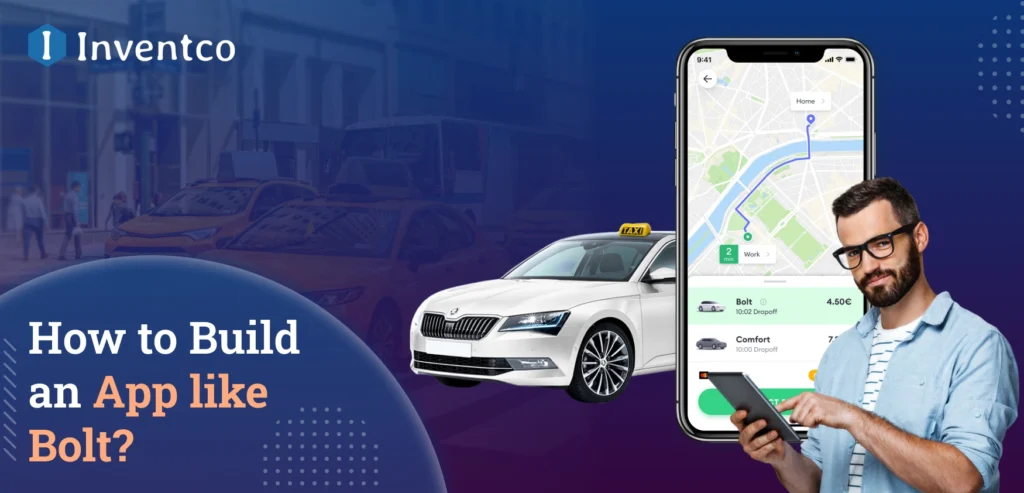
In 2026, we will focus on constructing the smartest ride-sharing app, not the biggest. Today’s founders are searching for innovative solutions that are cost-efficient, rapidly scalable, and capable of capturing local markets quickly. This is the growing interest in designing an app comparable to Bolt.
Bolt is a case study for the industry, as it has shown that ride-sharing is not constrained by a high burn rate. Through low commissions, short wait times, and effective regional strategy, Bolt has succeeded in multiple markets. This is an attractive option for startups and companies looking to develop a ride-sharing application for a specific city, nation, or niche market.
With demand increasing for apps such as Bolt and apps like Bolt for iPhone, other entrepreneurs are starting to ask smarter questions, such as “What is a Bolt application, how does it work, how does it build so efficiently, and what does it take to build an app like Bolt from scratch?”
This guide will walk you through the entire process of taxi booking app development service, from core features and technology to development costs and monetization, so that you can build an app like Bolt that is practical, profitable, and designed for growth.
What Is a Bolt Application? How Does It Work?
A Bolt application is a ridesharing service that allows users to book a ride from drivers who are nearby. While the concept is similar to other mobility services, what makes Bolt unique and stands out from competitors is its simplicity, speed, and cost. This is the reason many startups and founders look to Bolt for inspiration when developing a ride-sharing service that is scalable.
What are some ways the Bolt app works?
From the user’s perspective, it is simplified. A passenger enters the app, enters the pickup point and the destination. They check the estimate of the ride’s cost and confirm the ride. The system, in the blink of an eye, finds the nearest available driver who can accept the request, drive to the passenger, and complete the journey, all in one interface. Payments are made electronically, and then both of them rate the ride to keep the service quality in check.
The app uses GPS tracking, intelligent matching of drivers and riders, dynamic pricing, and payment processing. This simple structure is one of the reasons why many businesses want an app like Bolt.
The most important thing to take from this is that successful apps rely on good booking, precise location, and dependable drivers. This is true whether you are making the Bolt app for Android or Bolt for iPhone.
Note: You can also check out this step-by-step guide to planning a taxi app like Uber.
Bolt App Market Stats
- Bolt serves over 200 million riders globally, spanning ride-hailing, scooter rentals, food delivery, and other mobility services — a strong indicator of its widespread adoption.
- Bolt operates in 50+ countries and 600+ cities across Europe, Africa, Western Asia, Southeast Asia, and Latin America.
- On Android alone, the Bolt taxi app Request a Ride has been downloaded 100M+ times, with millions of reviews reflecting strong user engagement.
- In 2024, Bolt reported revenue of approximately €1.99 billion (~$2B), illustrating a solid financial scale for a mobility platform.
Key Features Required to Build an App Like Bolt
It is possible to build an app like Bolt by adopting a strong, clean, fast, and operationally efficient foundation. Bolt’s success is attributed to getting the basics right without over-engineering the product. Below are the must-have mobile app features in apps like Bolt.
Rider App – Essential Features
- User Registration & Login: Users can create accounts efficiently using their phone number, email address, or social logins, whilst the app provides secure authentication and a fast onboarding process, ensuring minimal friction and a seamless experience, globally and across devices.
- Real-Time Ride Booking: Users can input their pick-up and drop-off locations, view drivers that are in their vicinity, receive fare estimates in real time, and confirm rides to get matched to the nearest available driver in a matter of seconds and without confusion.
- Live GPS Tracking: Users can monitor driver locations and get real-time updates on estimated arrival times and progress of their routes, along with the status of the trip. This feature improves transparency and trust, creating a better experience for passengers globally on every completed ride.
- Multiple Payment Options: Users can choose the payment method that is most accessible and convenient for them from the following options: credit cards, digital wallets, or cash. This feature reflects the various payment preferences across different regions of the world.
- Ride History & Receipts: The app has records for all completed rides, which include date, route, and fare breakdowns for every ride, along with full invoices and receipts. This helps riders track spending and manage travel records in the app. Additionally, the records provide issue resolution and are stored securely and transparently for easy retrieval later.
- Ratings & Reviews: The app incorporates a system for both users (drivers and riders) to review and rate each other, which becomes a mechanism for enforcing accountability and increasing the quality of the service rendered on the platform. This will improve the platform over time through various markets and an expanding geographical reach.
Admin Panel – Core Controls
- User & Driver Management: Admins can control and manage records and profiles of riders and drivers, their documents, statuses, and suspensions, as well as activity logs to ensure safety, compliance, and streamlined operations in a given service area, across regions, cities, and the entire network.
- Commission & Pricing Control: Admins can set company controls and configure commission structures, base fares, and rules for surge pricing, discounting, and pricing by region in order to sustain profitability and competitiveness in a given business area, across cities and zones, during different seasons and demand cycles.
- Ride Monitoring & Analytics: Offers real-time dashboards and analytics to track trips and cancellations, driver behavior, revenue, and key performance indicators, facilitating operational efficiency and enabling data-driven decisions at scale and continuously across a multitude of regions, cities, fleets, markets, and platforms.
- Dispute & Support Management: Allows admin users to process customer support tickets, disputes, refunds, complaints, and incident reports while maintaining fairness in resolution, customer satisfaction, and trust among users, drivers, partners, and the entire ride-sharing ecosystem.
These features are essential for anyone looking to develop a Bolt-like app that is scalable, reliable, and capable of meeting real-world needs.
Advanced Features That Make Bolt Stand Out
Beyond its primary ride-booking offerings, Bolt sets itself apart with smart, innovative, cost-effective, and driver-friendly add-ons. These features highlight why many founders study Bolt when designing scalable ride-sharing solutions that align with the taxi business’s future.
- Smart Pricing & Cost Optimization: In price-sensitive developing regions, Bolt focuses on innovative ride pricing to keep fares as low as possible, while ensuring driver earnings are optimized and cancellations are minimized.
- Low-Commission Driver Model: Bolt has taken the counterintuitive stance that high commission rates lead to driver earnings being retained by Bolt’s competitors and, consequently, driver attrition, platform loyalty, and active driver rates during peak hours increasing.
- AI-Powered Driver Matching: Advanced algorithms match riders with the nearest and most suitable drivers based on distance, availability, traffic conditions, and historical performance, ensuring faster pickups and reduced idle time.
- In-App Navigation & Traffic Intelligence: Lane guidance, as well as instant traffic insights, help drivers select less congested stretches of the route, positively altering the trip’s ETA, while keeping third-party navigation to avoid subcontraction.
- Multi-Service Expansion Capability: Bolt’s core platform does not need to be rebuilt to add revenue streams from scooters, bikes, food delivery, and rentals, expanding resource offerings.
- Safety & Trust Enhancements: Regional safety regulations are met, and the trust of users is built with trip sharing, SOS buttons, trip tracking, and reciprocal rating systems.
Bolt’s real advantage is not in complexity, but rather, its intelligent efficiency at scale.
Step-by-Step Process to Build an App Like Bolt

When developing a ride-sharing platform, there is much more involved than simply copying features. Bolt is a ride-sharing platform, and to build one like it, you will need to develop a business-first, structured app development process that balances speed, cost, and long-term scalability.
Step 1: Market & Regional Research
Start with in-depth research on the target market, specifically demand by city, rider expectations, available drivers by city, and pricing sensitivity. Also, research the competition and don’t forget to review the regulations and licensing requirements for ride-sharing. Which are the most dominant players in each region? Most successful Bolt competitors start by dominating a few regions before global expansion.
Step 2: Define the Business Model
Business models can and should vary. A platform may generate revenue in one of a dozen ways. It is on the business to decide on commission structure, driver pay, boost incentives, cancellation rules, payment types, and driver reward flip. Creating a business model is the Kevin Bacon of the app development process. It is a requirement for a sustainable final product, and profitability starts the moment you build it. There will be an app to sustain Bolt’s balance between affordability for passengers and fair pay for drivers in sustainable, competitive markets.
Step 3: Feature Planning & MVP Scope
Determine what the most important features are for users (riders, drivers, and admins), and outline what a Minimum Viable Product entails. Booking, tracking, payments, and basic analytics should be the main focus. In the beginning, avoid adding any unnecessary features. Bolt’s success is a clear indication that simplicity and operational efficiency are far more important than feature overload, especially when launching and scaling for early-stage growth.
Step 4: UI/UX Design
Clean and simple is best, and therefore the user interface should be designed so that it encourages users to spend as little time as possible on additional, unnecessary actions. Simple and straightforward onboarding, clear ride confirmations, and intuitive navigation are all pivotal. When building a ride-sharing app, as user retention and adoption for drivers and riders are largely determined by the level of user experience, it is important to provide a seamless experience during rides. Bolt is an excellent example of this.
Step 5: Technology & Architecture Selection
Consider your options for a secure and scalable technology stack. Future flexibility for growth should always be a major consideration, including adequate real-time GPS tracking, seamless transaction processing, and payment handling. Ensure your architectural plans cover all three platforms (Android, iOS, and web) so everything is consistent and well-planned. With strong foundations in your technology, the reliability, performance, and future flexibility of your ride-sharing platform will all increase.
Step 6: Development & Integration
To foster a consistent workflow, develop the rider apps, driver apps, and the admin panel concurrently. APIs that enable mapping services, payment processing, push notifications, analytics, and customer support should be integrated. Timed development ensures all parts are coordinated, mitigating post-launch challenges and accelerating time-to-market.
Step 7: Testing & Quality Assurance
Perform methodical, thorough mobile app testing across platforms, devices, and real-world use cases. Validation should focus on app security, performance, GPS pinpointing, payment processing, and load stability. Quality assurance helps ensure stable operations at launch, minimising user complaints and building trust among riders and drivers from day one.
Step 8: Launch, Monitor & Scale
Launch the app in a targeted area and evaluate key performance metrics, including ride completion rates, cancellations, driver availability, and user feedback. Continuous app maintenance is essential to optimize pricing, incentives, and functionality. Once performance is stable, expand methodically into new regions following the proven growth strategy used by successful taxi-booking apps like Bolt.
By following these steps, you can build a reliable, efficient ride-sharing platform that is also poised for growth.
Technology Stack Required to Build an App Like Bolt
Choosing the right technology stack is critical to performance, scalability, and real-time reliability. Below is a concise, industry-standard tech stack for building an app like Bolt aligned with the architecture used by top taxi booking apps and optimized for 2026 scalability, security, and long-term growth.
| Layer | Technology Options | Purpose |
| Rider & Driver App | Flutter / React Native | Cross-platform development for Android and iOS with faster time-to-market |
| Web Admin Panel | React.js / Angular | Manage users, drivers, pricing, analytics, and operations |
| Backend | Node.js / Java / Python | Handles business logic, APIs, and real-time processing |
| Database | PostgreSQL / MongoDB | Stores user data, trips, payments, and logs securely |
| Real-Time Tracking | Google Maps API / Mapbox | Live GPS tracking, routing, and ETA calculation |
| Payments | Stripe / Razorpay / PayPal | Secure in-app payments and transaction handling |
| Notifications | Firebase Cloud Messaging | Push notifications for ride updates and alerts |
| Cloud Infrastructure | AWS / Google Cloud / Azure | Scalable hosting, load balancing, and data security |
| Analytics & Monitoring | Firebase Analytics / Mixpanel | User behavior tracking and performance insights |
Cost to Build a Ride-Sharing App Like Bolt
The cost to build a ride-sharing app like Bolt can vary widely based on features, platforms, and scalability requirements. In 2026, the cost to build a taxi booking app ranges from $10,000 to $100,000+, depending on the level of product complexity.
Estimated Development Cost Breakdown
| App Scope | What’s Included | Estimated Cost (USD) |
| Basic MVP App | Rider app, driver app, basic admin panel, ride booking, GPS tracking, standard payments | $10,000 – $25,000 |
| Mid-Level Ride-Sharing App | Advanced booking flow, real-time analytics, wallets, ratings, notifications, improved UI/UX | $25,000 – $50,000 |
| Advanced / Scalable App | AI matching, dynamic pricing, safety features, multi-service support, cloud optimization | $50,000 – $100,000+ |
Cost by Platform
| Platform | Development Approach | Estimated Cost (USD) |
| Android App | Native Android development | $10,000 – $30,000 |
| iOS App | Native iOS development | $12,000 – $35,000 |
| Cross-Platform App | Flutter / React Native | $15,000 – $40,000 |
What Impacts the Final Cost?
- Feature depth and real-time functionality
- Platform choice (single vs multi-platform)
- Third-party integrations (maps, payments, analytics)
- Scalability, security, and compliance needs
Considering building an app like Bolt and starting with a lean MVP to mitigate risk while allowing budgetary scaling to a potential $ 100,000+ enterprise-grade solution in the future is most prudent.
Note: Planning a fleet solution? Check out this step-by-step guide on how to build fleet management software.
How Apps Like Bolt Make Money?
Bolt-like apps utilize a multi-revenue-stream model so they can maintain low rider pricing while also providing driver incentives in order to stay profitable.
1. Commission per Ride
Bolt-like apps monetize by providing a small commission to their drivers after completing a ride. With this, the company also makes money by keeping the customer fares low in order to financially sustain the drivers.
2. Surge & Dynamic Pricing
Surge pricing is used to balance rider demand and driver supply during peak hours. This incentivizes drivers to drive and increases revenue for the company without permanently raising the fare price.
3. Subscription & Driver Plans
Some companies provide drivers with subscription-based plans that lessen their commission and then, in turn, provide them with “premium” access to rides. This creates a stream of recurring revenue for the company while also improving driver retention and loyalty.
4. Cancellation & Service Fees
Revenue is also created from service abuse or no-show penalties to ensure that the drivers of the system are compensated for their time and to discourage system abuse.
5. In-App Advertising & Partnerships
As an example, ride-sharing apps collaborate with companies to display specific in-app advertisements and promotions, thus capitalizing on user engagement while providing pertinent offers to users while they use the app.
This varied strategy helps explain why many founders creating apps similar to Bolt focus on app monetization from the beginning.
Common Challenges and Solutions While Building an App Like Bolt

There are several types of mobile app challenges (technical, operational, and business) that need to be overcome to build a scalable ride-sharing platform. If founders anticipate these challenges, they can avoid problems when building an app like Bolt.
1. Driver Supply Shortage
Challenge: Active drivers are needed for users to consistently request rides. User satisfaction can be affected by ride availability, creating a negative feedback loop.
Solution: Offer competitive commission rates, performance-based incentives, flexible schedules, and quick payouts to attract, retain, and motivate drivers consistently across regions.
2. Real-Time Matching & Performance
Challenge: If rides are taking too long to be matched, ETAs are incorrect, or there are GPS lag issues, rides will be canceled. This should be avoided at all costs. User experience is heavily affected.
Solution: Utilize optimized algorithms for real-time matching, dependable mapping technology, and performance-driven backend architecture to maintain accuracy in tracking locations and allocating drivers more quickly.
3. Pricing & Cost Control
Challenge: Identify pricing that results in profitability for the platform, drivers, and riders. Pricing is a complex facet.
Solution: To avoid user dissatisfaction, implement intelligent, dynamic (without the user feeling the change), and responsive pricing that considers demand, distance, and traffic. Doing this will avoid pricing shocks.
4. Scalability & System Stability
Challenge: As an app grows and sees more user traffic, it may become unstable (crashes, downtime, lag) and experience performance issues.
Solution: Implement modular design approaches and utilize load balancing to help build a scalable cloud infrastructure to maintain high performance and reliability.
5. Regulatory & Compliance Management
Challenge: Different cities and countries enforce different regulations for ride-sharing and create legal and operational risks.
Solution: Front-load the local transport law research and build adaptable systems that embed regional rules for compliance, documentation, taxation, and safety.
Case Study: Taxi Booking App Built by Inventco
Inventco offered a full-scale ride-sharing solution for the Nordic market, inspired by the Bolt model. The product emphasizes reliability, affordability, and scalability on a city level – all essential for founders to consider a development partner as a leading mobile app development company.
Business Objective
The client’s goal was to achieve the development of a cost-effective, dependable, and fast taxi booking app to the Bolt standard for Iceland. The app needed to enable speed of booking, provide fair pricing transparency, and assure optimal driver coverage.
Solution Delivered
Inventco developed rider and driver applications that include: real-time GPS tracking, fast ride matching, secure digital payment, and an admin dashboard. The architecture was tailored for optimal performance and compliance at low latency, in all weather and traffic conditions.
Results Achieved
- The company has successfully launched the application in the region and has demonstrated stable performance.
- Improvements have been made in ride matching speed and pickup accuracy.
- Because of the inclusive onboarding process, drivers have adopted the system at a high rate.
- A solid foundation has been created for probable future developments.

Conclusion
The construction of a ride-sharing platform in 2026 is measured by its efficiency and scalability, as well as its dominance in a particular region. It is not about copying the global giants. Bolt’s growth is a testament to the fact that smart pricing, a lean operating model, and a guide for smooth operations lead to success.
If you are looking to build a platform with the same features as Bolt, you must first define an MVP, assess demand for that service in your target market, and then scale vertically using the appropriate technology. Every feature, capability, monetization strategy, and cost management of the platform must attain the same objectives: affordability and reliability.
To get a competitive advantage in the ride-sharing industry, you must partner with a top mobile application company to create a fully robust and flexible design.
FAQ’s
Q1. How long does it take to build an app like Bolt?
Ans. Building an app like Bolt usually takes three to six months, depending on feature complexity, platform choice, development approach, testing cycles, and regulatory requirements in the target region and operating market.
Q2. What is the minimum cost to create a taxi booking app like Bolt?
Ans. The minimum cost to create a taxi booking app like Bolt typically starts around ten thousand dollars for an MVP, covering essential rider, driver, and admin features with basic real-time tracking and payments.
Q3. Can I build an app like Bolt for both Android and iOS?
Ans. Yes, you can build an app like Bolt for Android and iOS using cross-platform frameworks, which reduce development time and cost while maintaining consistent performance and user experience across both platforms.
Q4. What features are essential in apps like Bolt?
Ans. Essential features include user registration, real-time ride booking, GPS tracking, digital payments, ratings, driver onboarding, earnings dashboard, and an admin panel to manage pricing, users, analytics, and operations efficiently.
Q5. How do apps like Bolt make money?
Ans. Apps like Bolt make money through ride commissions, dynamic pricing during peak demand, driver subscriptions, cancellation fees, and strategic partnerships, creating diversified revenue streams while keeping rides affordable.
Q6. Is it possible to scale a taxi booking app region by region?
Ans. Yes, most successful taxi booking platforms scale region by region, allowing operators to refine pricing, operations, compliance, and user experience before expanding sustainably into new cities or countries.

Jitendra Jain
He is the CEO and Co-founder of Inventco, driving innovation in advanced computing and digital transformation. With deep expertise in modern IT ecosystems, he leads scalable, secure, future-ready solutions. His strategic leadership helps businesses accelerate growth, adopt innovation, and achieve success. You can connect with him on LinkedIn to follow his technology insights.