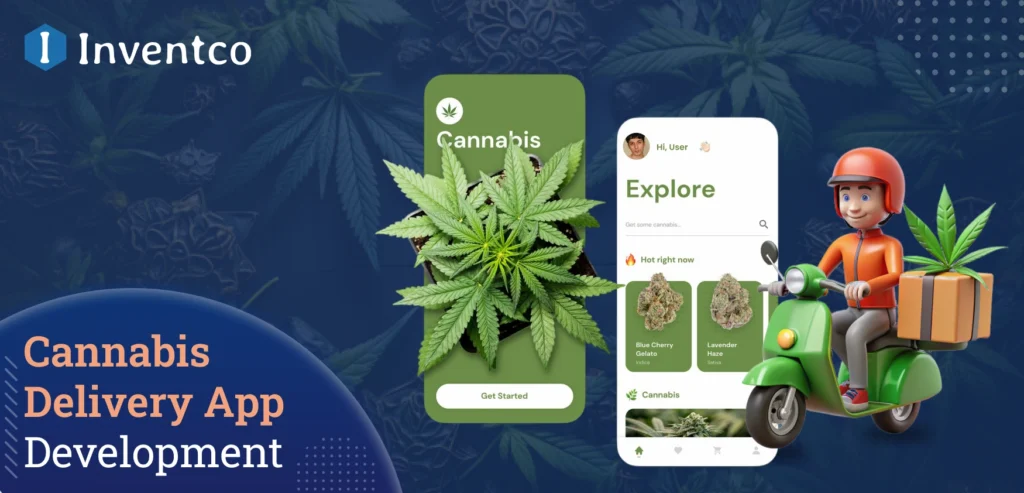
The global cannabis industry has begun moving away from being solely a regulated niche and is beginning to move towards a digital market that has a lot of potential for growth. This shift is influenced by the increase of regulations that allow for the use of cannabis and also the changes in how consumers want to buy cannabis and how they want the cannabis purchased to be delivered. A shift has been observed towards delivery services that allow customers to track their orders.
For founders and investors, the potential for developing cannabis delivery apps is noteworthy as it is scalable and a viable opportunity for the future. Trust can easily be built by legally meeting requirements because modern platforms allow for the integration of things such as tracking, identity verification, and real-time compliance to regulations. The provision of delivery services is also regulated to promote future growth and retention of customers.
This is a guide that will help in the delivery of business-oriented mobile cannabis delivery apps. It includes the app’s essential features, a breakdown of the development process, and a look at the regulations that are to be considered. It includes the regulations, estimates for costs associated with the app, and the strategies to be used in monetizing the app. This will ensure that you have the information you need to make the right decision, whether you are trying to test a concept, or you are trying to complete an acquisition.
Key Takeaways
- Legalization and changing customer behavior are strong catalysts for the development of delivery apps in the cannabis industry.
- The first step of creating cannabis delivery apps is the legal compliance process, which includes age verification, geo-fencing, and licensing.
- Integration of all regular and added important features is a must in order to drive success in the app development space. These features may include, but are not limited to, the following: tracking, payments, dashboards, and AI for recommendations and analytics.
- A structured mobile app development process, from market research to MVP and post-launch maintenance, is critical for reducing risks and ensuring product-market fit.
- Monetization strategies such as commissions, subscriptions, and premium features help generate sustainable revenue while supporting platform growth and user engagement.
- The general cost of app development is in the range of $10,000 to $100,000, and an ever-growing additional cost is maintaining compliance with app security and performance.
- Development challenges in cannabis-app delivery include the regulation of payment security, management of delivery logistics, and the restrictions of the development platform. All of these challenges can be solved through sound development planning and the right development partner.
- Partnering with an experienced cannabis delivery app development company ensures scalable architecture, regulatory alignment, and long-term success in a competitive and highly regulated market.
Why Businesses Are Investing in Cannabis Delivery Platforms?
The global cannabis industry is experiencing strong growth driven by legalization, digital adoption, and consumer convenience.
- According to Grand View Research, the global legal marijuana market was valued at $21 billion in 2023 and is projected to reach over $102 billion by 2030, growing at a CAGR of more than 25%.
- The global legal cannabis market is expected to reach $100+ billion by the early 2030s, driven by medical and recreational demand.
- For instance, the U.S. cannabis market alone is expected to reach over $76 billion by 2030, supported by regulatory shifts and increasing consumer adoption.
- Mobile commerce growth and on-demand services are driving demand for cannabis delivery mobile app development, as consumers prefer convenient, secure, and transparent ordering experiences.
What Is a Cannabis Delivery App?
Cannabis delivery apps are digital solutions designed to facilitate business for licensed dispensaries in terms of online sales and delivery of cannabis to validated and verified customers while staying compliant and secure. These apps allow customers to view product catalogs, verify their age and identity, place an order, track their delivery status, and make payments. All of the above, while remaining compliant with the laws of the region.
Cannabis delivery app development simplifies business processes of dispensaries by optimizing on-demand logistics, eCommerce, and compliance workflows. Depending on the business model, the app can operate as a marketplace for multiple cannabis vendors, or a single brand can offer integrated delivery services.
Legal & Compliance Considerations
As one of the most highly regulated industries, the cannabis industry makes compliance a necessity for operational continuity, investor confidence, and a clear path for scalability for the cannabis delivery app development process.
1. Age and Identity Verification
Trust from regulators and customers can be built by implementing age and identity verification systems to limit access to eligible users and decrease legal risks.
2. Geo-Restricted Delivery Zones
Location-based restrictions and geo-fencing allow for the compliance of cannabis delivery operations, making it legally possible to deliver cannabis to customers.
3. Local and Federal Licensing Requirements
Legal partners and delivery services must be compliant to the law within their jurisdiction, and compliance of the backend systems to the local regulations can be validated and adjusted.
4. Tax and Reporting Obligations
Risk of non-compliance is placed upon the business by the automated tax calculation and reporting systems with transparency to the cannabis-specific regulations.
5. Data Protection and Privacy Laws
With encryption and combined storage, strong data security practices can be developed for privacy security compliance to protect citizens.
From the start of the mobile app development process, compliance must be an integral part of it to win the trust of both end customers and the authorities.
Key Features of a Scalable Cannabis Delivery App
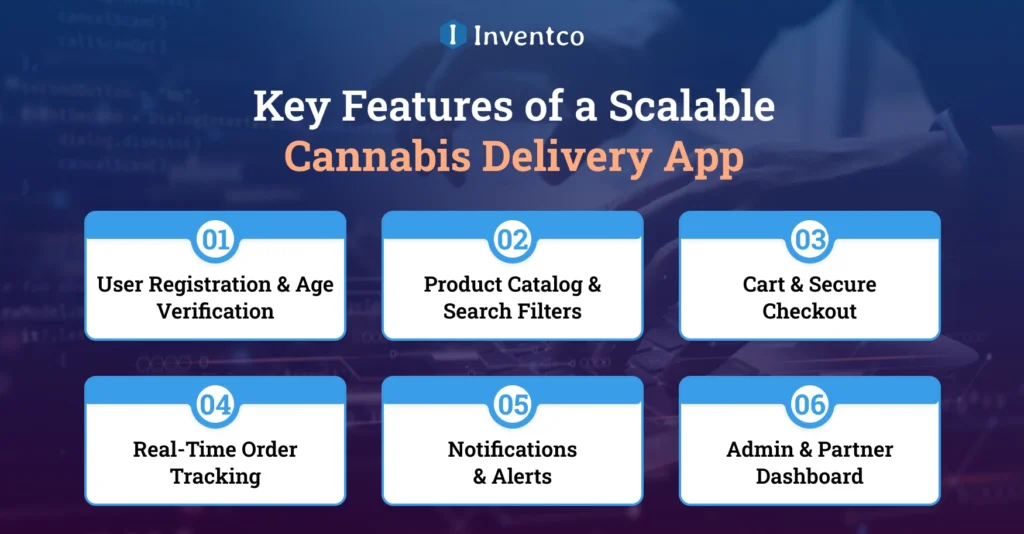
A delivery app for cannabis needs to integrate versatility in its design. It needs to be usable for the end user as well as the dispensary, comply with regulations, and be operationally efficient. To achieve overall versatility, the cannabis delivery app needs to include the following mobile app features:
1. User Registration & Age Verification
User mobile app onboarding must include a multi-part age and identity verification process. This ensures that your app remains compliant with cannabis-related regulations and builds confidence in both users and regulators.
2. Product Catalog & Search Filters
Users should have the ability to filter products by categories, potency, price, as well as other criteria. Use of filters should be intuitive. This will make the product selection process more efficient.
3. Cart & Secure Checkout
Secure checkouts and payment gateways are two critical components of your app that will help reduce the number of customers who abandon carts due to a less than seamless purchasing experience. Remember to remain compliant with all financial regulations.
4. Real-Time Order Tracking
Users will have a better overall experience if they have the ability to track their orders. This also helps to reduce the amount of support queries you will receive regarding the status of an order while improving operational efficiency.
5. Notifications & Alerts
Push alerts help businesses remain in communication with the user. Alerts can be sent to notify users of order status changes, to notify users of promotions, to remind users to make purchasing decisions, etc. This also helps keep users engaged with the app and promotes increased use of the app.
6. Admin & Partner Dashboard
Build a central system with a dashboard for administrators and dispensaries to optimize inventory, order tracking, performance analytics, and operational streamlining for informed decisions and scalable solutions.
Advanced Functionalities
To differentiate yourself in a saturated cannabis delivery app market, advanced features are crucial to ease the user journey, optimize performance, and enable sustainable growth.
1. AI-Based Product Recommendations
Use AI to drive personalized recommendations to users, improve user engagement, and convert users to buyers by analyzing behavior, patterns, and individual purchase history.
2. Geo-Fencing & Route Optimization
Use geo-fencing and smart route management for location based cannabis delivery compliance, effective management of delivery regions, reduced delivery times, and lowered operational costs.
3. Inventory & POS Integration
Streamlining operational effectiveness through fulfillment order processes, combined with real-time stock level control to actualize overselling, is a seamless and direct result of dispensary inventory and POS systems.
4. Loyalty Programs & Subscriptions
Long-term customer relations and brand loyalty can be achieved with the repeat purchase rewards system, and client retention, along with future revenue predictions through the introduction of loyalty systems, rewards, and subs, which can also promote repeat purchases.
5. Advanced Analytics & Reporting
Mobile application advanced analytics can be used to record user behavior, sales, and operational analytics which will assist in data-driven decision-making that aids in optimizing mobile app-based marketing and increasing operational efficiency and scalable growth in the business.
6. Enhanced Mobile App Security
Increase mobile application security through enhancement of security measures including data encryption, secure authentication, fraud detection, and other methods that may protect sensitive user data, and ensure their compliance.
Step-by-Step Development Process of Cannabis Delivery App
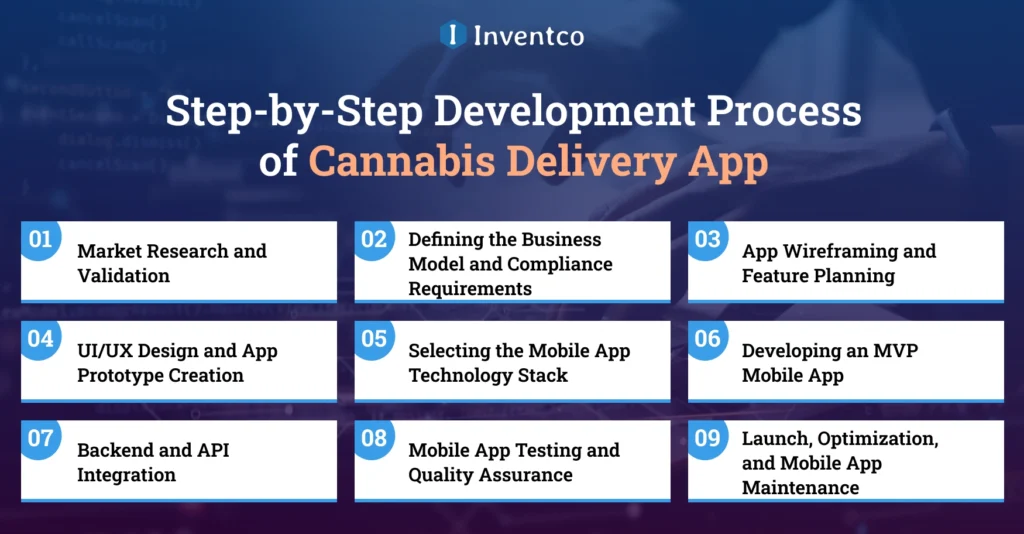
Building your app in a compliant and scalable way, and in order to streamline processes, adopting a structured and insight-driven approach to building your app is essential. A defined and structured mobile app development process reduces compliance and regulatory risks and supports growing your mobile app.
1. Market Research and Validation
Market research serves as a template to understand cannabis regulation, consumer behavior and competitors in your specific market. Validating data surrounding demand, pricing, and delivery framework is essential to building your business. Market research is fundamental to defining the structure and scope of your Cannabis delivery app. Research is a great way to illustrate a solid rationale for your business to your potential investors, i.e., data-driven demand.
2. Defining the Business Model and Compliance Requirements
Business models are generally defined as either marketplace-based or single-brand delivery models. Each is unique and requires separate compliance and legal documentation. Each of the aforementioned models, in addition to mobile app development, requires licensing, age, geographic, and taxation limitations. Closing these gaps regulatory-wise ensures that your cannabis delivery business is legally compliant and operational without limitations. A compliance focused position is the essence of circular endorsement and sustainable development.
3. App Wireframing and Feature Planning
Start by app detailing wireframes to illustrate user journeys and screen layouts and primary functionalities. Center this phase on determining pivotal features keeping in mind business goals like how users will browse products, complete a purchase, or check their orders. With solid groundwork, developers and stakeholders will have a clear vision and less chance for revisions. An initial solid app wireframe eases and quickens the user experience modification process. It helps to set the design limits and balancing act to achieve users and functional operational platform goals.
4. UI/UX Design and App Prototype Creation
Craft a strong design cycle for the app. The app should have a clear and straight to the point design and should be user friendly. The design should be trustworthy. Design an app prototype in a flow that provides users with a good, interactive experience when using the app. The prototype will provide users with a good, interactive experience when using the app. A strong UI/UX strategy enhances engagement, reduces friction, and improves conversion rates. It also ensures that compliance elements like age verification are seamlessly integrated without disrupting user experience. High-quality design plays a critical role in differentiating your cannabis delivery app in a competitive market.
5. Selecting the Mobile App Technology Stack
Choose the right mobile app technology stack based on scalability, security, and performance requirements. Decide between native or cross-platform app development frameworks, and select backend technologies that support real-time operations and integrations. The right stack ensures faster development, easier maintenance, and long-term flexibility. It also plays a crucial role in handling sensitive data securely and supporting compliance-driven features, making it a foundational decision for your app’s success.
6. Developing an MVP Mobile App
Determine the Minimum Viable Product (MVP) to consist of essential features for the first initial purpose of testing the idea in a practical environment. This allows for a greater understanding of user behavior, operational problems, and necessary updates, all without a significant investment. It also provides the opportunity for incremental updates, and posits the final version of the product to address the market’s expectations and users’ requirements.
7. Backend and API Integration
Construct an API and backend system to integrate payments, geolocation, inventory, and compliance. A robust backend is essential for uninterrupted data flow, system reliability, and real-time data integration. With smart integration APIs, systems communicate with external services, improving system functionality and operational efficiency. For operational efficiency, vertical scalability, and the ability to service complex delivery workflows, the cannabis delivery platform needs this integration.
8. Mobile App Testing and Quality Assurance
Mobile application functionality, performance, security, and compliance app testing must be done to a very high standard. Test the system using both manual and automated methods. Test compliance and security across various devices and operating systems to identify bugs and vulnerabilities. Quality assurance provides confidence to an application that will be used by the public and will be trusted by the legal system to meet compliance. Perfect testing captures the minimum necessary to enhance delivery experience.
9. Launch, Optimization, and Mobile App Maintenance
Launch the app with a strategic rollout plan, followed by continuous monitoring and optimization. Analyze user behavior, performance metrics, and feedback to improve features and user experience. Ongoing mobile app maintenance includes updates, app security enhancements, and compliance adjustments. This ensures your platform remains competitive, secure, and aligned with evolving regulations, supporting long-term scalability and sustained business growth.
This methodical development approach minimizes operational risks, facilitates regulatory compliance, and establishes a scalable base upon which to develop a successful cannabis delivery platform.
Monetization Models & Revenue Streams
Mobile app monetization strategies are one of the core pillars that contribute to profitability in a cannabis delivery business. Target audience, business operations, and growth vision over time are the most critical elements that will define your revenue model.
1. Commission on Orders
Commencing revenue generation with order commission model, operationally revenue from orders processed through the platform accelerates and scales with each transaction, thus, streamlining function and revenue with platform activity, and sales performance of partner.
2. Subscription Fees for Dispensaries
Another predictable and therefore, reliable source of revenue is the subscription model for dispensaries. They will be charged a subscription fee for listing their products on your portal and for access to analytics and tools on your portal.
3. Delivery and Service Fees
Delivery & service charges on each order will enable you to cover your logistics costs, therefore, increasing your profitability and also, the cost structure will be clear and understandable to the customer.
4. Sponsored Listings and Promotions
The dispensaries will wish to promote their products and as the owner of the cannabis delivery portal, you can charge dispensaries for this service. They will benefit by having increased sales as a result of this, and you will benefit by having additional revenue from the advertising side.
5. Premium Features for Users
User experience is enhanced with the addition of convenience, and also, with the addition of a premium charge. The premium features can include faster delivery, access to deals, and subscription bonuses, all of which will be additional revenue sources.
When choosing a monetization strategy it is important to consider market position, customer trends, and the scalability of the strategy in the long term. This also relates to sustainable growth for value, customer satisfaction, and business partners.
Cost to Develop a Cannabis Delivery App
Factors affecting the cost of cannabis delivery apps are complexity of features, choice of platforms, regulations, and future scalability. Budgets help streamline the development process as cannabis delivery apps are built focusing on the long-term goals of a client.
1. Basic App: $10,000 – $30,000
Basic delivery apps, suited for startups, are built to test the market and validate ideas. Such an app consists of basic features like user registrations, product catalogs, check out, and order tracking. They usually lack a simple UI and backend enough to be built for a single platform to help keep the development costs low.
2. Mid-Level App: $30,000 – $70,000
A mid-level app includes advanced features like real-time tracking, secure payment integration, and multi-platform support for Android and iOS. It also involves third-party integrations, improved UI/UX, and better scalability, making it suitable for businesses aiming to expand operations and enhance user experience.
3. Advanced App: $70,000 – $100,000+
An advanced cannabis delivery app offers custom features, scalable architecture, AI-based functionalities, and enhanced security systems. It is designed for large-scale operations, supporting high user traffic, complex workflows, and data-driven insights, making it ideal for enterprises targeting long-term growth and market leadership.
4. Ongoing Maintenance Cost
Ongoing mobile app maintenance costs generally stay within 15 – 20% of the total development costs annually. This includes updating, optimizing, securing, and adjusting the app for compliance. We also add features to keep the app competitive, secure, and aligned to the evolving market and regulatory demands.
Challenges in Cannabis Delivery App Development & How to Overcome Them
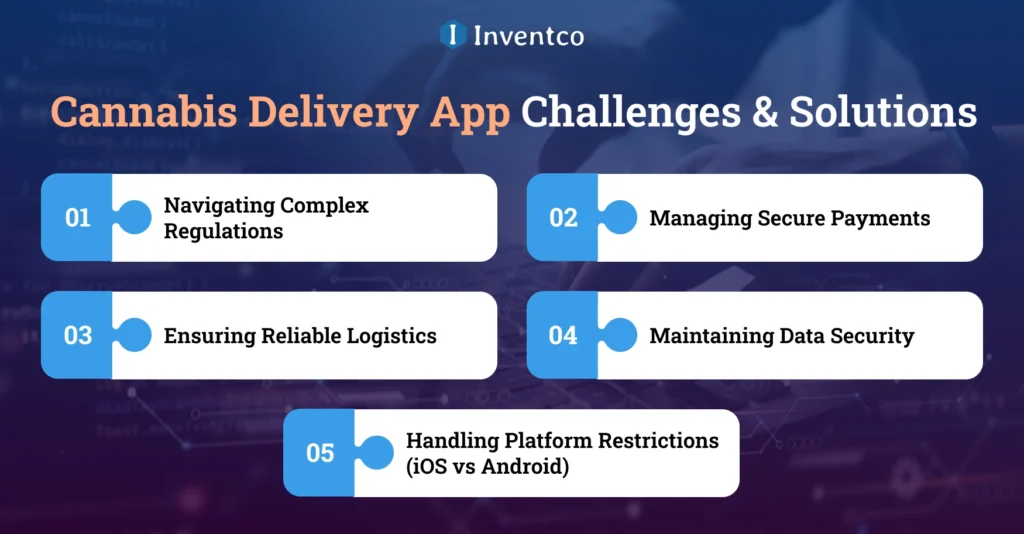
The increase in cannabis delivery services has encouraged more app development. However, the delivery of cannabis in an app has many challenges with legal statutes, regulations, and tracking deliveries. These challenges can be mitigated in different ways, as stated in the subsequent challenges and ways to overcome them.
1. Navigating Complex Regulations
The delivery of cannabis is legal on a state level and is legal in Canada. However, each state has different legal statutes and regulations regarding the delivery and sale of cannabis. These legal differences can make the development of a cannabis delivery app complicated. To overcome these issues, app developers must study the legal statutes and regulations of the state they are working with. This is very complicated to be done with just an app development team. However, with law consultants and app developers, they can be more compliant with legal regulations.
2. Managing Secure Payments
The cannabis industry has very limited forms of legal payment methods. Cash is the most secure and legal payment method because of the risk of the payment method becoming illegal and the payment constituted to be a payment for a cannabis product. By working with payment method consultants, the app can comply by being legal and secure for payment methods in a discreet manner.
3. Ensuring Reliable Logistics
The development of the cannabis delivery app must ensure that the deliveries are secure and reliable. With the development of the delivery app, the delivery issues can be reduced by improving the delivery and routing system, improving the operational coordination of the team, and using a real-time tracking system for the teams and dispatched team members.
4. Maintaining Data Security
With the potential breach of the app, consumer data, including payment information, must be kept secure and the app must comply with the legal statutes regarding data protection. By working with the data protection legal consultants, the app can comply with being secure, and can develop the proper mechanisms to comply. Regular audits are necessary to maintain the proper security measures.
5. Handling Platform Restrictions (iOS vs Android)
Each platform has distinct policies regarding cannabis-related applications, particularly concerning iOS. Businesses must creatively implement features that remain consistent across all platforms. Understanding policies and executing cross-platform approaches can mitigate rejections and facilitate easier implementations.
These obstacles can be addressed through comprehensive planning, ongoing regulation monitoring, and collaborating with cannabis delivery app developers who possess both technical and regulatory compliance knowledge.
Top Cannabis Delivery Apps
Leading companies in the cannabis sector show how compliance, user experience, and scalable technology can work in tandem to show growth and build trust.
1. Leafly
Leafly is a widely recognized cannabis platform that helps users discover products, read reviews, and connect with local dispensaries. Its strong content ecosystem and user-friendly interface make it a trusted choice for both beginners and experienced users.
2. Weedmaps
Weedmaps operates as a marketplace connecting users with dispensaries and delivery services. It offers real-time menus, deals, and compliance-focused features, making it one of the most established platforms in the cannabis delivery space.
3. Eaze
Eaze promotes fast and reliable cannabis delivery services, and has a user-friendly online platform. They are considered one of the best in the business for on-demand cannabis delivery.
4. Dutchie
Dutchie provides compliant, user-friendly technology to retailers, and helps them to integrate online ordering and delivery functionality.
5. Muncheez
Muncheez cannabis delivery app is on-demand and available on both iOS and Android. They also help users with easy ordering and delivery of cannabis products from local stores.
The platforms work to help the founders gain insight into the trends relating to application development, user satisfaction, and providing unique solutions to opportunities to build differentiated cannabis delivery solutions.
Why Choose Inventco for Cannabis Delivery App Development?
Selecting Cannabis Delivery App Development Services is very important for creating a reliable and customizable platform. Inventco has proven with Confidence Delivery Services and other similar company-focused and regulations-bound delivery services how Inventco’s Compliance First method, alongside other User-Centred methods, exceeds Customers’ expectations and satisfies Regulations. Inventco helps with Customer Communication Strategy and User-Centered method in a User-Centered Business Model.
Inventco provides full-service mobile app development for cannabis. Inventco’s Development Team provides custom delivery app development alongside performance based engineered development and develops secure systems. Inventco provides the proper tech and the quality delivery systems needed to help your business grow to meet the Customers’ needs.
Our experience is shown by our delivery management solution for merchants, drivers, and customers called ZONE Delivery App. ZONE demonstrates our capability to create scalable logistics ecosystems through features such as real-time tracking, optimization of delivery routes, order management, and third party integration. The app’s multi-role architecture, sophisticated dashboards, and API integrations, prove our ability to create and deliver high-complexity and high-performance delivery solutions.
At Inventco, we build technology solutions that are compliant, scalable, and will support your business’s growth for the long-term. We build our clients’ confidence, understanding, and clarity, and provide them with the ability to move from idea to execution.
Conclusion
The evolution of cannabis delivery has opened a rapidly expanding digital vertical due to changing consumer behavior, budding legal markets, and growing consumer demand for convenience. Companies that take a compliance-first approach and invest in flexible, scalable technology to capture emerging opportunities in the cannabis delivery space will enhance user trust and compete in a value-added manner in the evolving ecosystem for years to come.
The cannabis delivery ecosystem will also demand more than a mobile app for customers to place orders. Integrated, flexible technology for business-to-business (B2B) and business-to-consumer (B2C) processes that is compliant and facilitates secure transactions is vital for ensuring a consistent experience to customers across technology-enabled delivery solutions and customer service processes.
For founders and investors, now is the optimum time to consider developments in cannabis delivery technology in order to secure a more sustainable trajectory to value and growth, future-proof business models, and ease customer access in the delivery space in compliance with legal frameworks.
FAQs
Q1. How long does it take to develop a cannabis delivery app?
Ans. Developing a cannabis delivery app typically takes 3 to 6 months, depending on features, compliance requirements, integrations, and complexity. Advanced platforms with custom features and scalability may require longer timelines for proper development and testing.
Q2. Can I launch my cannabis delivery app on both Android and iOS?
Ans. Yes, you can launch your cannabis delivery app on both Android and iOS using cross-platform or native development approaches. This ensures wider audience reach, better engagement, and improved scalability across different user segments and devices.
Q3. Is compliance mandatory for cannabis delivery app development?
Ans. Yes, compliance is mandatory in cannabis delivery app development due to strict regional regulations. Businesses must implement age verification, licensing validation, geo-restrictions, and secure transactions to ensure legal operations and build long-term trust with users and authorities.
Q4. How can I reduce the cost of cannabis delivery mobile app development?
Ans. You can reduce development costs by starting with an MVP, focusing on essential features, and scaling gradually. Choosing the right development partner, using efficient frameworks, and avoiding unnecessary complexity also helps optimize your overall budget effectively.
Q5. Do I need ongoing support after launching the cannabis delivery app?
Ans. Yes, ongoing support is essential after launch to ensure performance, security, and scalability. Regular updates, bug fixes, compliance adjustments, and feature enhancements help maintain user experience, adapt to market changes, and support long-term business growth.
Q6. What monetization strategies work best for cannabis delivery apps?
Ans. Common monetization strategies include commission on orders, subscription plans for dispensaries, delivery fees, and featured listings. Selecting the right revenue model depends on your target audience, market dynamics, and long-term business growth strategy.

Ajay Bhal
He is an on-demand app solutions expert with 11+ years of experience in business consulting and building scalable, user-centric digital products. He specializes in robust on-demand platforms across industries, combining technical expertise with business-focused strategy to deliver efficient, top notch solutions that drive growth and enhance user experience. You can connect with him on LinkedIn to follow insights.