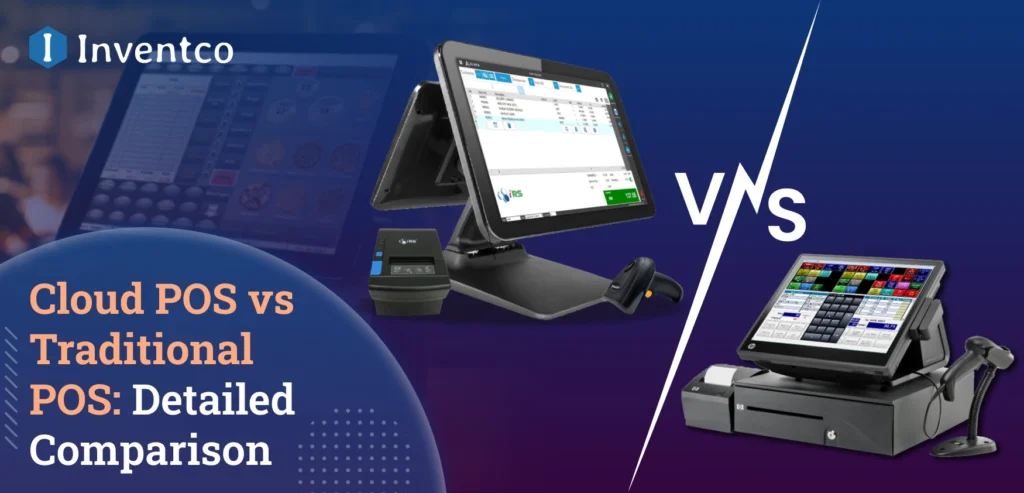
The requirements of a scalable, compliant, and data-driven commerce platform have never been more evident as businesses across retail, hospitality, and enterprise services reassess their point-of-sale infrastructure. Just as financial institutions have begun replacing legacy systems with intelligent platforms, founders and investors are now comparing cloud POS and traditional POS based on growth, compliance, and operational efficiency.
This is not just about adopting new technology. The analysis centres on requirements for rapid and comprehensive understanding of market shifts, the ability to manage remotely, integration without friction, and inversely the risk to the infrastructure. Given the regulatory changes, the customer’s perspective, and the technological landscape, the choice between cloud-based POS systems and traditional POS terminals has not been a paradox, it has been a strategic decision.
The global cloud Point of Sale (POS) market was valued at around USD 7.73 billion in 2025 and is projected to grow to about 45.20 billion by 2033, expanding at a CAGR of ~24.7% over that period. This guide will help you identify the features, advantages and disadvantages of traditional and cloud-based POS systems, the costs, the use cases, and the criteria for decision making regarding the implementation of a POS system with a positive, sustainable ROI.
What is a Traditional (Legacy) and Cloud POS System?
To evaluate cloud POS vs. legacy POS systems, it is important to understand the foundational differences between them. This is helpful for assessing long-term scalability and operational efficiency.
What Is a Traditional (Legacy) POS System?
A legacy POS system is the most basic type and is probably the most commonly used. It will consist of physical dowel rods, paper, and, more recently, a computer system. This POS system must be built with additional hardware, manually updated, and supported by its own on-site IT team. For the most part, these POS software systems are solid and built to last. But they don’t tend to excel at expansions or major growth, and often keep a company stagnant because these systems aren’t designed to scale. These systems tend to be the most expensive.
What Is a Cloud POS System?
A cloud POS is a system that allows businesses to manage and eliminate overhead related to purchasing, tracking, and storing physical components of their systems. These systems will allow businesses to access browsers on their web-enabled devices, providing them with a real-time view of their operations. This system will allow businesses to manage their overhead more effectively, eliminate additional charges for physical components, and make it easier to distribute cloud materials, thereby providing better service to their customers.
Choosing a cloud POS system leaves founders and investors with the most mobile, advanced and effective systems available while providing the company with the most optimal cash flow management, predictive growth and profitability.
Cloud POS vs Traditional POS: Key Differences at a Glance
Although cloud POS and traditional POS differ structurally, these differences help founders and investors assess parameters such as scalability, cost efficiency, and operational control before embarking on POS software development.
| Aspect | Cloud POS | Traditional POS |
| Deployment Model | Cloud-hosted and internet-based | On-premise installation |
| Data Access | Real-time access from anywhere | Local-only access |
| Scalability | Highly scalable for multi-location growth | Limited and complex |
| Maintenance | Vendor-managed with automated support | In-house IT management |
| Upfront Cost | Lower initial investment | High upfront hardware and licensing cost |
| System Updates | Automatic feature and security updates | Manual updates required |
| Multi-Location Support | Native centralized management | Complex and costly setup |
These considerations explain why cloud versus traditional POS systems are increasingly viewed as strategic platforms rather than basic transaction systems, especially by growth-oriented businesses and investors who prioritize long-term scalability and ongoing app maintenance.
Cloud-Based POS Systems vs Traditional POS: Feature Comparison
When comparing cloud-based and traditional POS systems, app features affect scalability, operational productivity, and long-term return on investment. Modern cloud systems are designed on more advanced technology than older systems.
| Feature | Cloud-Based POS | Traditional POS |
| Real-Time Analytics | Yes, with live dashboards and performance insights | Limited and delayed reporting |
| Remote Access | Full access from any device or location | Not supported |
| Inventory Synchronization | Instant, multi-location inventory sync | Delayed and location-specific |
| Third-Party Integrations | Extensive API support for ERP, CRM, payments, and delivery platforms | Limited integrations, often costly |
| Compliance Updates | Automatic tax, security, and regulatory updates | Manual upgrades required |
| Offline Mode | Smart offline sync with auto data reconciliation | Hardware-dependent offline operation |
| AI-Powered Features | Demand forecasting, sales predictions, fraud detection, and intelligent alerts | Not available |
| Advanced Reporting | AI-driven reports, trend analysis, and real-time forecasting | Basic static reports |
This feature gap is a key reason the adoption of cloud-based POS systems versus traditional POS systems is increasing among scaling, data driven, and investment-focused businesses that are competing for sustained competitive advantage.
Cost Comparison: Cloud POS vs Traditional POS
When assessing cloud POS against traditional POS, cost structure is especially critical to founders and investors focused on scalability, return on investment, and capital planning. Below is a realistic comparative outline of POS software development costs.
|
Cost Factor |
Cloud POS |
Traditional POS |
| Initial Setup | Subscription-based or phased development starting from $10,000+ | Heavy upfront investment typically ranging from $40,000 to $100,000+ |
| Hardware | Minimal hardware requirements, often tablets or mobile devices | Extensive hardware, including terminals, servers, and networking equipment |
| Maintenance | Included in subscription or development support plans | Ongoing IT, server, and support costs |
| Upgrade Cost | Included with automatic updates and feature enhancements | High upgrade costs due to manual installations and version changes |
| Scaling Cost | Predictable and linear, supporting growth from $25,000 to $70,000+ | Exponential costs that can exceed $100,000+ with multi-location expansion |
For founders assessing cloud versus legacy POS, the predictable operating expense model of cloud systems, which is typically between $10,000 and $100,000+, depending on the complexity, more closely aligns with cloud systems and investor expectations, budget forecast, and capital planning.
Cloud POS vs Traditional POS: Pros and Cons
The Cloud and Traditional systems have their pros and cons. Understanding these pros and cons is fundamental to POS decisions for founders and investors.
Cloud POS – Pros
- The deployment is quicker, and the POS systems can be easily scaled.
- Cloud POS systems have lower up front costs and ongoing expenses are predictable as they are on a subscription based model.
- Data access is also centralized. Real time data access as well as reporting and inventory management features also become available.
- Automated compliance, software updates, and app security patches are included as a service.
- Cloud systems have seamless integration with third party software and online platforms.
Cloud POS – Cons
- Cloud based systems have the con of relying on the internet for the system to function properly.
- The ongoing fees are a draw back, and the costs over time can be dramatic.
- With some of the systems, the cloud based POS systems also have a con of being limited with customizations, which are some of the disadvantages of cloud based systems.
Traditional POS – Pros
- The systems are offline and can be used whenever needed. No systems will be able to interrupt their transactions.
- Some of these systems will charge a one-time licensing fee.
- In the systems, customers have complete control over data processing.
- Suitable for businesses with a location and set revenue plans.
- No subscribed based systems will be paid.
Traditional POS – Cons
- Scalability is a significant con, and with multiple systems, the system becomes more complex.
- The costs can be high with all the systems added up.
- The systems can be limited as the updates are required to be performed manually, and the system does not have the greatest up to date architecture.
How to Choose Between Cloud-Based and Traditional POS Terminals?
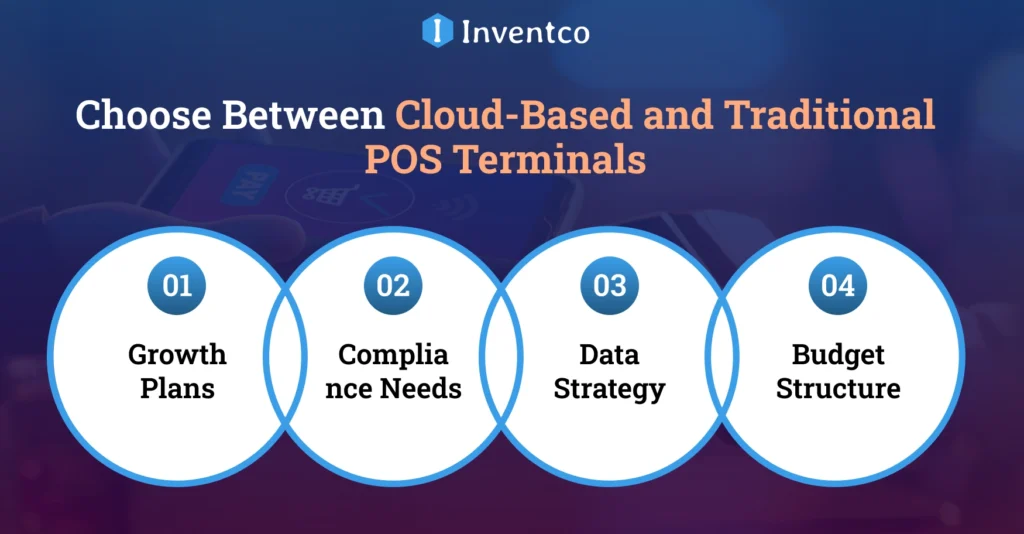
Choosing a POS terminal is more than an operational decision; it directly impacts scalability, compliance readiness, and long-term profitability. As businesses evolve and regulations change, organizations planning to create POS software must clearly distinguish between system types to build robust, sustainable commerce platforms.
1. Growth Plans
Plans for growth should guide the choice of a POS. Businesses that intend to vertically expand through multi-location franchising or omnichannel distribution will derive the greatest benefits from Cloud POS systems. This is because centralized control, real-time synchronization, and faster onboarding greatly simplify scaling. On the other hand, Traditional POS terminals bog down an enterprise during both vertical and horizontal expansion in Distributed Growth.
2. Compliance Needs
Compliance needs are another critical element in POS terminal selection. Cloud-based and POS systems continue to improve and are better able to keep up with changing regulations, driven by the need for such businesses to remain competitive. Traditionally, older systems are more bogged down by manual upgrades in an industry that is highly regulated and requires numerous audits.
3. Data Strategy
Your data strategy is critical for the choice of POS. Cloud POS systems offer real-time reporting, seamless dashboards, and recommendations to speed reporting and improve decision-making. Old school systems provide lagging reports and broken data sets that offer low visibility into trend reporting, optimizing inventory, understanding customers, and forecasting revenue over multi-location systems.
4. Budget Structure
Budget structures differ between cloud and traditional POS systems. Cloud-based POS systems operate on an OPEX model and offer a subscription-based, predictable cost structure, whereas traditional POS systems require CAPEX and overhead, leading to a more substantial financial commitment and higher system investment tiers. For cloud-based systems, financial risk is lower, cash flow is better, and growth is more sustainable over time.
Newer businesses benefit from the clear long-term advantages and strategic flexibility of cloud-based POS systems compared with traditional systems.
Use-Case Examples: Which POS Works Best for Different Businesses
Business models vary, and so do their POS system needs. Understanding these use cases can help the founder and the investor determine whether a cloud or legacy system best aligns with the use case’s operations and growth objectives.
- Retail Chains and Franchises: For retail chains and franchises, a cloud POS system is the best option given centralized inventory control, real time sales insights, and the ability to manage multiple locations from one interface.
- Hospitality and QSRs: For retail chains and franchises, a cloud POS system is the best option given centralized inventory control, real time sales insights, and the ability to manage multiple locations from one interface.
- Large Enterprises with Fixed Workflows: The best option for hospitality businesses and quick-service restaurants is a cloud POS. This enables real-time menu updates, integrated delivery partners, expedited order processing, and an enhanced customer experience.
- Startups and New Ventures: The cloud POS system is the best system for start ups because of the rapid system deployment, lower initial costs, and the simplicity of scaling as the business expands.
These cases demonstrate the growing preference for cloud systems in debates over legacy POS versus cloud systems, particularly for growth-oriented businesses.
Conclusion
It is no longer just a matter of upgrading to a new system when deciding between cloud POS and traditional POS. It is an investment in your business that will last for years to come and affect your growth, scalability, compliance, and operational efficiency. Legacy POS systems are made for stagnant periods of no growth, but as businesses around the world modernize, the need for agility, real-time, the ability to manage from a distance, and a system that will evolve with the changing needs of your customers and the laws is needed more than ever.
When considering future-ready commerce platforms, founders and investors find that both cloud-based and traditional POS systems offer lower risk, faster innovation, and measurable ROI. A cloud POS with a like-minded development partner and a well-defined roadmap transforms from merely transactional to strategic, offering continual improvement as an asset for growth, insightful data, and a long-term competitive advantage.
FAQ’s
Q1. What is a cloud POS?
Ans. A cloud POS is a web-based point-of-sale system that stores transaction data on secure remote servers, enabling real-time access, centralized management, automatic updates, and seamless operation across multiple devices, locations, and business channels globally scalable.
Q2. Cloud vs traditional POS systems: which is better for scaling businesses?
Ans. Cloud POS systems are better for scaling businesses because they support centralized control, real-time analytics, rapid onboarding of new locations, predictable subscription costs, easier integrations, and infrastructure that expands effortlessly as transaction volume grows sustainably.
Q3. Are cloud POS systems secure?
Ans. Modern cloud POS systems are highly secure, using enterprise-grade encryption, secure cloud hosting, app testing, automated backups, role-based access controls, and continuous compliance updates to meet industry regulations and protect sensitive customer and payment data.
Q4. Can traditional POS systems integrate with modern tools?
Ans. Traditional POS systems can integrate with modern tools through connectors or middleware, but these integrations are often expensive, slower to implement, harder to maintain, and less flexible than cloud-based POS platforms built on a different architecture.
Q5. Is cloud POS more cost-effective than traditional POS?
Ans. Cloud POS typically follows a subscription pricing model with lower upfront costs, while traditional POS requires significant hardware and licensing investments, making cloud solutions more predictable for budgeting, cash flow planning, and return on investment.
Q6. Do cloud POS systems work without internet access?
Ans. Most cloud POS systems include offline modes that allow transactions during internet outages and automatically sync data once connectivity returns, whereas traditional POS systems rely entirely on local hardware and risk data loss without backups.
Q7. How does cloud POS help with regulatory compliance?
Ans. Cloud POS platforms simplify regulatory compliance by delivering automatic updates to tax rules, security standards, and reporting requirements, reducing manual effort and risk, whereas traditional POS systems rely on manual upgrades and internal compliance management.
Q8. Which POS system is better for investors and founders?
Ans. For investors and founders, cloud POS offers faster time-to-market, scalable architecture, recurring revenue potential, and easier product iteration, making it more attractive than traditional POS systems when building, funding, and expanding modern commerce platforms globally.

Sandeep Agrawal
Sandeep Agrawal is the visionary CTO at Inventco, bringing innovation to life through his technical expertise. With a passion for cutting-edge technologies, Sandeep leads the team in developing robust solutions. His dedication and continous efforts to pushing the boundaries of what’s possible defines his role as a transformative and innovative force in the tech industry.