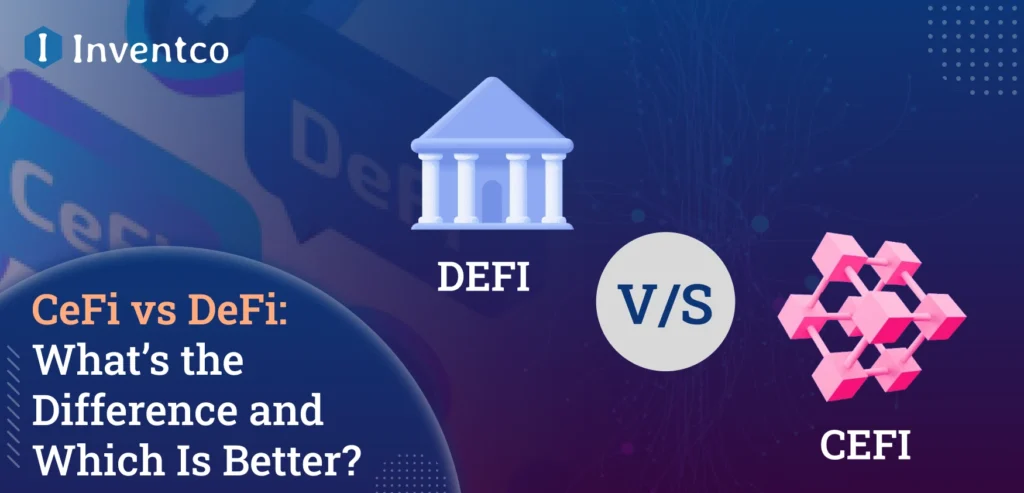
There is a massive shift in the global financial ecosystem to digital-first, borderless infrastructure through blockchain innovation, institutional adoption and demand for transparent, user-controlled systems. As cryptocurrency evolves from speculation to real-world application, two of the most prominent models for how value is stored, transferred and managed emerge: Centralized finance (CeFi) and Decentralized finance (DeFi).
Both are designed to make accessing digital assets and financial services easier for end users, but they do so on fundamentally different foundations: control versus autonomy, intermediated versus smart contracts, and regulated versus permissionless. This distinction is the more important one for businesses, investors, and developers working through this next stage of financial evolution.
In this guide, we analyze DeFi vs CeFi, their fundamental differences, potential use cases, risks associated with these ecosystems, and the future of finance as a whole! You’ll deepen your understanding of how DeFi crypto ecosystems work, what CeFi means in the context of crypto, and how each model fits into the broader DeFi vs. CeFi vs. TradFi conversation.
Key Takeaways
- Decentralized Finance (DeFi) and Centralized Finance (CeFi): Basics DeFi and CeFi are among the two primary financial models for managing, trading, and accessing digital assets within the crypto ecosystem.
- With DeFi, users have complete control over their assets and transparent transactions are possible without intermediaries via smart contracts and decentralized applications.
- CeFi relies on usability, regulatory compliance, and custodial services that abstract away crypto complexities via fiat integration, making it easier to use.
- At the heart of it is the choice between control and trust: DeFi gives power back to users, whereas CeFi demands we put our faith in intermediaries.
- DeFi offers global, permissionless access; CeFi imposes access through KYC and regulation structure.
- Both have risk profiles that are very different; DeFi has smart contract risks, while CeFi deals with hacks, mismanagement of user funds and platform failures.
- Ecosystem use cases differ from DeFi’s staking and lending to those of CeFi’s trading, custody and institutional services.
- Between DeFi and CeFi, a hybrid future of finance seems inevitable, with scalable mechanisms that maintain user-centricity amid the dynamic nature of finance.
Market Statistics: DeFi vs CeFi
- The global cryptocurrency user base has surged to 861 million users in 2026, reflecting the rapid mainstream adoption of both CeFi and DeFi platforms.
- The crypto market is expected to reach nearly 994 million users by 2026, highlighting strong global penetration and continued growth of digital finance ecosystems.
- The DeFi market size is expected to reach $37.27 billion in 2026, with long-term projections exceeding $1.4 trillion by 2033, indicating exponential growth potential.
- The blockchain fintech market is valued at $9.55 billion in 2026 and is projected to reach $39.18 billion by 2030, growing at a CAGR of over 42%, fueling both DeFi and CeFi innovation.
- Global fintech investment reached $44.7 billion in the first half of 2025 alone, signalling strong institutional confidence in digital finance infrastructure, including CeFi platforms.
What is DeFi?
Decentralized Finance (DeFi) is a financial network based on blockchain technology, transmitting power from traditional intermediaries like the bank to all individuals. DeFi allows for peer-to-peer transactions without depending on the government and centralized institutions in decentralized applications (dApps). These apps operate through smart contracts, which are self-executing codes that bring transparency, automation and security to the table by removing reliance on a third party and putting ownership of assets in the hands of users.
Features of DeFi
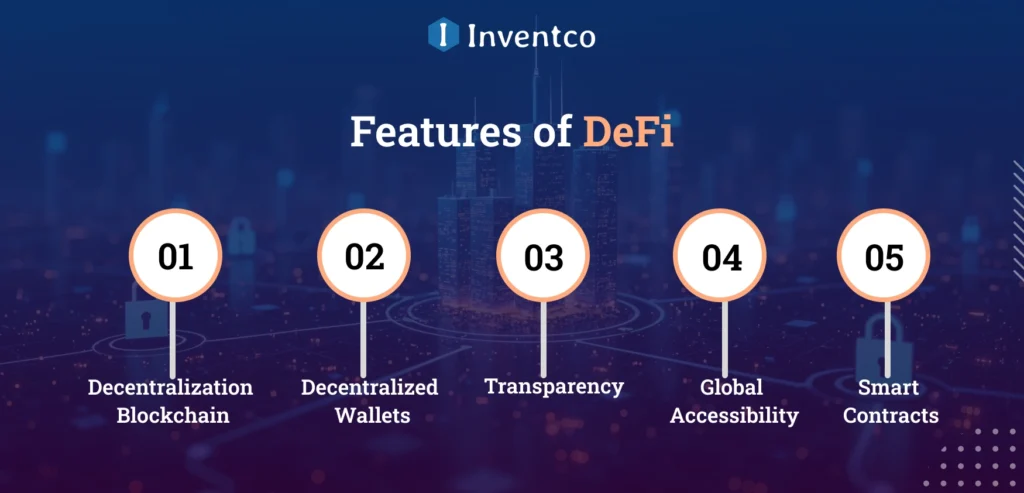
Decentralized finance is powered by blockchain innovation, enabling secure, transparent, and automated financial services without intermediaries, giving users greater control and global accessibility.
1. Decentralization Blockchain
Unlike other financial systems, DeFi runs on a decentralized blockchain, which means there is no central authority to act as the system’s vice. Decentralized finance isn’t dependent on centralized servers or authorities, making it secure, transparent and censorship-resistant.
2. Decentralized Wallets
Funds are stored in decentralized wallets, such as MetaMask, or in hardware wallets. What’s great about these wallets is that they give you full control of assets, and you get rid of intermediaries, unlike what’s on centralized finance platforms and custodial services. You may get a detailed understanding of these solutions through an e-wallet app development company.
3. Transparency
DeFi ensures that all transactions are recorded on a public blockchain. This transparency brings the idea that users can verify operations happening on crypto decentralized exchanges, lending protocols or any DeFi application, instilling confidence in the system.
4. Global Accessibility
Anyone can access DeFi platforms with only an internet connection, creating financial inclusion. These systems give people power in areas where conventional or centralised banking is unavailable or unreliable.
5. Smart Contracts
Operations like dex trading, loans and insurance are automated by smart contracts. These self-executing agreements reduce the need for manual processes and are the backbone of DeFi crypto ecosystems, including the best decentralized exchange options.
Examples of DeFi
Decentralized finance refers to myriad platforms facilitating trading, lending, staking and derivatives, all without intermediaries in transparent blockchain-rooted smart contract ecosystems.
1. Uniswap
It is worth noting that Uniswap is a well-known decentralized exchange platform, allowing users to easily swap tokens directly from their wallets via automated liquidity pools. With no intermediaries, high liquidity, and critical support for DeFi trading environments across the world.
2. Aave
A decentralized peer-to-peer lending platform with features like flash loans, variable interest rates, and collateralized lending, Aave has become a fundamental part of the DeFi lending landscape.
3. dYdX
dYdX is a decentralized derivatives exchange system for perpetual trading. It offers advanced features, like leverage and margin. Geared towards professional traders and bringing together the transparency of DeFi with a high-performance trading infrastructure, this became particularly apparent after the 2008 crypto bull run, when derivatives propelled billions in volume but few retail investors reaped rewards.
4. GMX
GMX is a non-custodial perpetual exchange that allows low-cost on-chain trading with high liquidity via multi-asset pools. The platform provides leverage trading without using traditional order books, leading to popularity among traders looking for capital efficiency and permissionless derivatives exposure.
5. Lido Finance
A leader in liquid staking, Lido Finance lets users stake assets like Ethereum and obtain liquidity in the form of a tokenized staking derivative. It is a key mechanism of DeFi that unlocks capital efficiency in a staking ecosystem.
6. Curve Finance
Curve Finance is a DeFi exchange that has optimized for static currencies and low-slippage swaps. Dave has been using it for trading stable assets and has helped form one of the backbone foundations of the DeFi world.
What is CeFi?
CeFi stands for centralized finance, which is a crypto-base money system where transactions and services are rendered through central-independent figures like exchanges, platforms or institutions. CeFi, on the other hand, depends on intermediaries to perform operations such as trading, lending, and holding assets. Users rely on these platforms to manage money, provide security and adhere to regulations, creating a structure that is more user-friendly, familiar with traditional financial systems and even follows the law.
Features of CeFi
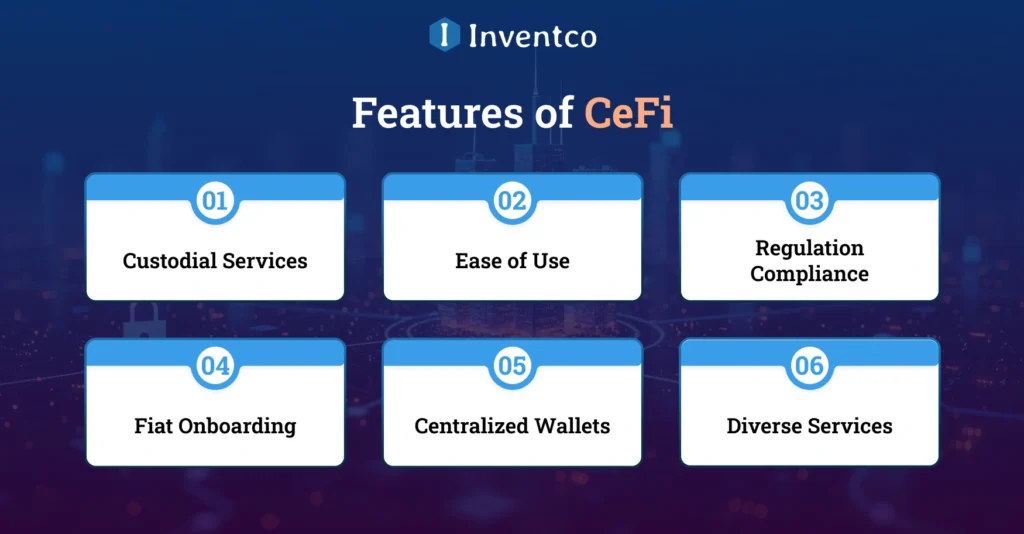
Centralized finance platforms offer structured, user-friendly financial services with regulatory support, custodial security, and seamless fiat integration, making crypto accessible for mainstream users.
1. Custodial Services
CeFi platforms provide custodial wallets, with which users safely hand over ownership of their funds to the platforms’ custody/model. Usage is simplified, as customers don’t have to manage private keys, unlike in decentralized finance, where customers have to manage decentralized wallets.
2. Ease of Use
User-friendly interfaces and 24/7 customer support make CeFi platforms more accessible to newcomers. Unlike crypto decentralized exchanges, these platforms are designed with a focus of intuitive designs and ease of use toward a better onboarding experience.
3. Regulation Compliance
CeFi is a regulated environment that manages your funds so you do not have to worry about whether your money is safe. A clear example of this structured approach to dealing with centralized cryptocurrencies and fiat integrations is found in marketplaces such as Coinbase and Kraken.
4. Fiat Onboarding
CeFi platforms enable you to convert fiat into crypto, bridging traditional finance and the crypto ecosystem. While DeFi protocols typically revolve around crypto, the CeFi platform allows buying and selling with regular money, such as USD or EUR.
5. Centralized Wallets
In CeFi, funds are stored in centralized wallets that are very convenient, but at the expense of user control. However, this is different from the autonomy of a decentralized wallet used in dex crypto apps.
6. Diverse Services
CeFi covers everything from lending and staking to crypto investment opportunities. Centralized crypto exchanges, like Binance and Kraken, are platform innovators that are always looking for ways to improve the user experience.
Examples of CeFi
CeFi provides services in a structured manner through a trusted intermediary, ensuring compliance and protecting the customer’s assets, privacy, and ease of use.
1. Coinbase
Coinbase is one of the most centralized exchanges that is user friendly and compliant to regulations, which makes it easier to use as a gateway into the crypto world to trade, buy, sell or hold crypto.
2. Binance
Binance is the most well known and the largest central exchange. They offer services in futures trading, spot trading, staking, and lending. They offer a large range of assets as well as high liquidity and a variety of trading instruments making them the largest competitor in the CeFi market.
3. Kraken
Kraken is one of the most secure and regulated centralized exchanges that offer trading, futures, staking and custodial services in crypto. Because of Kraken’s compliance and transparency, it is a top choice for institutions and professional traders.
4. Crypto.com
Crypto.com offers the most comprehensive CeFi solution. They provide services such as trading, staking, crypto credit cards, and payments. They focus on mass adoption and offer crypto and traditional financial services which is further enhanced by their strong marketing and global positioning.
5. OKX
OKX is a big centralized exchange that provides derivatives, staking, spot trading, and Web3 services. They have a global reach and sophisticated trading software, making them a great option for both retail and professional traders.
6. Central Bank Digital Currency
Central Bank Digital Currencies (CBDCs) are government digital currencies. They are digital currencies that are fully regulated and controlled by a central authority. CBDCs aim to improve a country’s payment system, economic inclusion, and increase digital regulation.
CeFi Vs DeFi: Key Differences
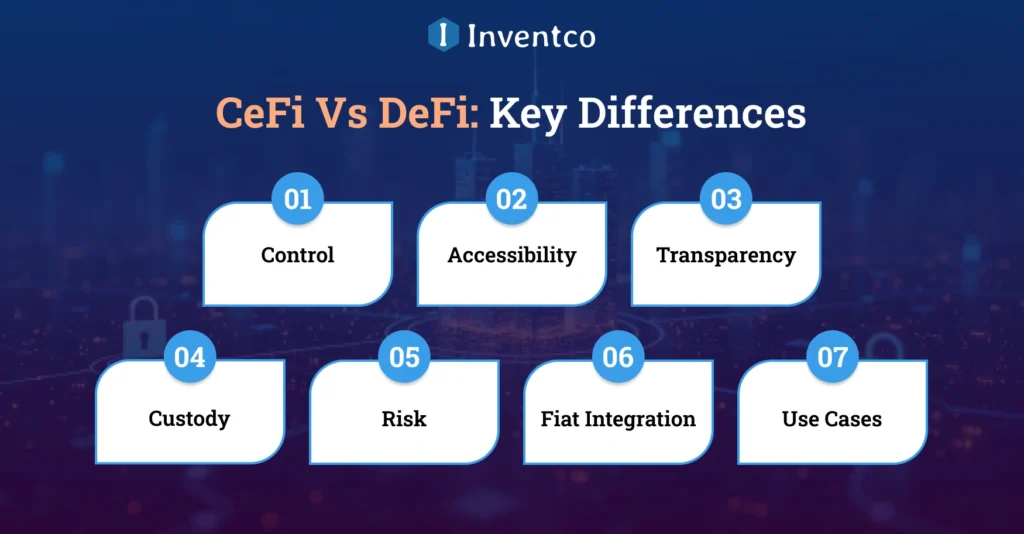
Both CeFi and DeFi are important for digital finance, and understanding the differences is fundamental to understanding the access, the management, and the growth of digital assets.
1. Control
Since transactions on DeFi are done via smart contracts, the users have complete control of the process because there are no intermediaries. Transactions are done automatically, so there is no third party reliance. CeFi, on the other hand, has a more hands-off approach. They have centralized control of the finances, and as a result, users are required to transfer trust to the institutions with custody and control of transactions.
2. Accessibility
There aren’t as many barriers to accessing DeFi as there are in other financial ecosystems. If you have an internet connection and a cryptocurrency wallet, you can access DeFi networks without going through identity verification. DeFi technology can raise regulatory issues, but from a financial inclusion standpoint, it works well. Centralized Finance (CeFi) systems, on the other hand, legally have to do Know Your Customer (KYC) checks and compliance reviews, so they do not have as many barriers legally, but they do have legal barriers to inclusion in the system. This helps ensure the system is safe, but people from certain regions without sufficient documentation may not be able to use it.
3. Transparency
In DeFi, the blockchain is public, so everyone can see the transactions and audit the system in real time, this is how it ensures transparency. There is a smart contract, and it is not a matter of trust because you can see everything happening. In CeFi, there is no public transparency. CeFi is a private system and there are no real visible transactions. Users rely on the platform to be in control and provide transparency, which is the opposite of DeFi, but in a controlled environment it is safer.
4. Custody
In DeFi, the self-custody model is used. The devices are self-custodial, so the users have full control of everything. This means the user has a lot of control, but it means the user also has to assume a lot of responsibility for their own security and the security of the system. In Centralized Finance (CeFi), users have to trust the system, as the system has a custodial model. This means all the user assets are in the hands of the system, and the users do not have control of their assets. On the one hand, this is safer for the user because they do not have to worry about security, but on the other hand, it creates all the risks of centralized storage, such as losing assets due to hacking or mismanagement.
5. Risk
The DeFi system has many operational risks associated with smart contracts and vulnerability to scams, incomplete regulations, and scant recovery options. Yet, it does operate without central authorities. The CeFi system has a lower operational threshold, but carries counterparty risks such as exchange hacks, bankruptcy, or mismanagement. Regulatory oversight does exist; however, the historical record shows centralized systems often lose their users considerable amounts of money, regardless of regulation.
6. Fiat Integration
The DeFi system has no real integration of traditional fiat currency and users typically have to convert their money into a cryptocurrency to access the DeFi services. The CeFi system allows users to deposit, withdraw, and trade money in fiat, meaning it also integrates directly with DeFi. This also means the CeFi system is more straightforward and beginner friendly and allows users to convert their money into cryptocurrency without using a third party service.
7. Use Cases
DeFi enables a wide range of automated smart contract services, such as decentralized trading, lending, staking, yield farming, and trading of derivatives. These automated services are innovative, but are often less user friendly. CeFi enables more traditional services and user experience such as centralized trading, custodial services, fiat onramps, and financial products for the institutional level. This structured approach makes it very appealing to large investors and the general public.
| Feature | DeFi (Decentralized Finance) | CeFi (Centralized Finance) |
| Control | Users control assets via private keys | Platforms control and manage user funds |
| Accessibility | Open to anyone, no mandatory KYC | Requires KYC and regulatory compliance |
| Transparency | Fully transparent on public blockchains | Limited, depends on platform disclosures |
| Custody | Non-custodial (user-owned wallets) | Custodial (platform-held funds) |
| Risk | Smart contract bugs, no regulatory protection | Hacks, mismanagement, counterparty risks |
| Fiat Support | Limited, requires third-party conversion | Strong fiat integration (deposit/withdraw) |
| Use Cases | DEXs, staking, lending, yield farming | Trading, custody, fiat onboarding, institutional services |
Why Choose Inventco for Fintech App Development?
The app development industry is ever-growing, and at Inventco, we don’t just develop apps. We create adaptable, scalable, and safe financial ecosystems for modern customers. Our engineered digital payment systems, like Easy Payment, illustrate our ability to align with user needs, regulatory requirements, and within high-performance architecture in the fast-paced world of fintech.
We take the Easy Payment Ewallet app very seriously and have built it with security, usability, and reliability in mind. We have incorporated various security measures like advanced encryption paired with multi-factor authentication to ensure seamless financial transactions. This is to ensure the protection of sensitive financial information. We prioritize the needs of the customers and do everything possible to be in compliance with the users’ and the businesses’ trust and the regulatory standards.
Our approach combines intuitive design with powerful functionality, enabling features like multi-payment integration, real-time transfers, bill payments, and peer-to-peer transactions. Whether it’s enhancing user convenience or enabling businesses to scale digital payments, Inventco ensures every solution is future-ready, resilient, and aligned with evolving financial technologies.

Conclusion
The DeFi vs CeFi debate reflects a larger transformation in how financial systems are built and accessed. Both models serve distinct purposes, addressing different user expectations, risk appetites, and levels of technical understanding.
DeFi brings transparency, automation, and user control, making it ideal for those seeking independence from intermediaries. In contrast, CeFi offers structure, regulatory support, and ease of use, helping mainstream users confidently enter the crypto ecosystem.
As technology evolves, a hybrid financial model will likely emerge, combining DeFi’s innovation with CeFi’s reliability. This convergence could deliver more secure, accessible, and scalable financial solutions for global users.
FAQ’s
Q1. What is the main difference between CeFi and DeFi?
Ans. The main difference between CeFi and DeFi lies in control and trust. DeFi removes intermediaries using smart contracts, while CeFi relies on centralized platforms to manage transactions, custody, and regulatory compliance.
Q2. Which is better in 2026: CeFi or DeFi?
Ans. There is no one-size-fits-all answer in 2026. DeFi suits users seeking control and transparency, while CeFi is better for beginners and institutions needing security, compliance, and easier access to crypto services.
Q3. Is DeFi riskier than CeFi?
Ans. DeFi carries technical risks, such as smart contract bugs and scams, without regulatory oversight. CeFi reduces complexity but introduces risks such as hacks, platform failures, or mismanagement despite operating under regulatory frameworks.
Q4. Can beginners use DeFi platforms easily?
Ans. DeFi can be complex for beginners due to the need for wallet management and technical knowledge. Most new users start with CeFi platforms, which offer intuitive interfaces, customer support, and simplified onboarding to facilitate adoption.
Q5. How does CeFi support fiat currency transactions?
Ans. CeFi platforms allow users to deposit, withdraw, and trade using fiat currencies like USD or EUR. This integration simplifies entry into crypto by efficiently bridging traditional banking systems with digital asset ecosystems.
Q6. What is the future of CeFi and DeFi?
Ans. The future of finance is expected to combine CeFi and DeFi strengths, creating hybrid systems. These models will deliver better security, scalability, accessibility, and innovation while balancing decentralization with regulatory compliance for users.

Jitendra Jain
He is the CEO and Co-founder of Inventco, driving innovation in advanced computing and digital transformation. With deep expertise in modern IT ecosystems, he leads scalable, secure, future-ready solutions. His strategic leadership helps businesses accelerate growth, adopt innovation, and achieve success. You can connect with him on LinkedIn to follow his technology insights.