The ways Tinder capitalizes on its competing users’ attention and emotions are somewhat of a blueprint for other subscription services and dating apps. Investors are buying into Tinder as a highly digital marketplace based on behavioral spend, attention monetization psychology, and premium user buys. Initial user interaction through swiping has become an ongoing revenue stream for Tinder in multiple countries. Tinder’s first-mover advantage as a user experience designer in the online dating industry has created an ongoing revenue generator in multiple countries.
The company began operations in 2012. Tinder’s use of gamified interactions has created an addictive experience, and monetization has become inevitable because users are so accustomed to swiping efficiently on other applications. Tinder has an advantage over other applications because user experience is a strong determinant of monetization.
Understanding Tinder’s business model is crucial for investors considering scalable consumer platforms, given the scale of its transformation. Tinder has around 75 million monthly active users and operates in over 190 countries. Tinder is the largest contributor to its parent company, Match Group, bringing in almost $2 billion. Tinder has about 10 million paying subscribers.
Tinder operates as a marketplace rather than a social networking platform. Tinder’s marketplace is supported by a recurring revenue model. Tinder’s revenue is generated through its premium features, algorithms that control user visibility, and tiered subscriptions that create engagement and convert it to revenue.
For founders looking to create innovative dating apps, the lesson is clear: sustainable growth is driven by more than interface improvements, it is built through integrating monetization systems into the product from the outset. For investors, the scalable dating app model depends on understanding how Tinder earns money and how monetization mechanisms are integrated into the app to ensure it meets subscription, security, regulatory, and revenue-generation requirements for sustainable growth.
Key Takeaways
- Tinder operates on a freemium monetization model.
- Revenue primarily comes from subscriptions and in-app purchases.
- Premium tiers unlock visibility, unlimited swipes, and algorithmic advantages.
- Add-ons such as Boosts and Super Likes generate high-margin microtransactions.
- Tinder’s monetization strategy is highly repeatable for founders exploring dating app development-driven growth models.
Dating App Market Statistics
Understanding how platforms like Tinder generate billions in revenue starts with understanding the size and growth of the digital dating economy.
- The global dating app market is valued at ~USD 11.61 billion in 2025 and projected to reach USD 12.52 billion in 2026, reflecting steady growth as more users engage with mobile dating platforms.
- The market is expected to expand further, potentially reaching USD 24.85 billion by 2035, driven by increasing monetization and user adoption worldwide.
- Leading apps like Tinder generated nearly USD 1.94 billion in revenue in 2024 and saw tens of millions of active users, contributing significantly to global market size.
- By 2030, this market is projected to reach USD 14.42 billion, reflecting sustained adoption and monetization of subscription-based dating apps.
- Another industry forecast estimates total online dating services revenue will be USD 7.79 billion in 2026, with strong growth projected through 2031 (CAGR ~11.8%).
How Does Tinder Make Money?
The primary way Tinder earns revenue is through a freemium model with sample-based, systematic access control. Tinder can reduce barriers and increase user acquisition by offering a free, basic service that lets users download the app and use its core app features. However, the broader functions that the user will ultimately pay for are strategically gated by Tinder, as the users’ engagement is ultimately monetized.
Moreover, in the free version, users can swipe, match, and message other users, but are subject to several other unspecified limitations. Then, several other critical functions that increase overall match potential through user visibility, control, and match probability are included. Some of these features include unlimited swipes, the ability to change their location via passport, prioritized likes, and boosts to be listed. Users will upgrade to these features after paying to gain an advantage in the application ecosystem.
There are three main sources of income for Tinder. Using a subscription model, Tinder sells individual access to different ‘Gold’ or ‘Platinum’ tiers to monetize access. Next, increased usage of the service will likely drive higher revenue from in-app purchases of ‘Boosts’ and ‘Super Likes’, which are a major source of microtransaction revenue for digital apps. Finally, although likely minimal, advertising can be an additional income stream primarily consisting of free users of the service.
This framework illustrates Tinder’s user growth strategies and retention at low user acquisition costs. Using behavioral psychology and premium revenue forecasting, the company integrates these with user freemium onboarding and premium feature layering. For founders of dating apps, this structured tiered-access model provides effective and sustainable growth and recurring revenue, proven app monetization strategies for a scalable dating app.
Tinder’s Subscription Plans & Revenue Model
Tinder’s monetization model uses a subscription ladder that segments the user base by engagement, urgency, and propensity to pay. Instead of monetizing basic access, the platform offers value through additional premium features that enhance visibility and improve competitive standing in the match ecosystem.
1. Tinder Plus
Tinder Plus is the first tier in the premium dating platform ecosystem. It is positioned for the most engaged users, but in this case, engagement is driven by a desire for control, choice, and agency rather than algorithmic dominance. At this tier and above, Tinder alters the match-visibility dynamics by reducing friction and improving overall usability.
Positioning: Entry-level premium tier
Core Features:
- Unlimited swipes
- Passport (change location globally)
- Rewind (undo last swipe)
- Ad-free experience
Monetization Logic: Engaged users who desire greater convenience, flexibility and control.
2. Tinder Gold
With Tinder Gold, the user experience paradigm shifts from convenience to certainty and clearer signalling. At this level, ambiguity is reduced, inbound interest is revealed, and profile selections are curated. This tier is designed for users who value efficiency and want clearer signals before investing time in swiping.
Positioning: Tier Increased Visibility
Added features:
- All Tinder Plus features
- Who liked your profile?
- Curated Top Picks access
Monetization Logic: Effortless inbound interest. Match potential goes up.
3. Tinder Platinum
This is the most premium tier and the most high-intent. Priority exposure and extra engagement power within the algorithm are what this tier is all about. It is about giving users the ultimate priority to help them succeed within a tiered system. Users compete with the highest level of visibility.
Positioning: Maximum exposure tier
Added Advanced Features:
- All Gold features
- Message before matching
- Priority likes
- Profile boosting
Monetization Logic: High-intent users. Positioning and engagement boosters.
Revenue Optimization Strategy
Intent intensity is evenly distributed across the tiers. Casual users will use the free tier. Active users will pay for engagement control. Highly interested users will pay for visibility.
This is where the alignment of Tinder’s monetization strategy is most optimal from an investor’s point of view. Paying users are not buying access to the platform; they are buying the means to increase their chances of matching through greater visibility and less competition.
This psychological trigger fuels recurring subscription revenue, enhances retention, and forms a scalable, structured access-differentiation monetization engine.
Tinder App Revenue: Key Numbers & Growth Trends
Tinder app revenue is tied to Match Group’s revenue. Tinder’s revenue is reported in Match Group’s quarterly and annual earnings reports. The reports help us understand how revenue is earned, how much revenue is earned, how the subscribers dimension is changing and how certainty of revenue growth over the long term is changing.
Revenue Performance Snapshot
Annual Revenue:
- Revenue is in the range of $1.9 – $2.0 billion each year
- Of all the brands in the Match Group, this is the most revenue-generating app
Revenue Contribution:
- This app generates the largest portion of total annual revenue of the Match Group
- This dating app itself is the most important of all the apps in terms of profitability
Subscriber Base:
- The Tinder dating app has millions of subscribers
- A dating app like Tinder is based on a subscription system
Operating Model Efficiency:
- High-margin digital infrastructure
- Scalable cloud-based systems
- Limited incremental cost per additional subscriber
Growth & Monetization Trends
- High subscription based recurring revenue
- Increasing Premium tier upto beyond Average Revenue Per User (ARPU)
- Global expansion long term revenue persistence
- A donation-based revenue model has low value and limited preference.
Regarding the overall performance, the sustained profitability of Tinder can be explained in terms of its financial architecture, where the durability of growth comes from the combination of experience gating on a premium basis and recurring billing cycles, and not from ad monetization. For founders of scalable dating apps, in terms of the revenue model of Tinder, focus on subscription structure and vertical margin in combination with global monetization is imperative.
Challenges & Limitations in Tinder’s Revenue Model
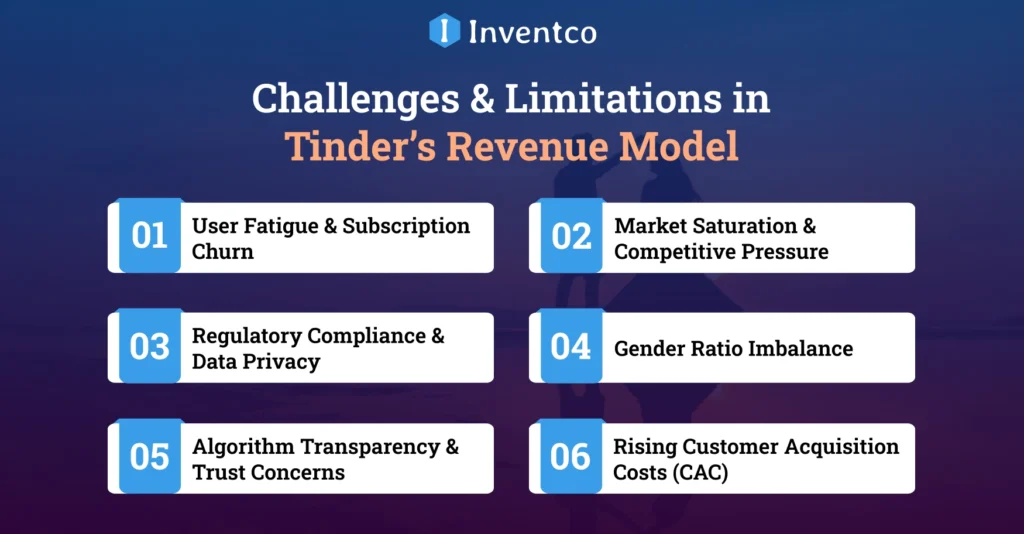
Tinder’s subscription-based revenue model faces challenges and limitations, yet it remains very profitable. These app development challenges may be structural and may pose potential threats to both the investors and founders. Sustaining revenue in the dating industry relies on user engagement and retention, regulatory adaptability, and differentiation from competitors.
1. User Fatigue & Subscription Churn
User engagement drops if match quality declines or users feel they have had the same experience repeatedly. Likewise, if users feel the app provides little value, they become unwilling to renew their subscriptions, directly reducing revenue, recurring revenue, and future revenue per user (ARPU).
2. Market Saturation & Competitive Pressure
There are numerous competitors in the dating app industry, including those that utilize AI and focus on particular niches. As the market grows increasingly fragmented, newcomers to the industry will face higher customer acquisition costs while also reducing the value they can provide to their customers.
3. Regulatory Compliance & Data Privacy
Tinder’s global expansion plans increase the complexity of complying with laws and regulations on data privacy, user age verification, and online safety. Non-compliance can result in regulatory restrictions, fines, and reputational damage.
4. Gender Ratio Imbalance
An imbalance in the app’s user base may be detrimental to engagement and retention. Lower engagement may lead to greater user loss, especially among paying users.
5. Algorithm Transparency & Trust Concerns
There are growing concerns among users regarding the visibility and ranking systems. Trust in the platform is likely to be diminished if users believe they will receive lower visibility as a result of a subscription. This may result in lower user engagement, whether users are using the app for free or paying for it.
6. Rising Customer Acquisition Costs (CAC)
Competition in digital advertising continues to rise, and as a result, costs to attract new users are increasing. Without retention and the ability to monetize users, CAC could negatively impact margins regardless of how much subscription revenue is generated.
In evaluating how to build dating apps at scale, founders must think differently than before. Sophisticated AI in dating apps must be built to enable features such as behavioral predictive analytics, safety and fraud monitoring, and identity verification, among others, in addition to compatibility.
Conclusion
The app monetization strategies employed by Tinder extend beyond subscription-based revenue. Tinder has a well-structured monetization ecosystem that leverages user behavior, the psychology of premium visibility, and digital economics to drive positive bottom-line outcomes. The company can convert emotional intent into revenue by matching users to engagement and revenue opportunities. The company’s freemium model promotes rapid adoption of the platform. The company’s premium subscription model monetizes user urgency, desire, and visibility in the marketplace.
Because user monetization is incorporated into the user experience rather than retrofitted, Tinder’s annual revenue is in the billions. Founders and investors see immediate value in building a dating app that incorporates revenue design from the start. A data-driven monetization strategy that incorporates scaling and compliance from the outset of a dating app build is the difference between sustainable growth and an idea that quickly reaches its limits.
FAQ’s
Q1. How does Tinder make money?
Ans. Tinder makes money through tiered subscription plans including Plus, Gold, and Platinum, alongside in-app purchases like Boosts and Super Likes. Advertising contributes minimally, while recurring subscriptions drive predictable, high-margin, global revenue growth.
Q2. How does Tinder earn money without charging everyone?
Ans. Tinder operates on a freemium model where basic swiping and matching remain free. Revenue comes from users who pay for enhanced visibility, unlimited swipes, location changes, and priority placement within the matching algorithm.
Q3. How do apps like Tinder make money?
Ans. Apps like Tinder make money using subscription tiers, microtransactions, premium exposure tools, and selective advertising. Their monetization strategy focuses on charging for increased visibility, match probability, and exclusive features rather than core access.
Q4. How much money does Tinder make annually?
Ans. Tinder generates approximately $1.9 to $2 billion annually, with most revenue coming from paid subscriptions. Strong global adoption, recurring billing cycles, and high-margin digital services support consistent year-over-year financial performance.
Q5. What percentage of Tinder revenue comes from subscriptions?
Ans. More than 90 per cent of Tinder’s total revenue comes from subscriptions and in-app purchases. Recurring payments from premium tiers significantly outweigh advertising income, making subscription monetization the company’s primary financial engine.
Q6. What is the cost to build a dating app?
Ans. The cost to build a dating app typically ranges from $10,000 to $100,000+, depending on features, platform selection (iOS, Android, or both), UI/UX complexity, backend infrastructure, AI integrations, security layers, and scalability requirements.
Q7. Is advertising a major revenue source for Tinder?
Ans. No, advertising is not a major revenue source for Tinder. While ads are available on free tiers, the company primarily relies on subscription upgrades and paid features to generate sustainable, recurring revenue.
Q8. Why are users willing to pay for Tinder?
Ans. Users pay for Tinder to increase their visibility, improve match rates, and gain better control over interactions. Premium features offer competitive advantages, creating perceived value in a crowded, algorithm-driven dating environment.
Q9. Can startups replicate Tinder’s revenue model?
Ans. Yes, startups can replicate Tinder’s revenue model by implementing freemium access, tiered subscriptions, and premium exposure tools. Success depends on strong user acquisition, engagement retention, behavioral monetization design, and scalable infrastructure systems.

Ajay Bhal
He is an on-demand app solutions expert with 11+ years of experience in business consulting and building scalable, user-centric digital products. He specializes in robust on-demand platforms across industries, combining technical expertise with business-focused strategy to deliver efficient, top notch solutions that drive growth and enhance user experience. You can connect with him on LinkedIn to follow insights.