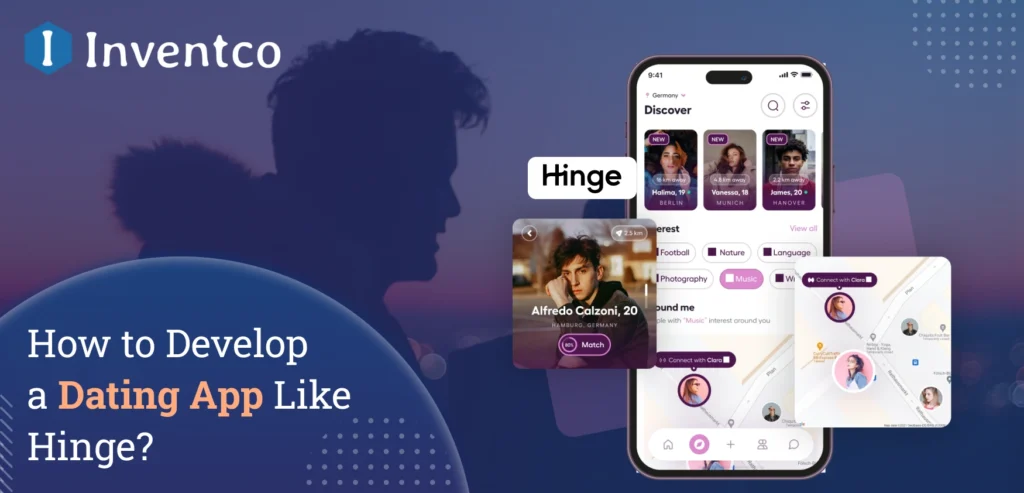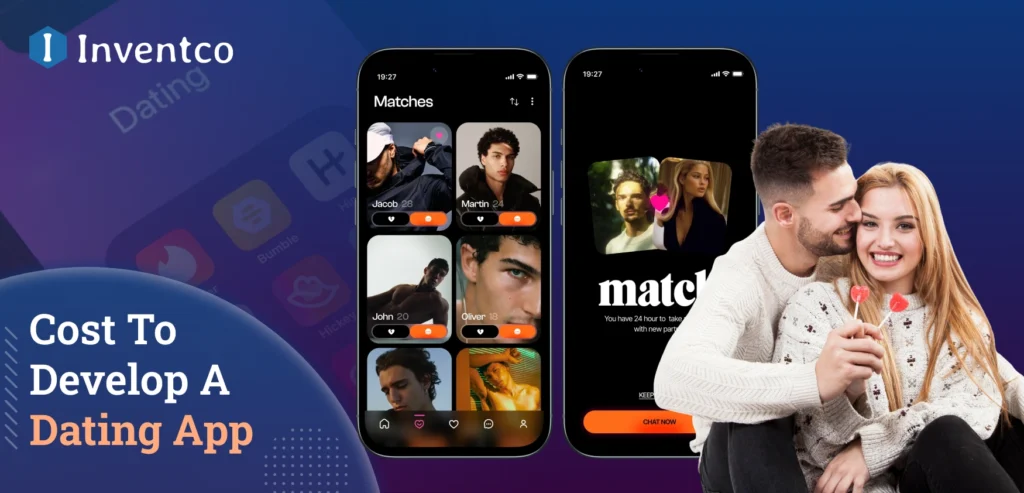
The current dating app market has evolved far beyond mere swiping, shifting toward apps that offer social discovery, ranging from casual to more formal. Regarding marketplace growth, consumer-oriented dating apps capitalize on the opportunity and invest in apps that meet user demand. The marketplace offers tangible growth opportunities that are attracting developers and investors committed to building enduring digital frameworks rather than ephemeral consumer apps.
The global Dating App Market size was valued at USD 11.61 billion in 2025 and is expected to reach USD 12.52 billion by 2026. As a result, success in this space is now defined by platform stability, user trust, and long-term scalability, not just downloads.
To protect user safety, privacy and address the potential for social moderation, platform developers must carefully determine which social moderation and user safety features to integrate into the platform/framework. Once the developers provide the necessary features, the potential consumer demand protection within an app’s download features must be balanced with the platform’s social moderation and user safety features.
Yes, the overall cost of developing an app that meets consumer demand and includes protection features will be between $10,000 and $100,000. The cost range depends on the app’s capabilities, components, and the overall structure on which it is built.
This guide focuses on developing a budgeting plan for a dating app and allocating it to a dating app development service. It helps to outline costs from a business standpoint to structure a dating app development service over time, and to track and reduce dating app development costs.
Key Takeaways
- The cost to develop a dating app typically ranges from $10,000 to $100,000+, depending on complexity, features, and scalability.
- MVP dating apps cost less upfront but often incur higher long-term technical debt.
- Advanced features like AI matching, moderation systems, and real-time chat significantly increase development costs.
- Backend infrastructure, compliance, and post-launch maintenance can account for 30–45% of total lifetime cost.
- A well-built dating app can generate strong long-term ROI through subscriptions, premium features, and data-driven monetization.
How Much Does It Cost to Develop a Dating App?
The cost to develop a dating app is influenced by several factors, including the product’s ambition, the application’s technical complexity, and the growth strategy. The cost of dating app development is categorized into three tiers rather than a single price point because each tier reflects a set of goals and business development stages.
Dating App Development Cost by Complexity
| App Complexity | Estimated Cost Range |
| Basic MVP Dating App | $10,000 – $25,000 |
| Mid-Scale Dating App | $25,000 – $60,000 |
| Enterprise-Grade Dating App | $60,000 – $100,000+ |
The cost tiers indicate the varying levels of scalability, functionality, and operational readiness associated with the app.
1. Basic MVP Dating App ($10,000 – $25,000)
A basic MVP dating app costs between $10,000 and $25,000. The MVP serves to validate a business concept at the lowest cost. Basic MVP apps include features such as customer registration, rudimentary user profiles, basic logic to facilitate user matching, and a messaging system with limited functionality.
The costs associated with the development of basic MVP dating apps make it suitable for newly established founders for the purposes of testing demand in a given market, and for the purposes of securing investment funding. However, as a result of streamlined backend structures and insufficient automation, MVP dating apps are poorly constructed, leading to the necessity for revisions development as the user base increases.
2. Mid-Scale Dating App ($25,000 – $60,000)
Mid-scale dating apps are built for early growth and monetization. In addition to the fundamental features, these apps often include advanced filters, real-time chat, push notifications, enhanced matching algorithms, and basic analytics.
More emphasis is required in this range on backend stability, performance optimization, and user experience. These apps are more scalable than MVPs, but expansion remains dependent on the quality of the underlying architecture.
3. Enterprise-Grade Dating App ($60,000 – $100,000+)
Enterprise-grade dating platforms are developed for scale, compliance, and sustainability. These platforms usually have AI-powered matching and moderation systems, advanced security, subscription management, and high performance to support large numbers of users.
This scale is usually used by funded start-ups and established companies seeking rapid growth, global expansion, and substantial revenue.
What Ultimately Determines the Final Cost?
The final cost to make a dating app is influenced by several critical factors, including:
- Platform strategy (iOS, Android, or cross-platform)
- Depth and complexity of features
- Use of AI and data-driven matching systems
- Backend architecture and cloud infrastructure
- Security, moderation, and compliance requirements
Most founders tend to think the mobile app development process will cost much less than it actually does because they focus on the UI and the app’s visual design. In reality, the time and money spent on infrastructure, data protection, and moderation workflows tend to dictate the app’s scalability and success, and this will cost the company a lot.
The earlier in the development process, the more accurate the budgeting will be for founders and investors, and this will minimize the need for redesign as the app develops and evolves.
Key Factors That Affect Dating App Development Cost
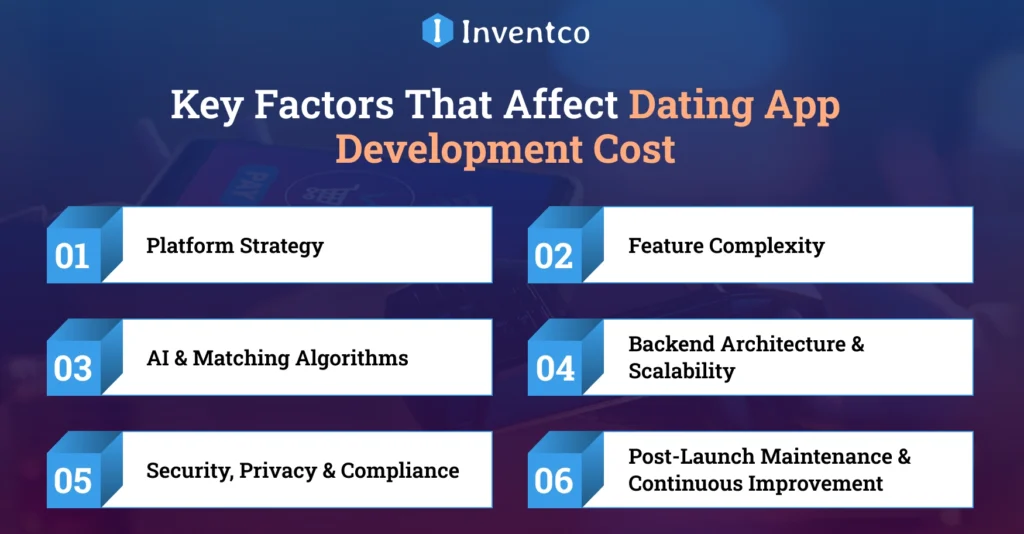
Taking the time to analyze and understand the factors driving the costs of app development for dating apps allows founders and investors to plan more strategically and avoid unplanned costs. This will also enable them to build sustainable platforms that can be effectively scaled to meet the expectations of modern users.
1. Platform Strategy
The decision and choice as to whether you will build apps specifically for iOS or Android, or both, will have a direct impact on both the cost and time it will take for the development of a dating app. Natively built apps offer better performance and long-term flexibility, however, this comes at a higher cost. In the long run, a cross-platform framework will allow you to save on initial investment, however, it may impose restrictions on future scaling. These restrictions may also be related to the addition of more sophisticated features later on.
2. Feature Complexity
There are some basic mobile app features essential to dating apps. These include user profiles and user preference settings, as well as user matchmaking and real-time messaging. These features are absolutely required; therefore, development costs will be higher. As platforms integrate additional, more advanced features like location based app discovery, user premium subscriptions, user in app purchases, and more, the costs will be higher as development efforts to integrate those features will be greater.
3. AI & Matching Algorithms
Most modern dating apps use algorithms to better engage and retain users. This means the app will need AI and Data engineering, which will, more often than not, incur high costs in both initial development and ongoing operations to retain and analyze user data. This means that as the number of app users increases, the cost of operating the app will rise.
4. Backend Architecture & Scalability
A dating app needs a backend architecture that focuses on real-time interactions. Users can attempt to connect with each other in real-time. In addition, the backend needs to handle multiple users simultaneously with quick response times. Cloud infrastructure, databases, and processing power can all improve response times. Cloud infrastructure and databases can be costly, so underinvesting in backend engineering can ultimately lead to costly construction when user traffic spikes.
5. Security, Privacy & Compliance
Dating apps can collect a significant amount of sensitive, personal, behavioral, and usage data. Implementing strong mobile app security measures, such as data encryption, multi-factor authentication, and transparent data usage policies, can increase development costs. Additionally, aligning business practices with local data protection laws adds further compliance expenses. These investments are essential for building user trust and ensuring the app provider maintains credibility.
6. Post-Launch Maintenance & Continuous Improvement
Development costs are ongoing, and the costs will not stop once the app is launched. Maintenance costs will be incurred to fix security flaws and enhance existing features. Post-launch, ongoing user support and app performance monitoring are needed. Some of these tasks will be the responsibility of app users. Dating app providers must continually invest in maintenance to keep their apps from going out of business.
All the points are pertinent to creating a dating app. Evaluating certain features needs to be considered from the get-go. This is to ensure the dating app’s longevity.
Dating App Development Cost by App Type
The cost of dating app development varies significantly depending on the target audience, platform, and level of complexity. Here is a breakdown of the different types of dating apps and their potential costs.
1. Swipe-Based Dating Apps
Cost to develop swipe-based dating apps: $30,000 – $60,000
The main focus of swipe base dating apps is to create a visually appealing interface. Swipe-based dating apps focus heavily on visual appeal and fast interactions, similar to popular apps like Tinder, where matches happen instantly through intuitive swiping. More money is usually allocated to other parts of the app, such as UI design, animations, and optimizations, to improve user engagement. Because of the app’s “swipe” feature, basic matching algorithms must be implemented to enable the app to function. After the algorithms are created, apps engage with users through fast interactions and the app designers can focus on the visual aspects of the app.
2. Niche Dating Apps
Cost to make a niche dating app: $25,000 – $55,000
When developing audience-specific apps, multiple factors must be taken into account. More audience-specific apps can be built using audience-specific filters, design, and community moderation. These features drive the pricing of audience-specific apps. Platforms modeled after an app like Sniffies require additional customization, moderation controls, and community-focused features.
3. Subscription-Based Dating Apps
Cost to develop subscription-based dating apps: $40,000 – $75,000
These dating apps are designed with the expectation that users will pay a fee to access certain features. A structure similar to a dating app like Hinge relies heavily on premium access, advanced filters, and tier-based memberships. To provide app users with a “premium” experience, certain features must be accessible through a paywall. In addition, the ability to pay for portions/set features of the app must be built into the app. These apps generate the most income for the designers.
4. Location-Based Dating Apps
Cost to build a location-based dating app: $35,000 – $70,000
Location-based dating services leverage users’ real-time geolocation data, proximity matching, and mapping services. Location-based dating services, including apps like Grindr, leverage users’ real-time geolocation data, proximity matching, and mapping services. For dating services that integrate additional backend optimization to support real-time location updates, this adds complexity to the system and requires careful attention to performance, privacy, and battery conservation.
5. Social & Community-Driven Dating Apps
Cost to develop social & community-driven dating apps: $45,000 – $85,000
Social and community-driven dating apps are a mix of dating and social media networks. They are also community-based dating apps that provide features such as group chats, communities centered around particular interests, content (micro) feeds, and social event calendars. Greater complexity in community moderation and engagement drives additional costs to develop and test the platform.
6. AI-Powered Dating Platforms
Cost to build an AI-powered dating app: $70,000 – $100,000+
The most complex dating apps to build are platforms that offer services using Artificial Intelligence (AI). AI dating apps analyze user behavior, offer recommendations, and provide intelligent, adaptive matching. While some apps may initially offer services within that cost range, there are considerable costs for enhancements such as data processing and AI model maintenance.
Backend, Infrastructure & Maintenance Costs
Estimating the costs of a dating app includes pre-launch costs, which are often overshadowed by post-release operational costs. In reality, operational costs, including backend infrastructure and app maintenance, are critical to long-term success.
Backend Infrastructure Costs Typically Include
In order for a dating app to be launch-ready, it must possess high-quality and reliability so it is able to provide real-time interactions and maintain user data. Some primary backend expense components are:
- Cloud hosting and scalable storage
- Real-time messaging and notification servers
- User data processing and matching logic
- Analytics, monitoring, and system logging
This is why these components are so crucial: user activity is guaranteed to increase, so performance, reliability, and overall system scalability are fundamental.
Ongoing Maintenance & Operational Investment
Investment in the dating app shouldn’t stop after launch. Founders must structure their financial planning to account for ongoing technical support so the app remains secure, responsive, and competitive. This recurring allocation covers app maintenance costs, typically estimated at 15–25% of the initial development cost annually. Below is an example breakdown of the annual financial framework founders should prepare.
- Bug fixes and platform stability improvements
- Security patches and compliance updates
- Performance optimization as usage grows
- Incremental feature enhancements and refinements
Many dating apps undermine their potential by failing to build a robust financial structure to maintain operational flow.
Hidden Costs in Dating App Development
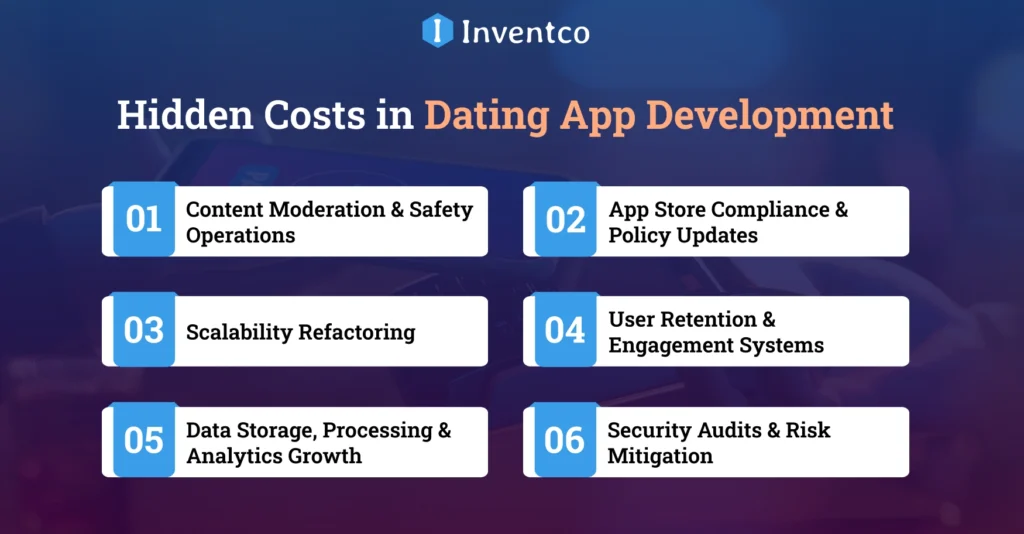
Most budgets in the first stages of dating app development focus primarily on visible features. However, the most crucial costs related to dating app development will remain hidden until the app is launched. If overlooked, these costs can significantly misestimate the most crucial costs of building and maintaining a successful platform.
1. Content Moderation & Safety Operations
Trust is the core of any dating platform, and a human moderation team that drives trust creation is an ongoing cost for the platform. The team should be supported by AI-driven content moderation, a reporting workflow, and an escalation process that will increase the platform’s costs and must be in place to sustain the platform as a regulatory and user safety requirement.
2. App Store Compliance & Policy Updates
The requirements of the mobile app store guidelines should be considered an ongoing cost of the app. Regular updates, metadata optimization, and new features are required to maintain app store compliance and ensure continued visibility through effective app store optimization (ASO). Many of these updates focus on user safety, privacy, and policy adherence, and often vary by platform, as each app store enforces its own compliance and ranking requirements.
3. Scalability Refactoring
Many applications are developed with short-term budgetary goals in mind. Unfortunately, many of these applications, especially dating applications, experience inconsistent user engagement, and increasing it can be very difficult. In order to remain relevant, a dating application may require the development of a mobile application in order to facilitate peer engagement.
4. User Retention & Engagement Systems
To keep users over time, even more than just core functionality is needed. Retention systems like push notifications, in-app engagement, and A/B testing incur ongoing costs but are indispensable for increasing user lifetime value and reducing churn.
5. Data Storage, Processing & Analytics Growth
With increased user activity, more data is accumulated which drives up company spending on more data storage, increased processing power, and sophisticated analytics for personalized reporting and data-driven decisions.
6. Security Audits & Risk Mitigation
Undue security measures, such as regular security audits, vulnerability scans, and incident response plans, are common targets of early budget cuts. Yet, they are instrumental in user data protection, and, in the long run, protection of the company’s reputation and finances.
Under-acknowledged factors can lead to under-resourced operations, growth stagnation, and higher costs in the long run. To fully understand the comprehensive costs of developing and operating a dating app, plans must extend beyond launch costs.
Dating App Development Cost vs Long-Term ROI
From an investment perspective, dating applications are appealing because they generate recurring revenue and have strong scalability potential. If designed properly, applications can deliver predictable subscription revenue, high customer lifetime value, and multiple app monetization models that become available as users engage with the platform.
Nonetheless, long term returns are dependent upon the architectural choices made during the app development process. A dating app with solid architecture can break even in 12 to 24 months, as long as it has strong customer retention, converts users to paid features, monetizes engagement, and scales effectively without performance or infrastructure issues.
Applications that do experience customer retention issues or that have to do extensive reengineering often end up with too little margin to justify the money spent up front. As a result, early investment in scalability, data consistency, and performance tuning leads to positive financial outcomes.
In the end, the more pertinent question is not how much money is needed to develop a dating app, but how effectively it can generate revenue and how much operational risk will be required to sustain it.

Conclusion
Avoidable costs to develop an app address superficial elements of a product; in this case, visual design or a feature list. If the elements of a dating app are overly superficial, costs increase in areas covered by the Pareto principle: backend scalability, data security, regulatory compliance, and the platform’s ability to evolve with changing user expectations and the market. The attributes affect trust, performance, and operational stability more in the long term than in the short term.
Founders and investors aimed at developing a sustainable dating platform should focus their attention on making prudent technical choices to help support growth and monetization over time, rather than simply minimizing upfront costs. Making the right architectural and technical partner choices early can help reduce future risks, avoid costly redevelopment, and establish a platform with a consistent foundation for returns as it grows.
FAQ’s
Q1. How much does it cost to develop a dating app in 2026?
Ans. In 2026, the cost to develop a dating app typically ranges from $10,000 for a basic MVP to $100,000 or more for a fully scalable, enterprise-grade platform. The final investment depends on feature depth, security requirements, infrastructure, and long-term scalability planning.
Q2. What factors have the biggest impact on dating app development cost?
Ans. The largest cost drivers include backend architecture, real-time communication systems, AI-based matching algorithms, and data privacy cnce. ompliaAs user expectations rise, investments in performance optimization, moderation tools, and scalable cloud infrastructure also significantly influence overall development cost.
Q3. Is cross-platform development a cost-effective option for dating apps?
Ans. Cross-platform development can reduce initial development costs and speed up time to market. However, for dating apps expecting rapid growth, high concurrency, or advanced personalization, native or hybrid approaches may provide better long-term flexibility and performance.
Q4. How long does it usually take to build a dating app from scratch?
Ans. A basic dating app MVP generally takes 3 to 6 months to build, while a full-scale, feature-rich dating platform can take 6 to 12 months. Timelines vary based on feature complexity, integrations, app testing requirements, and regulatory considerations.
Q5. Are dating apps profitable in the long term for founders and investors?
Ans. Dating apps can be highly profitable when built with strong user retention, subscription models, and premium features. Long-term profitability depends on engagement strategies, platform stability, and the ability to continuously evolve the product without major technical rework.
Q6. What ongoing costs should be expected after launching a dating app?
Ans. Post-launch costs include cloud hosting, maintenance, security updates, feature enhancements, moderation systems, and customer support. Most successful dating apps allocate 15–25% of the initial development cost annually to ensure performance, compliance, and user trust.
Q7. How important is scalability when estimating the cost of a dating app?
Ans. Scalability is critical because dating apps often experience unpredictable growth. Investing early in a scalable backend reduces the risk of system failures, performance bottlenecks, and costly rewrites, making it a key factor in accurate cost estimation and long-term ROI.
Q8. Should founders prioritize MVP cost or long-term architecture when building a dating app?
Ans. While controlling MVP cost is important, prioritizing long-term architecture is essential for sustainable growth. A well-structured foundation enables faster feature expansion, smoother scaling, and lower lifetime costs, making it a smarter investment for serious founders and investors.

Ajay Bhal
He is an on-demand app solutions expert with 11+ years of experience in business consulting and building scalable, user-centric digital products. He specializes in robust on-demand platforms across industries, combining technical expertise with business-focused strategy to deliver efficient, top notch solutions that drive growth and enhance user experience. You can connect with him on LinkedIn to follow insights.