If you’re planning to enter the on-demand mobility space, the first thing that comes to mind is “How much does it cost to build a taxi app?” An understanding of costs helps to capture market opportunities while considering market competition and user expectations.
Taxi booking apps of the future, which will be bookable by voice and will provide real time updates on the location of your taxi, will be much more complex than the taxi booking apps of today. This will impact the cost of app development. Costs will depend on the app’s attributes, including the choice of platform, functional characteristics, degree of customization, and overall scalability. A good software developer will focus on the long-term costs associated with a good app.
Whether you’re creating a regional alternative to Uber or a focused solution similar to Lyft, selecting the right Taxi app development services makes a measurable difference. A good development partner will control development costs and provide a solid foundation to secure a market position. Innovation in development will also provide a competitive advantage in mobility.
Taxi App Market Stats (2026 Snapshot)
- The global taxi & ride-hailing market size is projected to grow significantly over the decade, with estimates showing strong growth from USD 301.5 billion in 2025, continuing upward through 2026 and beyond.
- The ride-hailing services market size is projected to increase from USD 47.61 billion in 2025 to around USD 55.07 billion in 2026.
- Global ride-hailing market size is valued at USD 163.55 billion in 2025 and projected to grow to about USD 178.53 billion in 2026 (≈9.2% YoY growth).
How Much Does It Cost To Build a Taxi App?
The cost of developing a taxi app in 2026 depends on several factors, including mobile app features, scalability, and long-term business goals. To better understand the development of taxi booking apps, the development cost can be split into three categories.
1. Basic MVP Taxi App: Estimated Cost: $10,000 – $25,000
Developing a basic MVP (Minimum Viable Product) lets you quickly and economically confirm the app idea. The version includes basic features for user interaction, user onboarding, ride booking, basic GPS tracking, fare estimation, and a very simple admin panel. The transport app development cost is kept to a minimum to enable start-ups to test user responses. Customization at this stage is minimal.
2. Scalable Mid-Level Taxi App: Estimated Cost: $25,000 – $55,000
A mid-level app is well-suited for development and extension. At this level, apps can be equipped with add-ons that support driver matching, payment options, user notifications, a ratings and reviews system, and more advanced admin platforms. The development cost of booking taxi apps at mid-level is well justifiable. At this level, a taxi booking app can achieve the optimal development balance. The app can accommodate a multi-medium distribution with great user experience.
3. Enterprise-Grade Taxi App: Estimated Cost: $55,000 – $100,000+
Enterprise-grade solutions are designed for large businesses or global operations. These include AI-driven pricing, analytics and reporting, support for multiple languages and currencies, stronger security, and a cloud native system. While developing a taxi booking app in this category is more expensive, it does provide long-term stability, scalability, and a higher ROI.
Depending on your target market, growth strategy, and monetization goals, the optimal cost structure for 2026 should align with the proven models used by the top taxi booking apps in USA to ensure scalability, efficiency, and long-term profitability.
Note: Want to understand how fleet operations are digitized? Check out this detailed guide on how to build a fleet management software.
Taxi App Development Cost Breakdown by Core Components
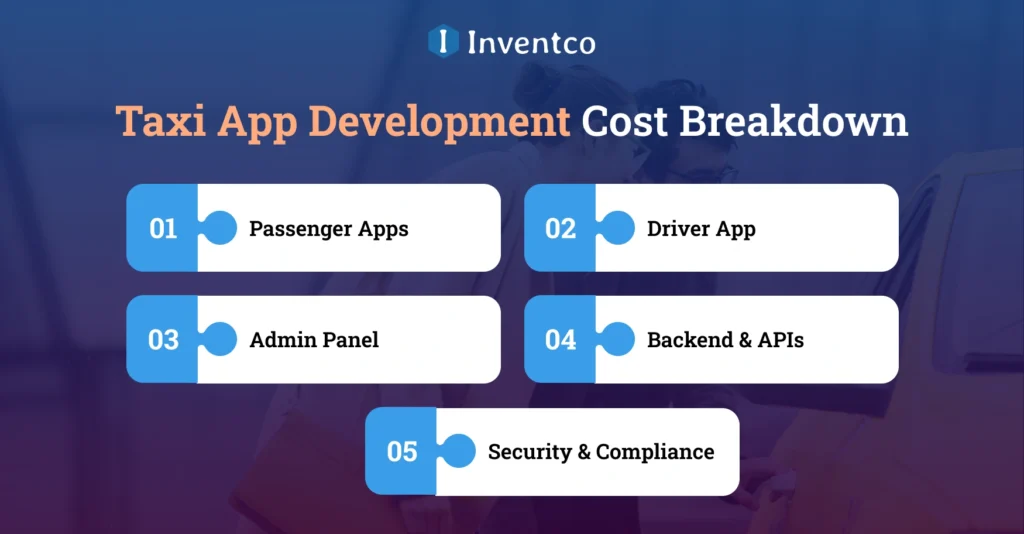
In 2026, there is a need to analyze the development cost of taxi booking apps by breaking the necessary system components that vary by modules that perform a business function and affect the performance, scalability, and the operational cost of passenger taxi booking apps in the long run.
1. Passenger Apps
This is the first and most expensive component of the system because of a number of factors such as the design of the user profile, and the performance of the driver, and the inclusion of features such as real time GPS, payment systems, histories of previous rides, and notifications of other users. By making the design and features more sophisticated, seamless user integration will be enhanced, attracting more passenger users and, in turn, increasing the cost of taxi app development.
2. Driver App
The expenses of driver oriented apps will need to focus on the add on components such as real time driver feedback via route, and performance dashboards. Additionally, driver feedback on schedules via optimized route charts, performance dashboards, and for driver incentive and route management will experience similar app development cost integration.
3. Admin Panel
The admin panel operates the entire system. It performs user and driver control, route management, system pricing, analytical control of system pricing, commission system reporting, and system admin reporting for disputes. Increasing the features of the admin panel of the booking taxi system, will increase the level of operational efficiency of the overall system.
4. Backend & APIs
This layer enables user, driver, and admin interactions and synchronizations. It involves cloud computing, databases, payments and other third-party integrations (mapping, notifications), and scalable architecture. Backend complexity is a significant cost factor when developing a taxi booking app, particularly for high-traffic services.
5. Security & Compliance
Standard features of modern taxi apps, including data encryption, secure user authentication, fraud prevention, and compliance with GDPR and PCI DSS, add additional costs to taxi booking app development. However, these mobile app security measures help to protect your business value over time.
All these factors are critical to determining your initial costs and the potential for growth and success.
Note: Thinking about launching an app like Uber? Start with this complete development guide.
How Features Impact Taxi App Development Cost?
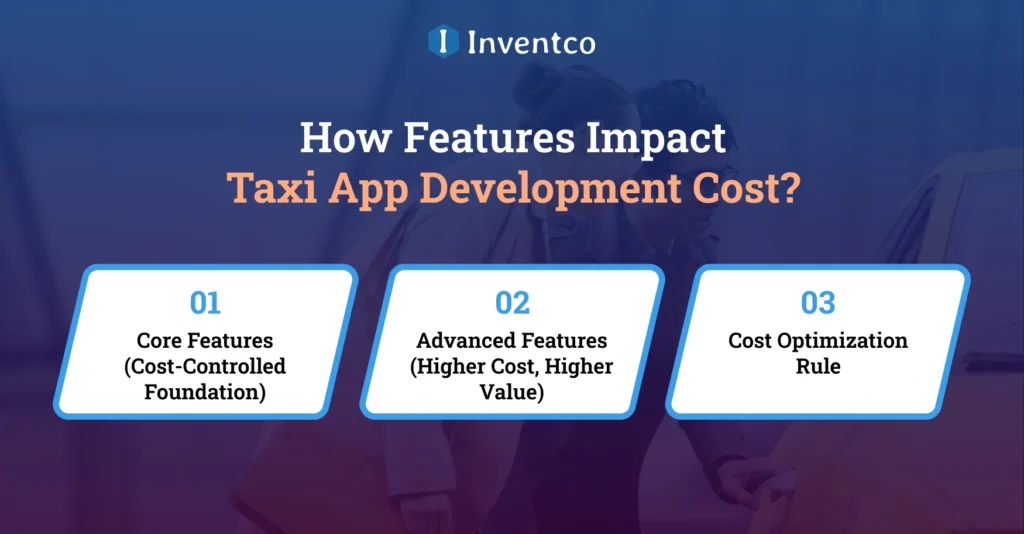
Estimating the cost of developing a taxi booking app increases due to the varying feature sets. Features dictate app functionality, scalability and profitability.
1. Core Features (Cost-Controlled Foundation)
Basic features serve as cost-effective foundational building blocks for any taxi booking service. These include user and driver registration, trip booking, fare estimation, GPS tracking, secure in-app payments, and basic fare calculation—an essential feature that an MVP taxi app should not exclude.
2. Advanced Features (Higher Cost, Higher Value)
Increased investment in taxi booking app development is associated with increased value offers and improvements in user experience that are cost justified. Automation, security, engagement, and monetization are the areas in which advanced features development is focused on.
Key advanced features include:
- AI-driven fare estimation with demand prediction
- In-app dynamic surge pricing
- Chat and call masking with SOS safety functions
- Geo-dispersed app functionality through multi-language and multi-currency support
- Referral engines with loyalty promotions and within-app currency systems.
Significant development time, sustained profitability and reduced cost of app development are achieved through the ongoing feature trade-off of taxi booking apps.
3. Cost Optimization Rule
A straightforward rule for 2026 is that increased automation results in higher initial development costs, but greatly reduced operational costs in the long run. Select features strategically to maximize cost-effective scalability.
Taxi App Development Cost by Platform
Selecting an initial platform will directly influence development costs, time-to-market, and long-term maintenance. By 2026, choosing between Android, iOS, or cross-platform development will be a strategic decision aligned with target demographics, scalability goals, and the taxi business’s future.
1. Android App Development Cost: Estimated Cost: $10,000 – $40,000
With more than 70% of the global mobile market share, Android app development is often revenue-generating for companies that operate within developing and high growth mobile markets. That said, Android development costs can have a high variability which can be attributed to the extensive range of devices, screen sizes, and operating system versions that developers have to account for during the testing and optimization phases of the development process.
2. iOS App Development Cost: Estimated Cost: $15,000 – $45,000
iOS app development can offer a similar level of app monetization and customer lifetime value to Android during the initial development cycle, but the iOS app development process is inherently more complex, requiring more sophisticated design and functionality to be built into the initial release. This is why for premium and urban taxi booking systems, iOS is the favored development platform.
3. Cross-Platform App Development Cost: Estimated Cost: $35,000 – $80,000
Using a cross-platform development framework means that a single codebase can run on both Android and iOS. This means that if you develop a cross-platform solution, you can launch on both platforms faster and streamline updates, reducing long-term maintenance costs. For new businesses and those developing a taxi app, this option offers valuable cost savings, especially for those with limited initial investment and future growth plans.
Note: Looking to launch a fast, efficient taxi app like Bolt? This guide shows how.
Hidden & Ongoing Taxi App Development Costs
Most founders who estimate the cost of developing a taxi app focus only on the initial build and ignore the ongoing costs of keeping the platform running effectively and efficiently. Post-launch costs are often the most impactful to consider when assessing the cost of developing a taxi booking app over months and years.
Key Ongoing Cost Factors
- Cloud Hosting & APIs: With increased app usage comes increased costs for real time databases and cloud services. Ongoing expenses will include cloud storage, real time databases, geo tracking and mapping services, push notifications, and any other integrated services.
- App Store Fees: Both the Apple App Store and Google Play Store charge annual developer fees and take a percentage of app revenue, which must be factored into long-term costs and app store optimization strategies to maintain visibility, compliance, and sustained performance.
- Payment Gateway Charges: Adding rides will only increase the cost of payment processing and other transaction fees to keep the app running, which will, in turn, eat into your profit margins.
- Maintenance & Feature Updates: To keep the app running smoothly, ongoing mobile app maintenance is essential, including regular operating system updates, security patches, performance improvements, lag fixes, and the rollout of new features to ensure long-term stability and user satisfaction.
- Customer Support Infrastructure: To help drivers and riders with their issues, additional support services will be needed, including support software, chat software, ticketing systems, and support staff.
Cost Planning Insight
Utilizing expenses that increase by 15-25% yearly are expected to recur in 2026 for the initial development of a taxi booking app. Incorporating cost estimates early in the planning process prevents budget overextension and allows continued long-term operation.
Custom Development vs Clone Apps: Cost Decision Guide
The taxi app development cost and long-term business success are heavily influenced by which development approach a business chooses. In 2026, businesses typically consider three alternatives: cloning apps, fully custom development, or a hybrid model.
1. Clone Taxi Apps
Building clone apps involves replicating an app’s existing structure. Because of a clone app’s lower upfront cost and quicker time-to-market, businesses can enter the market more quickly. Unfortunately, from an ROI standpoint, over time, the lack of customizations, the inability to scale, and overall performance begin to decrease in value.
2. Custom Taxi App Development
Custom development is the process of building an app from scratch. Although custom development delivers greater value in the long run, the initial cost is typically much higher. This is because businesses have more customization from flexible features, scalable, secure integrations, and more. Having higher development costs initially to create a custom app support, and even drives more innovation in the long run.
3. Hybrid Development Approach
The hybrid approach, which merges off-the-shelf components and custom features, provides a more balanced solution by offering time savings for development along with a greater degree of customization. This model is often sought by startups and scaling businesses that need to move quickly to achieve their growth goals.
For companies with aspirations that span into the future, custom development continues to deliver better ROI, albeit with a higher initial cost, by enabling sustainable growth and a competitive edge.
Case Study: 24×7 Taxi Rider Iceland App by Inventco
24×7 Taxi Rider in Iceland is the first and only tailored, on-demand mobility solution for locals and tourists, providing reliable 24/7 transportation throughout Iceland. App development was handled by Inventco, a leading mobile app development company delivering scalable, future-ready digital products.
The client’s aim was to create a top-tier taxi booking app to accommodate real-time ride requests, GPS tracking, and driver-passenger payment coordination, and seamless communication, even in areas with low connectivity. Inventco’s solution was to build a robust, cloud-based system with an intuitive user interface for the rider, a technologically advanced driver app, and a feature-rich administrator app for total operational oversight.
The system is fully compliant with the 2026 mobility standards. Its core values are performance optimization, scalability, data security, and user-centric UX. The app also offers seamless integration with a ride request facility to help the business streamline operations and enhance customer satisfaction.
With this project, Inventco demonstrated its ability to create modern, cost-effective, scalable taxi resources that offer sustainable, long-term value.

Conclusion
As we venture into 2026, understanding the intricacies of taxi booking app development costs will be key to building not just any mobility business, but a successful, scalable one. Costs will continue to differ based on anticipated features, platforms, timeframes, and even the desired growth goals. Preemptive planning is thus quintessential. From MVP to enterprise-grade solutions, development could be tailored to achieve a reasonable balance among performance, budget, and ROI.
Considering the recurring costs, the selection of the most ideal platform, and investment in scalable architecture will be necessary to ensure post-launch sustainability. In the end, a taxi booking app is a product of technology. More than that, however, in the right hands, it will become a strategic product that enhances operational efficiency, customer trust, and overall profitability. More importantly, it will do all of this in a market characterized by cutthroat competition in on-demand transportation.
FAQ’s
Q1. How much does it cost to develop a taxi app in 2026?
Ans. The cost to develop a taxi app in 2026 typically ranges from $10,000 to $100,000+, depending on the app’s complexity, features, platform selection, and scalability requirements. Basic MVPs cost less, while enterprise solutions require higher investment.
Q2. What factors have the biggest impact on taxi app development cost?
Ans. Key cost factors include feature complexity, real-time tracking, payment integrations, platform choice (Android, iOS, or cross-platform), backend infrastructure, security standards, and ongoing maintenance. Each of these elements directly affects development time and budget.
Q3. Is cross-platform development a good option for taxi apps?
Ans. Yes, cross-platform development is often ideal for startups in 2026. It reduces development and maintenance costs, speeds time-to-market, and enables businesses to reach both Android and iOS users with a single, scalable codebase.
Q4. What are the ongoing costs after launching a taxi booking app?
Ans. Ongoing costs include cloud hosting, third-party API usage, payment gateway fees, app store charges, regular updates, security patches, and customer support. These expenses typically add 15–25% to the initial development cost annually.
Q5. Can taxi app development cost be reduced without affecting quality?
Ans. Yes. Costs can be optimized by starting with an MVP, prioritizing essential features, choosing the right technology stack, and working with an experienced development partner. Strategic planning helps maintain quality while controlling unnecessary expenses.

Jitendra Jain
He is the CEO and Co-founder of Inventco, driving innovation in advanced computing and digital transformation. With deep expertise in modern IT ecosystems, he leads scalable, secure, future-ready solutions. His strategic leadership helps businesses accelerate growth, adopt innovation, and achieve success. You can connect with him on LinkedIn to follow his technology insights.