The rapid evolution of social media creates the need for scalable, compliant, and revenue-ready platforms that can be built at a reasonable cost. For social media founders and investors, development decisions now influence more than launch timelines, they shape the platform’s potential longevity, user retention, valuation, and ROI in a competitive digital economy, where the cost to build a social media app typically ranges from $10,000 to $100,000+ based on scope and scale.
Creator-led communities, AI-driven content discovery, and privacy-first infrastructure are shaping the social media landscape, which means social media app development is now about more than visual design and basic functionality. The ability to keep up with the social media landscape and provide core functionality is determined by platform architecture, performance, global compliance, and data security.
The purpose of the guide is to help decision makers understand the costs of development in the digital world and the hidden costs of development, as well as to help them prioritize the objectives and minimize costs. By aligning technical objectives with business objectives, social media founders can build scalable, future-ready, and compliant platforms at a reasonable cost.
Market Stats of the Social Media App Industry
- The social networking app market, which includes platforms central to mobile engagement and community growth, was valued at an estimated ~$49 billion in 2022 and is projected to reach over $310 billion by 2030 , growing at a CAGR above 23 %.
- Industry reports estimate the social networking app market size will grow significantly in the coming decade, with projections exceeding $1 trillion by 2035 at a ~24.4 % compound annual growth rate (CAGR) from 2025 onward
- Similarly, niche segments like social media management tools (used for analytics, engagement automation, and ad optimization) were valued at around $29.9 billion in 2025 and are expected to grow to $171.6 billion by 2033 at a ~24.8 % CAGR.
- Other research shows the social media market size expanding from about $208 billion in 2025 to $234 billion in 2026, driven by increased mobile usage, digital advertising spend, and platform engagement worldwide.
Average Cost to Build a Social Media App
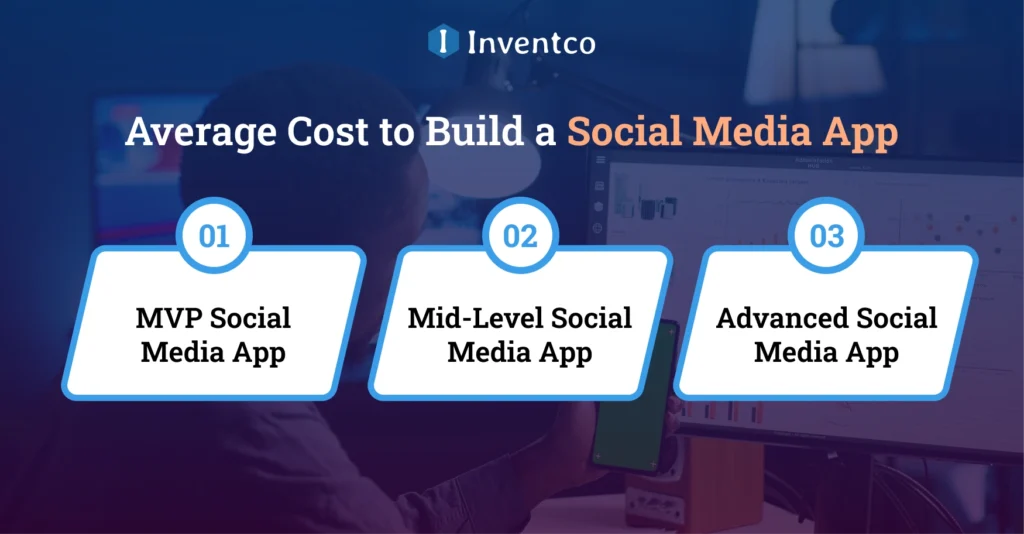
The social media app development cost of social media apps can vary as widely as $10,000 to $100,000. The costs associated with the development of the app directly relate to the business vision and app functionality. Below is a clear breakdown of app types to help founders and investors align business vision, budget, and growth strategy.
1. MVP Social Media App
MVP social media apps typically validate first-time concepts, and cost anywhere from $10,000 to $25,000. MVP budgets for social media apps typically focus on user profiles, content posting, feeds, and other basic functionalities. For start-up businesses, this method offers the best value in terms of time and money while also mitigating risk and gathering user feedback.
2. Mid-Level Social Media App
Social Media Mid-Level Apps range between $25,000 and $60,000. These social media apps provide a more ‘full-featured’ experience.‘Full-featured’ experiences include in-app payments, social media advertising, and social media messaging. These features allow the social media app to grow its revenue.
3. Advanced Social Media App
Advanced Social Media Apps cost between $60,000 and $100,000+ and are designed for large-scale apps. These social media apps provide cloud support across all tiers and almost
all of them offer uninterrupted global scalability. These scalable apps are designed for rapidly growing social media apps, are available for a large audience targeting, and can be used to gain market ownership.
| App Complexity | Estimated Cost Range | Ideal For |
| MVP Social Media App | $10,000 – $25,000 | Startups validating an idea, niche communities |
| Mid-Level App | $25,000 – $60,000 | Growing platforms with monetization and analytics |
| Advanced Social Media App | $60,000 – $100,000+ | Investor-backed platforms targeting scale and global reach |
This table reflects end-to-end development, not just UI or coding. Backend scalability, security, and compliance heavily influence the cost of the social media app.
Cost Breakdown: Where Your Budget Actually Goes
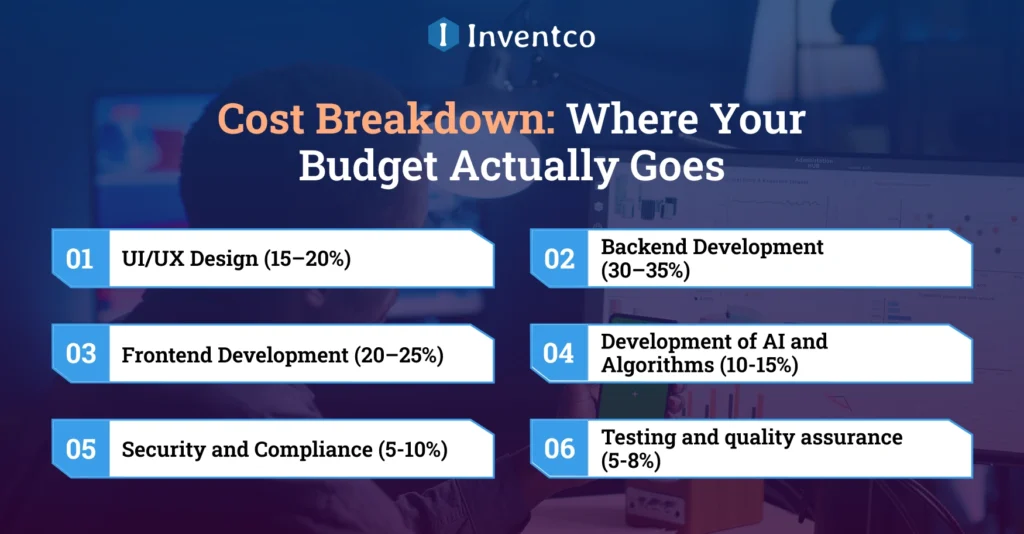
An assessment of the factors that affect the cost of building a social media app begins with allocating development budgets. The various components of a social media app shape the platform’s performance, scalability, security, and sustainability.
1. UI/UX Design (15–20%)
UI/UX design is the foundation of how customers interact with a platform, which affects engagement and retention, as well as how long they spend on it. This stage includes user research, wireframing, and building prototypes. In social media applications, seamless navigation and a frictionless onboarding process are vital for retaining customers.
2. Backend Development (30–35%)
As the foundation of a platform, back-end development will account for the largest share of a social media application’s costs. This stage involves developing the server-side logic, application programming interfaces (APIs), and database engineering. Ensuring a strong back-end is crucial, as it is instrumental for real-time messaging, updates, notification systems, and overall performance, making it essential for sustaining long-term reliability.
3. Frontend Development (20–25%)
The next stage is front-end development, where the designer’s work is translated into interactive, fast, and responsive user interfaces. This stage encompasses the optimization of performance, mobile responsiveness, and responsiveness across different platforms. In addition to user satisfaction, a well developed front-end will ensure that there is seamless scrolling, quick content loading, and it will yield better reviews for the app.
4. Development of AI and Algorithms (10-15%)
The most important factor enhancing user engagement and the overall experience on the platform is the AI and algorithm systems built into the app, such as recommendation systems, content moderation and ranking, and automated spam moderation. These systems increase user engagement by analyzing content and identifying user preferences. However, developing these systems is both complex and expensive.
5. Security and Compliance (5-10%)
The features under app security and compliance ensure that the app is in line with the user’s country’s regulations, including, but not limited to, data protection laws, secure authentication, encryption, access control, and user role assignments. Digital security and the protection of user data build trust with users and reduce the risk of lawsuits, which is especially important for platforms used in multiple countries.
6. Testing and quality assurance (5-8%)
Testing and QA for the app are conducted by evaluating real-world performance through load, security, functional, and performance app testing. Ongoing app maintenance ensures the app remains user-ready, stable, and bug-free after launch, supporting smooth releases while protecting brand reputation and user experience.
All of the previously mentioned layers influence the cost of building the social media app, especially when the priorities are scaling and future growth.
How Features Directly Impact Social Media App Development Cost?
Certain features in a social media application increase costs slightly due to added technical complexity and infrastructure requirements. While basic functionalities such as user registration, user profiles, and messaging will always be needed, adding more complex features will drive costs even higher.
- Real-Time Chat and Media Sharing: Supports instant messaging, image/video uploads, and send/receive notification features. Requires implementing low-latency servers and building a scalable messaging infrastructure.
- AI-Based Content Recommendations: Involves the optimization of machine learning algorithms to enhance personalization of the user feeds, support the discovery of new content, and foster content engagement. Drives up the costs associated with development and data processing.
- Live Streaming and Short-Form Video: Requires implementing high-performance streaming technologies, content delivery networks, and real-time engagement tools with moderator controls.
- Creator Monetization Tools: It involves integrating payment processing technologies to support compliant financial workflows such as subscriptions, creator tipping, and ad revenue sharing, enabling sustainable app monetization across the platform.
- Advanced Analytics Dashboards: Requires greater investment in backend systems and data engineering to provide user engagement, content performance, and behavioral insights.
- Multi-Region Cloud Deployment: Offers greater performance and reliability at a higher infrastructure and maintenance cost.
Social media platforms that rely on data-driven personalization and advanced app features offer stronger competitive advantages, but they also come with higher development costs.
Hidden Costs Most Businesses Ignore in Social Media App Development
Many hidden costs can appear excessive when compared with the average cost to develop a social media app, especially when viewed from a one-time launch perspective rather than a continuous investment perspective. If ongoing expenses are not factored in from the outset, growth can be significantly impeded, and the ability to scale sustainably will be jeopardised.
- Cloud Hosting and Bandwidth Scaling: With increased user activity comes the need for improved infrastructure to cope with the increased demands of data storage, content delivery, and real time processing.
- Ongoing Security Audits and Updates: To protect user data and maintain the platform’s credibility, additional auditing, patching of vulnerabilities, and compliance upgrades will be required more often.
- App Store Compliance Changes: Changes to platform policies that must be complied with will require additional changes to features, permissions, and how users interact with the app to make payments and to monetize services.
- Content Moderation Operations: To ensure platform safety and compliance, human moderators and automated compliance and content-moderation tools are needed.
- Third-Party API Pricing Increases: Third-party services, such as payment processing and analytics, often incur higher costs that scale with app usage and can be more expensive than anticipated.
- Post-Launch Feature Iteration: An ongoing expense that must not be overlooked is post-release updates to address users’ ever-changing needs and modify the app’s features.
Failing to consider these hidden costs can limit vertical scaling and worry customers and stakeholders.
How to Reduce Social Media App Development Cost Without Cutting Quality?
Cutting costs does not mean that the performance or the user experience has to be affected. With the right methods in place, businesses can cut costs in social media app development while keeping quality, scalability, and longevity in focus.
- Launch with an MVP Focused on Core Engagement Loops: This enables the app to be validated quickly and helps manage initial costs effectively.
- Use Modular, Scalable Architecture: Create systems that are flexible and can be improved or expanded without overhauling the entire platform.
- Prioritize Cross-Platform Development: Development time and maintenance costs can be easily reduced by using the same codebase to develop both iOS and Android versions of the app.
- Automate Testing and Moderation Workflows: Manual effort can be reduced through automated quality assurance and moderation systems. This improves the system’s accuracy and reduces operational costs.
Partner with a Product-Focused Development Team: Such teams are efficient in minimizing the architecture of the system and are best utilized to align the system to the needs of the business goals.
With the right methods in place, businesses can ensure enterprise-grade reliability and performance while keeping costs down.
Case Study: Wegram App by Inventco
The Wegram application is a performance-based platform that focuses on social media user engagement metrics and social media creator monetization. It also offers a monetization model for social media creators. The objective is to establish Wegram as an industry-scale performance platform. Throughout the application’s life cycle, Inventco planned to ensure that the platform remained aligned with the organization’s goals. Inventco focused its technical efforts on the Wegram social media application.
The development goals of the Wegram social media application were to provide a basic, first-of-its-kind social media platform that would provide artificial intelligence-based personalized content feeds. Initial development of the social media application would provide infrastructure for future regional growth. The social media application would provide growth potential for future positive regional expansion and overall growth.
To minimize costs and launch delays, Inventco focused on a minimal viable product (MVP) development model. The social media platform quickly entered the market; after gaining traction, Inventco introduced core and advanced engagement features.
This phased development model offers numerous advantages. Overall, the approach offers positive revenue growth, lower Wegram costs, and shorter development time. The overall approach has improved investor confidence in the Wegram social media application and positioned the company to sustain positive revenue growth.

Conclusion
It is important for investors and funders to understand the costs of building a social media platform, especially if their ambitions are for sustainable growth. Depending on the platform’s complexity, required features, and level of scalability, development costs can vary. When costs are fixed in advance, development can begin without the need for future technological enhancements, which can limit the platform’s functionality.
The successful building of platforms entails integrating technological choices with monetization strategies, compliance, and ever-changing user expectations. Development choices affect the outcome, organizational strategy, security, and competitiveness of the platform in the market.
A well-thought-out social media application will provide the organization with more than just a successful launch. It will also create an asset of sustained future value, attracting users, building stakeholder confidence, and providing measurable value through scalability, engagement, and monetization.
FAQs
Q1. What is the minimum social media app development cost?
Ans. The minimum social media app development cost typically starts between $10,000 and $25,000 for an MVP. This includes essential features, basic UI/UX, and backend infrastructure to validate the idea before scaling.
Q2. What factors influence the cost to develop a social media app the most?
Ans. Key factors include feature complexity, scalability requirements, AI integration, compliance standards, and platform choice. These elements collectively determine the final cost to develop a social media app.
Q3. Is the average cost to build a social media app higher in 2026?
Ans. Yes, the average cost to build a social media app has increased due to higher security standards, AI-driven personalization, and compliance requirements, but these investments improve long-term platform sustainability.
Q4. How does monetization strategy affect social media app cost?
Ans. Monetization features like ads, subscriptions, and creator payouts increase development complexity. These directly affect the cost of the social media app but also enhance revenue potential and investor appeal.
Q5. Can I reduce costs when building a social media app without sacrificing quality?
Ans. Yes, by launching an MVP, using scalable architecture, and prioritizing core features, businesses can reduce the cost to make a social media app while maintaining performance and user experience.
Q6. How long does it take to create a social media app?
Ans. The cost to create a social media app is closely tied to timeline. MVPs take 3–4 months, while advanced platforms may require 6–9 months depending on features and integrations.
Q7. What ongoing costs should investors consider?
Ans. Ongoing costs include hosting, security updates, compliance audits, moderation, and feature upgrades. These recurring expenses are critical when evaluating the true cost of a social media app.
Q8. Why should founders partner with a professional development company?
Ans. A professional partner ensures optimized development cost, scalability, compliance, and faster go-to-market, reducing long-term risks and maximizing ROI for social media app investments.

Ajay Bhal
He is an on-demand app solutions expert with 11+ years of experience in business consulting and building scalable, user-centric digital products. He specializes in robust on-demand platforms across industries, combining technical expertise with business-focused strategy to deliver efficient, top notch solutions that drive growth and enhance user experience. You can connect with him on LinkedIn to follow insights.