The demand for scalable, compliant, and data-driven platforms has intensified as fleet management software development services gain traction across logistics, transportation, construction, and EV-driven businesses. According to industry research, the global fleet management software market is projected to reach around $38.28 billion in 2026, driven by digital transformation, real-time analytics needs, and broader adoption of cloud-based fleet solutions.
Fleet management software has broadened the scope of these services for founders and investors. It is now seen as a strategic digital asset for cost control, operational visibility, and new revenue pathways. There is a clear trend toward organizations moving from spreadsheets and legacy systems to new intelligent fleet systems.
This is the first of several documents detailing the process of developing fleet management software, how the software works, development costs, and the reasons for a custom solution.
What Is Fleet Management Software?
Fleet Management Software is a complete solution for managing, monitoring, and optimizing fleet vehicles. It integrates data on vehicles, drivers, maintenance, fuel, routes, and compliance into a single system.
Fleet management software development, from a business standpoint, helps organizations reduce costs, optimize assets, ensure regulatory compliance, and maintain real-time operational visibility.
What does fleet management software do in plain and simple terms? It helps companies monitor vehicles, manage drivers, minimize downtime, and make data-driven decisions to increase operational efficiency and profitability.
How Fleet Management Software Works?
Understanding how fleet management software works defines the interrelationships among data within vehicles, systems, and business processes is of utmost importance before development begins. Current fleet management systems function as an integrated ecosystem, connecting vehicle hardware, mobile apps, cloud systems, and analytics.
Let us examine how fleet management systems work:
- Data Collection from Vehicles: Operational data is gathered by the vehicles’ GPS devices, telematics systems, and on- board IoT sensors. These devices record and transmit operational parameters, such as location, speed, fuel level, engine performance, and driving behavior.
- Real-Time Cloud Data Transmission: The collected data is sent and stored in the cloud. The cloud offers continuous availability, reliability, and the ability to process data for a fleet of any size and in any geographical location.
- Data Processing and Analytics: The fleet management software is equipped with analytical systems that process data to generate relevant insights. Advanced analytics helps fleet managers make data-driven decisions by analyzing operational parameters such as compliance, maintenance, route optimization, and performance.
- Dashboards and Operational Visibility: The software includes cloud dashboards that provide integrated operational data in a sequential, actionable format. This offers fleet commanders active management and an unrestricted view of the fleet’s operational parameters. This removes all operational restrictions and greatly decreases the operational obstacles.
- Automated Alerts and Notifications: Automated alerts inform teams of important occurrences such as maintenance needs, compliance deadlines, unsafe driving, or deviations from planned routes. This approach reduces risks and decreases manual supervisory actions.
- Integration with Business Systems: Using APIs and middleware, fleet management software integrates easily with existing business functions. Integrations with ERP, accounting, payroll, and logistics systems enable data uniformity, operational alignment, and process automation in a continuous flow.
This framework provides seamless integration with existing business functions, including ERP, accounting, payroll, and logistics systems.
How to Build Fleet Management Software?
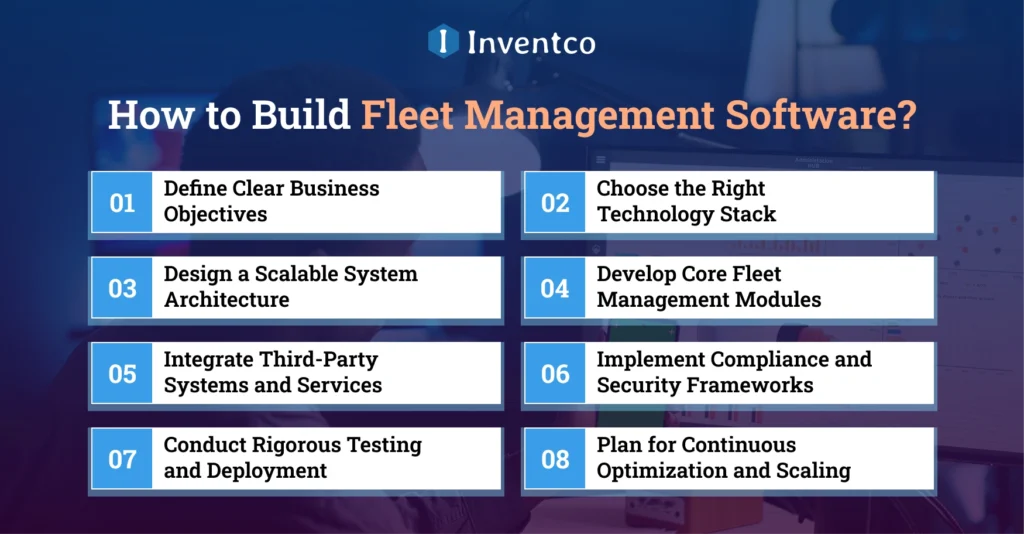
Developing tailored fleet management software requires considering the business’s needs, including technology, compliance, business goals, and operational growth.
1. Define Clear Business Objectives
Determining specific business goals is the first step of developing fleet management software. Goals can include reducing operational expenses, enhancing regulatory compliance, optimizing battery-powered fleets, supporting real-time analytics, and more. Goals should be set early so that software features, development actions, and financial investments align with them.
2. Choose the Right Technology Stack
Identifying an appropriate technology stack is essential for scaling and ensuring long-term viability. Building fleet management software these days typically involves the Cloud, GPS and mapping, telematics and IoT, and analytics tools. Choosing the best stack will improve system reliability and enable the processing and deployment of real-time integrations with new technologies.
3. Design a Scalable System Architecture
Cutting-edge system architecture eliminates the need for extensive overhauls as the company grows. Fleet management software should be designed with modular, cloud-native, and API-first principles. This supports the effortless addition of features, improvements to third-party integrations, and overall software performance, while also providing adaptability for a growing fleet and geographic operations.
4. Develop Core Fleet Management Modules
The backbone of the fleet management software consists of core modules. These include driver management, software alerts, maintenance scheduling, reporting dashboards, and real-time vehicle tracking. Construction of these modules with clean workflows and smooth interfaces delivers and ensures usability, actionable, and accurate operational insights for daily workflows.
5. Integrate Third-Party Systems and Services
The best fleet software solutions provide integration with external systems, fuel cards, accounting systems, ERP systems, and telematics. With these integrations, data silos are eliminated, reporting is automated, and a complete circle of operational visibility is achieved. This helps businesses streamline workflows and improve cross-departmental decision-making.
6. Implement Compliance and Security Frameworks
Fleet management software must comply with transportation regulations, data privacy regulations, and industry-wide requirements. With embedded workflows, audit logs, role-based access control, and system encryption, the sensitive data is protected, and the system remains compliant with the requirements of the different regions and environments in which it operates.
7. Conduct Rigorous Testing and Deployment
Reliability is the main concern, and achieving it requires testing. The fleet software must undergo testing for performance, security, and integration, as well as validation and user acceptance. The structuring of a deployment strategy reduces operational disruption and ensures seamless onboarding and system availability across teams.
8. Plan for Continuous Optimization and Scaling
Developing fleet management software is an iterative process. Long-term value is achieved by regularly optimizing the software through analytics, upgrading features, and monitoring performance. Developing custom fleet management software allows founders to adapt the platform to evolving business needs, changing regulations, and new mobility trends.
With a carefully defined strategic development roadmap, companies can create fleet management software that optimally balances scalability, compliance, cost efficiency, and competitive differentiation.
Cost to Develop Fleet Management Software
One question investors and founders alike frequently ask is how much fleet management software costs. The cost to build a fleet management software can range somewhere between $10,000 to $1,00,000+, but it depends on several different variables, such as system complexity, feature depth, third-party integrations, system scalability, and ultimately the long-term business goals. Because custom fleet management software development entails variable costs, it offers the greatest flexibility for prioritising features based on immediate and future needs.
1. Basic MVP: $10,000 – $25,000
A basic MVP is often best suited to startups and pilot programs focused on validating core functionality. It usually includes real-time GPS tracking, basic dashboards, vehicle status monitoring, and limited-scope reporting. This version is useful for testing whether there is a market for the product, assessing the solution’s operational feasibility, and providing early ROI with minimal risk.
2. Mid-Level Platform: $25,000 – $60,000
The mid-level fleet management platform is designed to support operational growth for a business that has automated previously manual tasks and is ready to make data-driven decisions, a need for late-stage product development. This platform includes driver behavior and analytics, maintenance scheduling, route optimization, advanced reporting, and basic integrations with other accounting, ERP, or logistics systems. This is the tier that achieves the best balance of scalability, performance, and cost efficiency.
3. Enterprise-Grade Solutions: $60,000 – $100,000+
Enterprise solutions are designed for very large or multi-region fleets with more complex compliance and performance requirements. These more complex solutions include integrated advanced analytics powered by artificial intelligence, EV fleet management, advanced data security, customized data processing for large volumes, and AI-based analytics.
4. Feature-Wise Cost Influencing Factors
Several features, with varying degrees of technical complexity and data processing requirements, affect the development costs of fleet management software.
- Real-time mapping with GPS tracking and live vehicle location and route updates
- Analytics of driver behavior and telemetric and performance-based safety
- Automation of maintenance with predictive alerts to minimize downtime and repair costs
- Reporting and dashboards with real-time and historical analytics
- AI route optimization to enhance fuel economy and improve delivery time windows
- EV fleet management and energy analytics on charging, battery health, and sustainability metrics
Custom fleet management software is a long-term operational expense rather than a short-term expense. It will be a future-ready investment, as it enables partial updates, reduces long-term maintenance costs, ensures flexibility, and delivers a more scalable, cloud-native architecture.
Key Features Required in Custom Fleet Management Software
The most successful custom fleet management software solution focuses on features that enhance operational visibility, efficiency, and regulatory compliance. Custom software development, in contrast to off-the-shelf platforms, enables companies to tailor functionality to the size of the fleet, specific industry needs, and scalability requirements.
For custom fleet management platforms, the following app features, both core and advanced, provide the essential foundation for achieving the goals of sustained growth, compliance, and progressive analytics-based decision-making.
Core Features of Fleet Management Software
- Real-Time GPS Vehicle Tracking: Real-time GPS tracking of vehicles enables companies to maintain constant visibility into the fleet, including where vehicles are, where they are going, and their status. This is vital for optimizing routes, reducing delays, improving asset utilization, and proactively addressing operational issues within the fleet.
- Driver Management and Performance Monitoring: This feature of the software tracks driver behavior and hours worked to improve driver safety, accountability, and productivity (pun intended). Performance analytics are used to reduce accident risk, promote regulatory compliance, and facilitate operational standard training tailored to drivers’ needs.
- Fuel Consumption Tracking: Fuel Tracking enables companies to monitor and understand their fuel usage and spending. The analytics derived from fuel tracking and the fuel used can help reduce operational costs by optimizing fleet driving behavior and improving cost efficiency.
- Maintenance Scheduling: Automated maintenance scheduling allows the business to set service reminders to ensure preventative maintenance is completed before the vehicle gets serviced. Breakdowns, vehicle downtime, overall vehicle longevity, and costly repairs are all negatively affected by a lack of preventive maintenance. Proactive management of fleet maintenance will keep costs down.
- Route Planning and Optimization: Route optimization and planning assist with the operational efficiency of completing the assigned shipment assigned to the fleet. Improving route optimization and planning improves customer service by reducing delivery times and fuel costs and making more effective use of the routes assigned to drivers.
- Compliance and Documentation Management: Compliance management consolidates the management of inspections, licenses, registers, and documentation for applicable regulations. Automated alerts help the business remain compliant with transportation industry regulations and safety measures and avoid legal risks and administrative overhead.
- Alerts and Notifications: Alerts and notifications cover all events, including maintenance schedules, geofence limits, and time limits for compliant slowing. These include notifications about the route assigned to the employee. These help monitor employees to ensure routes are followed and mitigate operational disruptions.
- Reporting and Analytics Dashboard: A centralized dashboard to fleet data streamlines access to the data and turns it into useful information. Monitoring data helps develop actionable strategies by improving how costs and budgets are analyzed, assessing time spent and collected data to improve the overall performance of the fleet.
Advanced Features of Fleet Management Software
- AI-Powered Predictive Maintenance: Advanced AI predictive maintenance uses historical and current data to predict vehicle breakdowns and improve fleet reliability. It improves data-driven maintenance planning, lowers repair costs, and reduces unexpected downtime.
- EV Fleet Management Software Support: Support for fleet management software for electric vehicles helps organizations monitor and manage electric fleets and meet established sustainability and environmental regulations. This feature optimizes battery health, charging cycles, and consumption, and improves your range.
- Telematics and IoT Integration: Telematics and IoT integration combine vehicles, sensors, and other onboard hardware with the fleet software platform. This streamlines real-time diagnostics and behavior-driving analytics for data and modern fleet management.
- Carbon Emission Tracking: Carbon emissions tracking measures and calculates the environmental impact of fuel consumption and driving behavior. It is helpful for sustainability reports, regulatory compliance, and your company’s ESG initiatives to reduce emissions from your fleet.
- Geofencing: The use of geofencing establishes Virtual Perimeters around specified locations. Automated notifications provide alerts whenever vehicles enter or exit those zones, improving security, compliance on selected routes, asset control, and accountability for operational costs.
- Advanced Security and Access Control: Role-based access control, audit logs, and data encryption protect detailed fleet-sensitive data. Security, privacy, access control, and compliance remain intact across teams and locations.
- Multi-Fleet and Multi-Region Support: Managing multiple fleets across different geographies is supported by multi-region and multi-fleet capabilities. It provides standard reporting that considers different regional compliance, operations, and regulations.
- API-Based Third-Party Integrations: Seamless connectivity with ERP, accounting, fuel card, payroll, and logistics apps is enabled by API-based integrations. It promotes data integration and operational unification across the enterprise.
Core Functions of Fleet Management Software
Fleet management software aims to streamline multiple fleet activities while improving visibility, efficiency, and regulatory compliance. Its core functions focus on turning fragmented, manual processes into smart, integrated, and flexible workflows that allow the optimization of scaling and costs.
1. Operational Visibility and Asset Tracking
The software provides visibility into real-time vehicle location, status, and utilization. Asset tracking provides businesses with valuable operational data to monitor fleet performance, reduce idle time, prevent misuse, and improve data-driven decision-making.
2. Driver Oversight and Safety Management
Driver behavior, along with work hours and safety metrics are monitored and analyzed by fleet software. This function helps businesses enhance and reinforce work accountability, mitigate and manage safety risks, support training, and maintain compliance with all applicable transport and labor regulations.
3. Performance Analytics and Reporting
Fleet management software operationalizes data flows into dashboards that deliver actionable analytics. The outputs help managers assess route performance, fuel efficiency, maintenance patterns, and overall fleet productivity. This ultimately helps managers make strategic and operational financial decisions.
4. Automated Workflows and Compliance Management
Automation of manual tasks, such as maintenance reminders, compliance reports, and alerts, is handled through workflows. In doing so, the system minimizes manual administrative workload, reduces the risk of error, and makes the workflow’s focus on compliance more pronounced and consistent.
Types of Fleet Management Software
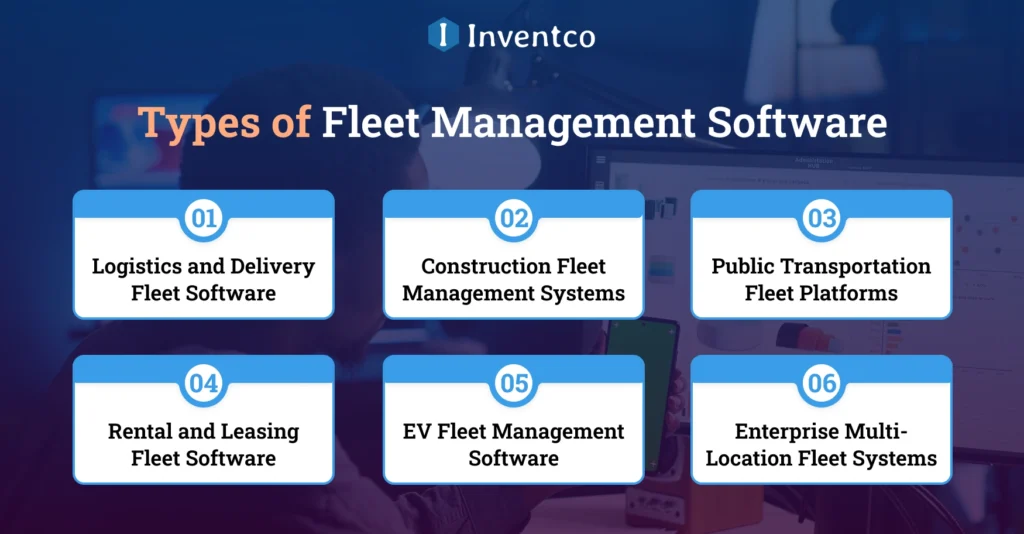
The varying industries and the operational and compliance complexities lead to differing fleet management software. By understanding the industries and niches of fleet management software, founders and investors can select or design the right solutions for their business and the scale they need to achieve.
1. Logistics and Delivery Fleet Software
Managing time-sensitive deliveries and transporting goods requires managing logistics and completing last-mile delivery operations, which requires specialized fleet management software for logistics and deliveries. It offers solutions for route optimization, fuel management, delivery performance analytics, and real-time tracking. Logistics and delivery software effectively support operational cost management and the scaling of delivery networks by reducing delivery time and increasing visibility, thereby improving customer satisfaction.
2. Construction Fleet Management Systems
Heavy vehicles and construction equipment operating on different job sites require their own construction fleet management software. These construction fleet management software platforms help manage vehicles and construction equipment by tracking compliance with fuel, scheduling, maintenance, safety, and more. Fleet management software geared towards construction helps with project timing, cost control, and on-site safety by better utilizing construction assets and reducing downtime.
3. Public Transportation Fleet Platforms
Public transport vehicle fleets use platforms built specifically for buses, city cars, and transport authorities that require strict reliability and adherence to laws. Systems for these types of fleets include schedule management, vehicle health monitors, route optimization, and passenger safety data. With centralized supervision and real-time data, public transport fleets can provide authorities with software to maintain consistent service and streamline operations.
4. Rental and Leasing Fleet Software
Software for rental and leasing fleets enables management of vehicle availability, contracts, billing cycles, and asset lifecycle tracking. It enables organizations to track vehicle usage, minimize idle time, and automate maintenance and compliance tasks. This type of software increases the asset’s profitability while enhancing operational transparency and the customer experience.
5. EV Fleet Management Software
Management software for EV fleets is designed specifically for electric vehicles. It monitors and tracks charging schedules, battery health, energy usage, optimized range, and sustainability metrics. As the use of EVs increases, this software enables companies to efficiently manage their electric fleets, in compliance with environmentally friendly regulations, while also achieving long-term goals in reducing carbon emissions.
6. Enterprise Multi-Location Fleet Systems
Enterprise multisite fleet systems are for large companies that operate fleets across multiple regions. These systems consolidate data, streamline reporting, and support compliance across various operations. Enterprise fleet software facilitates consistent fleet governance and delivers strong predictive analytics, with the added value of advanced analytics and unlimited, seamless integrations.
Selecting the appropriate fleet management software type secures operational effectiveness, regulatory compliance, and potential growth. From the perspective of founders and investors, this software selection influences long-term ROI, platform adaptability, and prevailing competitive advantage.
Who Should Use Fleet Management Software?
Fleet management software provides a comprehensive set of tools for organizations that use vehicles in their operations and need to manage visibility, expenses, and regulatory compliance. However, it provides the most significant advantages to companies that manage complicated, diverse, and/or large fleets.
1. Logistics and Supply Chain Companies
Fleet management software helps logistics and supply chain companies to see the current status of their fleets, optimize their operations, and to manage their expenses, including fuel. Other benefits include improved delivery accuracy and the ability to maintain the same level of service with consistent consistency across international and cross-border routes.
2. Transportation and Delivery Startups
Fleet management software helps transportation and delivery start-up companies scale operations by automating dispatch while controlling costs. Start-up companies can also meet customer demands while maintaining service reliability and high delivery speed in competitive, time-sensitive markets.
3. Construction and Mining Firms
Construction and Mining companies use fleet management software to track heavy construction equipment use, schedule maintenance to minimize downtime, ensure compliance with safety regulations, and reduce or eliminate costly downtime across multiple job sites.
4. EV Fleet Operators
Operators of Electric Vehicle (EV) fleets use specialized fleet management software to track maintenance and usage, charging cycles, energy consumption, total range, and sustainability metrics to support environmental compliance.
5. Corporate Enterprises with Large Vehicle Assets
Fleet management software helps corporate enterprises that handle large fleets of vehicles streamline operations, unify reporting, enhance asset optimization, and sustain compliance in cross-departmental, cross-geographic, and intracompany organizational complexities.
6. Investors and SaaS Stakeholders
From an investor’s standpoint, the software designed for fleet management offers high potential for a Software as a Service (SaaS) business model that has recurring revenues, rapidly growing cross-sector demand, and, in the long run, offers sustainable scalability due to the regulatory compliance and stretchable long-term mandates that pertain to the industry.
Fleet management software offers strong potential for SaaS business models, with verified recurring revenue, growing cross-sector demand, and long-term scalability.
Challenges in Fleet Management Software Development
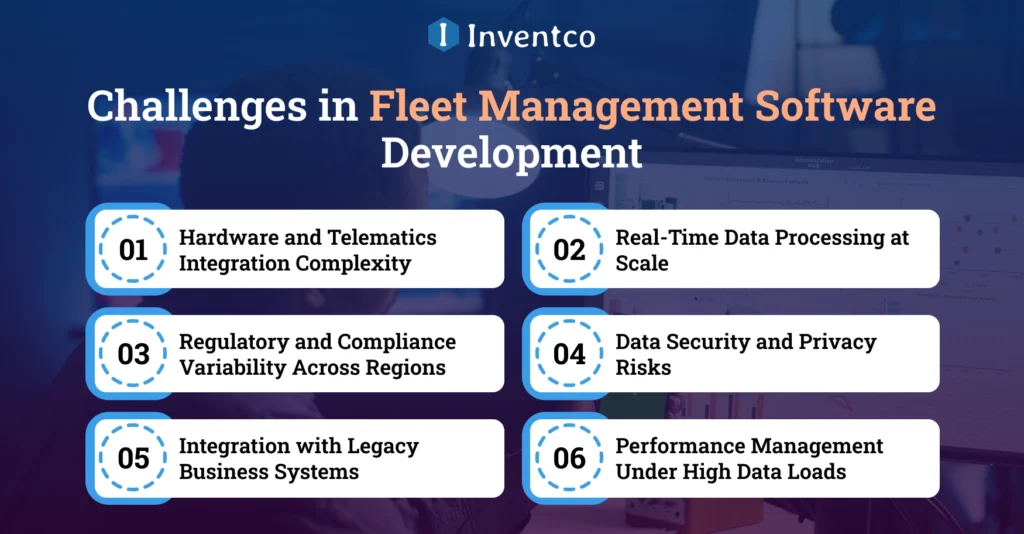
Developing scalable, compliant fleet management software is a multi-phased endeavor. In the subsequent sections, the development challenges most businesses encounter when creating fleet management software in the early stages, and the reasons it is fundamental to long-term success, will be examined.
1. Hardware and Telematics Integration Complexity
Fleet management software must synchronize with a variety of GPS devices, telematics units, and other IoT sensors from different suppliers. Data formats and communicative language protocols vary from vendor to vendor. It’s not that standardization is impossible, but it is very complicated. In the absence of the necessary middleware and validation layers, tracking and system reliability will be compromised by inconsistent data.
2. Real-Time Data Processing at Scale
Fleet platforms process large volumes of data in real time, including vehicle location, speed, diagnostics, and driver behavior. To ensure low-latency data ingestion, accurate processing, and uninterrupted operational performance for thousands of vehicles, the company needs scalable cloud architectures, event-driven architectures, and optimized data pipelines.
3. Regulatory and Compliance Variability Across Regions
Fleet operations span many cities, states, and even countries, where different regulations governing transport, safety, and data protection apply. Software needs a rule-setting compliance design that enables it to adapt in a timely manner to different regulations without expensive redesigning, redeploying operational systems, or losing operational productivity.
4. Data Security and Privacy Risks
Sensitive information, such as vehicle locations, driver information, and operational patterns, is stored in fleet management systems. Protecting this information requires measures such as enterprise-level data encryption, role-based access control, audit logs, and compliance with data privacy regulations, including the GDPR and the regulations governing the region’s transport systems.
5. Integration with Legacy Business Systems
In addition to the modern fleet software, many businesses still use legacy systems for ERP, accounting, human resources, and logistics. The process of integrating new fleet software can be disruptive and complex, so it often requires custom API development, data mapping, and step-by-step migration to ensure business operations continue uninterrupted.
6. Performance Management Under High Data Loads
As fleets grow, system performance tends to degrade under heavy data loads unless the architecture is scalable. Insufficient load management results in sluggish dashboards, delayed alerts, and downtime. These factors hinder operational effectiveness and decision-making.
A steadfast fleet management software development partner eliminates such obstacles by employing proven frameworks, scalable architecture, and systems designed for compliance. These factors ensure performance, security, and long-term ROI.
Why Choose Inventco to Develop a Fleet Management Software?
Inventco is a trusted mobile app and software development company specializing in building scalable, secure, and high-performance fleet management platforms. We work closely with founders and investors to design systems that solve real operational challenges while supporting long-term business growth. Our focus is not just on development, but on delivering measurable ROI through intelligent automation and data-driven decision-making.
With deep expertise in custom fleet management software development services, Inventco builds solutions that align with regulatory requirements, industry standards, and evolving mobility trends. From logistics and transportation to EV and enterprise fleets, our platforms are designed to integrate seamlessly with existing business processes and scale effortlessly as operations expand.
Inventco is set apart from the rest by our combination of management compliance standards across the evolving mobility ecosystems that govern systems and software solutions. We have gone beyond generic, off-the-shelf solutions to offer fully made-to-order management and control systems and software for evolving management systems. out of the shelves.
Conclusion
Fleet management software has shifted from an operational tool to a digital asset that enhances efficiency, compliance, and profitability. For founders and investors, understanding how to build fleet management software, how it operates, and which features deliver value is critical to staying actionable and defensible. Modern fleet software offers features such as real-time visibility, automation, EV readiness, and analytics that support scalable operational growth while managing risk and cost leakage.
With the right partner in fleet management software development and a clear roadmap, companies can evolve from siloed systems and manual workflows. Tailor-made systems enable the integration of optimized workflows, adapt to regulations, and grow to meet the needs of business expansion. When developed with intention, fleet management software becomes a value-adding operational asset rather than an expense.
FAQ’s
Q1. What is the best fleet management software?
Ans. The best fleet management software is the one that aligns with your business size, fleet complexity, compliance requirements, and long-term growth strategy. For growing companies and enterprises, custom fleet management software development often delivers better scalability, data ownership, and integration flexibility than off-the-shelf tools.
Q2. How does fleet management software integrate with existing business processes?
Ans. Fleet management software integrates with existing business processes through secure APIs, middleware, and cloud-based connectors. These integrations allow seamless data exchange with ERP systems, accounting platforms, HR tools, fuel card systems, and logistics software, ensuring operational continuity without disrupting current workflows.
Q3. How much does fleet management software cost?
Ans. Fleet management software development cost typically ranges from $10,000 to $100,000+, depending on system complexity, features, integrations, and scalability requirements. Basic platforms focus on tracking and reporting, while enterprise solutions include AI analytics, compliance automation, EV support, and third-party integrations.
Q4. What does fleet management software do?
Ans. Fleet management software centralizes vehicle tracking, driver monitoring, maintenance scheduling, fuel management, and compliance reporting into a single platform. It enables businesses to reduce operational costs, improve asset utilization, enhance safety, and make data-driven decisions using real-time and historical fleet data.
Q5. What is EV fleet management software?
Ans. EV fleet management software is a specialized solution that monitors electric vehicle charging, battery health, energy consumption, range optimization, and sustainability metrics. It helps organizations manage EV-specific challenges while supporting regulatory compliance and long-term carbon reduction strategies.
Q6. Who should invest in fleet management software development?
Ans. Fleet management software development is ideal for logistics companies, transportation startups, construction firms, public-sector operators, and enterprises managing large fleets of vehicles. For investors, it represents a scalable SaaS opportunity with recurring revenue potential and strong demand across multiple industries.
Q7. How does fleet management software improve operational efficiency?
Ans. Fleet management software improves operational efficiency by automating manual processes, including route planning, maintenance reminders, compliance tracking, and reporting. Real-time insights allow managers to proactively address issues, reduce downtime, optimize fuel usage, and improve overall fleet productivity.
Q8. Why choose custom fleet management software over off-the-shelf solutions?
Ans. Custom fleet management software development offers greater flexibility, scalability, and control compared to off-the-shelf tools. It allows businesses to build features tailored to specific operational needs, integrate seamlessly with existing systems, and evolve the platform as regulations, fleet size, and technology change.

Jitendra Jain
He is the CEO and Co-founder of Inventco, driving innovation in advanced computing and digital transformation. With deep expertise in modern IT ecosystems, he leads scalable, secure, future-ready solutions. His strategic leadership helps businesses accelerate growth, adopt innovation, and achieve success. You can connect with him on LinkedIn to follow his technology insights.