The requirements for building a scalable, compliant, and intelligent drone platform have never been more evident. As drone software development accelerates across logistics, last-mile delivery, agriculture, surveillance, and infrastructure inspection. Investors and founders are realizing that drones are no longer just hardware, they are software-driven ecosystems.
The success of a drone delivery app depends on many factors related to software development. From autonomous navigation to real time telemetry, from regulatory compliance to AI-powered route optimization, the list goes on and on. Choosing the right drone software development company is not about hiring developers.
Your choice is for a value-adding partner who can accompany you on the journey in the long haul. One that can define and design the solution based on the requirements from the aviation sector, the safety-critical systems, and the enterprise level sustenance and growth.
This guide explains how to choose a drone software development company, what factors truly matter, common mistakes to avoid, and how the right partner can turn a high-potential drone idea into a revenue-generating, regulation-ready platform.
Why Businesses Need Custom Drone Software?
Off-the-shelf software might work for firms and hobbyist drone users, however, commercial drone delivery systems software operates in a more complex and regulated environment. Once drone delivery services move beyond experimentation and into the distribution phase, the software requirements become greater in order to ensure compliance for operational, regulatory and growth scale.
Market Growth Is Driving Customization
The results of rapid market growth and operational divergence have created a sense of urgency for businesses to invest in custom drone software.
- The global commercial drone market was valued at approximately USD 30.02 billion in 2024 and is projected to reach about USD 54.64 billion by 2030, driven by enterprise use in logistics, infrastructure inspection, agriculture, and industrial automation.
- The drone delivery services segment is smaller but fast-growing, forecast to grow from around USD 1.5 billion in 2025 to roughly USD 5.8 billion by 2030.
- Other analyses estimate the broader global drone market, including passenger, commercial, industrial, and defense UAVs, could reach approximately USD 52.96 billion by 2030.
What Custom Drone Software Enables?
Businesses get complete control of custom-built drone systems over mission-critical possibilities such as:
- Autonomous flight logic and safety protocols tailored to specific delivery routes and environments
- AI-driven obstacle avoidance and route optimization for faster, safer operations
- Real-time drone fleet management, monitoring, and delivery orchestration
- Built-in compliance with aviation regulations, data security standards, and audit requirements
Strategic Value for Founders and Investors
For drone delivery platform founders and investors, custom software is more than just a technical decision, it is a strategic decision. It builds a unique technological layer, reduces regulatory risk, and facilitates vertical scope. In the custom rapid development of competitive drone delivery markets, it is both a growth driver and a protective moat.
Key Factors to Consider When Choosing a Drone Software Development Company
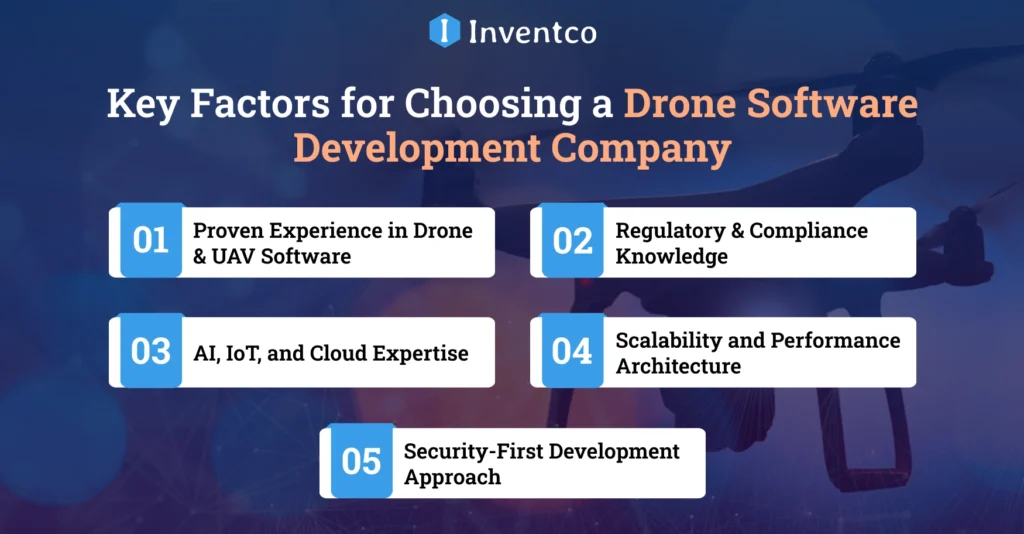
Picking a good drone software development company is a large-scale, long-term decision that will affect everything from scalability and compliance to ROI. For founders and investors creating drone delivery platforms, the following will help you narrow down your choices.
1. Proven Experience in Drone & UAV Software
The various subfields of drone software development are far more intricate than those in mobile and web app development. Your potential tech partner should be able to show you their work in:
- UAV (unmanned aerial vehicle) flight control and mission planning systems
- Commercial drone delivery application development
- The processing and analysis of real-time telemetry and sensor information
- The development of AI for systems of autonomous navigation and decision making
Getting your partner to claim they have a strong enough record to instill you with confidence in drone software development will cause you to face technical and regulatory complexity.
2. Regulatory & Compliance Knowledge
Several aviation and data protection regulations govern the operation of drone delivery platforms. Your development partner must be able to demonstrate knowledge of and compliance with:
- BVLOS (Beyond Visual Line of Sight) operational standards
- Geo-fencing and no-fly zone enforcement
- Flight logging, traceability, and audit trails
- Data privacy, cybersecurity, and regulatory reporting standards
Compliance should be built in from the get-go. It should be part of the foundational architecture, not something added after the product is launched.
3. AI, IoT, and Cloud Expertise
The latest drone platforms are built using multiple, integrated, cutting-edge technologies. A dependable drone software development company should have integrated proficiency in:
- AI and machine learning for obstacle detection, route optimization, and predictive maintenance
- IoT systems for real-time communication between drones, ground control stations, and backend servers
- Cloud infrastructure to support scalability, analytics, and real-time data processing
A drone software development company should provide integrated, complete solutions rather than disjointed services.
4. Scalability and Performance Architecture
While initiating a pilot project tends to be straightforward, scaling operations with drone technologies is not. In this regard, your development partner should be equipped with a scaling perspective from the outset, which entails the following:
- Microservices based architecture of the systems.
- Real-time data streaming, processing and continuous data integration.
- Load balancing for the management of a large heterogeneous drone fleet.
- Cloud solutions that are highly available and fault tolerant.
All of the above are fundamental building blocks for businesses looking to establish cross-border or countrywide drone delivery networks.
5. Security-First Development Approach
Drone software involves sensitive operational and customer data, including routes, locations, payload information, and personal details. Prioritize strong app security standards and choose a partner known for secure architecture, encryption protocols, and compliance-driven development practices.
- End-to-end encryption for all communications
- Secure APIs and data exchange
- Role-based access and identity management
- Continuous security testing, monitoring, and auditing
Security breaches in drone delivery platforms can disrupt operations, lead to regulatory fines, and damage reputation. Hence, the importance of security becomes non-negotiable.
Common Mistakes to Avoid When Hiring a Drone Software Development Company
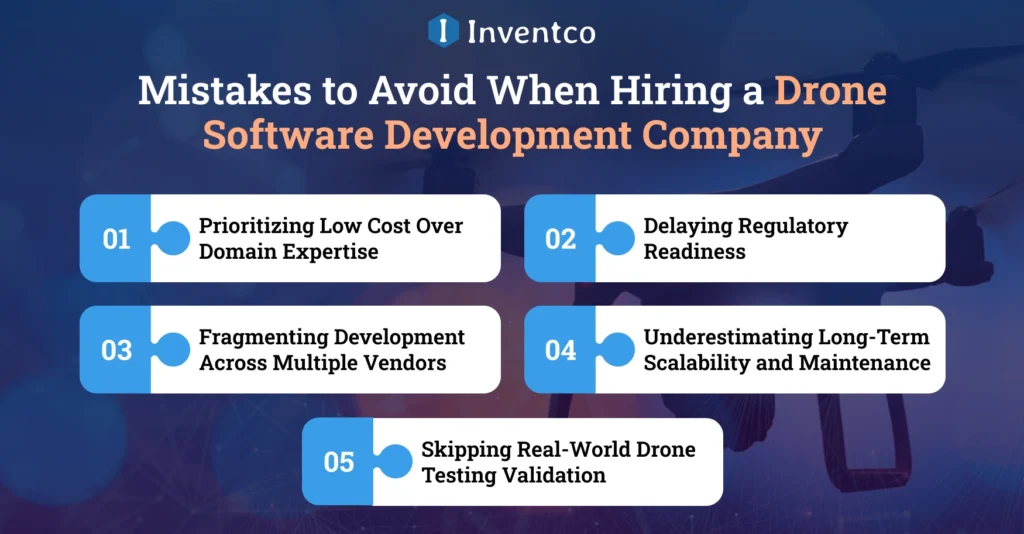
Even well-funded startups often fail to identify scalable technologies that prove to be long-lasting when initial technology decisions are made too quickly or too cost-cuttingly, in an effort to address long-term viability.
The following avoidable mistakes can save founders and investors valuable time and eliminate high costs and regulatory setbacks.
1. Prioritizing Low Cost Over Domain Expertise
Selecting a cheaper vendor instead of a proven, higher-priced provider can lead to weak drone software architecture, safety risks, and expensive redevelopment. Aviation-grade drone software demands experience, quality engineering, and compliance-driven design.
2. Delaying Regulatory Readiness
This is the most common post-launch regulatory compliance issue, especially with aviation laws, air traffic, and data oversight. Failure to understand these rules can lead to significant regulatory atrophy.
3. Fragmenting Development Across Multiple Vendors
One of the most common mistakes is outsourcing software, hardware, and cloud architecture to different vendors. Drone technology is key to achieving a continuous, unified system. Highly integrated controllers, software, and architecture.
4. Underestimating Long-Term Scalability and Maintenance
A typical oversight of most startups is concentrating attention on the immediate delivery of an MVP, and at the same time ignoring the need for subsequent optimization, on-going performance augmentation, and growing to fleet scale. Often, without an evolving structural architecture, a startup reaches a high level of technical risk and monetary cost.
5. Skipping Real-World Drone Testing Validation
Not validating the flight experience means the software could perform successfully in simulation but fail at scale. Field app testing is essential to proving its functionality.
For drone delivery startups, such oversights may prove detrimental to the company’s ability to enter the market quickly, exhaust investment capital, and lose investor confidence at a critical stage, especially when founders lack clarity on how drone software works within real-world operational and regulatory environments.
Questions to Ask Before Finalizing a Drone Software Development Partner
To mitigate technological, regulatory, and operational risks, founders and investors should take a more evaluative approach to potential partners before entering into a software development agreement. The questions below outline a basic evaluation framework for determining whether a vendor is a true technological partner rather than a temporary servicer.
1. What experience do you have with drone delivery or UAV software projects?
Experience with commercial drone delivery systems, autonomous flight technology, and UAV fleet management is the type of vendor experience founders should seek. Anything less, including experience with mobile and IoT, is irrelevant.
2. How do you manage aviation compliance and evolving drone regulations?
A credible partner will be able to address compliance in system design and describe how the system adapts to changes in aviation and drone-use regulations.
3. Can your platform support autonomous flight and fleet-scale operations?
Companies should be able to explain how their systems manage fully autonomous flights, real-time telemetry, and the operational app development challenges associated with large-scale drone fleet maneuvers.
4. How do you ensure security and data protection?
Answers should be detailed and cover data encryption, secure API’s, role-based access, audit logging, anomaly detection, and security evaluations integrated within the entire drone ecosystem.
5. What is your approach to scalability and cloud infrastructure?
The partner should explain how their cloud services facilitate scalability, high uptime, immediate processing, and expansion at the country or global levels.
6. Do you offer post-launch support, optimization, and upgrades?
Sustained success is dependent on iteration. Make sure the partner supports system optimization, new app features, regulatory compliance updates, and post-launch system maintenance.
The more concise and organized the answer, the greater the operational maturity and technical sophistication they demonstrate. Generic or abstract answers typically indicate operational challenges.
How Inventco Can Help You in Drone Software Development?
Inventco supports the development of bespoke drone software for high-growth enterprises and investor-backed startups focused on building scalable drone-delivery platforms. Inventco is a leading custom software development company, combining technical expertise and experience in civil aviation systems, regulations, and enterprise scaling.
Inventco has provided more than end-to-end software services. We also provide software development for custom applications for drone delivery, AI software for autonomous navigation, and platforms for the real-time management of drone fleets. Our teams design the very best in cloud-based, flexible systems and high-performance software architectures that support scalable, lag-free integration across logistics, analytics, and enterprise systems.
Even after the products are complete, Inventco has a development relationship with clients. Our clients are also protected by our compliance centered on the regulation of the aviation industry. Other clients invest in us not only to serve them as a vendor, but also to become a technology partner, focusing on return on investment, regulatory compliance, and sustainable growth from basic to enterprise-scale. Some of our clients support us with the auditable version of the product.
Conclusion
Selecting a company to work with on the development of drone software for a commercial delivery platform is a critical decision. Choosing the wrong partner could introduce poor design, delays, and a lack of scalability, increasing risk and leading to lost opportunities.
A competent development partner accelerates execution and integrates compliance into systems that adapt to new operational and regulatory challenges. Such a partner becomes even more critical in a competitive and rapidly advancing drone ecosystem.
For founders and investors, successful drone delivery in the long-term cannot be limited to hardware. It must entail a strong, compliant, and smart software that regulates operations, safeguards the value of the investment, and drives growth.
FAQs
Q1. How do I choose a drone software development company?
Ans. Choose a company with proven UAV experience, aviation compliance knowledge, AI and cloud capabilities, strong security practices, and a clear scalability roadmap aligned with commercial drone delivery operations and long-term business growth objectives globally.
Q2. Why is custom drone software better than off-the-shelf solutions?
Ans. Custom drone software provides full control over autonomy, compliance, integrations, and performance, enabling businesses to adapt workflows, meet regulations, scale fleets efficiently, and securely protect intellectual property in today’s competitive commercial drone markets worldwide.
Q3. What industries benefit most from drone software development?
Ans. Industries benefiting most include logistics and last-mile delivery, agriculture, infrastructure inspection, construction, surveillance, energy, and healthcare logistics, where drones improve efficiency, safety, data accuracy, and operational visibility at scale for modern enterprises globally today.
Q4. How long does it take to develop a drone delivery app?
Ans. Drone delivery app development timelines vary by scope, but an MVP typically takes four to six months, while enterprise platforms require phased development, testing, compliance approvals, and gradual, safe scaling across regions and fleets.
Q5. Is post-launch support and scaling important for drone platforms?
Ans. Post-launch support typically includes performance optimization, feature enhancements, security updates, regulatory compliance upgrades, monitoring, scalability improvements, and app store optimization, ensuring the drone platform remains reliable, compliant, competitive, and aligned with evolving global business and market requirements.
Q6. How much does drone software development cost?
Ans. Drone software development costs depend on autonomy level, AI complexity, compliance requirements, integrations, and scalability needs, with pricing influenced by development phases, testing, certifications, and long-term maintenance and support commitments for commercial drone businesses.
Q7. Why is regulatory compliance critical in drone software development?
Ans. Regulatory compliance is critical because non-compliant drone operations risk fines, grounded fleets, and revoked permissions, while compliant software enables safe operations, faster approvals, investor confidence, and sustainable scaling in regulated airspace worldwide.
Q8. Why should scalability be planned from the beginning?
Ans. Scalability planning ensures the platform can handle growing drone fleets, higher data volumes, and regional expansion, preventing re-architecture, reducing costs, and supporting reliable performance as commercial operations and demand increase over time.

Sandeep Agrawal
Sandeep Agrawal is the visionary CTO at Inventco, bringing innovation to life through his technical expertise. With a passion for cutting-edge technologies, Sandeep leads the team in developing robust solutions. His dedication and continous efforts to pushing the boundaries of what’s possible defines his role as a transformative and innovative force in the tech industry.