Real estate buyers want transparency, tenants need reliability, and investors need real estate app development that reshapes how people search, verify, and manage properties, especially in rapidly growing markets like Dubai, where digital convenience drives better decisions.
That is precisely why Dubai REST became a benchmark example of regulatory real estate apps.
Dubai REST has been designed to simplify everything from rental contracts to ownership verification, serving as proof of utility within a well-designed digital ecosystem. If you’re planning to build something similar, you’re entering a market with massive demand, a strong government push, and endless opportunities for innovation.
Dubai REST & Real Estate App Market Stats (2026)
The global real estate app industry is booming, driving demand for digital real estate solutions. As the latest real estate tech trends emerge, there is rapid investment in regulatory ecosystems, such as Dubai REST.
- The UAE PropTech market (real estate technology, including mobile platforms) was valued at around USD 607 million in 2024 and is expected to reach USD 1.55 billion by 2030 with strong CAGR growth (~17.5 %).
- According to the official Google Play listing, Dubai REST targets over 300,000 owners, 700,000 tenants, and 700,000 investors globally, indicating a mobile audience and potential adoption scale.
- Over 98% of UAE residents use smartphones, and 70 %+ of property searches begin online, driving demand for mobile real estate services.
- In the first half of 2025, Dubai’s real estate market recorded over 125,000 transactions worth approximately AED 431 billion, up about 25% year-on-year, highlighting vigorous market activity that underpins demand for digital platforms like Dubai REST.
What Makes Dubai REST Unique?
Dubai REST is the only real estate system that consolidates the traditionally slow, paperwork-heavy process in Dubai into a cohesive, government-regulated platform. Dubai REST provides instant baseline support for Buyers, tenants, and landlords, and real-time updates on developer contracts and ownership from the Dubai Land Department (DLD).
From title deed validation to Ejari contracts and ownership updates, everything happens in real time. The app eliminates fraud, provides transparency, and streamlines the property continuum lifecycle. Dubai REST has become an example of how regulatory real estate apps should operate to the world because of this trust-based framework.
How to Develop an App Like Dubai REST?
Creating a regulatory-grade real estate platform like Dubai REST requires more than just coding—it needs precision, planning, compliance, and technology that can handle sensitive property data
Here is the step-by-step guide on how to build a real estate app with the same reliability and intelligence.
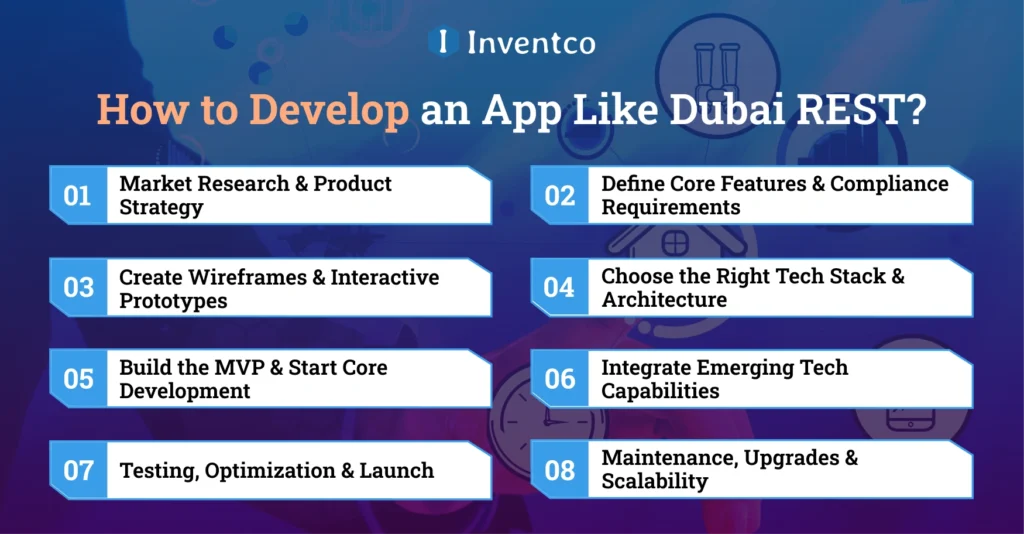
1. Market Research & Product Strategy
This is the first step of the mobile app development process that requires you to examine user expectations, the governing frameworks, and the real estate technology trends that dictate the marketplace. It is important to know the expectations of the buyers, the tenants, the landlords, and the regulators of the system. This will guarantee that your product vision meets a real market need.
2. Define Core Features & Compliance Requirements
The second step is to define your core features and user requirements that include, but are not limited to, verification tools, a flow of ownership, and remote signing of agreements. Analyze your competitor apps, such as real estate apps like Property Finder, to benchmark UX and functionality. During the planning phase, the incorporation of Blockchain technology should be considered, as Blockchain in Real Estate allows property transactions to be more secure and more transparent.
3. Create Wireframes & Interactive Prototypes
To build a real estate app, the next step is to create a mobile app wireframe, user flows, and a usability test plan. After that, prepare a mobile app Prototype to simulate the user experience. This step of the real estate app development process helps you to identify the usability issues at the start that are aligned with user expectations before any development effort.
4. Choose the Right Tech Stack & Architecture
Choosing the right mobile app tech stack increases the value delivered to the user and should be based on the requirements for scalability and performance. Strong algorithms for secure APIs and encrypted data storage will be required for regulatory-compliant apps. Prescient views should be given to any decentralized add-ons, such as a Web3 real estate app solution.
5. Build the MVP & Start Core Development
Begin development using modular architecture and best practices. Launching an MVP mobile app helps you test essential features like verification, authentication, and contract workflows early. Mobile app developers must follow mobile app best practices to secure sensitive documents and identity data.
6. Integrate Emerging Tech Capabilities
Further increased automation will be supported with AI-driven insights. Businesses focusing on advanced analytics often explore Generative AI in commercial real estate, while smart properties benefit from IoT in Smart Home integrations for connected experiences.
7. Testing, Optimization & Launch
Perform thorough mobile application testing, including reviewing its functionality, assessing its load performance, conducting penetration testing, and validating compliance. Before release, refine discoverability with App Store optimization to ensure strong visibility from day one.
8. Maintenance, Upgrades & Scalability
Following the app launch, ongoing mobile app maintenance ensures security, speed, and long-term stability. Budgeting for mobile app maintenance costs helps you plan upgrades, new features, and optimization cycles effectively.
Following this real estate app development process will ensure the Dubai REST-style platform is secure, compliant, feature-rich, and ready for large-scale adoption across the real estate ecosystem.
Why Build an App Like Dubai REST?
The achievements of Dubai REST demonstrate the desire of property buyers, sellers, and tenants for faster verifications, precise record-keeping, and transparent transactions. While developing an app like Dubai REST, you’re not merely creating an additional platform. You’re addressing and alleviating genuine industry challenges.
Businesses can improve their trust accounts and client trust, simplify documentation, automate compliance, address regulatory processes, reduce fraud risk, and provide a trusted environment for ecosystem participants to transact in property. For most governments and businesses, it is an excellent way to modernize real estate management.
As demand for real estate apps that support digital governance continues to grow, the Dubai REST app stands among the top real estate apps, offering strong service demand, attractive return on investment, and long-term relevance in an increasingly competitive market.
Empowering Brokers with Technology: The Brokerland App Journey
Inventco and Brokerland collaborated on improving and streamlining agent-centric real estate platforms to simplify listings, manage leads, and enhance buyer-agent relationships.
The Challenge: Digital solutions that Brokerland provided needed to achieve the centralization of listings while optimizing the workflow of the brokers and enhancing the conversion of leads all whilst achieving the promised velocity, accuracy of the data, and user-friendliness. Growth for agents was becoming hindered due to manual processes, dispersed inquiries, and an absence of visibility.
The Solution: A custom-designed, scalable mobile app, built by Inventco, includes sophisticated search capabilities, real-time listing updates, secure communication channels, and dashboards for agents. Brokerland’s UI/UX was optimized, and improvements were made to the backend and data flow, which helped to enhance engagement, expedite the closure of deals, and facilitate the effective scaling of operations.
Must-Have Features for an App Like Dubai REST
When creating a mobile app with real estate app features similar to the Dubai REST app, your platform must prioritize reliability and security, and ensure users feel secure, verified, and at peace.

1. Verified Property Data
One of the key features of a real estate app is verified property data; users are assured of accurate ownership information, property record details, and other information securely obtained and presented by authoritative government databases.
2. Digital Identity Checks
Digital identity verification ensures that users are verified through secure and comprehensive methods, eliminating the potential for fraud and establishing lawful compliance in property transactions and documentation.
3. Title Deed Validation
When Title Deed Validation is used, it confirms that the customers have the legitimate title deeds, which reduces the chances of fraud, disputes, and builds trust with customers during the buying and selling of real estate.
4. Smart Contract Management
Through Smart Contract Management, the AI can manage contracts, enabling the buying and selling of real estate without the parties involved being present.
5. Secure Document Vault
Secure document vault stores essential files, certificates, agreements, and property-related documents safely with encrypted access controls and tamper-resistant mechanisms.
6. Multilingual User Interface
The Multilingual User Interface helps people who speak different languages and supports improving the platform by bringing more people into the platform and using it.
7. Payment Gateway Integration
The Payment Gateway Integration feature allows people to make secure online payments, and transaction processing, service fees, and financial operations are key parts of the real estate system.
8. Verified Agent Authentication
Verified Agent Authentication ensures that the real estate agent using the platform is a licensed property agent operating, adding reliability, security, and compliance. This improves the security and trust of the interactions on the platform.
The key features of real estate applications include those that provide a safe and unparalleled user experience similar to Dubai REST.
Advanced Dubai REST App Features
Building a modern regulatory platform means integrating AI in real estate app development to enhance user experience, accuracy, and automation.
Here are the top advanced features:
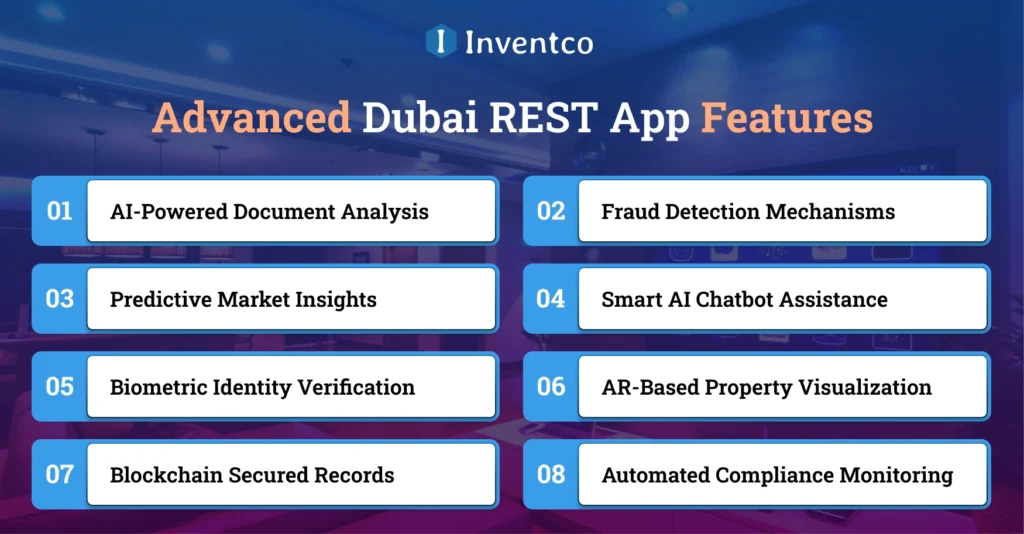
1. AI-Powered Document Analysis
AI algorithms extract information and analyze documents to verify, in seconds, whether ownership records, certificates, and contracts are valid and accurate.
2. Fraud Detection Mechanisms
Fraud detection mechanisms detect suspicious behaviors and prevent fraudulent property transaction activities in real time using a combination of predictive models and anomaly detection.
3. Predictive Market Insights
Predictive real estate market insights and opportunities depend on an accurate analysis of economic activities, pricing behavior, and user trends.
4. Smart AI Chatbot Assistance
An intelligent AI chatbot in a real estate app helps users complete property-related tasks such as processing, verification, and transfers of rental agreements and fundamental properties.
5. Biometric Identity Verification
One of the advanced features in the real estate app is Biometric identity verification that ensures secure, credible, digital interactions for digital onboarding by facial recognition, fingerprint, and tamper-proof verification.
6. AR-Based Property Visualization
Virtual property tours eliminate physical visiting by letting users view a property’s interior, layout, and environment to help them make an informed purchasing decision.
7. Blockchain Secured Records
Digital real estate transactions ensure compliance and trust by securing company records and property information on a blockchain-based real estate app that is secure and tamper-proof.
8. Automated Compliance Monitoring
Automated compliance monitoring assesses documents, contracts, and property submissions for compliance consistency across all user actions and transactions.
This comprehensive functionality transforms a Dubai REST-style application into a secure, AI-driven ecosystem, delivering continuous innovation through a powerful real estate app for agents focused on efficiency, accuracy, and scalability.
How Much Does It Cost to Build an App Like Dubai REST?
The average cost to build a real estate app like Dubai REST depends on features, existing compliance, backend integrations, and access to government datasets. An MVP app with contract digitalization and property verification will be cheaper; however, using advanced features such as Blockchain, AI, and multilingual support can increase the real estate app development cost.
Other factors that influence mobile app development costs include the location of the mobile app development team, the tech stack, and security standards. Depending on the level of customization, scalability, and access to real-time data, the average price for a Dubai REST-level platform, with features expected of a real estate app, will range from mid-level to enterprise-tier pricing.
Monetization Models for a Dubai REST-Like App
Mobile app monetization strategies can be effectively implemented on a real estate app like Dubai REST to generate substantial revenue. With advanced real estate app features, these strategies help a real estate app make money through premium listings, transactions, subscriptions, and value-added digital services.
Additional verification tools can be placed behind subscription-tier paywalls for landlords, brokers, and developers. Transaction-based fees may apply to ownership transfers, contract generation, and document validation.
Advanced insights and downloadable reports also generate additional revenue. These tools have added value for government integrations and enterprise API licensing. With the proper mobile app monetization framework, your platform doesn’t just streamline real estate operations, it becomes a high-return digital ecosystem that grows as user trust and adoption increase.
Why Choose Inventco for Dubai REST App Development?
Inventco is a trusted mobile app development company known for building secure, compliant, and scalable real estate platforms. Our team specializes in regulatory architectures, government-grade verification workflows, and advanced technology integrations such as AI, blockchain, and AR. We create custom solutions tailored for Dubai’s property market, ensuring alignment with DLD and RERA guidelines.
By using proven Mobile App Development Frameworks, we deliver fast performance, seamless user experience, and future-ready scalability—making your Dubai REST–style app reliable, intelligent, and built for long-term growth.
Conclusion
Building an app like Dubai REST means creating a platform that delivers trust, transparency, and secure real estate operations. With the right planning, technology, and compliance alignment, your app can simplify verification, automate documentation, and support every stage of the property lifecycle. As regulatory digital transformation accelerates across Dubai, now is the perfect time to bring an advanced, future-ready proptech in real estate solution to market, one that elevates user confidence and sets a new benchmark in real estate innovation.
FAQ’s
Q1. How do I create an app like Dubai REST?
Ans. To create a mobile app like Dubai REST, you need clear features, regulatory alignment, real estate data integration, and a skilled development team experienced in secure platforms.
Q2. What is the Mobile App Development Cost for a Dubai REST–style platform?
Ans. The mobile app development cost depends on features, APIs, compliance layers, and the complexity of verification workflows integrated into the system.
Q3. What Mobile App Development Challenges should I expect?
Ans. Key mobile app development challenges include handling government data, ensuring security, integrating blockchain, and maintaining accuracy across verification and ownership processes.
Q4. How is an app like Property Finder different from Dubai REST?
Ans. An app like Property Finder focuses on listing discovery, property searches, agent communication, and buyer–seller interactions, while Dubai REST is built for verification, regulation, ownership validation, and government-backed documentation. One helps users explore available properties; the other ensures the legality, authenticity, and compliance of every transaction.
Q5. What must-have mobile app Features should my platform include?
Ans. Your app must include must-have mobile app features such as identity verification, digital contracts, secure document storage, property validation, and multilingual support.
Q6. How long does it take to develop a Dubai REST-like app?
Ans. The time to develop a mobile app ranges from 4–9 months, depending on scope, complexity, technology stack, and required regulatory integrations.

Jitendra Jain
He is the CEO and Co-founder of Inventco, driving innovation in advanced computing and digital transformation. With deep expertise in modern IT ecosystems, he leads scalable, secure, future-ready solutions. His strategic leadership helps businesses accelerate growth, adopt innovation, and achieve success. You can connect with him on LinkedIn to follow his technology insights.