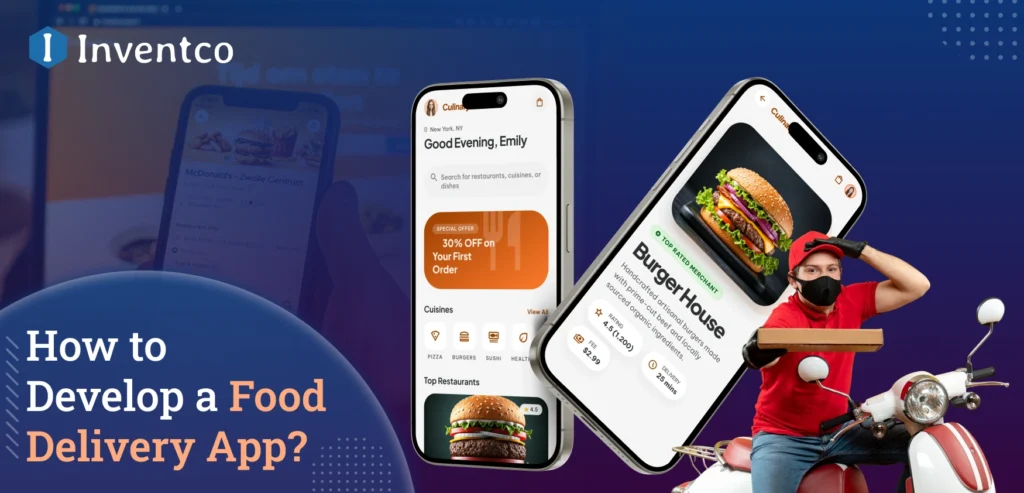
The digitalization of the food industry has changed how people find meals, place orders, and get them. Food delivery apps are a crucial component of contemporary urban living thanks to mobile-first lives, on-demand services, and quick processes. This change has created a huge chance for restaurant groups, startups, and investors to build flexible digital platforms that connect customers, restaurants, and delivery partners in real time.
Now, online platforms for food delivery are more than just ways to place orders. They use smart operations, real-time tracking, AI-driven suggestions, and personalized user experiences to make things easier and run more smoothly. If you want to know how to make a food delivery app, you need to know the right plan, technology stack, development process, and range of investments.
To assist creators and investors in creating scalable food delivery platforms, this guide shows how to build a food delivery app, the cost of building a food delivery app, important features, advanced technologies, and the step-by-step food delivery app development process.
Key Takeaways
- The global market for online food delivery is growing quickly and is anticipated to reach $505 billion by 2030, creating excellent chances for startups and investors to build scalable digital food delivery platforms.
- An organized food delivery app development process is needed to make a platform work well. This process includes market research, planning features, UI/UX design, choosing technologies, development, testing, and growing after launch.
- There are three main parts to a normal food delivery ecosystem: the customer app, the restaurant website, and the delivery partner app. These are all meant to make buying, managing, and moving things around easier.
- Essential features such as user registration, restaurant lists, private payments, real-time tracking, and reviews form the basis of every successful food delivery platform.
- Advanced features like AI-powered tips, smart delivery routes, demand forecasts, and robots improve individuality, delivery efficiency, and customer interaction.
- The food delivery app development cost usually runs from $10,000 to $100,000+, depending on app complexity, features, and technology infrastructure.
- Businesses should start with an MVP food delivery app to confirm market demand, lower original investment, and grow the platform gradually with advanced features.
Online Food Delivery Market Growth
The rapid expansion of on-demand services and smartphone adoption is transforming how consumers order meals. Food delivery platforms powered by mobile apps, AI-driven recommendations, and hyperlocal logistics are becoming essential infrastructure for modern digital commerce.
- The global online food delivery market was valued at USD 288.8 billion in 2024 and is expected to surpass USD 505.5 billio n by 2030, growing at a 9.4% CAGR.
- The online food delivery platform segment is projected to grow from USD 142.1 billion in 2024 to USD 325.1 billion by 2032, reflecting a 10.9% CAGR.
- The U.S. online food delivery market generated about USD 52.67 billion in 2024 and is expected to reach USD 93.35 billion by 2030, growing at a 9.6% CAGR.
- Industry forecasts also estimate the U.S. market will grow from USD 34.9 billion in 2025 to nearly USD 75.4 billion by 2034, with a CAGR of 8.94%.
How to Develop a Food Delivery App: Step-by-Step Process?
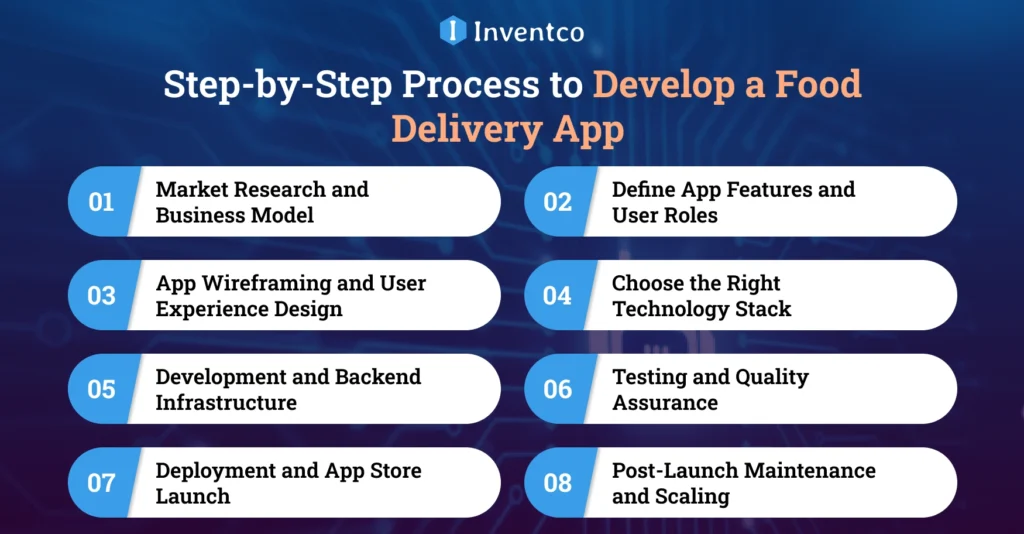
Building a scalable platform needs an organized food delivery app development process that blends market research, user experience design, and strong server architecture.
1. Market Research and Business Model
The first step in the app development process is performing a thorough market study. Businesses must assess customer demand, area food buying trends, and rival platforms to find possibilities. Study popular Restaurant Online Ordering Platforms and assess their business strategies, delivery methods, and income streams. Choose the right business model, such as broker platforms, restaurant-owned delivery apps, cloud kitchens, or logistics-only systems. This step helps founders understand customer standards, find successful areas, and describe the app’s core value offering before going into development.
2. Define App Features and User Roles
Clearly describing app features and user jobs is important when planning how to develop a food delivery app. Most platforms include three main panels: a customer mobile app, a restaurant monitor, and a delivery partner app. Each panel must offer personalized features such as order management, real-time tracking, and payment handling. Prioritizing important features helps businesses start faster and reduce development complexity. Many startups begin with an MVP mobile App that includes only key features, allowing them to test the market and collect user input before growing the platform.
3. App Wireframing and User Experience Design
User experience plays a key part in the success of any food delivery platform. During this step, artists create app wireframing layouts and develop an app prototype that shows the full user trip. This process focuses on easy browsing, quick restaurant finding, and a smooth checkout experience. Wireframes help picture how users interact with the app, making it easier to spot usability problems before development starts. A well-designed interface improves customer interaction, lowers confusion in the buying process, and eventually increases order rates.
4. Choose the Right Technology Stack
Selecting the right technology is a crucial step in online food delivery app development. The development team must decide which frameworks, computer languages, and technology will power the platform. A trusted Mobile App Technology Stack provides flexibility, high speed, and safe data management. Founders must also consider the best Mobile App Development Frameworks based on their product needs and target platforms. The chosen technology stack influences the time to develop a mobile app, total development cost, and the platform’s ability to support future feature expansions.
5. Development and Backend Infrastructure
After finishing the technology stack, the development phase starts. Engineers build both the client interface and backroom technology needed for order handling, payment processing, and restaurant connections. This stage includes adding user identification, position tracking, menu control systems, and push messaging services. Developers must also focus on safe design to support mobile app security requirements and protect user info. A flexible server ensures that the platform can handle high user traffic, especially during busy buying hours when demand grows greatly.
6. Testing and Quality Assurance
Testing guarantees that the program works easily across devices and operating systems. During this phase, development teams conduct thorough mobile app testing to find problems, speed issues, and security flaws. Quality assurance teams test payment platforms, delivery tracking systems, and user interface performance. Testing also ensures compatibility across different screen types and running systems. Proper testing lowers the risk of crashes, improves app stability, and ensures a smooth user experience before the product is released to the market.
7. Deployment and App Store Launch
Once development and tests are complete, the platform is ready for launch. Businesses post their application on major platforms such as Google Play and the Apple App Store. A well-planned app store optimization approach improves exposure, increases sales, and draws early users. Marketing efforts, start deals, and referral schemes can help speed user growth. A successful launch strategy ensures the app becomes popular quickly and establishes a strong position in the competitive food delivery market.
8. Post-Launch Maintenance and Scaling
Launching the app is only the beginning. Continuous improvements are important to keep the speed and customer happiness. Businesses must spend on mobile app maintenance to fix bugs, make changes, and improve its usefulness. Monitoring analytics helps spot user behavior trends and improve the platform accordingly. As the app grows, developers can add advanced features such as AI suggestions and reward programs. Ongoing support also includes handling mobile app maintenance costs while ensuring the platform remains safe, scalable, and aligned with evolving App development trends.
Key Features Required in a Food Delivery App
Successful food delivery apps rely on essential features that simplify ordering, improve user experience, and streamline operations. Integrating the right functionality ensures smooth performance and supports scalable online food delivery app development.
| Feature | Description |
| User Registration | Allows users to sign up via email, phone number, or social login for quick access. |
| Restaurant Listings | Displays restaurants based on location, cuisine type, and ratings. |
| Smart Search and Filters | Helps users find dishes quickly using filters such as price, ratings, and cuisine. |
| Menu Browsing | Shows detailed menus with images, pricing, and customization options. |
| Secure Payment Integration | Enables payments through cards, wallets, and digital payment gateways. |
| Real-Time Order Tracking | Allows customers to track delivery status using GPS integration. |
| Ratings and Reviews | Customers can rate restaurants and delivery partners to improve platform credibility. |
| Order History | Provides a record of previous orders for quick reordering. |
These features represent the must have mobile app features that every successful food delivery platform should include.
Advanced Features in a Food Delivery App
Advanced features enhance the functionality of food delivery apps by improving personalization, delivery efficiency, and customer engagement. These innovations help platforms scale faster and deliver smarter, data-driven experiences for users and restaurants.
| Advanced Feature | Description |
| AI-Based Food Recommendations | Suggests meals based on previous orders and user behavior. |
| Smart Delivery Routing | Optimizes delivery routes to reduce delivery time. |
| Voice Search Ordering | Allows users to search and order food using voice commands. |
| Subscription Delivery Plans | Offers free delivery through monthly or annual memberships. |
| Loyalty and Rewards Programs | Encourages repeat orders through discounts and reward points. |
| Predictive Ordering | Uses analytics to suggest frequently ordered items automatically. |
| AI Demand Forecasting | Helps restaurants prepare inventory based on predicted demand. |
| Chatbots for Customer Support | Provides instant assistance to customers during ordering or delivery. |
Technology Stack for Online Food Delivery App Development
Choosing the right technology stack is crucial for building a scalable and secure food delivery app. It ensures smooth performance, efficient integrations, and supports long-term growth of the platform.
| Layer | Technology Options |
| Frontend | Flutter, React Native, Swift, Kotlin |
| Backend | Node.js, Django, Ruby on Rails |
| Database | PostgreSQL, MongoDB, MySQL |
| Cloud Hosting | AWS, Google Cloud, Microsoft Azure |
| Payment Gateway | Stripe, PayPal, Razorpay |
| Maps & Location | Google Maps API, Mapbox |
| Push Notifications | Firebase Cloud Messaging |
| Security | SSL Encryption, OAuth Authentication |
Choosing the right mobile app development frameworks and backend architecture is essential for long-term scalability and performance.
Role of AI in Food Delivery App Development
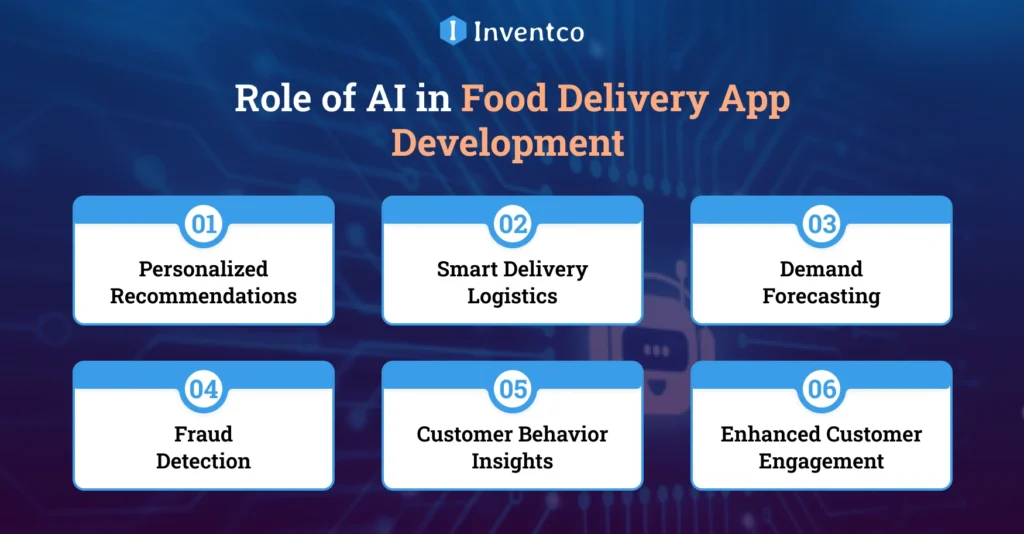
Artificial Intelligence is transforming how modern food delivery platforms operate by improving personalization, operational efficiency, and decision-making through advanced data analysis and automation.
1. Personalized Recommendations
AI analyzes user behavior, past orders, preferences, and browsing patterns to recommend relevant dishes and restaurants. These personalized suggestions enhance user experience, increase engagement, and significantly improve overall order value.
2. Smart Delivery Logistics
Machine learning algorithms optimize delivery routes by analyzing traffic conditions, delivery locations, and driver availability. This helps reduce delivery times, minimize operational costs, and improve overall delivery efficiency.
3. Demand Forecasting
AI helps restaurants predict peak ordering times by analyzing historical data and seasonal trends. This allows businesses to prepare inventory, manage staff, and reduce food preparation delays.
4. Fraud Detection
AI-based security systems monitor unusual payment activities, suspicious transactions, and fraudulent behavior. These systems help platforms prevent financial losses and protect both businesses and customers.
5. Customer Behavior Insights
AI analyzes user interactions, order frequency, location trends, and customer preferences. These insights help businesses improve marketing strategies, optimize menu offerings, and enhance overall platform performance.
6. Enhanced Customer Engagement
Many of the best food delivery apps with AI insights use machine learning to improve customer engagement through chatbots, personalized notifications, and targeted promotional campaigns that increase retention.
Food Delivery App Development Cost by Type: Complete Breakdown
The food delivery app development cost can change based on the complexity of the application, the number of features, supported platforms, and the amount of customization needed. Businesses planning online food delivery app development often start with a simple version and gradually grow their platform with advanced capabilities. Understanding different development steps helps founders estimate the cost to develop a food delivery app and choose the right way based on their business goals and budget.
MVP Food Delivery App
A Minimum Viable Product (MVP) food delivery app focuses on important features needed to launch the platform fast. These apps usually include user registration, restaurant names, menu watching, order placement, and easy payment interaction. MVP apps help companies test their business plan, prove user demand, and enter the market faster. The development cost for an MVP food delivery app usually runs between $10,000 and $25,000, making it an ideal starting place for new companies.
Mid-Level Food Delivery Application
A mid-level food delivery application includes extra features that improve user experience and running efficiency. These platforms generally mix real-time order tracking, multiple payment methods, push messages, delivery partner management, and customer reviews. Such apps provide a more full setting for buyers, companies, and delivery people. The development cost of a food delivery app at this level usually runs from $25,000 to $60,000, based on design and technology needs.
Advanced Level Food Delivery Application
Advanced food delivery apps are fully scalable platforms built to compete with major industry players. These apps mix AI-based ideas, advanced analytics tools, smart delivery routes, award programs, and high-performance server infrastructure. They often serve big user groups and mix difficult systems, such as predictive buying and demand predictions. The cost to build an advanced food delivery platform usually runs between $60,000 and $100,000+, depending on features, links, and size needs.
For owners looking to develop a food delivery app, starting with an MVP offers faster market launch while lowering the original Cost to build mobile app infrastructure.
Factors That Affect Food Delivery App Development Cost
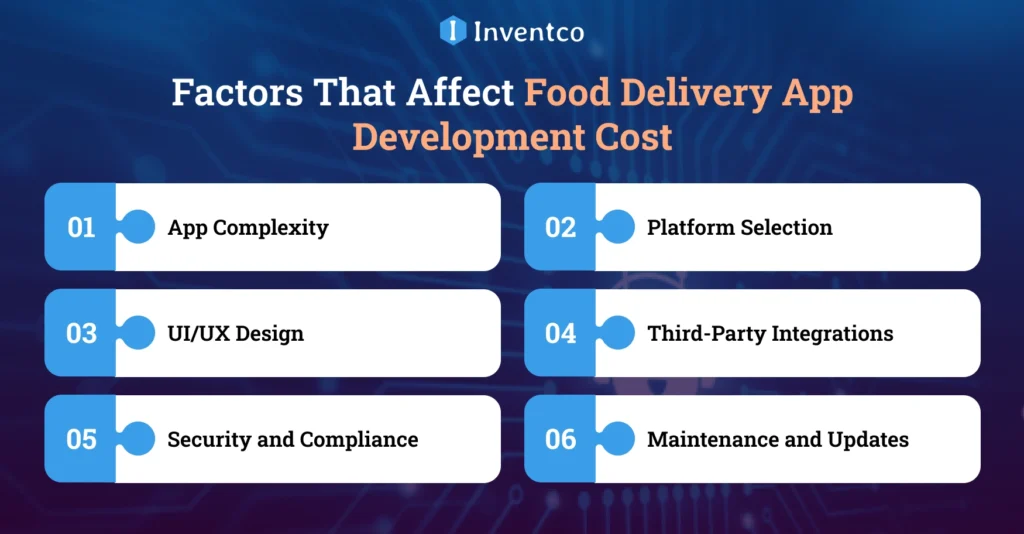
Several factors impact the development cost of a food delivery app, including technology options, feature complexity, design requirements, and long-term upkeep needs.
1. App Complexity
The general complexity of the application greatly affects development cost. More features, connections, and advanced functions take additional development time, resources, and testing efforts.
2. Platform Selection
Choosing between Android vs. iOS or cross-platform development changes the project cost and schedule. Building apps for various platforms takes extra development, testing, and tuning.
3. UI/UX Design
A well-designed user interface improves user experience but increases development work. Advanced UI/UX designs demand thorough study, unique layouts, and extra design tools.
4. Third-Party Integrations
Integrating payment platforms, GPS tracking, push alerts, and analytics tools expands usefulness but increases development complexity and cost.
5. Security and Compliance
Implementing strong mobile app security features, such as data protection, safe login, and scam detection, is important for protecting user information and keeping trust.
6. Maintenance and Updates
After launch, businesses must spend on regular changes, bug fixes, and speed improvements, which add to the total mobile app maintenance cost.
Common Challenges Faced During Food Delivery App Development
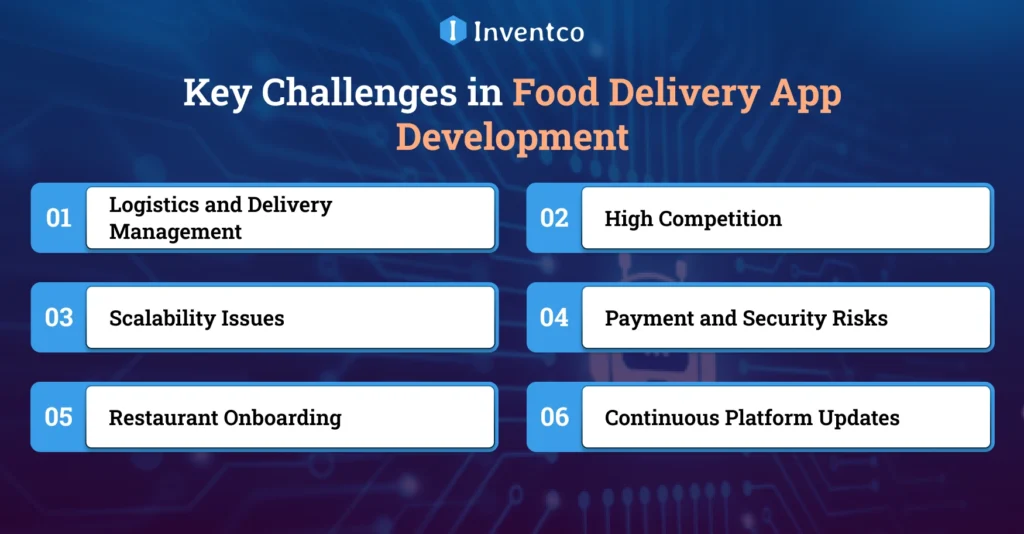
Developing a scalable food delivery platform includes several technical and organizational challenges that businesses must address to ensure easy performance, user happiness, and long-term platform growth.
1. Logistics and Delivery Management
Managing real-time delivery processes is complicated. Businesses must adopt efficient route systems, GPS tracking, and delivery planning tools to ensure orders are delivered quickly and correctly.
2. High Competition
The food delivery market is highly competitive, with many established platforms. Startups must offer unique features, a better price, or an improved user experience to stand out.
3. Scalability Issues
Food delivery apps must handle large amounts of orders, especially during busy hours. Without flexible infrastructure, platforms may experience slow performance, crashes, or poor user experience.
4. Payment and Security Risks
Secure payment handling is important for food delivery platforms. Businesses must combine reliable platforms, encryption systems, and scam detection methods to protect user data and financial operations.
5. Restaurant Onboarding
Attracting and hiring businesses can be difficult initially. Platforms must provide easy hiring processes, attractive payment models, and marketing help to encourage businesses to join.
6. Continuous Platform Updates
Food delivery platforms require regular changes to fix bugs, improve features, enhance speed, and stay matched with changing user standards and mobile app development challenges.
How to Choose a Food Delivery App Development Service?
Choosing the right development partner is one of the most important decisions when planning end-to-end food delivery app development. As a development business, we understand that owners and funders need more than just code help. Businesses should work with a partner that offers business knowledge, strong technical skills, a proven collection, and the ability to build scalable digital goods. A trusted food delivery app development service should provide strategic advice, safe design, and long-term product support to ensure the platform grows successfully in a competitive market.
At Inventco, we focus on providing a full development approach that includes product strategy, UI/UX design, scalable server infrastructure, and current technologies such as AI interfaces and cloud-based systems. Our goal is to help businesses build high-performance applications that offer smooth user experiences while supporting long-term growth and operating efficiency.
Our experience includes creating new digital solutions such as Pocket Chef, a smart cooking and food aid application intended to ease recipe finding, meal planning, and personalized cooking advice. Projects like Pocket Chef show our ability to build user-centric platforms backed by strong technology architecture and simple design experiences.
By working with Inventco, businesses gain a team that supports the full product journey—from idea approval and development to launch and long-term Mobile App Maintenance. We help owners reduce technical risks, speed product starts, and build scalable platforms matched with changing App development trend innovations. With the right strategy and technology base, we ensure your business can safely build a mobile app that is ready for real users and sustainable growth.
Conclusion
The fast growth of the on-demand market has created vast possibilities for businesses looking to develop a food delivery app. With the right strategy, features, and technology infrastructure, food delivery platforms can create sustainable revenue while improving ease for customers and operational efficiency for restaurants.
Understanding the food delivery app development guide, picking the right business plan, and combining technologies such as AI-driven operations and smart tips are important for building a competitive platform.
For companies and investors planning online food delivery app development, releasing a scalable MVP and working with experienced development teams can greatly speed market entry and long-term growth.
FAQs
Q1. How much does it cost to develop a food delivery app?
Ans. The food delivery app development cost usually ranges between $10,000 and $100,000+, depending on app complexity, features, platform choice, and development expertise. Advanced platforms with AI and analytics require higher investment.
Q2. How long does it take to develop a food delivery app?
Ans. The food delivery app development process typically takes 3 to 6 months for an MVP version. A fully scalable platform with advanced features, integrations, and testing may require 6 to 9 months.
Q3. What features should a food delivery app include?
Ans. A food delivery app should include user registration, restaurant listings, menu browsing, order placement, secure payment integration, delivery tracking, ratings, and order history to ensure a smooth user experience and operational efficiency.
Q4. What technologies are used in food delivery app development?
Ans. Common technologies include React Native or Flutter for frontend development, Node.js for backend, cloud services like AWS, and Google Maps APIs for location tracking and delivery route optimization.
Q5. Can AI improve food delivery app performance?
Ans. Yes, AI in food delivery apps improves personalized food recommendations, delivery route optimization, demand forecasting, and customer behavior analysis, helping businesses enhance efficiency, increase order value, and improve user experience.
Q6. Why should businesses start with an MVP food delivery app?
Ans. Launching with an MVP food delivery app helps businesses test their idea, validate market demand, and collect real user feedback while reducing initial development investment and accelerating a faster product launch.

Ajay Bhal
He is an on-demand app solutions expert with 11+ years of experience in business consulting and building scalable, user-centric digital products. He specializes in robust on-demand platforms across industries, combining technical expertise with business-focused strategy to deliver efficient, top notch solutions that drive growth and enhance user experience. You can connect with him on LinkedIn to follow insights.