The rapid rise of institutional participation in crypto has fundamentally reshaped how large-scale transactions are handled. When it comes to high-volume trading, conventional exchanges are often hindered by factors like liquidity gaps and significant price slippage, highlighting the need for more efficient alternatives. That’s where OTC (Over-the-Counter) crypto exchanges provide a clear advantage.
OTC crypto exchange development provides an exciting opportunity to entrepreneurs and investors alike, for developing a high-end, stable trading environment dedicated to institutions, high-net-worth individuals and whale traders.
In this guide, we uncover vital market insights, app development process and cost factors, core features to include within your app as well as trends on the rise, empowering you to plan for and implement your OTC crypto exchange app development in a safe manner.
Key Takeaways
- The OTC crypto exchange development allows trading without slippage insurance.
- With strong institutional adoption and rising transaction volumes, OTC platforms present an attractive opportunity for founders and investors worldwide.
- The OTC exchanges operate by way of private negotiation, allowing for price stability, increased privacy, and greater execution efficiency without affecting public market conditions.
- It is important for institutional users to trust a platform, and strong security combined with compliance & regulatory alignment helps facilitate this.
- Instead, the process includes research and design, backend systems, testing, etc. promoting better performance and scalability along with a quicker time-to-market.
- Selecting an appropriate technology stack enhances performance, security, and scalability, thus it is crucial for creating a top-notch future-ready OTC trading platform.
- Development costs range from $10,000 to $100,000+, depending on features, compliance, security infrastructure, and overall platform complexity requirements.
- Innovating, staying compliant, and adapting will be vital for survival as OTC platforms evolve in the face of trends such as AI price forecasting, DeFi integration, and tokenization.
Market Overview of OTC Crypto Exchange
The OTC crypto market has grown alongside institutional participation in digital assets.
- Institutional investors now contribute over 60%–70% of total crypto trading volume, driving strong demand for OTC trading solutions.
- Around 86% of institutional investors are already exposed to crypto or planning allocations, reflecting increasing capital inflow into OTC trading channels.
- Stablecoins now account for over 70% of OTC trading volume, highlighting their role in facilitating large, low-volatility transactions.
Key Insight: The OTC market is less volatile, more private, and increasingly favored for large-scale trading, making it a lucrative segment for platform builders.
How Does an OTC Crypto Exchange Work?
In contrast to traditional exchanges that process trades based on public order books, OTC platforms enable buyers and sellers to negotiate directly in private, making it an ideal setup for executing large volumes of trades quickly.
Here’s how it works:
- Trade Request Initiation: The buyer or seller requests a trade, providing the details regarding the asset, volume and preferred pricing.
- Quote Generation: An OTC desk or broker will assess the state of the market, assembling a customized price quote accommodating liquidity and trade size.
- Private Price Negotiation: These transactions allow for private price negotiation and do not affect public market prices, as both sides negotiate a better deal.
- Off-Exchange Execution: The trade is executed directly between the parties involved once the terms of entry have been agreed upon, without going through traditional exchange order books.
- Secure Settlement: Funds & assets are transferred using escrow services or custodial solutions, ensuring secure and transparent settlement.
This approach eliminates price slippage, enhances privacy, and guarantees stability, this is why OTC crypto exchanges are the most favored options for institutional investors and high volume traders.
Security, Compliance & Regulatory Considerations
Security and compliance are not optional in OTC crypto exchange development, but essential for trust building, onboarding institution clients, and sustaining your platform in the long-run.
Key considerations:
- KYC/AML Compliance: Introduce strong identity verification systems to reduce fraud, money laundering and unauthorized access while fulfilling global standards of compliance.
- Jurisdiction-Specific Regulations: Ensure your platform complies with regional laws and licensing requirements to operate legally in multiple markets while mitigating compliance risks.
- Cold Wallet & Multi-Signature Custody: Employing cold wallets paired with multi-signatures to secure digital assets against hacks and unwanted tokens withdrawals.
- Smart Contract Audits: Conduct regular audits of escrow and transaction-related smart contracts to patch vulnerabilities and provide guaranteed execution.
- Real-Time Fraud Detection: Utilize AI-driven monitoring systems that help in identifying suspicious activities, anomalies, and potential threats instantly.
- Data Protection & Privacy Compliance: Ensuring compliance with global standards of data protection such as GDPR would safeguard user data and maintain the credibility of the platform.
Investors and institutions are understandably wary, so platforms that prioritize security, transparency, and regulatory readiness will be far more able to instill trust, scale faster and achieve long-term growth.
OTC Crypto Exchange Development Process
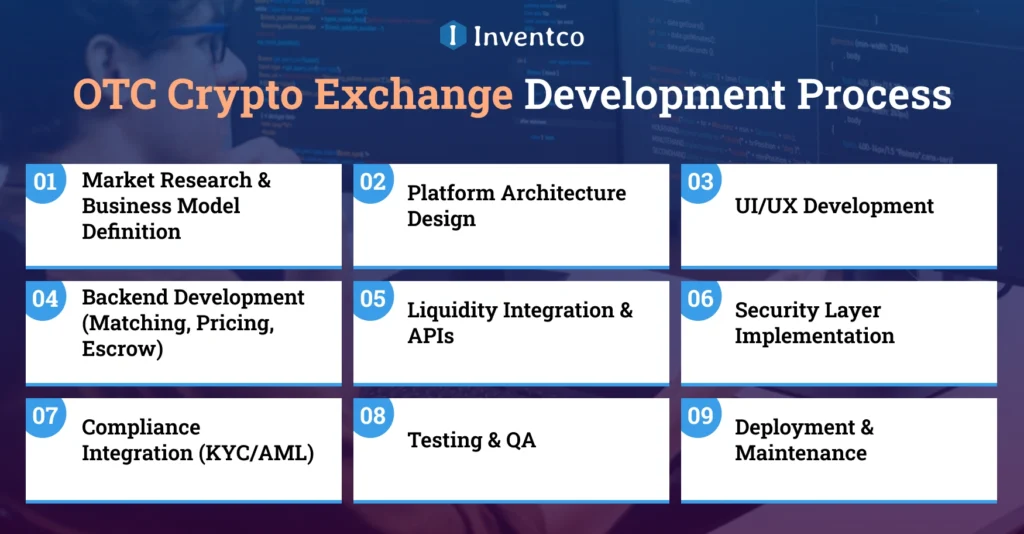
A well-defined app development process is essential to ensure scalability, regulatory compliance, and faster time-to-market. Here is a step by step process to build a mobile app:
1. Market Research & Business Model Definition
Market research and a sustainable business model is the foundation of OTC crypto exchange development. This consists of defining target users, examining competitors, and verifying revenue strategies in accordance with mobile app monetization. And founders should also know regional compliance requirements, and shifting trading behaviors. Adopting learnings from mobile app development has to be structured rightly that best suits execution. Moreover, during early-stage planning, test MVP mobile app for product-market fit iteration on core functionalities before scaling up into a fully fledged institutional and high-volume traders platform.
2. Platform Architecture Design
Scalable and secure architecture based design is important for long term performance. Choosing the right infrastructure, android Vs iOS deployment strategies, also choosing reliable mobile app development frameworks all fall under this stage. The backend architecture needs to support high-volume transactions, and the frontend systems need to ensure a smooth user experience. It also eases out the planning stage if app wireframing is done in this phase, it graphically visualizes workflows and user journeys. A solid architectural foundation allows the platform to efficiently respond to varying liquidity demands, security layers, integrations, without sacrificing speed, reliability, or flexibility as business scales.
3. UI/UX Development
User experience is a critical factor in winning over and keeping institutional clients. At this stage, the teams are working on designing various intuitive dashboards, trading interfaces, admin panels, etc. Using app prototype development helps stakeholders validate the design flows before complete implementations. Mobile app features like real-time updates, smooth navigation, and responsive layouts are part of user-facing aspects that improve usability. The right interface can streamline a complex OTC transaction, foster engagement and minimize friction. User-centric design also allows for device accessibility, resulting in a unified experience for traders and administrators alike.
4. Backend Development (Matching, Pricing, Escrow)
Backend is the “engine” of an OTC crypto exchange platform, which negotiates trade execution, pricing logic and escrow systems. Developers create the systems that deliver accuracy, speed, and reliability in transactions. Advanced algorithms that enable dynamic pricing and negotiation mechanisms Integrating security is a best practice for mobile app security, protecting sensitive financial information. Backend systems also need to be scalable in order to accommodate growing trade volumes. Furthermore, this phase provides smooth communication between the modules so that it will be easy to execute complex OTC trades without growing delays or system failures.
5. Liquidity Integration & APIs
Liquidity is the most important element for any OTC desk to operate. Incorporating trusted liquidity providers and APIs allows for smooth execution of trades with high volume. Implement secure API connections to external exchanges, payment gateways, and institutional liquidity pools. So continuous monitoring and mobile app testing is important to check its performance, and also ensures stability during high loads. A perfect liquidity integration reduces timeframes, enhances pricing precision and increases user assurance. It also helps keep the platform competitive by providing high-performance trading experiences in a reliable and scalable manner.
6. Security Layer Implementation
OTP crypto exchange solutions development includes security implementation as a fundamental pillar. Here, we implement multi-layer protection solutions such as encryption, multi-signature wallets and secure authentication systems. Mobile app security standards must be followed on this to protect from cyber threats and unauthorized access. Developers also use monitoring tools to identify real time anomalies. A robust security framework protects user assets while also instilling trust in institutional investors. By prioritizing security at all levels, the platform continues to maintain its credibility and resilience within an extremely sensitive financial ecosystem.
7. Compliance Integration (KYC/AML)
Adhering to regulatory guidelines becomes important and helps maintain the legal status of your business and gains the trust of investors. The second phase is the implementation of the KYC/AML system for identity verification and transaction monitoring. Consequently, platforms need to operate within local laws and global norms to avert liability. Integrating compliance into the mobile app development process can ensure a seamless onboarding and verification workflow. ASPs reduce errors caused by human hands and are more efficient. This compliance-focused approach significantly improves transparency, which really attracts institutional clients and guarantees sustainability within a regulated economy.
8. Testing & QA
The platform will never let you down if it is thoroughly tested and can work flawlessly in all conditions. The phase includes functional, performance and security testing as per mobile app testing standards. The QA teams identify bugs, optimize performance, and validate system stability. Testing overcomes integration challenges between various features, APIs, and security protocols. As a result of simulating real-world trading scenarios, developers can enhance the platform prior to launch. This means a thorough testing process minimizes risks, improves the user experience and guarantees that the platform meets all industry standards for performance, security and reliability.
9. Deployment & Maintenance
Even though the testing has completed, the platform gets deployed on a live environment for added monitoring. After a successful launch, mobile app maintenance is integral to maintain performance, apply security updates, and include feature enhancements. For long-term viability, brands should also account for the mobile app maintenance cost. These are regular updates and fixes that help in optimizing overall user experience along with the system efficiency. Moreover, App Store Optimization and similar strategies can be put into place. Constant maintenance keeps the platform competitive, secure and in line with changing market needs.
Team with a seasoned OTC crypto exchange development company to make the whole process streamlined, minimize risks, speed up time-to-market while providing a scalable and compliant platform.
Technology Stack for OTC Crypto Exchange Development
Selecting the optimal app development tech stack is crucial to creating a secure, scalable, and high-performing OTC trading platform. A solid architecture guarantees smooth execution as well as reliability and growth over the years.
| Layer | Technologies |
| Frontend | React.js, Angular, Vue.js |
| Backend | Node.js, Python, Golang |
| Database | PostgreSQL, MongoDB |
| Blockchain Integration | Ethereum, BNB Chain, Solana |
| Smart Contracts | Solidity |
| Cloud Infrastructure | AWS, Google Cloud |
| Security | SSL, Multi-Sig Wallets, HSM |
| APIs | REST, WebSocket |
| Payment Integration | Fiat gateways, crypto wallets |
The combination of modern app development technology, scalable app infrastructure, and secure integrations forms the backbone of successful OTC crypto exchange development. The selection of the right mobile app tech stack not only enhances app performance but also ensures app security, regulatory readiness, and seamless trading experiences, making it essential for institutional-grade OTC trading platforms.
How Much Does It Cost to Develop an OTC Crypto Exchange?
The cost to build an OTC crypto exchange app depends on several factors such as app complexity, features, compliance requirements, and scalability goals. Here is a broad overview to help founders and investors better strategize.
Basic Platform: $10,000 – $30,000
A simple OTC crypto exchange platform is the most basic product possible and consists of user onboarding, trade execution feature, limited liquidity integration as well as some key security layers. This is best for startups that are testing an idea using a minimal viable product. Although economical, customization and scalability fall short. Such a stage is appropriate for early-stage founders who want to discover market demand before putting lots of effort into developing a fully-fledged OTC crypto exchange application and entering into long-term expansion.
Mid-Level Platform: $30,000 – $60,000
A mid-level OTC crypto exchange supports advanced trade matching, liquidity aggregation, and compliance mechanisms like KYC/AML modules. It enables significantly better performance, scalability and usability than simple solutions. This option is best for businesses that wish to build up a competitive platform but also want to balance cost and feature richness following an OTC trading destination development approach.
Enterprise-Grade OTC Exchange: $60,000 – $100,000+
Enterprise OTC crypto exchange development emphasizes establishing an enterprise-grade, scalable, secure-based, and compliant infrastructure for institutional end-users. It consists of advanced features such as AI-based pricing engines, deep liquidity integration, multi-layer security infrastructure, and complete regulatory compliance. While this handles a high performance, reliability and global scalability, making it suitable for investors and enterprises looking to maintain that position into the future as leaders of the pack in crypto OTC trading platform.
Cost Factors:
- Features & customization
- Security infrastructure
- Regulatory compliance
- Liquidity integration
- Development team expertise
For founders, investing in quality development ensures long-term ROI and scalability.
Essential Features of OTC Crypto Exchange
Your platform must provide institutional-grade capabilities in order to stay competitive, ensuring security, efficiency, and fluid trading experiences. Here is a list of key features with short descriptions:
Core Features
1. User Onboarding with KYC/AML
With KYC/AML verification, secure onboarding guarantees that the new client undergoes identity authentication while also preventing fraudulent activities as part of standard compliance measures, establishing overall trust among institutional users through seamless access to OTC crypto trading services well beyond their countries.
2. OTC Trading Desk Interface
Intuitive interface OTC trading desk enables users to open, negotiate and carry out large-volume trades quickly while offering brokers and traders real-time communication tools as well as integrated transaction management capabilities.
3. Real-Time Price Negotiation System
Buyers and sellers can negotiate prices in real-time through a negotiation system that provides instantaneous and market-neutral price quotes, culminating in immediate trade execution under transparency, flexibility, and optimal processing efficiency.
4. Multi-Currency Wallet Integration
Multi-currency integrated wallets (cryptocurrency and fiat) allow holders to store, transfer, and manage their assets securely while providing flexibility to those who process large OTC transactions across the globe.
5. Escrow-Based Settlement
Escrow systems safeguard transactions by retaining funds in the escrow account until both the buyer and seller fulfil specific conditions, promoting trust between parties by limiting counterparty risks or potential fallout by enabling pressure-free settlement of high-value crypto trades without conflict.
6. Trade History & Reporting
Advanced trade history and reporting features offer a detailed representation of transactions, allowing users to monitor performance, maintain records, comply with regulations, and gain insights for data-driven decisions in future OTC trading strategies.
7. Liquidity Management Tools
These liquidity management tools pool liquidity from several sources to facilitate large trades, minimize stalling and reduce slippage while ensuring price accuracy as well as stability and efficiency in the OTC trading platform.
8. Secure Communication & Chat System
Traders can communicate with brokers over a built-in secure system, allowing encrypted messaging in real-time and ensuring seamless negotiation for deals that are often high-value over-the-counter (OTC) transactions, thereby providing private communications to get the best possible price executed.
Advanced Features
1. AI-Based Pricing Engine
Employing an AI-driven pricing engine that dynamically analyzes market trends, liquidity depth, and trading patterns allows for accurate price quotes in real-time, enabling a more efficient trade while ensuring competitive pricing for high-volume transactions.
2. Institutional Dashboards
Such progressive dashboards give the institutions access to real time analytics, monitoring of portfolio volatility and overall performance that facilitates effective decision making along with risk assessment and operational control over a secure and scalable OTC trading platform.
3. API Access for Brokers
API access enables brokers and institutional clients would want to use it by integrating external systems, automating trading processes, accessing liquidity pools, or executing trades at optimal prices seamlessly across multiple channels.
4. Multi-Signature Custody
Multi-signature custody security mechanism means that you need to sign a transaction by multiple private keys at the same time before it can be transferred to the blockchain during transmission, which greatly increases the security of OTC trading and prevents unauthorized use when signing.
5. Risk Management Tools
With risk management tools, platforms track real-time exposures to market volatility and transaction risks to mitigate losses and ensure compliance within an ambiguous environment of high-value OTC derivatives.
6. Automated Trade Matching Engine
An advanced automated trade matching engine facilitates efficient market matching between buyers and sellers based on their trades in terms of order size, price sensitivity, and liquidity availability by minimizing manual interventions required to process trades which improves the execution speed as well as overall trading efficiency.
Common Challenges in OTC Crypto Exchange Development
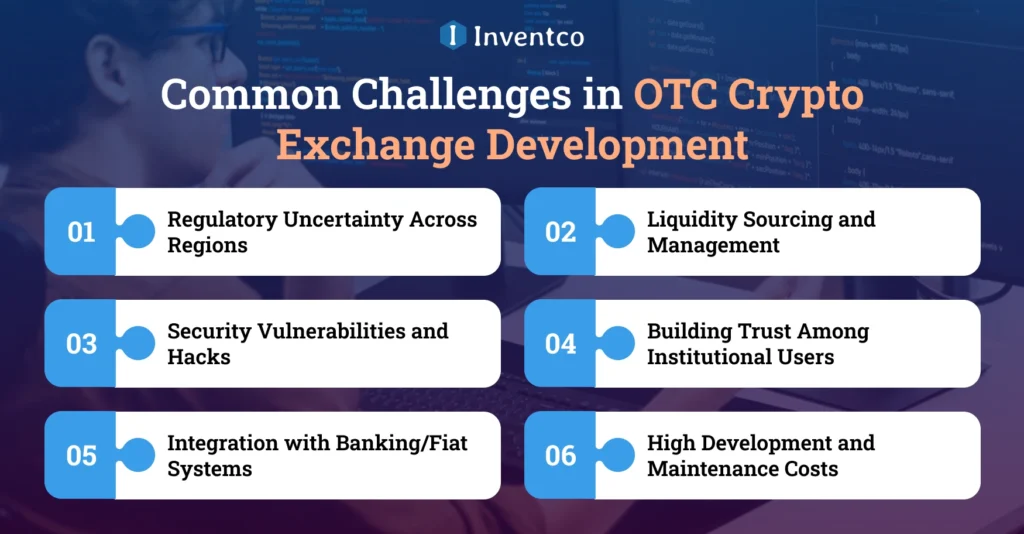
Implementing a crypto OTC trading platform is an extremely challenging task that touches upon various aspects of mobile app development which can affect performance and scalability, the trust of users in the platform. Here are the biggest challenges in detail.
1. Regulatory Uncertainty Across Regions
One of the top mobile app development challenges faced is that, at a global level, there are different regulations in each region with different compliance requirements. With laws, licensing frameworks and policies changing over time it is imperative to adapt in order to maintain seamless operations and scalability.
2. Liquidity Sourcing and Management
Maintaining broad liquidity is critical to optimizing the execution of large orders. Integrating multiple liquidity providers with real-time performance, pricing accuracy, and execution is one of the leading Challenges in Mobile App Development.
3. Security Vulnerabilities and Hacks
Security is another challenge of OTC exchange app development, especially in the case of crypto platforms. It also needs to implement advanced encryption, secure authentication, and constant monitoring to keep breaches and cyberattacks at bay.
4. Building Trust Among Institutional Users
This is one of the key OTC exchange app development challenges that you need to solve to establish trust. For institutional users, transparency, legal compliance, and reliability are crucial considerations that must be underpinned by a robust high-performance platform capable of providing ongoing trust and efficiency.
5. Integration with Banking/Fiat Systems
Integrating fiat transactions requires secure and compliant payment gateway integrations, which adds yet another OTC exchange app development challenge due to regulatory restrictions and limited support.
6. High Development and Maintenance Costs
Managing costs is a significant mobile app development challenge, as building and maintaining a scalable, secure OTC crypto exchange requires continuous investment in technology, compliance, updates, and performance optimization.
To counter these mobile app development challenges, you need to take a well-thought-out approach and seek help from an experienced OTC Trading platform development partner in order to ensure the long-term success and scalability of your OTC trading platform.
Future Trends of OTC Crypto Exchange
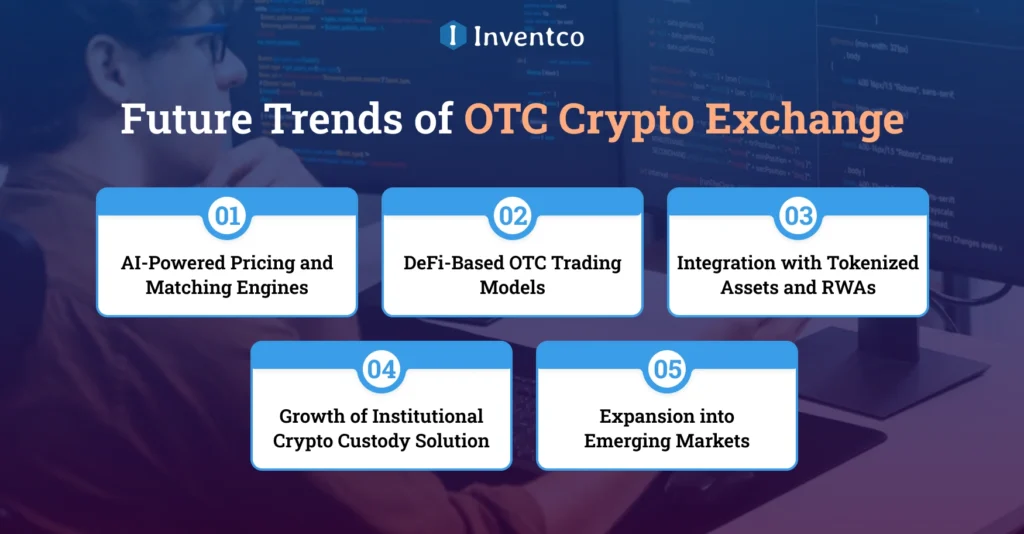
Institutional adoption is shaping the OTC crypto market quickly, emerging mobile app development trends have a significant impact on scalability, automation, and user experience. However, the future is defined by key trends, as detailed below:
1. AI-Powered Pricing and Matching Engines
AI is making these OTC trades more effective by providing timely pricing, predictive analyses, and automated trade matching. In summary, these innovations are in line with the trends of OTC crypto exchange app development and significantly improve efficiency, decrease manual interventions, and enhance execution accuracy.
2. DeFi-Based OTC Trading Models
Decentralized finance (DeFi) is impacting over-the-counter (OTC) platforms by allowing peer-to-peer trading with no need for intermediaries. A rising OTC crypto exchange app development trend is DeFi integration that enhances transparency, minimizes costs, and gives more control over transactions.
3. Integration with Tokenized Assets and RWAs
Now, OTC platforms evolve from cryptocurrencies to tokenize assets and RWAs. This trend enriches investment opportunities and broadens trading ecosystems supported by mobile app development trends.
4. Growth of Institutional Crypto Custody Solutions
The need for institutional-grade custody solutions for secure asset storage. These solutions fit into the trends of OTC crypto exchange apps of the current times to address improved security, compliance, trust needed for large investors or enterprises as well.
5. Expansion into Emerging Markets
New growth opportunities for OTC exchanges driven by emerging markets. With OTC crypto exchange app trends in their favor, platforms can achieve global reach while ensuring responsiveness to local requirements and engagement with growth markets seeing a rise in crypto penetration.
Over-the-counter crypto exchanges must embrace new trends in mobile app development, responding to compliance and liquidity while enhancing their offerings with software innovations for the future.
Note: Choosing between DeFi and CeFi is one of the most important financial decisions a crypto investor can make today.
Why Choose Inventco for OTC Crypto Exchange Development?
When deciding on an OTC crypto exchange development partner, you must consider proven experience, security features and a track record of real-world executions. Inventco; where we deliver scalable fintech and crypto solutions with a focus on implementation, measurement, and results.
Examples of innovative platforms developed under Inventco include March, a cryptocurrency trade application engineered specifically to enable fast and secure transactions with real-time data processing capabilities. It also showcases the company’s capabilities to power enterprise-grade trading environments, built for high-volume users with a focus on performance-driven architecture, intuitive UX/UI and advanced trading features.
Moreover, solutions such as Ewallet also shed light on Inventco’s prowess at creating safe financial infrastructures blended in multi-layer encryption and slick payment integration with a user-centric design. This expertise directly contributes to shaping compliant and secure OTC trading platforms.
Inventco follows a full-cycle development process, strategy, backend, frontend, testing, and compliance, to deliver more reliability and scalability while shaving time to market. This translates to less risk, greater trust for founders and investors, and a future-proofed OTC crypto exchange platform that is designed for sustainability.
Conclusion
OTC crypto exchanges have evolved from being niche services to front-ends of a critical infrastructure for institutional crypto trading. The demand for secure, compliant, and scalable platforms will continue to grow as the market matures.
For founders and investors, an OTC crypto exchange app development is a promising opportunity to create a high-value company with long-term growth potential.
By leveraging the right strategy, technology stack, and development partner, your business can create a platform that meets market demand while also engendering trust and power sustained revenue.
FAQ’s
Q1. What is OTC crypto exchange development?
Ans. OTC crypto exchange development involves building platforms that facilitate private, large-volume cryptocurrency trades outside public exchanges, enabling direct negotiation, reduced slippage, enhanced liquidity access, and secure transactions for institutional investors and high-net-worth traders.
Q2. How to develop an OTC crypto exchange?
Ans. To develop an OTC crypto exchange, businesses must conduct market research, define a business model, design architecture, implement secure trading systems, integrate liquidity, ensure regulatory compliance, and deploy scalable infrastructure for seamless operations.
Q3. How much does it cost to develop an OTC crypto exchange?
Ans. The cost to develop an OTC crypto exchange typically ranges from $10,000 to $1,00,000+, depending on platform complexity, features, security infrastructure, compliance requirements, integrations, and the expertise of the development team involved.
Q4. What are the key features of an OTC crypto exchange?
Ans. Key features of an OTC crypto exchange include trade negotiation systems, escrow-based settlements, multi-currency wallets, liquidity integration, KYC and AML compliance, real-time pricing engines, reporting dashboards, and institutional-grade security mechanisms.
Q5. Why choose an OTC crypto exchange development company?
Ans. Choosing an experienced OTC crypto exchange development company ensures faster deployment, access to industry expertise, regulatory compliance support, secure architecture, scalable solutions, and ongoing maintenance, helping businesses reduce risks and accelerate time-to-market.
Q6. What is OTC crypto exchange app development?
Ans. OTC crypto exchange app development focuses on creating mobile-friendly platforms that enable seamless trading, real-time communication, secure transactions, user verification, and portfolio management, ensuring accessibility and convenience for institutional and high-volume traders globally.
Q7. What challenges arise in OTC crypto exchange development?
Ans. Common challenges in OTC crypto exchange development include regulatory uncertainty, liquidity sourcing, ensuring platform security, building user trust, integrating banking systems, managing volatility, and maintaining scalability while delivering seamless and efficient trading experiences.

Jitendra Jain
He is the CEO and Co-founder of Inventco, driving innovation in advanced computing and digital transformation. With deep expertise in modern IT ecosystems, he leads scalable, secure, future-ready solutions. His strategic leadership helps businesses accelerate growth, adopt innovation, and achieve success. You can connect with him on LinkedIn to follow his technology insights.