The requirements of building a scalable, compliant, and engagement-driven platform have never been more evident as social media app development continues to evolve in 2026. With user expectations rising and competition intensifying, founders and investors are no longer asking whether to enter the social networking space but how to develop a social media app that can scale, monetize, and comply with global regulations from day one.
Today’s social platforms are no longer limited to posting and messaging. They are AI-powered ecosystems built around personalization, creator economies, real-time communication, and data privacy. At the same time, regulatory pressure, platform trust, and content moderation have become business-critical priorities.
This guide explains how to approach social media app development from a strategic, technical, and financial standpoint. It covers app types, core and advanced features, technology stacks, development timelines, costs, monetization models, and real-world challenges, along with a practical case study. Whether you are validating an MVP or planning enterprise-grade mobile app development for social media, this guide is designed to support both ranking and conversion.
Market Stats of the Social Media App Industry
The social media market continues to attract strong investor interest due to its global reach and monetization potential.
- The global social media market, including platforms, tools, and monetization, is projected to grow from $208.08 billion in 2025 to $234.34 billion in 2026, representing a 12.6% CAGR.
- Social media ad spend alone was estimated at $276.72 billion in 2025, with continued strength expected.
- The social media advertisement segment is forecast to grow from $202.63 billion in 2025 to $227.95 billion in 2026 (about 12.5% CAGR).
- Total global advertising revenue (all channels) reached $1.14 trillion in 2025 and is forecast to grow further in 2026.
These trends reinforce why develop a social media app with a clear niche, strong engagement mechanics, and long-term scalability.
Step-By-Step Process to Build A Social Media App
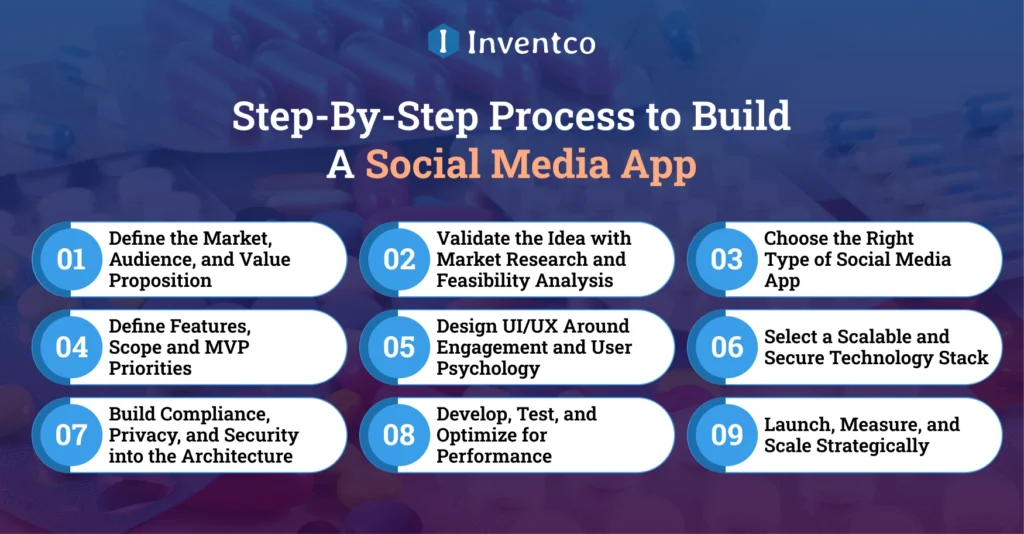
Creating a scalable, successful, and monetizable social media platform means more than copying already existing networks. Developing a successful social media app involves crafting strategies grounded in market insights and the product’s psychology, and building compliant frameworks and mechanisms for future growth. The following steps outline the proven strategies that founders and investors use to develop a social media app that succeeds in the market, following a structured app development process from ideation to scalable execution.
1. Define the Market, Audience, and Value Proposition
An integral part of the social platform conception involves having clarity. Establish the primary audience, the desired geography, and the behavioral patterns the product will create. Identify and define the problem the platform will solve, that other platforms do not. An example would be data privacy, monetizing the creators, or niche and private community access. The platform then has to create a primary value proposition around the problem, which will then drive the product design, platform building, and monetization strategies.
2. Validate the Idea with Market Research and Feasibility Analysis
Prior to any development, the various competing apps in the market, potential users, and other data sets need to be analyzed and research completed that shows potential demand for the app. Examining data sets for levels of user engagement, successful cases of monetization, and potential compliance issues monetization will serve as a guide for the development of the app. Proper research and data analysis will help define the course the development will take, the potential levels of investment the development may attract, and the potential the app has on the market.
3. Choose the Right Type of Social Media App
Consider whether you are building an application for social networking, media sharing, messaging, forums, or creator-centric communities. Each application type requires unique attributes for social media application development, ranging from infrastructural boundaries to the app monetization model used to generate sustainable revenue. Choosing an application type helps define the project scope, align the platform with user expectations, and achieve the desired revenue.
4. Define Features, Scope and MVP Priorities
Building everything at the same time is usually not the most optimal approach. The most successful teams first build a minimum viable product with the most important features, such as user profiles, user feeds, social interactions, and messaging. After gaining traction, additional features such as artificial intelligence (AI)-driven recommendations, analytics, monetization features, and advanced engagement super tools can be added. The scope of features helps to keep development lean and moves to a more advanced state quicker.
5. Design UI/UX Around Engagement and User Psychology
Effective UI and UX design will greatly enhance user retention. When designing the application, make it easy for users to create profiles, and to onboard, and create systems for social interactions to increase user retention. Design feeds and notification systems to encourage users to revisit the application, without facilitating negative user behaviors. Platforms with systems focused on high user engagement to promote positive user behaviors will be preferred by investors in 2026.
6. Select a Scalable and Secure Technology Stack
Your technology choices shape your performance and growth trajectory. Frameworks and backend architecture that support real-time interaction and high concurrency are imperative for global scalability. Your stack also needs to support AI, cloud scalability, and data security. For long-term growth, a scalable, flexible technology stack is essential when learning how to build social media apps.
7. Build Compliance, Privacy, and Security into the Architecture
There’s no such thing as optional compliance anymore. GDPR, regional data protection laws, and evolving content moderation policies require compliance to be embedded directly into the architecture. Building early frameworks for encryption, role-based access control, content governance, and data access is essential for strong app security and one of the most effective ways to build trust with users, partners, and investors.
8. Develop, Test, and Optimize for Performance
Development should be done in iterations using agile methodologies, with continuous evaluation and app testing throughout the process. Functional, security, performance, and usability testing are critical to a successful launch. Beta releases help gather real user feedback and identify friction points in the user flow. Optimizing performance at this stage ensures the end product is stable, high-performing, and scalable.
9. Launch, Measure, and Scale Strategically
Analytics, user behavior tracking, and post-launch improvements determine success. Monitor and analyze retention, engagement, and monetization to better understand users. These insights help optimize features, marketing strategies, and infrastructure to scale, while app store optimization improves visibility and discoverability, making growth through social media app development sustainable.
Types of Social Media Apps You Can Develop
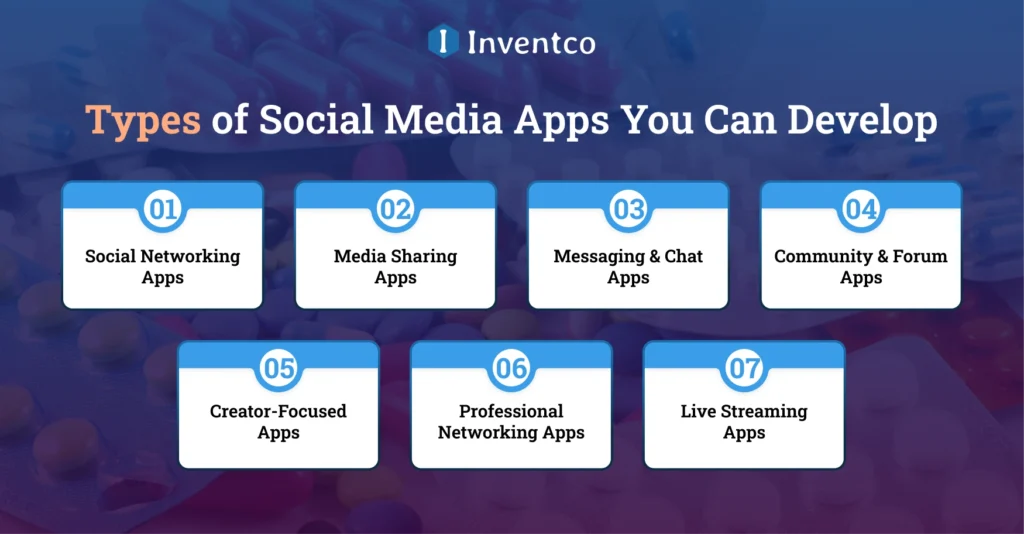
The variants of social media applications you wish to pursue are a vital choice as it influences your revenue model, your choice of social media application scalability, and the technical structure of your application. Each variant addresses a unique set of social media application user behavior and business goals and objectives, making it a critical decision in your social media application development plans.
1. Social Networking Apps
Social networking applications enable profile-based connections and social interactions through user feeds. To promote user engagement, social networking applications leverage interactions such as likes, comments, and shares, as well as the creation of social networking followers’ networks. Monetization of social networking applications is achieved through advertising, premium account features, or subscription services. Social networking applications require real-time computations and a robust data infrastructure to sustain continuous user activity, therefore, they are complex from a technical perspective.
2. Media Sharing Apps
The core of media-sharing applications is the storage and delivery of content, including user-generated videos and short-form content. Therefore, media-sharing applications require media storage, high-performance delivery, and data-streaming services. Monetization of media sharing applications is typically achieved through advertising, partnerships with content creators, and user subscriptions to premium content. In social media application development, user retention and discoverability are driven significantly by AI-powered recommendations based on users’ contextual activity.
3. Messaging & Chat Apps
Apps that focus on chat and messaging offer a more private and secure way for people to communicate in real-time. The primary functions needed for these apps are encrypted messaging that can be sent and received at high speed and high availability. The monetization of these apps may take the form of additional paid messaging services, business tools, or API integrations. Constructively speaking, these platforms are more demanding when it comes to advanced, larger real-time systems to build and maintain users’ confidence that their data will remain private and secure.
4. Community & Forum Apps
Apps that offer community and forum services provide a central hub for users interested in the same topic, where multiple users can collaborate across various threads. These apps are built to promote long-term usage through deeper user engagement rather than rapid consumption of content. Monetization is commonly through membership contracts, subscriptions, and sponsored communities. Constructively, these platforms need advanced systems to foster multiple discussions at once, complemented by moderation systems and/or tools for reputation and ranking.
5. Creator-Focused Apps
Some apps are built to enable streamers and influencers to use the most monetization tools, such as brand collaborations, subscriptions, tips, and monetization analytics. These apps also provide the creator’s manager with tools to manage the audience, insights into the content, and revenue tracking. Constructively, these apps need integrated payment systems, creator dashboards, and scalable content delivery systems to enable sustainable growth.
6. Professional Networking Apps
Professional networking apps enable users to build careers, make business connections, and engage with the industry. Most of these apps include profiles, direct messaging, job opportunities, and content sharing. Advertising and recruitment features are common ways these apps generate revenue. Professional networking apps integrate data credibility, advanced search and recommendation systems, and professional trust.
7. Live Streaming Apps
Real-time video communication, audience participation, and virtual events are enabled by live-streaming applications. Revenue streams include virtual gifts, apps, and sponsorships. These apps are the most advanced from a technology standpoint. They require real-time video processing, low-latency streaming, and optimized bandwidth to provide seamless user experiences.
Directing your audience to the appropriate social media type determines monetization options, development costs, and scalability. Understanding the goals of your users, business, and technology, while learning from top social media apps, helps you design and develop a social media application built for growth and long-term success.
Key Features Required in Social Media App Development
Social media app development success depends on what users see, user adoption, platform monetization, and scaling. Therefore, investors and founders should go beyond basic engagement and consider features that support retention, intelligence, and long-term revenue.
Core Social Media App Development Features
The mobile app features listed here are essential for basic social media app development and are crucial for early engagement and adoption.
- User Registration & Profile Management: Self-secure onboarding, user authentication, and profile terry that reflect engagement, tracking and identity to personalize the presence. It also sets the stage for recommendations and connections across the platform.
- News Feed & Content Publishing: A feed with users allows users to consume content every day. Active usage and session time are also impacted by refresh speed, feed performance, and ranking logic.
- Likes, Comments, and Shares: Social validation and engagement loops are without the diversification of the content. Participatory, the visibility and engagement with the content of the processes significantly increase the content and generate audience behavior. The recommendations and monetization strategies will also be used later.
- Follow / Friend System: This interaction model structures user relationships such as followers, mutuals, or a combination of both, while managing roles, access controls, content feeds, and key social network dynamics.
- Push Notifications: Notifications play a major role in bringing users back to the app and showing what is new, what is trending, and what is important. Smart notification systems increase user retention without too many complaints.
- Search & Discovery: The search tool lets users find people, posts, subjects, and groups. In the platform’s earliest stages, the discovery tools hasten the network effect and improve the onboarding experience.
- Privacy and Account Controls: Basic controls and privacy options, such as account closure or restricting who can see or interact with the account, and strengthening security layers (e.g., a firewall) elicit user confidence and help maintain compliance with regulations.
- User Onboarding & Guided Experience: The essential part of interaction design is to guide the user through onboarding steps and demonstrate the platform’s value. Guiding the user, they can choose interests and showcase the tools, which will improve the user experience.
Advanced Features for Scalable Social Media Apps
These elements enable transforming a basic MVP into a platform for investment, global scalability, and sustainable monetization.
- AI-Based Content Recommendation: AI-based recommendation systems increase the average time users spend on the platform and improve retention, while providing greater value to the platform.
- Real-Time Chat and Video Calling: Video and text communication strengthen user engagement and extend user reach. These services are fundamental for technology and are necessary for industry-standard social applications.
- Live Streaming and Short-Form Video: Short-form video formats and live streaming are two primary drivers of user engagement and participation in the creator economy. These video formats place significant demands on technology for media processing, content delivery, and moderation.
- End-to-End Message Encryption: The ability of users to send messages securely enhances users’ trust in the platform and the private messaging services it offers. Encryption ensures the platform is compliant with global data protection and privacy standards.
- AI-Powered Content Moderation: Automated tools that operate in real time can identify and eliminate spam, abuse, or harmful content. Moderation helps protect and maintain the platform, bring it into compliance with regulations, and reduce operational costs.
- Analytics Dashboards: Advanced data analysis provides consolidated reports that identify key trends in user engagement, content engagement, and revenue. These reports are useful to the platform owner and investors by providing the foundation for actionable strategies.
- Creator Monetization Tools: Creators can earn revenue through features such as brand collaborations, paid content, tipping, and subscriptions.
- Multi-Language and Regional Compliance Support: Global reach requires compliance with regional data protection laws, language support, and local laws. These capabilities are critical for enterprise adoption and global expansion.
The features mentioned above are what set an MVP apart from a platform ready for investors.
Technology Stack Used for Social Media App Development
Choosing an appropriate technology stack is an initial decision that will affect almost every aspect of social media application development. In addition to affecting development speed and maintenance, the technology stack will also affect the platform’s performance, scalability, and security. For founders and investors, choosing a future-ready stack is critical to avoid large-scale platform issues as user growth accelerates, interactions become more timely, real-time AI personalization becomes more prevalent, and regulatory requirements shift.
Recommended Technology Stack for Social Media Apps
| Layer | Technologies | Strategic Purpose |
| Frontend | React Native, Flutter, Swift, Kotlin | Enables responsive, high-performance user interfaces across iOS and Android while supporting native-level experiences |
| Backend | Node.js, Python (Django), Java | Handles business logic, APIs, scalability, and real-time processing for high-concurrency social interactions |
| Database | PostgreSQL, MongoDB, Firebase | Supports structured and unstructured data, user profiles, content storage, and real-time updates |
| Cloud Infrastructure | AWS, Google Cloud, Azure | Provides elastic scalability, global availability, disaster recovery, and cost-efficient infrastructure management |
| Real-Time Communication | WebSockets, Firebase, Socket.io | Powers instant messaging, live feeds, notifications, and real-time engagement features |
| AI & Machine Learning | TensorFlow, OpenAI APIs, Recommendation Engines | Drives personalized content feeds, user discovery, moderation, and engagement optimization |
| Security | OAuth 2.0, JWT, End-to-End Encryption | Ensures secure authentication, data protection, and compliance with global privacy standards |
| DevOps & Deployment | Docker, Kubernetes, CI/CD Pipelines | Enables faster deployments, system reliability, automated testing, and seamless scalability |
Why the Technology Stack Matters?
A well-defined stack allows social media platforms to shift and scale from MVP to millions of users. This also supports advanced capabilities such as AI recommendations, live streaming, and real-time analytics. For investors, estimating a social media app’s technology stack is a strong indicator of scalability, operational effectiveness, and return on investment.
Real-World Challenges in Social Media App Development
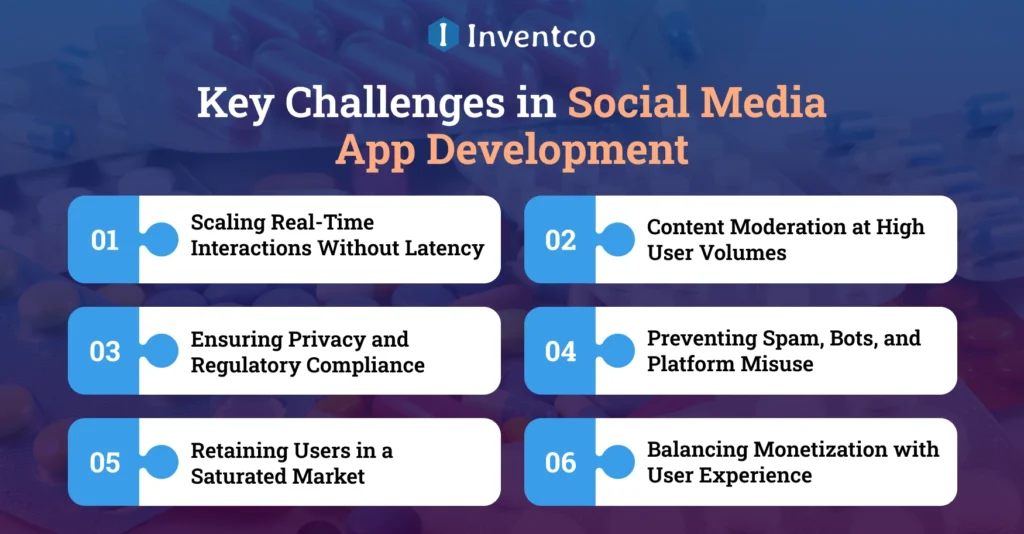
Building a successful social platform involves far more than launching features. The real complexity of social media app development and its core app development challenges emerges as platforms scale, user behavior evolves, and regulatory expectations increase. Addressing these early in the design and build phase helps mitigate future performance and growth issues.
1. Scaling Real-Time Interactions Without Latency
The services offered by social networks rely on real-time feeds, messaging, notifications, and live streaming. As users become more active, providers are increasingly required to attend to user latency issues. Poor performance directly impacts engagement and retention. For this reason, sophisticated back-end architecture, real-time-optimized communication, and data processing become necessary even in the initial phases of development.
2. Content Moderation at High User Volumes
As platforms expand, the activities associated with moderating user-generated content become even more complex, both technically and operationally. From a service perspective, content moderation is not efficient. Delays in reviewing the content increase the risk associated with the application. Even in its simplest form, an AI-enabled moderator, coupled with a human reviewer, is critical for balancing moderation, brand trust, and the ever-present requirements of the law.
3. Ensuring Privacy and Regulatory Compliance
The majority of social applications handle large volumes of data, particularly sensitive data. They are required by law to comply with GDPR and other regional data protection laws. These requirements force applications to be more stringent in how they handle data, obtain user consent, and be transparent about how they use data. Compliance is a must. Ultimately, the system design must incorporate compliance requirements, data protection, and the potential loss of user trust.
4. Preventing Spam, Bots, and Platform Misuse
Automated bots, fake accounts, and spam are all substantial threats to user experience and the credibility of any platform. Issues like these can balloon quickly without proactive detection strategies. The use of behavioral analytics, artificial intelligence, rate limiting, and a verification system appears to be key to preventing these issues.
5. Retaining Users in a Saturated Market
User retention is directly linked to the platform’s overall success and longevity. In today’s market, social media users are seeking a personalized experience and meaningful interactions. Therefore, social media platforms need to streamline user experience across onboarding, content discovery, and overall user engagement to avoid attrition.
6. Balancing Monetization with User Experience
The integration of revenue through advertising, monetization tools for creators, or even subscriptions can enhance the user experience in negative ways. Avoiding disruptive monetization enables a greater increase in a platform’s overall value. Providing a disruptive monetization strategy is one of the best ways for a platform to improve its overall value.
During the product planning and system architecture stages, these issues must be addressed and not left for the post-launch period. In the field of social media app development, anticipating potential challenges is one of the best ways to gauge app extensibility, along with the inevitable challenges of compliance and long-term app sustainability.
How Long Does It Take to Develop a Social Media App?
The social media app development cost is the result of the social media app development investor’s goals, planning depth, feature expansion, scalability, security, and the cost of social media app development. The social media founders and investors must view the cost as a function of the app’s ambition, technical complexity, and market conditions.
Social Media App Development Timeline Breakdown
| App Stage | Estimated Timeline | What This Phase Covers |
| UI/UX Design | 3–5 weeks | User research, wireframes, prototypes, onboarding flows, and engagement-focused interface design |
| MVP Development | 8–12 weeks | Core features such as user profiles, feeds, interactions, authentication, and basic notifications |
| Backend & APIs | 10–14 weeks | Scalable server architecture, databases, real-time APIs, security layers, and integration setup |
| Advanced Features | 4–8 weeks | AI recommendations, real-time chat, live streaming, analytics, and monetization tools |
| Testing & Launch | 3–4 weeks | Performance testing, security audits, beta testing, bug fixes, and app store deployment |
| Total Duration | 4–9 months | End-to-end development from concept to launch |
How Much Does It Cost to Build a Social Media App?
The social media app development cost is the result of the social media app development investor’s goals, planning depth, feature expansion, scalability, security, and the cost of social media app development. The social media founders and investors must see the cost as a function of the social media app’s ambition, technical complexity, and market conditions.
Estimated Cost to Build a Social Media App
| App Type | Estimated Cost Range | Typical Scope |
| MVP | $10,000 – $25,000 | Core features, basic UI/UX, limited scalability, ideal for market validation |
| Mid-Level App | $25,000 – $60,000 | Advanced engagement features, improved performance, and early monetization support |
| Advanced App | $60,000 – $100,000+ | AI-driven personalization, real-time communication, enterprise-grade security, global scalability |
Monetization Models for Social Media Apps
Social media apps employ various monetization strategies as they grow their businesses. The best platforms for social media app development build a business that best fits their monetization strategies, all while remaining flexible during business development to avoid locking into a suboptimal monetization approach.
1. In-App Advertising
Advertising is one of the most effective revenue methods for social media platforms with high engagement metrics for social media app development. Advertising methods such as display, native, and video ads can be implemented in user feeds to create a seamless user experience. This revenue model is most effective when implemented on social media platforms with large user bases and high levels of content consumption.
2. Subscription Plans
Subscriptions allow social media platforms to develop a consistent revenue stream by providing users with enticing value. This revenue model is best implemented in tightly knit communities, professional platforms, and creator-focused social media platforms.
3. Creator Commissions
Social media platforms that support their own ecosystems of influencers and content creators can also generate revenue through the monetization of creator commissions and the retention of a percentage of creators’ revenue. This business model also allows social media platforms to develop revenue through a diversified ecosystem of high quality content creators.
4. Sponsored Content
Sponsored content and branded collaborations enable advertisers to market the content organically within the advertising partner’s social post. When the post is properly targeted and the sponsored content is ROI positive, user trust and engagement are preserved.
5. In-App Purchases
In micro-transaction models, digital items such as gifts, badges, boosts, and special interactions are sold. This model applies to live-streaming and community platforms that encourage patronage to content creators.
6. Premium Features
Users experience a freemium model, with access to basic service offerings and the option to pay for additional premium features such as analytics, visibility, or customization. This practice captures revenue from upper-tier users while also minimizing barriers to entry for the community.
7. Brand Partnerships
Co-branded activities and partnerships offer a mechanism for revenue generation. This works best with middle- to upper-tier platforms that have a defined target audience and robust audience demographics.
Choosing a monetization model is influenced by user characteristics, interaction frequency, and platform socialization. For founders, designing monetization strategies that are adaptable and evolve with the platform’s growth delivers the greatest value over time.
Common Mistakes to Avoid When Developing a Social Media App
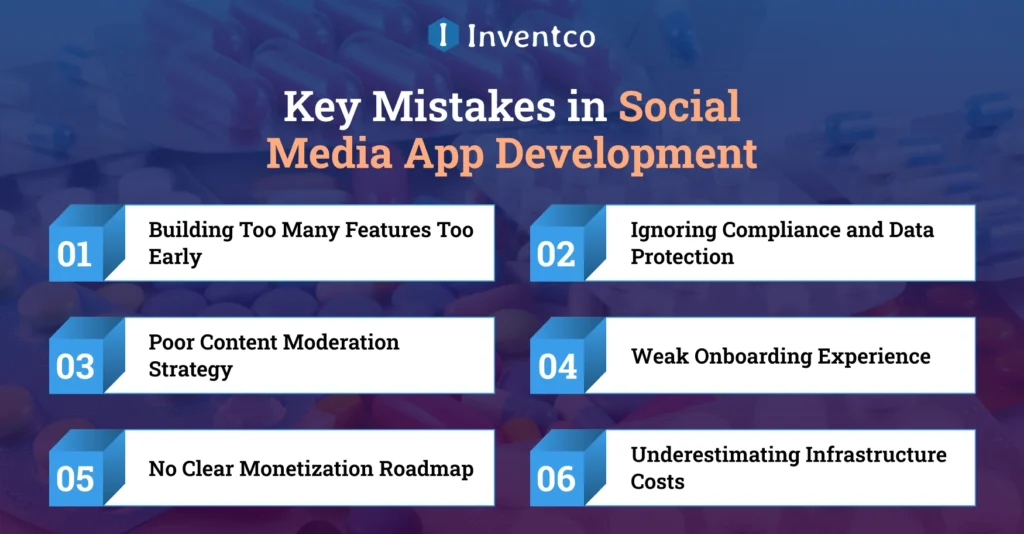
Even well-funded social platforms can fail due to critical strategic errors stemming from social media app development. By avoiding these social media development pitfalls, your business will better control risk, create scalability, and increase investor confidence.
1. Building Too Many Features Too Early
Even though this sounds logical and many first-time developers consider doing it, it can create a time, money, and complexity sinkhole and add zero real user demand. Instead, focus on an MVP and gain user engagement. From here, scale the platform based on actual user needs.
2. Ignoring Compliance and Data Protection
Failing to comply with privacy regulations, data protection laws, and other legal guidelines can lead to severe penalties, loss of customers, and erosion of user trust. Avoiding this shortened vision will be harmful in the long term to the platform.
3. Poor Content Moderation Strategy
This can escalate to spam, platform abuse, and reputational loss. Only manual moderation does not scale. Full collaboration on new AI moderation, along with clear guidelines and human oversight, is essential.
4. Weak Onboarding Experience
If new users don’t see the value of the platform or don’t know how to use it, they will likely leave. Bad onboarding experiences lead to increased churn and potential loss of new customers. Controlled onboarding, selection of interests, and cues that foster engagement early are essential to improving activation and retention.
5. No Clear Monetization Roadmap
Delays in planning for monetization often lead to abrupt or forced revenue strategies that will have to be implemented down the line. A clear, user-oriented monetization roadmap enables seamless addition of revenue opportunities without negatively impacting the user experience or their trust in the platform.
6. Underestimating Infrastructure Costs
Social networking platforms will need scalable infrastructure to support real-time user interactions, media storage, and traffic spikes. Ignoring these costs can lead to performance deficiencies and greater operational costs. Planning infrastructure for operational growth will help manage expenses in the long run.
Alternative approaches to avoiding these mistakes will help improve ROI, scalability, and potential investors’ confidence. For founders learning how to create a social media application, disciplined planning and execution are often the difference between sustainable growth and early failure.
Case Study: Wegram App by Inventco
Wegram is a contemporary social networking platform that lets users connect with others, upload and share photos and videos, create communities, and communicate via an intuitive interface. Users can access a customizable home feed, participate in group chats, and use advanced messaging features to send and receive various forms of media.
Wegram places a strong focus on privacy and safety, giving users full control of their content visibility (users can block other users on Wegram), offering AI-assisted content moderation, and providing end-to-end (E2E) encryption on private messages. Wegram includes other features such as short- form video content, interactive live streams, real-time user polling, and personalized content recommendations powered by AI.
Wegram also offers a range of tools to help influencers and businesses expand their audiences and monetize their content. Wegram’s retention-optimizing, consumer-growth-driven architecture is a testament to the social media app development industry’s focus on Wegram.
Why Choose Inventco for Social Media App Development?
Inventco is renowned as a top mobile app development company, creating scalable, durable platforms that are investor-attractive. With a specialization in social media app development, Inventco provides guidance to investors to realize their vision for a social media app through the development of a predictive, adaptable app.
The development team turned its attention to building real-time interactive systems that foster user growth to scalable cloud systems, AI-driven engagement, and security-first development. Every platform built has user compliance systems, privacy, and global data protection attuned to the regulatory requirements of the jurisdictions. Conversion-focused user experience design and long-term technical support foster user retention and ensure optimal and scalable systems.
Inventco, for founders and investors, aesthetically closes the gap in vision, execution, and enduring market success for social platforms.

Conclusion
To build a successful social platform in 2026, simple prototyping of existing social networks is not enough. Knowing how to build a social media app means building it with the right technology, compliance, user psychology, monetization, and in a time when scalability, security, engagement, and not just adoption, are crucial.
The right product strategy, combined with social media app development with an experienced partner, can deliver sustainable revenue and substantial user growth. For investors and founders, the opportunity is high, but success relies on a focus on simple, future ready architectures, disciplined execution, and in an ever increasing competitive marketplace, long term value.
FAQ’s
Q1. How long does it take to develop a social media app?
Ans. Development usually takes four to nine months, depending on feature complexity, real-time functionality, compliance scope, and scalability goals, while MVP versions launch faster, and advanced platforms require longer backend and AI phases.
Q2. What is the minimum cost to develop a social media app?
Ans. MVP development typically costs between $10,000 and $25,000, while costs increase significantly with advanced features such as AI recommendations, real-time messaging, live streaming, higher security standards, scalability planning, and support for global compliance requirements.
Q3. Which monetization model works best for social media apps?
Ans. The most effective monetization model depends on user behavior and platform positioning, with apps combining advertising, subscriptions, creator commissions, premium features, and brand partnerships to diversify revenue streams and reduce dependency risks.
Q4. Is AI necessary in social media app development?
Ans. AI is essential in modern social media app development because it powers content moderation, personalized feeds, spam and bot detection, behavioral analytics, and engagement optimization, making platforms safer, more relevant, and scalable.
Q5. Can social media apps scale globally from launch?
Ans. Yes, social media apps can scale globally from launch when built with cloud-native infrastructure, modular architecture, localization support, and compliance-ready systems that adapt to data laws, performance demands, and user growth markets.
Q6. Why is security important in social media app development?
Ans. Security plays a critical role in social media app development, requiring encryption, secure authentication, data protection, and proactive threat detection to safeguard user trust, meet regulatory obligations, and prevent costly breaches.
Q7. How does the technology stack affect the success of a social media app?
Ans. Choosing the right technology stack ensures performance, scalability, and future expansion, allowing social platforms to support real-time interactions, AI-driven personalization, global growth, efficient maintenance, and long-term cost optimization as user demand increases.
Q8. Why should founders start with an MVP for a social media app?
Ans. Launching with an MVP helps founders validate market demand, control development costs, gather real user feedback, and refine features before scaling, reducing risk while improving product-market fit and investor confidence long-term success.

Ajay Bhal
He is an on-demand app solutions expert with 11+ years of experience in business consulting and building scalable, user-centric digital products. He specializes in robust on-demand platforms across industries, combining technical expertise with business-focused strategy to deliver efficient, top notch solutions that drive growth and enhance user experience. You can connect with him on LinkedIn to follow insights.