

The global web application development market is on a steep upward trajectory, projected to exceed $89 billion by 2030. As businesses race to build digital products that can scale, retain users, and generate measurable ROI, one decision keeps coming up in technical conversations: Laravel vs React. Which one fits your business goals?
It’s a question that sounds straightforward but rarely is. Laravel and React are both best-in-class technologies, but they solve fundamentally different problems. Choosing between them without understanding those distinctions can lead to misaligned architecture, inflated development costs, and missed go-to-market timelines.
For a mid-size web application, development costs typically range between $10,000 and $1,00,000+, depending on complexity, tech stack, and team structure. Making the right technology call at the start can significantly impact where your project lands on that spectrum.
This article breaks down the core differences between Laravel and React, walks through real-world use cases for each, and helps founders and investors make an informed decision or explore why combining the two might be the right approach.
Key Takeaways
- Laravel is a full-stack PHP framework designed for backend logic, APIs, and server-side rendering.
- React is a JavaScript UI library focused entirely on building fast, dynamic frontend interfaces.
- They are not direct competitors, they operate at different layers of the application stack.
- Laravel and React can be combined effectively to build scalable, full-stack products.
- Your choice should be driven by project type, team expertise, scalability goals, and budget, not trend-following.
Web Development Market Insights for Laravel and React
The numbers behind Laravel and React tell a clear story, both technologies have earned their place in the modern development stack, just at different layers.
- According to the 2025 Stack Overflow Developer Survey, React remains among the world’s most-used web technologies and frontend frameworks.
- According to the JetBrains State of PHP 2024 Survey, 61% of PHP developers use Laravel regularly, and the State of Laravel 2024 Survey found that 40% of tech startups choose Laravel as their primary development framework.
- Laravel’s built-in authentication, routing, ORM, and security features continue making it a preferred backend framework for scalable SaaS and enterprise applications.
- According to the Stack Overflow Developer Survey 2025 (49,000+ respondents), React holds a 44.7% usage share among web frameworks, maintaining its position as the most widely used frontend framework for multiple consecutive years.
What is Laravel?
Laravel is a PHP framework for building web applications. It is done in a simple, elegant, and, most importantly, easy-to-use manner for the developer. Laravel uses the MVC model, which breaks the project into model, view, and controller layers.
It offers built-in app features such as authentication, routing, sessions, caching, and more, making it an ideal choice for web developers looking to create scalable, secure, and maintainable applications.
Features of Laravel:

- Routing System: Laravel’s routing system is one of the strongest, and it facilitates easy management of your application URL routes.
- Eloquent ORM: This is Laravel’s own ORM through which we can handle database operations without using complicated SQL statements.
- Blade Templating Engine: This framework offers designers a very basic yet sound templating engine, Blade, making it easy to separate the look and feel from the functionality.
- Artisan CLI: Laravel provides a command-line interface that handles time-consuming tasks, making developers’ work easier.
- Security: Laravel includes security measures such as Cross-Site Request Forgery (CSRF) protection, Password Hashing, and SQL Injection protection.
What is ReactJS?
Generally, it is called React or ReactJS and is a JavaScript library for building UI developed by Facebook. React is used to develop mobile applications with reusable components, with a strong emphasis on managing and maintaining existing components.
Unlike Laravel, which is a backend framework, React is primarily used for front-end development. It enables developers to build dynamic, interactive web applications, making it the go-to choice for single-page applications (SPAs) and mobile app development.
Features of ReactJS:

- Component-Based Architecture: React breaks the UI into components that are easier to use and manage in larger applications.
- Virtual DOM: React uses a concept similar to the DOM, but it is called the virtual DOM to enhance performance, since only the changed components are rendered.
- One-Way Data Binding: React uses a one-way data flow, ensuring that data flows only from the parent to the child component.
- JSX (JavaScript XML): JSX is an extension of JavaScript that lets developers write React components more easily and is understood by Developers.
- React Router: A library used in transitioning between various pages in a React application.
Laravel vs React JS — Key Differences at a Glance
Understanding Laravel and React JS differences helps businesses choose the right technology stack for scalable, high-performance, and future-ready web application development.
| Feature | Laravel | React JS |
|---|---|---|
| Type | Full-stack PHP Framework | JavaScript UI Library |
| Primary Use | Backend / Server-side | Frontend / Client-side |
| Language | PHP | JavaScript / JSX |
| Architecture | MVC (Model-View-Controller) | Component-Based |
| Rendering | Server-side rendering | Client-side rendering |
| Database Support | Built-in ORM (Eloquent) | Requires external libraries |
| Learning Curve | Moderate | Moderate to High |
| Best For | APIs, CMS, SaaS backends | SPAs, dashboards, interactive UIs |
| Community | Strong PHP ecosystem | Massive JS ecosystem |
| SEO Readiness | Natively strong | Requires additional configuration (SSR/Next.js) |
Laravel vs React: Detailed Feature Comparison
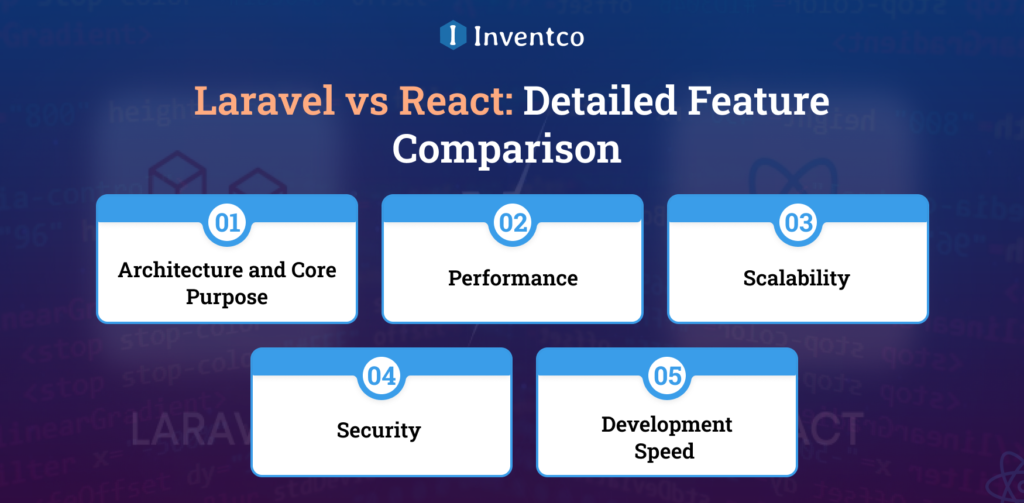
Laravel and React are leading app frameworks for modern web app development. Businesses looking for fast development cycles with flexibility, performance, and scalability should understand Laravel vs React.
1. Architecture and Core Purpose
Laravel is a Model-View-Controller (MVC) PHP Framework that has out-of-the-box server-side routing, authentication, database logic, and operations. Laravel is purely backend, focusing on the development of APIs, admin panels, and systems for data-intensive enterprises.
React is a component-based, declarative JavaScript library. It has one key focus: to construct fast, high-level, dynamic, and interactive UIs. React does not handle backend operations such as data visualization, authentication, data fetching, or rendering. It simply shows a dynamically functional UI, based on the data it receives. Recognizing the difference in architecture is the basis for every right technology choice.
2. Performance
Laravel performs well in intensive backend data and logic operations. When combined with other tools such as Laravel Octane, which is based on Swoole or RoadRunner, it can handle thousands of concurrent requests with ease.
React uses a virtual DOM, which is in-memory, making your application not only fast but also highly responsive to your users, regardless of its size and complexity.
3. Scalability
Laravel offers built-in job management, caching layers (Redis, Memcached), and a queue system for in-built vertical and horizontal scaling. It is the perfect option for SaaS businesses that have complex background operations.
React employs code splitting, lazy loading, and appropriate state management to offer front-end scalability. The more complicated your UI, the more maintainable your codebase becomes using React’s modular component structure.
4. Security
Across the board, Laravel’s built-in app security features, from CSRF protection and XSS filtering to preventing SQL injections via Eloquent ORM and encrypted sessions, make it one of the strongest frameworks in this category.
React does not handle any form of backend security. However, standard practices for sanitizing user input and correctly managing political tokens are essential when building React projects. Game security in React is highly dependent on games and backend communication.
5. Development Speed
Laravel’s scaffolding tools, Artisan CLI, and pre-built modules significantly reduce backend project development time through integrated systems for authentication, API resource management, and database migrations.
React facilitates rapid UI development thanks to the modular system of buildable components. Design systems and component libraries like Material UI and Ant Design significantly reduce front-end development time.
When Should You Use Laravel?
Laravel is your ideal choice for building applications with specific backend requirements, such as complex processes or data management.
Ideal Use Cases:
- SaaS Platforms: Subscription management, billing logic, multi-tenant architecture
- Enterprise Web Applications: ERP systems, CRM platforms, internal tooling
- API-first Backends: RESTful or GraphQL APIs powering mobile apps or third-party integrations
- E-commerce Platforms: Product catalogs, order management, payment gateway integrations
- Content Management Systems: Custom CMS builds requiring role-based access and content workflows
For more complex projects that require customized scheduling, data relationships, background processes, and real-time event systems, Laravel has a solution for everything in its robust ecosystem.
From a business perspective, Laravel is a cost-saving choice, as it can reduce backend costs and shorten the go-live timeframe, giving a competitive edge when working with a leading Laravel development company. This is due to how convenient Laravel makes the backend with its reduced need for decisions when creating conventions.
When Should You Use ReactJS?
React is the right choice when user experience, interface speed, and frontend interactivity are central to your product’s value proposition.
Ideal Use Cases:
- Single-Page Applications (SPAs): Fast-loading, app-like web experiences
- Customer-facing Dashboards: Analytics platforms, data visualization tools, admin panels
- Social Platforms and Marketplaces: Dynamic feeds, real-time updates, complex UI states
- Healthcare and FinTech Portals: Interfaces requiring real-time data, form-heavy workflows, and intuitive UX
- EdTech Platforms: Interactive learning tools, progress tracking UIs, adaptive quiz interfaces
React is a great technology choice when your web app should deliver a native-like experience and meet users’ expectations with fast UX, transitions, and real-time updates without full-page refreshes.
React’s huge developer community makes it easier to hire, has a ton of open-source tools available, and offers promising long-term community support, which will give you a lower total cost of ownership over time and allow you to partner with the best React app development company.
Can You Use Laravel and ReactJS Together?
Yes, and in many enterprise-grade projects, this is the most strategic approach.
The combination follows a clean decoupled architecture pattern:
- Laravel serves as the backend API layer: managing data, authentication, business logic, and server-side operations.
- React serves as the frontend consumption layer: fetching data from Laravel APIs and dynamically rendering the UI.
This stack is commonly referred to as a Laravel + React SPA setup, delivering the best of both worlds: Laravel’s robust backend capabilities and React’s superior frontend performance.
When does this combination make sense?
- When you need a high-performance, interactive frontend backed by a secure, scalable API.
- When your product roadmap includes both a web application and a mobile app (both consuming the same Laravel API).
- When your team has distinct frontend and backend expertise that can work in parallel.
Several mature SaaS platforms, healthcare applications, and enterprise portals are built on this exact architecture. It’s a proven, production-ready combination that scales with your business.
React JS vs Laravel — Which Is Better for Your Project?
There’s no universal answer, and any technology partner who tells you otherwise isn’t giving you sound advice. Here’s a practical decision framework:
Choose Laravel if:
- Your project is backend-heavy with complex data relationships
- You need a robust API or a server-rendered web application
- Your team has strong PHP expertise
- Security and data integrity are non-negotiable priorities
Choose React if:
- Your product’s competitive advantage is its user experience
- You’re building a SPA, a real-time application, or a complex dashboard
- You need a fast, scalable frontend with a large developer talent pool
- You’re planning to eventually expand to a React Native mobile app
Choose Both if:
- You’re building a full-stack product that needs to be both powerful on the backend and exceptional on the frontend
- You want a decoupled, API-first architecture that’s scalable and maintainable long-term
- Your product will eventually integrate multiple client interfaces (web, mobile, third-party tools)
The real question isn’t which technology is better in the abstract, it’s which combination aligns with your product goals, team composition, and runway.

Conclusion
Laravel and React are powerful technologies that excel in their respective areas. Laravel is best for building reliable, scalable backend systems. React is best for building useful interfaces. Each of these technologies has its pros and cons, depending on the problem you’re trying to address and the product you’re developing.
As an investor or founder, evaluating a technology stack should not be about moving with the trends, but rather about building the right technology base that aligns with your business model, supports it, grows your mobile app tech stack in a manageable way, and minimizes the risk of wasted effort.
If you want an instinctive response to your technology architecture assessment or if you’re evaluating your tech stack, you can take an informed, straightforward decision that won’t be a loss to you while working with an experienced team that has a wealth of relevant experience.
FAQs
Q1. Is Laravel better than React for web development?
Ans. They aren’t directly comparable. Laravel handles backend and server-side operations, while React manages the frontend. The better choice depends on your project’s specific requirements.
Q2. Can Laravel and React be used together?
Ans. Yes. A popular and scalable approach is to use Laravel as a backend API and React as the frontend SPA. This decoupled architecture is widely used in enterprise and SaaS products.
Q3. Which is faster, Laravel or React?
Ans. React excels at frontend rendering speed thanks to its virtual DOM. Laravel performs efficiently in backend operations. They optimize performance at different layers of the application.
Q4. Is Laravel good for building APIs?
Ans. Absolutely. Laravel is one of the most mature PHP frameworks for building RESTful APIs, offering built-in support for authentication, rate limiting, resource controllers, and API versioning.
Q5. Is React a framework or a library?
Ans. React is technically a JavaScript library, not a full framework. It focuses specifically on building user interfaces and requires additional libraries for routing, state management, and data fetching.
Q6. Which is easier to learn, Laravel or React?
Ans. Both have moderate learning curves. Laravel requires knowledge of PHP and an understanding of MVC patterns. React requires proficiency in JavaScript and familiarity with component-based architecture.

Sandeep Agrawal
Sandeep Agrawal is the visionary CTO at Inventco, bringing innovation to life through his technical expertise. With a passion for cutting-edge technologies, Sandeep leads the team in developing robust solutions. His dedication and continous efforts to pushing the boundaries of what’s possible defines his role as a transformative and innovative force in the tech industry. You can connect with him on LinkedIn to follow insights.


