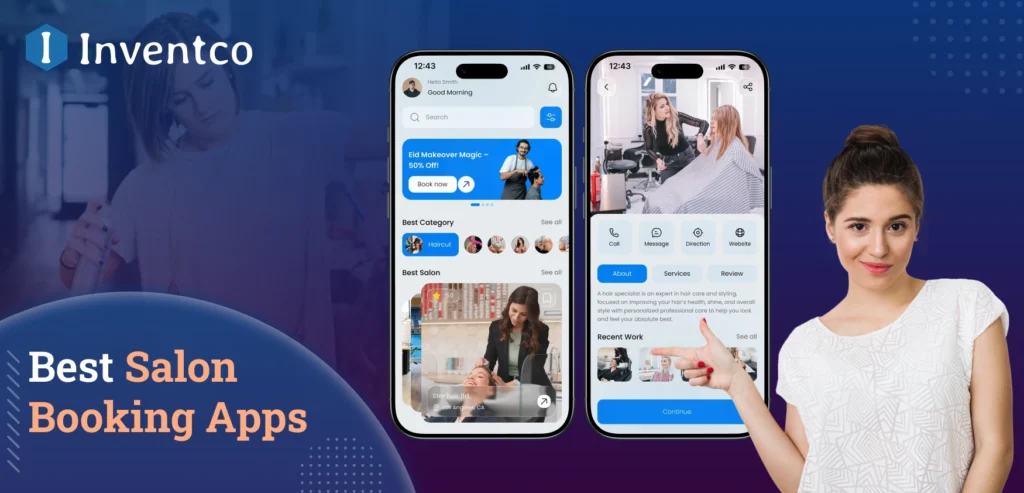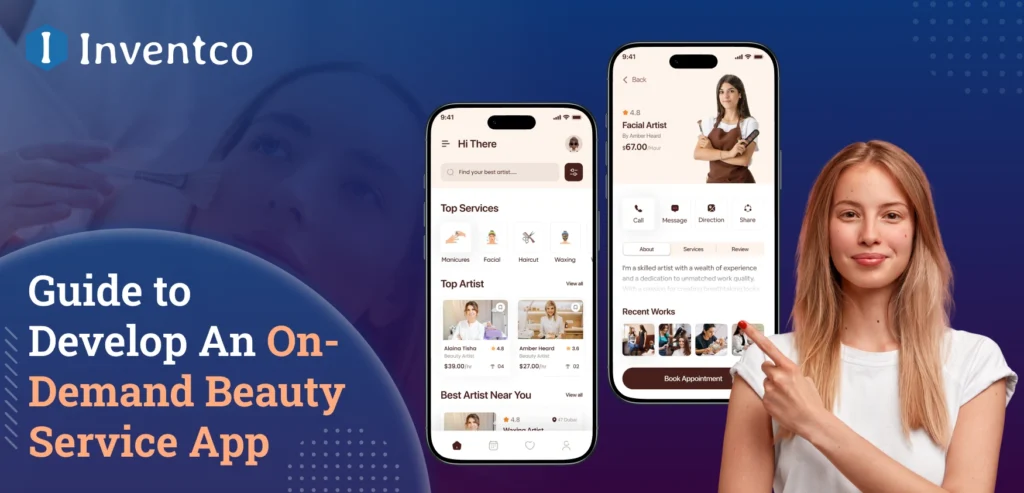
The beauty and personal care industry is undergoing a quiet yet powerful transformation. Consumer expectations have shifted to demand convenience, personalization, and immediacy. This shift has raised the potential of developing apps for on-demand beauty services, making it a worthwhile pursuit for founders and investors.
Previously, customers could only walk into a salon and book an appointment. This is now changing the customers’ expectations, they expect a mobile-first experience and for services to be available at home. Customers expect beauty and wellness professionals to be bookable like a rideshare service.
The potential for recurring revenue and for scalability is strong. For founders, this potential comes with a cost. It is imperative that a clean, compliant, and operationally efficient platform be built for sustainable growth.
This guide is for investors, startups, and founders seeking to develop an app for beauty services as a sustainable business opportunity. It will outline the features, technology, costs, market data and patterns, and monetization strategies. It will also define the elements essential to creating a platform with high conversion rates and strong scalability.
Market Stats of the Beauty Services App Industry
The global beauty and personal care services market continues to grow steadily, driven by urbanization, higher disposable income, and increasing demand for convenience-led services.
Key industry indicators shaping on-demand beauty services mobile app development include:
- Multiple industry reports estimate the global beauty and personal care market to grow substantially by 2030 and beyond. For example, one forecast projects the market to reach roughly $697–$732 billion by 2030–2031, with steady annual growth.
- The global salon services market was valued at approximately USD 240.35 billion in 2024 and is expected to reach around USD 382.34 billion by 2030, growing at a CAGR of ~8.08%.
- Another estimate shows the salon services market growing from USD 271.61 billion in 2025 to USD 510.22 billion by 2033 at a ~8.2 % CAGR, reflecting strong long-term demand.
For startups, these trends validate the long-term viability of custom beauty services mobile app development, particularly platforms that focus on professional vetting, real-time availability, and seamless payments.
How to Build a Beauty Services Mobile App?
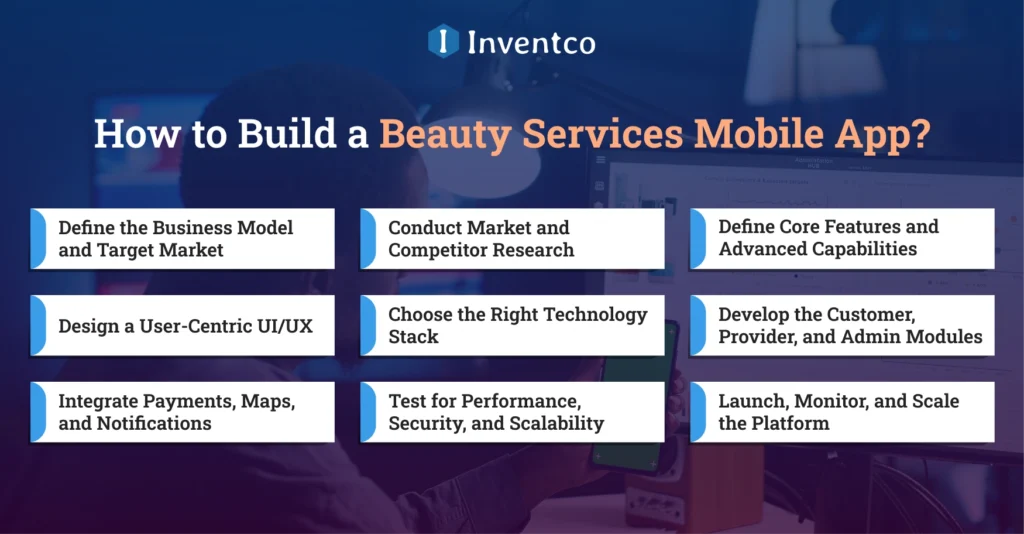
Creating a successful beauty service platform encompasses so much more than simply coding an app with a proper app development process. It requires architectural design and planning for future scalability, compliance, and a monetization strategy.
Below is a successful step-by-step strategy commonly used by seasoned professionals in on-demand beauty services app development.
Step 1: Define the Business Model and Target Market
The first step in developing a beauty services app is to identify your business model and target audience. It is important to determine whether your app will serve freelancers, salons, or both. Make sure to specify the region you will target and consider how you will charge users. Will it be commission-based, subscription, or a combination of both? This is an area where investors will be most concerned, because your pricing model will directly impact scalability, unit economics, and the value of your business in the future.
Step 2: Conduct Market and Competitor Research
Before you start the development of your on-demand beauty services mobile application, you must first survey the current competition in your intended market. You should analyze the features and functions of the competitor app and the subscription price, and collect their customers’ reviews to analyze the strengths and weaknesses of their operational model. This will help you pinpoint where your target users are underserved and where you can differentiate your app or service. Comprehensive market research will help you develop a platform that meets modern customer needs rather than replicating an outdated model. It will also serve to increase customer and investor satisfaction.
Step 3: Define Core Features and Advanced Capabilities
Identifying attributes and functionalities is an integral part of mobile app development. Specify the fundamental attributes for end users, beauty service providers, and administrators, including booking, payment, reviews, and dashboards. Simultaneously, identify premium features, such as AI recommendations, instant payouts, and analytics. Development costs can be controlled by balancing these features, and the platform is set up for future development.
Step 4: Design a User-Centric UI/UX
The development of the interface and experience shapes users’ perception of and trust in the app. In app development for beauty services, less is more. Users’ service bookings should take little time, and providers should be able to adjust their availability and total earnings with minimal effort. Engaging users with design that is clean and obvious reduces the drop-out rate and supports an increase in availability. All of these factors accelerate the business’s growth.
Step 5: Choose the Right Technology Stack
Identify technologies that support the performance, safety, and scalability required for the on-demand app. Use cross-platform technology, such as Flutter and React Native, to speed up the process, and strong frameworks for backend analytics, booking, and transactions. Your choice of cloud service should support scalability so that your app can meet increased user demand.
Step 6: Develop the Customer, Provider, and Admin Modules
Beauty services apps are usually developed in separate modules. Each customer app allows for service discovery and booking. Each provider app allows service professionals to manage services and earnings. Each admin panel manages and controls operations. To streamline development, experienced beauty services app developers usually build these modules in parallel to avoid cross-platform integration issues.
Step 7: Integrate Payments, Maps, and Notifications
Implementing payment solutions, location tracking, and notification services is a must-have for any beauty service app. Payment services must include multifactor authentication options, mapping services must support accurate routing, and notification services must enable user tracking throughout the process. These factors are the most critical to customer satisfaction, platform reliability, and service completion.
Step 8: Test for Performance, Security, and Scalability
While there are many testing parameters, only after mobile app testing for on demand beauty services under real-world scenarios can the app developers begin to test for inadequate performance. There are many tests to run, app security must be audited, and payments must be validated. Users must accept the testing. This testing subsystem minimizes the probability of system failures after launch, secures the system against potential breaches of user personal data, and addresses compliance concerns, which are critical for potential investors and enterprise clients.
Step 9: Launch, Monitor, and Scale the Platform
Starting your app’s launch is only the beginning. After the app is launched, start monitoring user behavior patterns, operational analytics, and service demand using the analytic tools. App store optimization should be driven by operational analytics to increase retention and improve revenue. You need to focus on the mobile app maintenance. For founders and their prospective investors, this moment is critical – now we can ascertain whether the beauty services mobile application development is an MVP or can truly become a scalable business.
A structured development approach reduces risk, controls cost, and improves time-to-market. When executed correctly, on-demand beauty services app development creates a scalable digital asset with strong revenue potential and long-term investor appeal.
How On-Demand Beauty Services Apps Work?
For an on-demand beauty services application to scale successfully, it’s essential to balance operational simplicity for beauty professionals and admin staff with rich, flexible workflows for customers. This balance seen across the best salon booking apps is critical for building user trust, maintaining service quality, and driving long-term retention and growth.
The workflow of beauty services apps generally consists of three layers: customer booking, beauty professional execution, and admin execution.
1. Customer Booking Flow
Beauty services apps aim to make the customer journey as quick and efficient as possible, making it convenient and encouraging repeat bookings.
- Users sign up and choose their location
- They browse beauty services such as hair styling, makeup, skincare, spa, or grooming
- A beauty professional is selected based on ratings, pricing, and availability
- The customer picks a date, time, and service location (home or studio)
- Payment is completed securely within the app
- Real-time notifications confirm the booking and service status
- After the service, customers rate and review the professional
This entire booking flow illustrates the importance of a seamless experience in the development beauty services app.
2. Beauty Professional / Service Provider Workflow
The service app also provides a digital workspace for beauty service professionals to manage their jobs and track their earnings.
- Professionals register and submit verification documents
- The admin team reviews and approves profiles
- Providers set their availability, services, and pricing
- Booking requests are accepted or declined
- In-app navigation guides them to the customer location
- After completing the service, payments are credited to their account
- Earnings, ratings, and performance data are tracked in the app
This structure helps the experienced developers of beauty service apps to grow long term.
3. Admin & Operations Management
Admins oversee the platform’s overall health and scalability.
They are responsible for:
- Approving and managing users and beauty professionals
- Setting commission rules and handling payouts
- Managing cancellations, disputes, and refunds
- Controlling service categories and pricing guidelines
- Monitoring analytics, demand trends, and platform security
As the platform scales, so does the smoothness of the strong admin system.
Why This Structure Matters?
Operational efficiency, service quality, and user trust are improved by a simplified and clear workflow. For founders and investors, the structure reduces risks, controls costs, and accelerates scaling.
This is why on-demand services and beauty apps need well-thought-out workflows to succeed in the long term.
Key Features Required in an On-Demand Beauty Services App
Success in the Beauty On-Demand Services Application developer field comes from the right set of mobile app features and engagement that translates into smooth operational performance and scalability over time. Features are grouped by user role and classified as either essential or advanced.
1. Customer App Features
The customer-oriented app prioritizes convenience and booking transparency to drive repeat bookings.
- User Registration & Profile Management: Facilitates user registration via email or social media login. Users can then manage their personal details in the app, including preferences, addresses, and payment methods.
- Service Discovery with Smart Filters: Users can filter their searches within beauty service categories by price, reviews, proximity, and service availability.
- Real-Time Booking & Scheduling: Bookings can be made based on time and service location availability, providing flexibility and reducing service cancellation rates.
- Secure Payment Gateway Integration: Users can make payments via multiple secure methods, and the payment experience is user-friendly, allowing them to view a payment checklist, view the service invoice, and request a refund.
- Push Notifications & Automated Reminders: Cancellation and service reminders are provided, along with booking status notifications and fillers to keep customers updated throughout the journey.
- Ratings, Reviews & Service History: Displays the completed service history, verified customer reviews, and quick rebooking features to promote trust and rebooking.
- In-App Chat & Support Access: Enhances service satisfaction and chat support with beauty professionals to resolve service details and queries.
- Personalized Recommendations: AI-based insights, user behavior, preferences, and previous booking history, to automobile services and professionals recommendations.
These features combine to deliver exceptional customer service in beauty service app development.
2. Beauty Professional App Features
Beauty professionals and service providers grow their earnings while operating seamlessly with the business management tool.
- Profile & Service Management: Enables service professionals to update their profiles, certifications, service offerings, pricing, and experience details to attract customers.
- Availability Calendar Management: Improves time management and scheduling flexibility with real-time updates to avoid overbooking.
- Booking Request Handling: Service professionals may accept or decline booking requests based on their availability, scope of services, and location preferences.
- Earnings Dashboard & Wallet: Financial dashboards centre on income tracking, commission deductions, payout summaries, and transaction histories, with transparent income tracking.
- In-App Chat & Navigation: Enables direct communication with customers and integrates chat and GPS for real-time arrival times and instructions.
- Performance & Rating Insights: Show service ratings, reviews, booking patterns, and completion metrics to help professionals enhance their service.
- Instant Payout & Payment History: Provides settlements with detailed payout summaries for improved cash flow and professional satisfaction.
- Service Performance Analytics: Provides actionable insights on demand, pricing, and popularity to foster the professional’s growth.
These are the minimal tools for on-demand beauty services mobile app developers to have.
3. Admin Panel Features
Admin panel provides for control, scalability, and profitability of the platform; the spine of custom mobile app development for beauty services.
- User & Provider Management: Automates onboarding, verification, approvals, suspensions, and role-based access for customers and beauty professionals.
- Commission & Payout Control: Let’s admins set commission structure, payout frequency, transaction capture, and financial summaries.
- Service Category Configuration: Enables governance of service categories, pricing policies, regional availability, and service standards across the platform.
- Analytics & Reporting Dashboard: Delivers real-time visibility on bookings, income, growth, user engagement, and overall performance of the platform.
- Dispute Resolution & Support Management: Focuses on the centralization of cancellations, refunds, complaints, and related service disputes for improved and expedited resolutions.
- Marketing & Promotion Tools: Includes coupon code customization, referral program management, featured listing control, promotional campaign capabilities, and marketing via push notifications.
- Fraud Detection & Platform Security: Automated detection of fake accounts, fraudulent payment processes, and other misuse of the platform’s services.
- Demand Forecasting & Business Insights: Utilizes predictive analytics to assist in setting optimal pricing, supply and demand management, and planning for regional growth.
The robust administration system of the beauty services app enables app developers to create platforms that scale seamlessly and meet investor expectations.
Why Feature Planning Matters?
Thorough, robust feature planning enables the development of scalable platforms rather than an MVP with a very limited lifespan. For founders and investors, a well-designed feature set minimizes operational risks, increases customer retention, and supports long-term app monetization.
It is evident that in the development of on-demand beauty services applications, well-designed features are paramount.
Technology Stack for Beauty Services App Development
Choosing the right technology stack is critical to the success of beauty services app development. A well-architected stack ensures smooth performance, strong security, scalability, and the flexibility to add advanced features as the platform grows.
Below is a commonly used and proven technology stack for on-demand beauty services mobile app development.
Recommended Technology Stack
| Layer | Purpose | Recommended Technologies |
| Frontend (Mobile App) | User interface and user experience for customers and professionals | Flutter, React Native |
| Backend Development | Business logic, APIs, and data processing | Node.js, Django, Laravel |
| Database Management | Secure storage of user data, bookings, and transactions | PostgreSQL, MongoDB |
| Cloud Infrastructure | Hosting, scalability, and high availability | AWS, Google Cloud |
| Payment Gateway Integration | Secure in-app payments and payouts | Stripe, Razorpay, PayPal |
| Maps & Location Services | Real-time location tracking and navigation | Google Maps API |
| Push Notifications | Alerts, reminders, and booking updates | Firebase Cloud Messaging |
| Security & Authentication | User authentication and data protection | OAuth 2.0, JWT, SSL Encryption |
| Analytics & Tracking | User behavior and performance insights | Firebase Analytics, Mixpanel |
Why This Technology Stack Matters?
Technology stacks affect operational efficiency and ROI for investors and business owners alike. Some benefits of a modern stack include the following:
- Increased Speed and Improved User Experience
- Secure Payment and User Data Protection
- Easy Company Growth
- Quick Feature Upgrades, Including AI
- Less Technical Debt and Maintenance Over Time
Because of this, on demand beauty services mobile app developers have more focus on flexible and proven technology than untested frameworks.
Business Models for On-Demand Beauty Services Apps
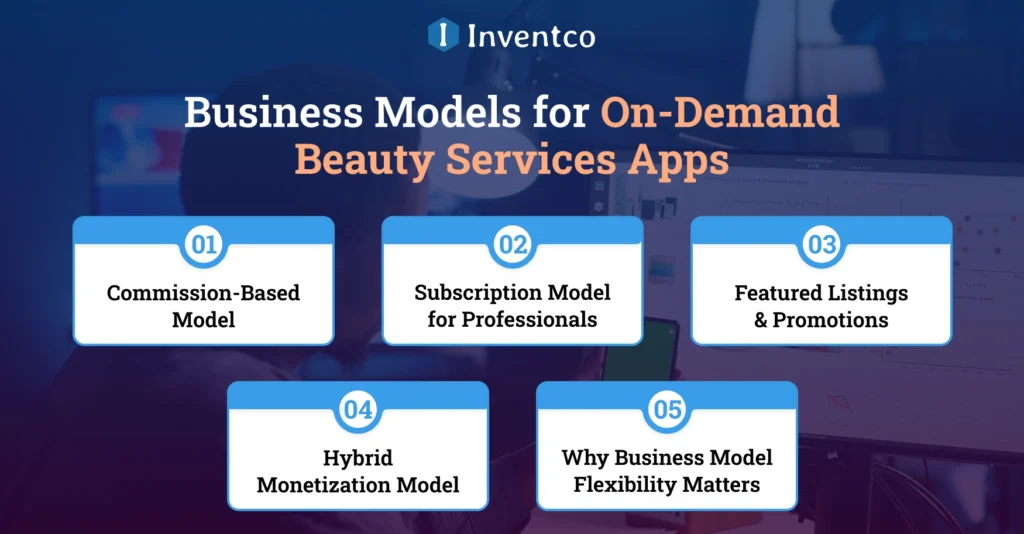
Selecting the right business model is essential for profitability and business stakeholder confidence. The most successful players in beauty service applications use the most flexible monetization models, striking a balance among platform operational costs, professional service costs, and customer service access.
Below are the most successful monetization strategies used in app-based beauty services.
1. Commission-Based Model
In this model, the platform takes a cut for every successful booking. Beauty professionals are able to join the marketplace with very little risk, and the business can create a profit with little cost, because this revenue model is fully dependent on demand and volume, and this is why it is the most successful model.
2. Subscription Model for Professionals
Beauty professionals can pay a monthly or annual subscription to access leads and increase their visibility on the platform. This method brings in steady, predictable recurring revenue and is a sufficient model for platforms aimed at full-time professionals or salons that want steady bookings through custom beauty services mobile app development.
3. Featured Listings & Promotions
Paying to be positioned at the top of search results or in the app’s promoted sections is also common. This model monetizes visibility, and in competitive spaces, where professionals need to acquire customers, this is very effective.
4. Hybrid Monetization Model
In this example, the hybrid model combines a subscription, a commission, and a fee for a promoted listing. This combination provides financial stability and reduces the risk of overreliance on any one model, thereby increasing interest from potential investors. This is the most common approach from seasoned beauty services app developers.
5. Why Business Model Flexibility Matters?
Investment in on-demand mobile beauty services app development is predicated in part on the platform’s ability to offer flexible pricing, scale across multiple geographies, and adapt easily to shifts in market demand.
Cost of On-Demand Beauty Services App Development
Costs to build an on-demand beauty service app can range from $10,000 to $100,000+. This large price difference is due to app complexity, features, scalability, and compliance. Development costs should not be viewed as an expense that founders and investors need to pay, but rather as an expense that will improve user experience, operational efficiency, and ultimately, revenue.
Below is a clear cost breakdown by app complexity level.
1. MVP Development Cost: $10,000 – $25,000
The purpose of an MVP is to validate a business idea and, as such, is built with only the critical features. An MVP in the beauty services app development sector would include: a customer booking system, basic service provider administration, an app payment system, and an admin panel. An MVP is ideal for startup companies in the early stages of testing market demand, gathering user feedback, and pitching to early investors.
2. Mid-Level App Development Cost: $25,000 – $55,000
A mid-level app would contain additional app features such as: advanced filters, real time notifications, additional service provider dashboards, professional dashboards, and an overall improved UI/UX of the app. A beauty services app at this stage development aids in streamlining operational processes, increasing user retention and support and increasing geographical scalability of the app. This level app would suit growing businesses looking to app developments beyond MVP.
3. Advanced App Development Cost: $55,000 – $100,000+
With the highest level of operational sophistication, the on-demand beauty services app at this tier is likely to attract large-scale investors, as it offers instant payouts, AI-driven recommendations, advanced analytics and fraud detection, robust security, and scalable cloud infrastructure. This level is most suitable for founders who are expecting to make multi-city expansions, and undertaking enterprise-partner collaborations or long-term monetization plans.
The level of investment required to develop on-demand beauty services apps largely depends on advanced analytics, fraud detection and security features, scalable cloud infrastructure, and instant payment capabilities. Experienced app developers are likely to build lasting advanced apps.
Why Choose Inventco for Beauty Service App Development?
Inventco stands out as a trusted mobile app development company for founders and investors looking to build scalable, high-performing platforms. With proven experience in service-based marketplaces, Inventco follows a custom-first approach to beauty service app development, ensuring each solution aligns with business goals, user expectations, and long-term growth strategies. Every app is designed with investor-grade architecture, enabling seamless expansion, operational efficiency, and strong monetization potential from day one.
Every phase of development incorporates security, compliance, and performance. This is backed by milestone-driven delivery and clear and transparent pricing. Inventco also offers dedicated support after launch to help companies optimize features, improve retention, and scale. Inventco doesn’t simply develop applications, they create businesses that are ready for investment, growth, and funding.
Conclusion
There are now structural reasons to support the demand for mobile-first beauty services. Consumer behavior is increasingly focused on convenience and personalized offerings, making mobile app development for bespoke beauty services a significant opportunity for entrepreneurs and investors.
However, achieving this potential is not a simple matter of launching an app. Success is built on a solid platform, well thought out user journeys, the implementation of best-in-class security, and a monetization strategy that balances short and long term goals to deliver sustainable growth.
With a clear business plan and the right development partner, an on-demand beauty services app can become a valuable digital asset with positive, sustainable cash flow.
FAQ’s
Q1. How long does it take to develop an on-demand beauty services app?
Ans. On-demand beauty services app development usually takes 3–5 months for an MVP, while a full-scale beauty services app with advanced features may require 6–9 months.
Q2. What is the minimum cost to build a beauty services app?
Ans. The minimum beauty services app development cost typically starts from $10,000–$25,000 for an MVP, depending on required features, platform type, and scalability needs.
Q3. Is on-demand beauty services app development scalable?
Ans. Yes, on-demand beauty services mobile app development is highly scalable when built using cloud infrastructure, modular architecture, and optimized backend systems supporting multi-city expansion.
Q4. Can beauty professionals work independently on the platform?
Ans. Yes, most beauty service apps allow freelancers and salons to operate independently through verified profiles, flexible schedules, and self-managed pricing within the platform.
Q5. What revenue model works best for beauty service apps?
Ans. A hybrid revenue model combining commissions, professional subscriptions, and featured listings works best, offering stable income and strong monetization for beauty services app development platforms.
Q6. Are these apps compliant with data and payment regulations?
Ans. When developed correctly, beauty services apps comply with data protection laws and secure payment standards through encrypted transactions, authentication protocols, and compliant payment gateways.
Q7. Why hire professional on demand beauty services mobile app developers?
Ans. Professional on demand beauty services mobile app developers ensure secure architecture, scalability, compliance, and faster time-to-market, which is critical for long-term growth and investor confidence.

Ajay Bhal
He is an on-demand app solutions expert with 11+ years of experience in business consulting and building scalable, user-centric digital products. He specializes in robust on-demand platforms across industries, combining technical expertise with business-focused strategy to deliver efficient, top notch solutions that drive growth and enhance user experience. You can connect with him on LinkedIn to follow insights.