Most people cannot remember the last time they had to sit down in front of their TV and wait for their favorite show to come on. This is exactly what the rise of OTT is. How people consume content has changed with OTT. Instant access is expected by customers, along with tailored suggestions and a smooth experience on mobile, web, and smart TV.
Streaming platforms like Netflix and Amazon Prime Video have fundamentally changed how content is consumed. Viewers now expect instant access, personalized recommendations, and seamless experiences across mobile, web, and smart TV devices.
For startups and investors, this isn’t just a trend, it’s a high-growth digital opportunity. The increasing demand for OTT app development is driven by evolving consumer behavior, rapid mobile adoption, and advancements in cloud-based streaming technologies.
Building an OTT app is not enough, you need to build a successful OTT platform. This success is built on the foundation of a clear monetization model, a well defined target audience, solid strategic planning, the appropriate technological, and adaptable support. If you are interested in developing an OTT app, this is the most comprehensive guide you will get.
In this guide, we will cover all the aspects of development costs, monetization strategies, scalability, and essential features to empower you to make business-centric OTT app development decisions.
Key Takeaways
- OTT platforms have become the dominant players in digital entertainment due to their unique ability to tailor the content consumption experience. Their platforms offer on-demand content that can be streamed on multiple types of devices.
- Increased competition in OTT services creates tremendous opportunities for startups and investors to develop scalable digital platforms capable of generating high revenue over the long term.
- Identifying a business model (SVOD, AVOD, TVOD, hybrid) is critical to business success because that model will drive user acquisition, user engagement, and monetization.
- A premium tech stack, scalable cloud architecture, and seamless streaming functionality are essential to deliver optimal performance and reliability, and to meet user expectations on any device.
- Enhanced engagement and reduced user churn can be achieved through the effective implementation of advanced features like artificial intelligence (AI)-based content recommendation services, support for offline video viewing, and multiple language options.
- Addressing infrastructure, content acquisition and licensing, and security on the OTT platform will provide a strong and secure OTT solution.
- OTT (Over-The-Top) solutions must be built on a foundation of strategic planning and continuous improvement. As a result, the platform development team must create a solution that focuses on user engagement, retention, and revenue generation.
Evolution of Video Streaming: From Cable to OTT
Traditional cable television evolved content consumption through fixed time scheduling and a limited number of channels. The audience was completely passive and did not have the flexibility to watch any show.
Content consumption began to evolve with the introduction of OTT services like Netflix, Amazon Prime Video, and Hulu. These platforms redefined content consumption by giving users complete control over what to watch, when to watch, and how to watch it.
Today’s OTT ecosystem is powered by advanced technologies and user-centric experiences, including:
- AI-driven content recommendations for personalized viewing
- Seamless multi-device compatibility across smartphones, smart TVs, and web platforms
- Flexible subscription-based ecosystems with global content access
Advancements in technology accompany behavioral shifts and growing self-service expectations. Streaming video apps that provide personalized and instantaneous experiences are becoming popular with customers, making them an attractive and high-potential development prospect for startups and investors on scalable digital platforms.
OTT Market Size, Growth & Trends (2026 Outlook)
- The global OTT market is projected to reach $383.5 billion in 2026, with forecasts exceeding $626 billion by 2031, reflecting strong long-term growth potential
- The global video streaming market is estimated at around $277 billion in 2026, driven by increasing internet penetration and digital consumption
Key Trends Shaping OTT in 2026
- Mobile-First Consumption Dominates: A majority of users now prefer streaming on smartphones, making mobile optimization critical for any video streaming app development strategy.
- Rise of Regional and Niche Content Platforms: Emerging markets are seeing increased user engagement and subscriptions as a result of localized videos, and therefore, more regional and niche content platforms are expected to be developed.
- AI-Driven Personalization Engines: OTT platforms increasingly rely on AI to deliver tailored content recommendations, improving retention and watch time.
- Integration With Smart TVs And Connected Devices: The rapid growth of connected TV users highlights the shift toward multi-device streaming ecosystems.
- Hybrid Monetization Models Are Gaining Traction: Ad-supported and subscription-based models are merging to maximize revenue potential in a competitive landscape.
As a result of the continuous development of the OTT ecosystem, these trends present one clear direction for startups and investors, and that is to stay competitive, to develop, and to secure market share.
Types of OTT Platforms
Understanding your business model will help you better understand your customer acquisition, customer engagement, and customer retention while providing you with effective long-term revenue streams through mobile app monetization.
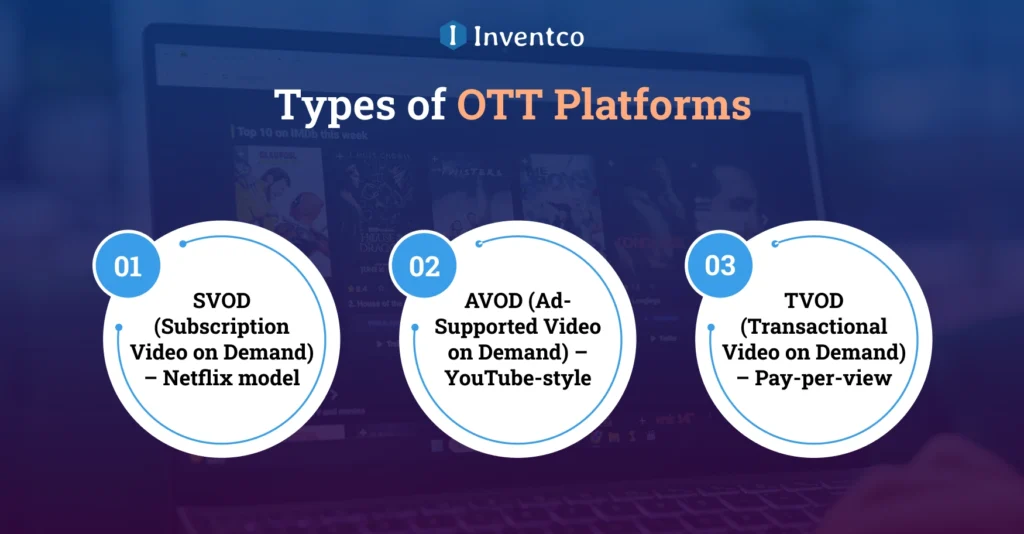
1. SVOD (Subscription Video on Demand) – Netflix model
SVOD is a subscription video-on-demand service. i.e., SVOD services such as Netflix give users unlimited access to content for a monthly fee or an annual fee. This model allows for predictable, recurring revenue and good customer retention. It is best used with libraries of exclusive, high quality, and frequently updated content.
2. AVOD (Ad-Supported Video on Demand) – YouTube-style
AVOD, or advertising video on demand services, such as YouTube, give free access to content and make revenue through ads. This model attracts a larger audience base, lowers entry barriers, and works effectively when combined with high user traffic and consistent content consumption patterns.
3. TVOD (Transactional Video on Demand) – Pay-per-view
TVOD, or transactional video on demand, services allow users to pay, without a subscription, for certain content, such as movies or live events. This model is good for providing premium content and exclusive content, and it allows flexible on-demand purchasing for users, which can offer higher margins per transaction.
How OTT Platforms Work?
A working pipeline assists OTT services in developing a technologically structured operational framework that offers scalable and high-quality user experiences across numerous services and devices.
1. Content Acquisition
Predictably, OTT services acquire content that may be licensed, partnered, or a product of original production. The content that an OTT Service secures explains its value to consumers. Furthermore, optimally exclusive and high-quality content fuel consumer acquisition, retention, and engagement levels.
2. Encoding & Storage
The acquired content must be encoded and stored in various formats and resolutions to facilitate adaptive streaming. The acquired content must be processed in a manner that provides access, redundancy, and cost-effective storage to large media libraries.
3. CDN-Based Delivery
A content distribution network offers elevated levels of streaming. The network also reduces latency and buffering by directly transferring data to the endpoint closest to the OTT user, whether high or low traffic.
4. Frontend Streaming Interface
A range of devices offers access to the services provided by an OTT app. The OTT app integrates a customizable streaming experience for users and combines it with immense functionality to guarantee OTT consumer satisfaction through various streaming services.
OTT services must notify the regulators to concede the mobile app technology framework and note the app development lifecycle for perfecting the app development OTT lifecycle responsiveness and app lifecycle improvement.
Key Features of a Successful OTT App
Developing a video streaming application involves defining essential mobile application Features that affect user interaction, user retention, and overall success of the platform.
1. User Profiles & Personalization
User Profiles help the streaming platform personalize user experience, improve user satisfaction and retention in the long run by tailoring content recommendations based on user data like preferences, view history, and behavioral data.
2. Advanced Search & Recommendation Engine
To improve platform user experience, engagement, and view duration, the platform should have a strong AI-based search and recommendation engine that can help users easily find content through recommendations and various filters and categories.
3. Multi-Device Compatibility
Integrating multi-device compatibility into the platform would allow users to have a consistent and convenient viewing experience, whether they are using smartphones, tablets, smart TVs, or web devices.
4. Secure Payment Gateway Integration
Integrating secure payment gateways to the platform helps in improving platform user trust and conversion rates by providing safe and seamless payment options, data security, and payment flexibility.
5. High-Quality Video Streaming
Adaptive video streaming improves user experience by providing less buffering and greatly improved satisfaction. Video quality will change through the playback and will only retain a lower quality under low internet conditions and only on the previously set lower quality.
6. Offline Viewing Capability
Offline viewing enhances convenience, increases engagement, and makes the platform more user friendly in low or unstable network areas.
Choosing the right mobile app features directly impacts engagement and retention.
Advanced Features That Drive Engagement
OTT platforms need to implement and integrate cutting-edge technology to improve user experience, improve user retention, and maximize watch time.
1. AI-Based Personalized Recommendations
AI recommendation engines create personalized suggestions for each user based on their viewing history. This is done using behavioral analysis which is helpful for content discovery.
2. Offline Downloads for Flexible Viewing
Users can download videos for offline viewing and this flexibility adds to user engagement with the platform. This is especially useful when internet connectivity is unstable.
3. Multi-Language Subtitles & Audio Support
Multi-language support enables users to access content in different languages through subtitles and audio options, expanding global reach, improving accessibility, and delivering a more inclusive viewing experience across diverse audiences.
4. Watch Party & Social Streaming Features
Integrated chat functionality and streaming allow users to create their own ‘watch parties’ with friends, and this encourages social engagement with the platform.
5. AI-Powered Voice Search & Smart Navigation
Voice search and AI technology improve content discovery and browsing functionality. This is across all devices, and AI technology can improve user experience.
6. Advanced Analytics & User Behavior Tracking
User engagement analytics and behavior tracking can help increase platform retention and monetization. This can help enhance content strategies and retention.
When planning to scale to a successful OTT platform, it is crucial to consider these advanced capabilities, as they are important for reducing churn, increasing user satisfaction, and improving session time.
OTT App Development Tech Stack
When it comes to developing an OTT application, picking the right app tech stack is essential as it will affect the performance, scalability, and operational efficiency in the long run.
A well-structured tech stack typically includes:
- Frontend Technologies: Businesses can speed up their time to market and ensure digital uniformity across their customer devices with cross-stage construction and digital platform scalability. Additionally, reactive cross-stage frameworks like React Native and Flutter help to construct spectacular and seamless customer experiences.
- Backend Technologies: When properly built, backend systems using Node.js or Python facilitate seamless service integration for the management of users and the streaming of data, even in conditions of high traffic and when content is being streamed in real-time.
- Cloud Infrastructure: The global extension and dependency of the customer becomes the focus as the users grow. Amazon Web Services and Google Cloud are Cloud Services that deliver dependable, scalable storage and computing.
- Streaming Protocols: In order to achieve uninterrupted and high-quality video playback, optimized adaptive video streaming is essential. HLS and MPEG-DASH technologies are essential for optimized adaptive video playback.
The choice of mobile app development frameworks is vital in achieving cross-platform efficiency, reducing development effort, and maintaining performance consistency.
In addition, as compared to a cross-platform approach, the choice of either Android or iOS, or both, will determine the development costs, market reach, and the overall product strategy.
Step-by-Step OTT App Development Process
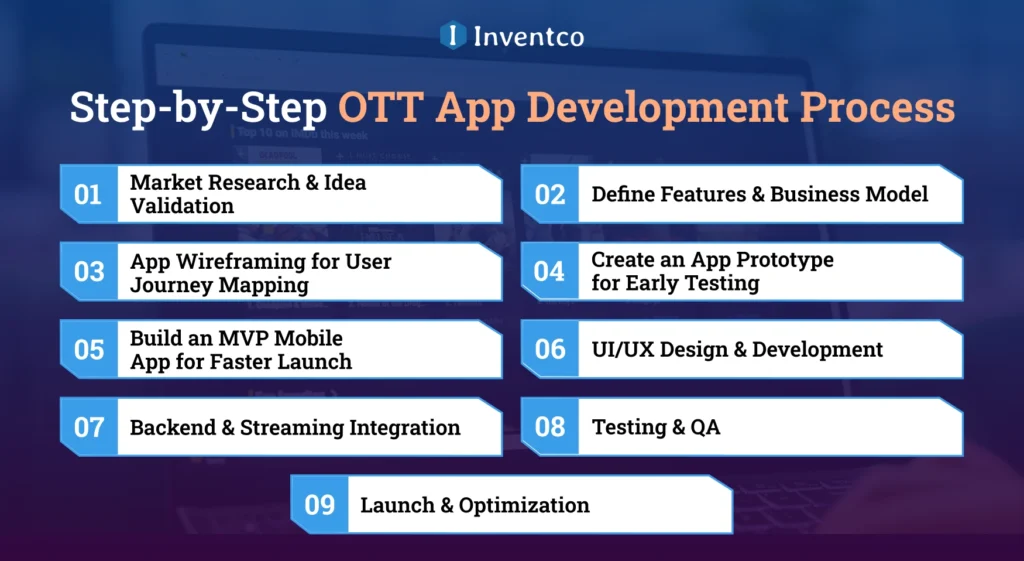
When developing an OTT app, having a solid plan in place allows for risk to be managed, resources to be used efficiently, and time to market to be reduced. Outlined below are the nine most important steps for any startup investor to consider.
1. Market Research & Idea Validation
Start by analyzing market demand, competitor offerings, and target audience behavior to validate your OTT app idea. Documentation of your findings will also provide insight into consumer preferences, content gaps, and advertising. Market research will demonstrate the viability and practicality of your solution to your audience’s problems, as well as support your business and help identify potential market demand.
2. Define Features & Business Model
Clearly outline your platform’s core features, such as streaming capabilities, personalization, and payment systems, along with selecting a suitable business model like subscription, ad-based, or hybrid. Features such as streaming, personalization, and payment options should also be included, as they will help improve the end-user and revenue retention of your app and provide the fundamental framework for OTT app scalability.
3. App Wireframing for User Journey Mapping
Begin your journey with wireframes documenting the structure of the app and the flow of each interaction. Successful app wireframing should keep your designers and developers focused on the objectives of the app and simplify the app’s usability. It also lays the groundwork for instinctive UI/UX, and it contributes to fewer design errors overall, which helps ensure an extraordinary experience for users.
4. Create an App Prototype for Early Testing
Using an interactive prototype for an application can provide an early opportunity to get user feedback, test the app’s usability, and evaluate design features of the prototype to refine the design before full-blown development of the app. Developing an app prototype will provide the opportunity to avoid costly revisions and ensure that the final product is aligned with the needs of the user and the objectives of the business.
5. Build an MVP Mobile App for Faster Launch
To create an MVP mobile app, it is important to first identify the core features that will provide the functionality needed to test the business idea before entering the OTT streaming business. Creating an MVP is the fastest way to develop a business idea and test it with real users, allowing the OTT streaming business to develop an MVP at a lower investment risk.
6. UI/UX Design & Development
Create a design that is both attractive and easy to use; one that will help to improve the customers ability to navigate the site, interact with the site, and help them to discover the content provided. Design for ease of use, quick load times, and responsive design. A strong UI/UX design is one of the key elements that will help improve customer retention and help to create a seamless and enjoyable experience for the customers.
7. Backend & Streaming Integration
Build a backend system that is flexible and has the ability to grow in the future and easily manage the customers’ data, content, and streaming services; and integrate video processing, content management, and adaptive streaming so as to improve seamless video playback. A strong backend will help to support the customers’ use of the service, ensure the service remains dependable, and allow the service to easily grow as the number of customers grows.
8. Testing & QA
Perform tests that will identify and eliminate bugs, improve system performance, and enhance system security. Pay particular attention to the streaming quality and the overall user experience. Strong mobile app testing will ensure that your system will function without any issues, regardless of the circumstances, and will help to reduce the number of issues after the launch and enhance the trust that the users have in the system to deliver a consistent, high-quality user experience.
9. Launch & Optimization
Once the system has been deployed, ensure that the system is continuously monitored so as to understand the performance, the behavior of the users, and the levels of engagement of the system, so as to enhance the overall performance of the system. Make the changes needed, correct the problems identified, and improve any functions as needed to be more user friendly. A successful launch means that there is a starting point where future enhancements can be made so as to improve retention and keep users from switching to another competing service.
The confidence and clarity that a well defined mobile application development process has provided the start-ups and the investors has streamlined the execution and has also helped them to develop scalable OTT platforms with high performance.
OTT App Development Cost Breakdown
OTT app development costs can be affected by the type of features included, the choice of platforms, how the app will scale in the future, and the overall app complexity. OTT application development costs can be broken down by category which helps founders and investors budget their costs and plan development to fit their business objectives over time.
Basic OTT App ($10,000 – $25,000)
Basic OTT apps feature user registration, content browsing, and video streaming. This is the best option for startups trying out concepts. They offer low scalability, few integrations, and plain UI/UX for quicker development.
Mid-Level OTT App ($25,000 – $60,000)
Mid-level OTT apps offer further personalization, device recommendations, secure payment integration and better UI/UX. This is best for trying growing startups and expanding businesses as they perform better, and increase user engagement.
Advanced OTT Platform ($60,000 – $100,000+)
Advanced OTT apps possess AI recommendations, traffic analytics, offer streaming in various languages and great scalability. This is best for premium user experiences as they handle complex tasks seamlessly and upgraded integrations.
Key Cost Factors
- UI/UX complexity
- Features and third-party integrations
- Platform selection (single vs cross-platform)
- Ongoing updates and infrastructure
Understanding the cost to build a mobile app helps businesses make informed investment decisions. Additionally, accounting for long-term mobile app maintenance costs is essential to ensure performance, scalability, and sustainability over time.
Monetization Models for OTT Platforms
A strong revenue model is essential when you create a live streaming app, as it directly impacts profitability, scalability, and long-term growth through an effective mobile app monetization strategy.
1. Subscription (SVOD)
Revenue for subscription OTT services is generated from a user’s monthly or annual fee payment, providing them with unlimited access to a given content library. This model yields good revenue, and user retention is high with the addition of quality content that is regularly updated and exclusive to that platform.
2. Ads (AVOD)
When OTT service users access content for free, and the service makes money providing ads to the users, this is called Advertisement video on demand. This model is a good choice for user acquisition and is likely to give good results with high engagement, traffic, and demand for ads.
3. Pay-per-view (TVOD)
Transactional video on demand is good for content owners but flexible for customers. The content provider can choose to charge customers for viewing an event or for accessing a movie, and this is a good choice for exclusive/non-regular content.
4. Hybrid Models
Using hybrid monetization methods, video streaming apps can be monetized with a combination of subscription-based, advertisement, and transactional methods. This is a good choice as it accommodates the likely varying preferences of users, and also helps to balance profitability and accessibility.
Choosing the right mobile app monetization strategy should help an app developer with the assurance of a reliable flow of revenue.
Challenges in OTT Development & How to Overcome Them
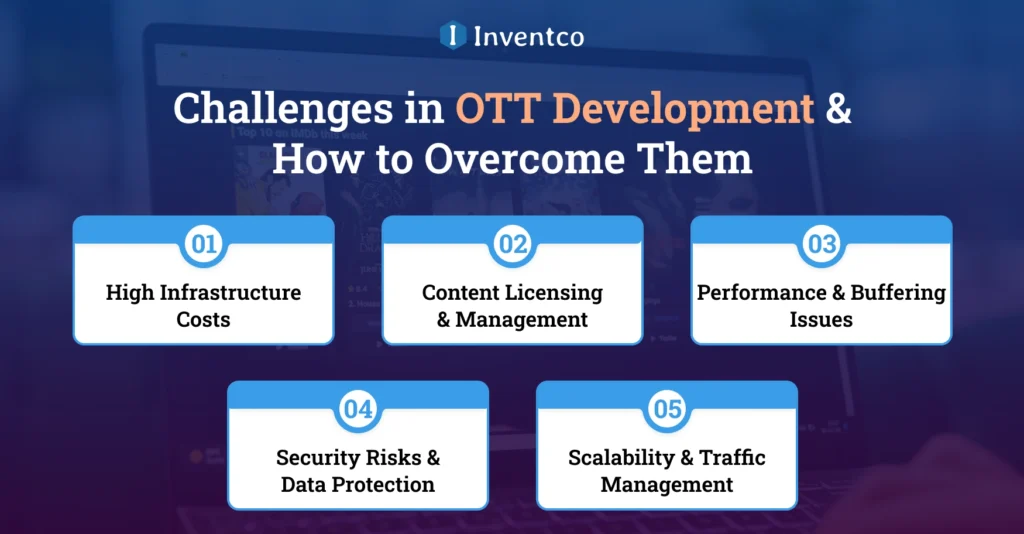
Creating a successful OTT platform is a complicated process partly due to the initial challenges associated with mobile app development. Addressing these challenges early on can reduce risks, boost performance, and help ensure continued success for the OTT platform.
1. High Infrastructure Costs
The financial requirements for using cloud servers and cloud storage to manage user traffic and large scale video streaming is significant. Without proper planning, costs can quickly escalate and impact profitability.
Solution:
Resource consumption in streaming video can be optimized and maintained by using efficient CDN’s. This allows streaming video to be cost effective, financially manageable, and in turn, streaming video content to be long term, predictable.
2. Content Licensing & Management
Developing a strategy for the acquisition of content and the associated rights can be a complicated, expensive, and slow process. In addition, the limitations due to licencing can impact the level of engagement and growth of the platform.
Solution:
Adopt a content acquisition strategy that includes both licenced and original content. A focused content acquisition strategy may be enhanced by establishing a good content management system.
3. Performance & Buffering Issues
The level of user engagement for OTT platforms can be significantly reduced due to the following user experience challenges associated with streaming content: the quality of the video streaming is poor, high occurrence of buffering, long loading time, etc.
Solution:
Adopt streaming solutions and optimize back end systems and CDN’s to ensure user experience challenges are addressed and to ensure user engagement is not reduced.
4. Security Risks & Data Protection
OTT platforms are inherently susceptible to data breach, unauthorized account access, and digital piracy. OTT platforms that do not prioritize the protection of customer data risks losing customer trust and possibly their business.
Solution:
Investing in mobile app security, including security audits and means of protection such as encryption, secure authentication, and DRM protection as it reduces the risk of loss of user data and the unauthorized use of products.
5. Scalability & Traffic Management
Without the proper management of the infrastructure, the strains on the system caused by unpredictable, sudden, and potential spikes of user traffic during peak times or whilst live events can cause system downtime or a degradation of the system’s functionality.
Solution:
To better manage the growth of the system in the future, build a system’s architecture that is capable of being expanded using the cloud’s auto-scaling, load balancing, and microservices
In addressing the aforementioned issues, companies will be able to create a flexible, safe, and efficient over-the-top platform that will continuously benefit users while effectively managing the growth and sustainability of the system.
Scalability, Security & Compliance Considerations
In the OTT sector, scalability is a result of thoughtful planning in the areas of infrastructure, security, and compliance, all of which simultaneously contribute to increasing performance, reliability, and the long-term sustainability of the business as a whole.
1. Cloud Infrastructure for Scalability
Cloud infrastructure sets OTT platforms to scale resources dynamically based on user demand, ensuring high availability, flexibility, and performance without heavy upfront investment in physical server infrastructure.
2. CDN Implementation for Faster Delivery
Getting a CDN is equally important, as it allows for the rapid dissemination of video content. This is achieved by fetching the default video content from the CDN’s server that is closest to the users.
3. DRM Protection for Content Security
The implemented DRM system makes it impossible for others to access content, in that it makes content accessible only to subscribed users. This means that the provider’s entitlements for the digital content have been secured.
4. Compliance with Global Regulations
Compliance with the varying frameworks is beneficial to the provider and user, given that it facilitates the provider’s ability to operate without interruption, as the user’s data is kept private.
5. Continuous Maintenance & Performance Optimization
Mobile apps must be maintained for the continuous monitoring of their functionality, the elimination of any errors that disrupt the functionality, the update of all existing features and the addition of new features that are meant to enhance the functionality. This is done to keep the platform competitively advantageous.
When Scalability, Security, and Compliance are balanced, OTT platforms will unrelentingly meet the demands of the consumers and, as a result, will build and sustain ever-increasing revenue streams.
Why Choose Inventco for OTT App Development?
Inventco has built a name for credibility through the OTT App Development Process by providing scalable, secure, and high-performance efficient streaming solutions for startups and developing companies. They aim for technology and business alignment, ensuring your OTT platform is constructed for success, and providing the option for continued development through further integration of technology.
With a thorough understanding of OTT platform development, Inventco has proven success by building OTT platforms such as StreamX, which is equipped with many OTT solutions designed for seamless streaming, optimal user engagement, and high performance with consistent use, across all formats. This exemplifies their confidence and competence to meet and manage the challenges of OTT.
The most unique and differentiating factor of Inventco is their end to end development process, meaning they will manage all aspects of the process from the strategic development, the building of the platform, the creation of the content for the platform, and the continued development of the platform for OTT. Their compliance with the OTT framework and high performance of their platform, they have set the standard for performance and high efficiency for streaming.
With a reputation for excellence, Inventco is defended by the best OTT development team. Their team of OTT developers has profound knowledge and experience which is combined with high levels of design and development, to allow Startups and investors to build OTT platforms that are safe and reliable, with added features for user engagement, and sustained growth.
Conclusion
OTT services are already the dominant service provider, and the common practices of the industry reflect that these services are now an integrated aspect of most users’ lifestyles and expectations with media consumption. Further, because of the varying methods and services that allow consumption of media, OTT services continue to be an essential part of the digital service media ecosystem.
The OTT media service space presents some of the most significant opportunities for investment for new businesses and media service providers, and media content service providers. However, the success of any investment in this space relies on an effective and appropriately aligned combination of technology, services, and media consumption patterns.
The most effective way for businesses to achieve success in this space is to understand the most effective methods of developing an OTT app, which in combination with the appropriate selection of features and an established service provider, will yield the most convenient, valuable, and revenue generating service to users.
FAQ’s
Q1. How much does it cost to build an OTT app?
Ans. The cost to build an OTT app typically ranges from $10,000 to $100,000 or more, depending on features, platform selection, UI complexity, integrations, and scalability requirements for your business model.
Q2. How long does it take to develop an OTT app?
Ans. Developing an OTT app usually takes between three and nine months, depending on the app’s complexity, features, integrations, testing requirements, and whether you are building a basic MVP or a fully scalable platform.
Q3. What is the best monetization model for OTT apps?
Ans. The best monetization model for OTT apps depends on your audience and content strategy, with subscription-based, ad-supported, transactional, and hybrid models offering different revenue opportunities based on user engagement and content exclusivity.
Q4. Do I need a cross-platform OTT app?
Ans. Yes, building a cross-platform OTT app ensures wider audience reach, consistent user experience across devices, reduced development costs, faster deployment, and better scalability for growing businesses targeting multiple operating systems and devices.
Q5. What features are essential for OTT app development?
Ans. Essential features for OTT app development include user profiles, content recommendation engines, secure payment integration, multi-device compatibility, search functionality, video streaming optimization, and analytics tools to track user engagement and performance metrics.
Q6. What challenges arise in OTT app development?
Ans. OTT app development challenges include high infrastructure costs, content licensing complexities, performance optimization, scalability issues, security risks, and maintaining seamless streaming experiences across devices, requiring strategic planning and robust technology implementation from the start.
Q7. How can I make my OTT app successful in the market?
Ans. To make your OTT app successful, focus on user experience, personalized content, reliable streaming performance, strong monetization strategies, effective marketing, and continuous updates based on analytics, ensuring long-term engagement and sustainable growth.

Ajay Bhal
He is an on-demand app solutions expert with 11+ years of experience in business consulting and building scalable, user-centric digital products. He specializes in robust on-demand platforms across industries, combining technical expertise with business-focused strategy to deliver efficient, top notch solutions that drive growth and enhance user experience. You can connect with him on LinkedIn to follow insights.