The real estate industry has advanced significantly with intelligent automation, especially with the development of real estate chatbots. Instant responses to queries about listings, pricing, availability, and financing options have become the norm for property buyers and renters. However, real estate agents struggle to answer these queries due to their cross-channel, multi-inquiry, engagement workloads. AI-powered chatbots address this by providing real-time assistance and capturing leads without agent intervention.
Real estate chatbots provide virtual assistant services, qualify leads, schedule property visits, answer repetitive questions, and assist first-time home buyers navigate tricky transactions. Automation of repetitive communication tasks improves the efficiency of real estate agents by allowing them to focus on negotiation and relationship building in a more developed way. Furthermore, serious prospects can be separated from window shoppers which significantly improves sales conversion.
The ability to contain and engage an audience is an asset. For businesses focusing on the development of real estate applications, the utilization of chatbots improves the operational demand of the workforce and increases consumer satisfaction. Responsive consumer chatbots, which can be integrated into a business’s mobile and web platform, allow the business to remain competitive in a rapidly changing digital market environment.
Key Takeaways
- Starting in 2026, real estate chatbots have become a strategic necessity because they provide instant communication and automated engagement to provide an improved customer experience throughout the various property platforms.
- Chatbots powered by AI solve this problem for agents as they provide an automated method to qualify leads, provide property suggestions, schedule viewings, and manage follow-up.
- The automation of real estate sales using chatbots provides integrated customer relationship management (CRM) + multiple listing services (MLS) + Internet Data Exchange (IDX) listings and associated databases.
- The core advantages chatbots provide in real estate sales are 24/7 availability, less operational costs, improved agent(s) productivity, and increased lead(s) conversion.
- The use of advanced AI chatbots have a positive impact on real estate lead generation by intelligent lead segmentation, personalized messaging, and auto lead nurturing.
- The seller’s and buyer’s journey can be improved by having CRM integrations, automated scheduling, providing multi-lingual chat options, and offering intelligent suggestions.
- The development process includes Natural Language Processing (NLP) training, system integrations, planning for the development, system testing, and system optimizations.
- Finding a competent partner to develop the chatbots for the real estate industry provides scalable integration, secure system development, and consistent ROI for automation integration in the real estate industry.
Real Estate & Chatbot Market Growth (2026)
The rapid adoption of AI and conversational tools is reshaping how businesses interact with customers, and the real estate sector is no exception.
- The global chatbot market is poised to grow to about USD 11.45 billion in 2026, up from USD 9.30 billion in 2025, and is forecast to reach around USD 32.45 billion by 2031, growing at a 23.15 % CAGR through the period.
- Broader conversational AI, which includes intelligent virtual assistants and advanced chatbots, was valued at approximately USD 11.58 billion in 2024 and is expected to expand to USD 41.39 billion by 2030 at a 23.7 % CAGR.
- Enterprise adoption continues to rise: real estate firms using AI chatbots report up to 40% higher lead capture rates and 50% faster response times compared with traditional engagement methods.
- In 2025, analysis from industry research shows AI in real estate markets (including automation and intelligent tools) growing from USD 222.65 billion to over USD 303 billion, indicating broader AI integration in property tech, including chatbots.
How Real Estate Chatbots Work
A real estate chatbot is like a virtual assistant who is always on standby. When a customer inquires about a property, the bot retrieves the listings, filters by relevant criteria, and displays the results in seconds. The process is fast, and the customer is satisfied.
Unlike other lead-capture systems on the market, such as real estate lead-capture chat widgets, real estate lead-capture chatbots are integrated with CRMs, MLS/IDX, and website forms, enabling them to pull, update, and modify lead data in real time with high accuracy.
With every interaction, the bot learns and becomes better at responding and personalizing the conversation. Their automation enables chatbots to respond to FAQs, recommend properties, set appointments for showings, and even pre-qualify leads, thereby keeping real estate agents free to finalize transactions rather than wasting time on low-level inquiries.
Benefits of Using Chatbots in Real Estate
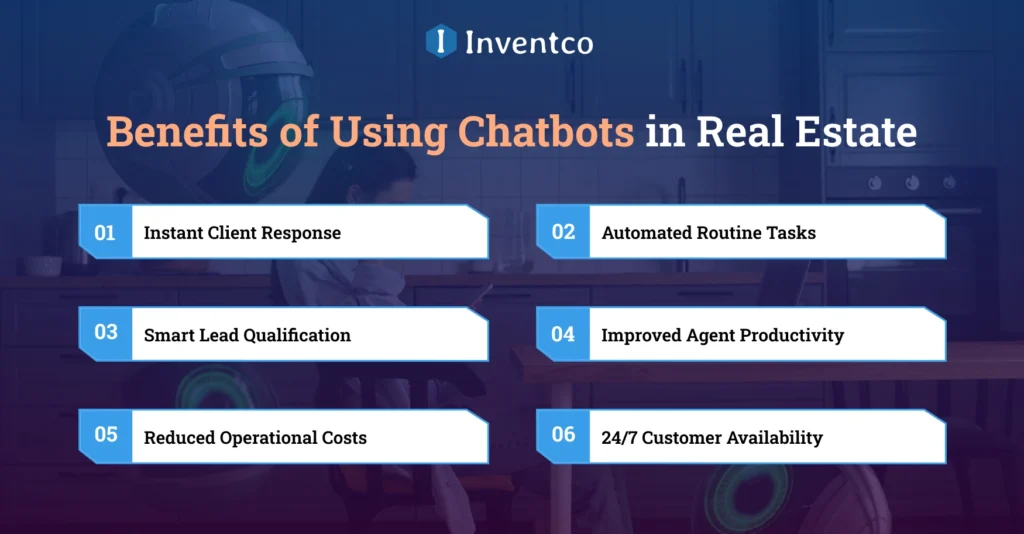
Let us take a moment to highlight some of the most crucial features of real estate chatbots, in the simplest terms, so users of real estate and real estate offices and agencies can appreciate the reliance on real estate chatbots they use every day.
1. Instant Client Response
The moment a real estate chatbot receives a question, it can analyze and respond to the user. This eliminates waiting time for the prospective customer and reduces the risk of a missed opportunity. When prospective customers receive instant feedback to their questions, they tend to engage more with the site. And the real estate chatbots maintain engagement and even encourage prospective customers to complete their property searches.
2. Automated Routine Tasks
Real estate chatbots handle answering frequently asked questions, sharing real estate listings, and scheduling appointments. This scouting of repetitive tasks allows sales agents to focus on personal conversations that really matter, go deeper down the funnel, and improve customer relationships.
3. Smart Lead Qualification
These AI chatbots can assess a buyer’s potential interest based on their property preferences, budget, and timelines. This information allows for adding efficiency to automated conversations. Attention is directed toward leads most likely to convert, increasing efficiency across multiple channels.
4. Improved Agent Productivity
By filtering out leads unlikely to convert, chatbots save agents time that would otherwise be spent answering invaluable questions. This optimisation increases workflow efficiency and sales, positively impacting other metrics by enabling professionals to do meaningful client work.
5. Reduced Operational Costs
By reducing the number of support staff needed, chatbots lower operational costs. Furthermore, their ability to automate responses and manage communication flow results in greater efficiency, reducing costs while enhancing the system’s ability to manage customer engagement.
6. 24/7 Customer Availability
Chatbots’ availability ensures that every customer question is answered as soon as it’s asked. Increased responsiveness on the part of the company results in greater customer satisfaction, as they do not feel neglected. These benefits describe how chatbots can help and have become a necessity in the real estate industry.
They are streamlining the work that clients and employees do, enabling clients to have a good experience on the platform.
AI Chatbots in Real Estate Lead Generation
In the real estate industry, AI chatbot development is changing how real estate businesses generate leads, attract, qualify, and convert prospects. AI chatbots eliminate time-consuming manual follow-ups by capturing inquiries, asking relevant questions, and guiding potential buyers to listings in real estate apps.
Bots collect data and make real estate listing recommendations as an AI real estate listing application would. Thanks to the rise of AI in real estate apps, chatbots can create custom, human-like, and coherent property summaries and follow-up emails that capture a property’s essence and leverage human intuition.
AI chatbots in real estate automate lead capture, email follow-up, and lead nurturing. For real estate firms, this increases client engagement, streamlines lead conversion, and improves the efficiency of the sales funnel.
Key Features of an AI Chatbot for Real Estate
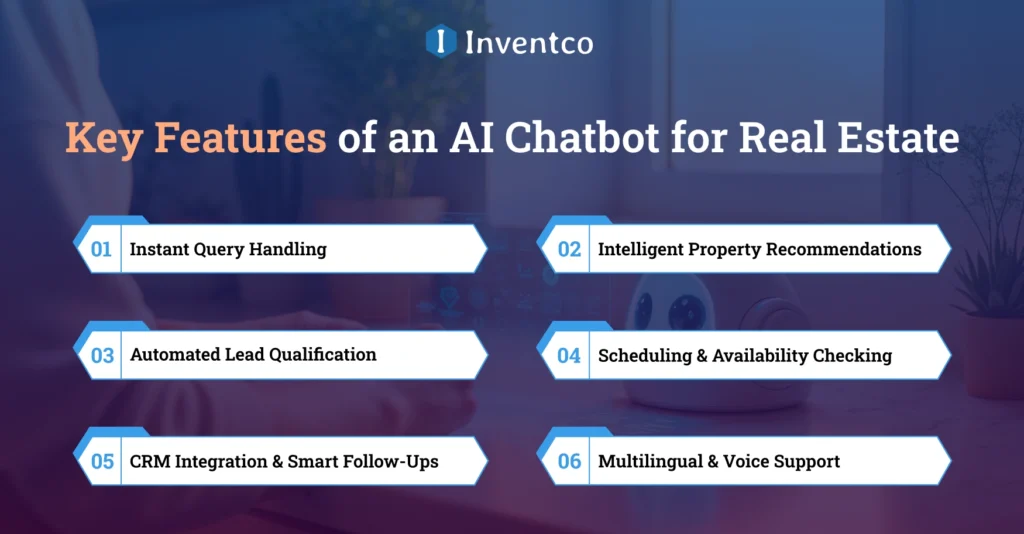
These features of real estate apps are the foundation of powerful, efficient AI chatbots that enable real estate businesses to improve buying and selling processes, automate tasks, and provide users with seamless, cohesive journeys.
1. Instant Query Handling
AI chatbots respond to clients’ inquiries instantly, improving efficiency and creating a positive experience for users when selecting a property from multiple listings.
2. Intelligent Property Recommendations
The chatbot customises recommendations for users based on their budget, desired location, amenities, and property type.
3. Automated Lead Qualification
Buyers’ intents, purchase readiness, and needs are identified so agents can spend their time on better leads rather than on the minutiae of determining who their best prospects are.
4. Scheduling & Availability Checking
The bot can check property availability in real time and auto-book site visits to reduce coordination time and enhance user convenience.
5. CRM Integration & Smart Follow-Ups
When the chatbot is integrated with listing databases or CRM systems, it can manage conversations, send reminders and automate follow-ups to keep potential customers from becoming entirely disengaged.
6. Multilingual & Voice Support
The most sophisticated chatbots can interact in multiple languages and let users speak rather than type, improving inclusivity and accessibility for more users.
The combination of these attributes enables real estate companies to improve customer experience, optimize business processes, and increase the number of customers buying their products, making AI chatbots incredibly valuable in today’s real estate market.
How to Use a Chatbot for Real Estate?
Knowing how to use a chatbot for real estate will improve the customer experience and automate workflows. Begin by integrating the chatbot on your website, where customers interact, or on your mobile app or social media. When designing the bot, conversational flows should allow customers to request property discovery, ask frequently asked questions, request pricing, or schedule appointments via the chatbot without waiting for an agent.
Afterward, connect the bot to your CRM so that any inquiries received are automatically collected and assigned a tag. Utilize property data, neighborhood information, and qualifying/segmentation questions to train the bot on answering inquiries correctly. The bot learns inquiry patterns over time and recommends listings, evolving into an intelligent assistant that automatically converts passive users into active leads.
Types of Real Estate Chatbots
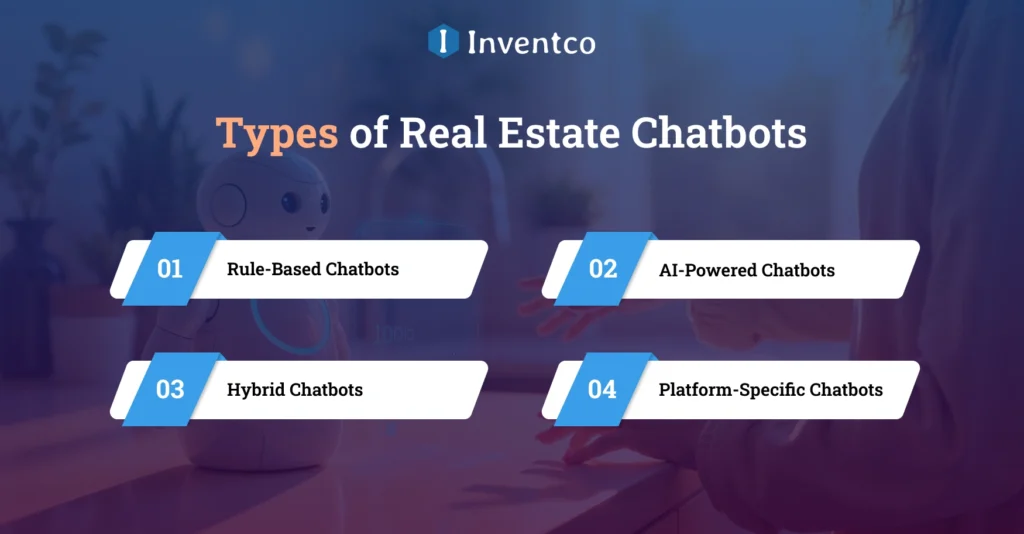
For real estate companies, there are various types of chatbots available, allowing flexibility in choosing the type that best meets customers’ needs, use cases, and automation requirements.
Here’s a structured breakdown of the most common options.
1. Rule-Based Chatbots
This kind of bot is based on a given conversational model and is set to follow a specific logical sequence of responses. These bots are good for FAQs and other low-level questions. They are fast, efficient, and straightforward for answering the same questions repeatedly.
2. AI-Powered Chatbots
This is the more evolved and complex version of chatbots. They can ask intelligent questions and answer complex inquiries. They use a form of Natural Language Processing, so the more questions they receive, the more they can provide the required answer. Also, they recommend and qualify potential customers for the company.
3. Hybrid Chatbots
This type of bot is a combination of the first two. Most of the time, they have a set of rule-based flows to guide the interactions, but the flexibility and smarts of AI augment this. They are suitable for companies with specific efficiency and smart automation needs.
4. Platform-Specific Chatbots
These are designed for specific applications, for instance, WhatsApp, a mobile application, or a website. They adapt to the particular application and leverage available features to deliver a good experience wherever customers are.
For companies exploring innovative Real Estate App Ideas, the specific type of chatbot will provide a more effective, smarter experience for transforming potential leads by speeding up response times and making it easier to find the desired property.
Top Real Estate Chatbot Use Cases in 2026
The continuously evolving technologies in real estate chatbots are integrating innovative applications that are crucial to business performance in 2026. One of the top applications is automated lead qualification, in which chatbots identify serious buyers in real time based on their intent, budget, and timeline. They can offer personalized property recommendations and serve as virtual agents online at all times.
Moreover, in real estate, chatbots help automate scheduling site visits, monitor inquiries, provide mortgage insights, and provide price estimates. As real estate tech trends increasingly lean towards automation, chatbots now offer virtual tours, community insights, and predictive recommendations. For real estate agencies, these predictive chatbots streamline operations, lessen the workload, and improve conversion rates.
Real Estate Chatbot Development Process
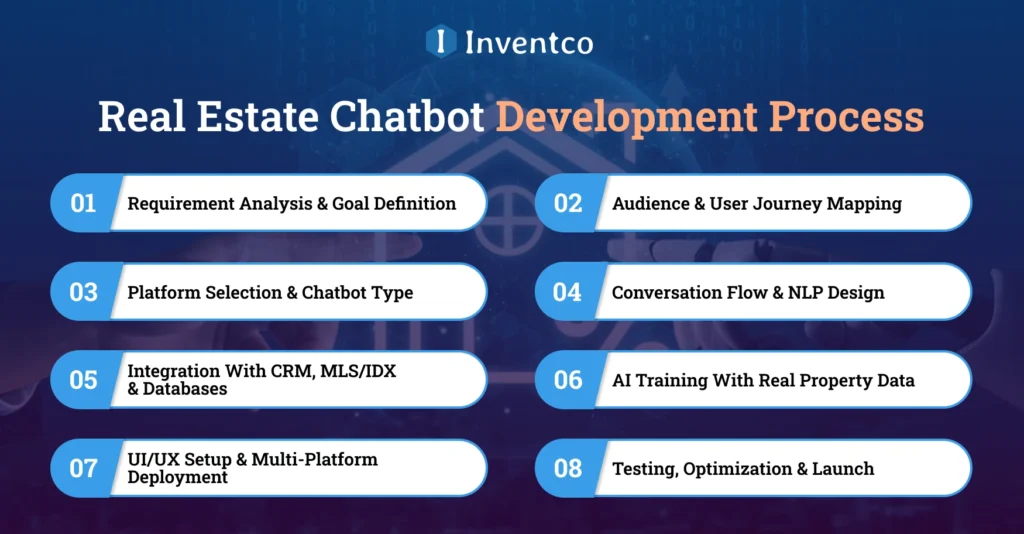
Building high-performing real estate chatbots requires significant complexity and organization. Just like any robust mobile app development process, every stage must be precise, data-driven, and aligned with business goals.
This is a concise, professional description of the chatbot-building process used by the most prominent players in real estate who focus on intelligent, high-performing chatbots.
1. Requirement Analysis & Goal Definition
The first stage should focus on determining the bot’s focus: lead qualification, property recommendations, client support, or complete automation? Concentrating on setting clearly defined objectives will help outline the plan.
2. Audience & User Journey Mapping
Determine who will be the bot’s end user. Is it buyers, sellers, tenants, investors, or agents? Mapping their journey will help determine the most significant points of concern, essential questions, and the information required in responses.
3. Platform Selection & Chatbot Type
Define who will interact with the bot: buyers, sellers, tenants, investors, or agents. Mapping their journey helps identify key touchpoints, essential questions, and expectations for responses.
4. Conversation Flow & NLP Design
Teams design smart flows for a property search, FAQ answering, tours, and mortgage questions. The bot should be trained to understand naturally phrased queries and provide accurate responses.
5. Integration With CRM, MLS/IDX & Databases
A real estate chatbot becomes effective when interconnected. Integrating it with listing platforms, CRMs, calendars, and email systems guarantees live data and automated tracking and workflows.
6. AI Training With Real Property Data
Chatbots can be trained using property types, locality data, amenities, user intent and qualification questions. This ensures better recommendations and quality conversations.
7. UI/UX Setup & Multi-Platform Deployment
After training, chatbots will be installed in your digital environment. Whether you create your real estate app or use a website, chatbots should be seamlessly integrated into the architecture and user experience.
8. Testing, Optimization & Launch
Before launch, the teams conduct various functional tests, NLP tests, load tests, and user experience tests. After the launch, real estate chatbots require constant optimization to adapt to changing market trends.
Real Estate Chatbot Development Cost in 2026
In 2026, the cost of developing a real estate app with a chatbot will vary depending on features, AI capabilities, integrations, and customizations. Basic rule-based chatbots are cheap, while advanced AI, NLP, CRM integration, and property-suggestion systems are priced higher. The development team’s location and the complexity of the conversational flows are also price determinants.
Compared to developing a real estate app, using a chatbot is more cost-effective and offers a better return on investment in the long run. Both SaaS and custom development options are available to build a chatbot that will reduce operational burden, improve lead conversion rates, and automate lead processing within the real estate ecosystem.
Why Inventco Is a Trusted Partner for Enterprise-Grade Real Estate Mobile App Development?
For a company to be a good fit at real estate mobile app development, it’s necessary for the company to understand the industry and the scope of the app in a business context. Numerous mobile development companies build apps at the code level, and fail to understand the business use of the app. This is what Innovo aims to break. Our apps are built at the level and scale of modern secure mobile applications. Our mobile applications incorporate the app modern use of artificial intelligence for automation, integrations with CRM, and provide cloud-based architecture and enterprise level systems for real estate developers to modernize their developers and enhance their customers.
For real estate applications like modern mobile development apps, our past experiences with real world AI technologies. We built SALLA & WhatsApp Chat Support, a business automation-based conversational platform with intelligent workflow automation and API seamless integration to Chatbot. We also built Pocket Chef, which is an AI-based application with an OCR functionality, which demonstrates our machine learning/ deep learning and scalable data cloud deployment expertise. We also built the salient features of real world AI for cloud scalable verticals with secure and performance optimizations.
We create mobile applications for real estate companies that facilitate finding properties, searching for properties with advanced searching capabilities, qualify leads with AI chatbot automation, and CRM and backend integrations. Also, we keep data security, compliance, scalability, and sustainability in focus when we build mobile applications. Our focus with our clients is to build mobile applications that combine technology and business strategies to improve efficiency, operational efficiency, and digital growth.
Conclusion
Real estate companies are in need of real estate chatbots to help them transform the way they focus on attracting, engaging, and converting customers. With the ability to provide real time automated recommendations and qualify leads in real time, the real estate industry is becoming more innovative and rapid. Because of the increased demand, in an industry where most facilitators are inundated with leads and inquiries the need for a real estate chatbot is to answer questions and facilitate inquiries to the fullest degree, freeing guides to concentrate on conversion activities outside the chatbot’s realm.
For real estate companies, developers, and real estate marketplaces, the necessity to invest in automation has reached the point of no longer being innovative; rather, they are simply reacting to the needs of the industry. In the hands of the right developer, the chatbot has the potential to enhance customer experience, and optimize the growth and efficiency of an organization to an extent that far surpasses the expectations of the industry.
FAQ’s
Q1. What is a real estate chatbot?
Ans. A real estate chatbot is an AI-powered virtual assistant that helps buyers, sellers, and agents by answering queries, recommending properties, qualifying leads, and automating repetitive tasks 24/7.
Q2. How do chatbots help real estate businesses?
Ans. Chatbots streamline communication, handle inquiries instantly, qualify leads, book appointments, recommend listings, and reduce manual workload—boosting conversions and customer satisfaction.
Q3. Are AI chatbots better than rule-based chatbots for real estate?
Ans. Yes. AI chatbots use NLP and machine learning to understand user intent, offer personalized recommendations, and improve over time—making them far more effective than basic scripted bots.
Q4. Can chatbots qualify real estate leads automatically?
Ans. Absolutely. A chatbot can ask questions about budget, location preference, purchase timeline, and property type to identify serious buyers and route them to agents instantly.
Q5. How long does it take to develop a real estate chatbot?
Ans. Depending on complexity, integrations, and AI training, development typically takes 3–8 weeks. Advanced chatbots with CRM, MLS/IDX, and automation features may take longer.
Q6. How much does a real estate chatbot cost in 2026?
Ans. Pricing varies based on features, platform, AI depth, and customization. Basic bots cost less, while advanced AI chatbots with automation, integrations, and personalization cost more.
Q7. Can a real estate chatbot integrate with existing apps and CRM systems?
Ans. Yes. Chatbots can integrate with listing databases, mobile apps, calendars, email systems, and CRMs like Salesforce, HubSpot, and Zoho for seamless automation.
Q8. Do chatbots support commercial real estate needs?
Ans. Definitely. They can handle tenant inquiries, leasing questions, pricing details, availability checks, and appointment bookings for commercial properties as well.
Q9. Are real estate chatbots customizable?
Ans. Yes. Everything—from the conversation flow to branding, tone, property filters, and integrations—can be tailored based on your business goals.
Q10. Will chatbots replace real estate agents?
Ans. No. Chatbots support agents, not replace them. They handle repetitive tasks so agents can focus on negotiations, property tours, and closing deals.

Jitendra Jain
He is the CEO and Co-founder of Inventco, driving innovation in advanced computing and digital transformation. With deep expertise in modern IT ecosystems, he leads scalable, secure, future-ready solutions. His strategic leadership helps businesses accelerate growth, adopt innovation, and achieve success. You can connect with him on LinkedIn to follow his technology insights.