In the U.S., these changes have coincided with a huge digital transformation in the restaurant industry. Online ordering has become an essential part of many restaurants, evolving from a convenient add-on to a major source of revenue for restaurants today. Consumers today also expect frictionless digital experiences, whether ordering delivery, pickup or simply planning meals in advance.
For founders and investors exploring the opportunity in the food-tech ecosystem, restaurant online ordering platforms are one of the fastest growing digital segments. These platforms enable restaurants to take orders directly via websites and mobile apps, manage menus, smooth payments and integrate delivery logistics.
Instead of just relying on expensive third-party marketplaces with high commissions, many restaurants are using online ordering platforms for restaurants that help them form more direct relationships with customers and better margins as well as brand ownership.
This guide will outline what we list as the best restaurant online platform solutions in the US, offer a comparison of capabilities, information on how to choose the right system for your needs, and reveal challenges you should think about before building or adopting an online ordering solution.
Key Takeaways
- With the evolution of digital ordering, routing customers for their delivery, pickup and scheduled orders, restaurant online ordering platforms are now must-have features.
- Companies such as Toast, Square Online and ChowNow also provide restaurants with menu management, payment and customer engagement through integrated digital systems.
- Given the news about high commission delivery marketplaces, many restaurants are using restaurant-based online ordering platforms to increase profit margins.
- With direct ordering platforms restaurants can keep the data to own their customers for personalized marketing, loyalty programs and relationships with customers over the years.
- Choosing the best online ordering platform for restaurants requires evaluating POS integration, scalability, pricing models, and customization capabilities.
- Enterprise systems like Olo help multi-location restaurants with a high-volume ordering infrastructure and analytics.
- Many independent restaurants choose commission-free solutions such as ChowNow, Restolabs or GloriaFood to maintain more control over their ordering ecosystem.
- Gaining an understanding of existing online restaurant ordering platforms is essential for founders and investors who plan to develop large-scale food-tech solutions or build a mobile ordering app.
Market Statistics: Online Ordering in the Restaurant Industry
- The U.S. online food delivery market generated approximately $52.6 billion in revenue in 2024 and is projected to reach $93.3 billion by 2030, reflecting strong long-term growth in digital ordering adoption.
- Another industry forecast estimates the U.S. online food delivery market at $34.9 billion in 2025, expected to grow to $75.4 billion by 2034, demonstrating sustained demand for digital restaurant ordering solutions.
- Digital ordering now accounts for nearly 40% of restaurant sales in many full-service concepts, highlighting how online ordering has become a major revenue driver.
Best Online Ordering Platforms for Restaurants
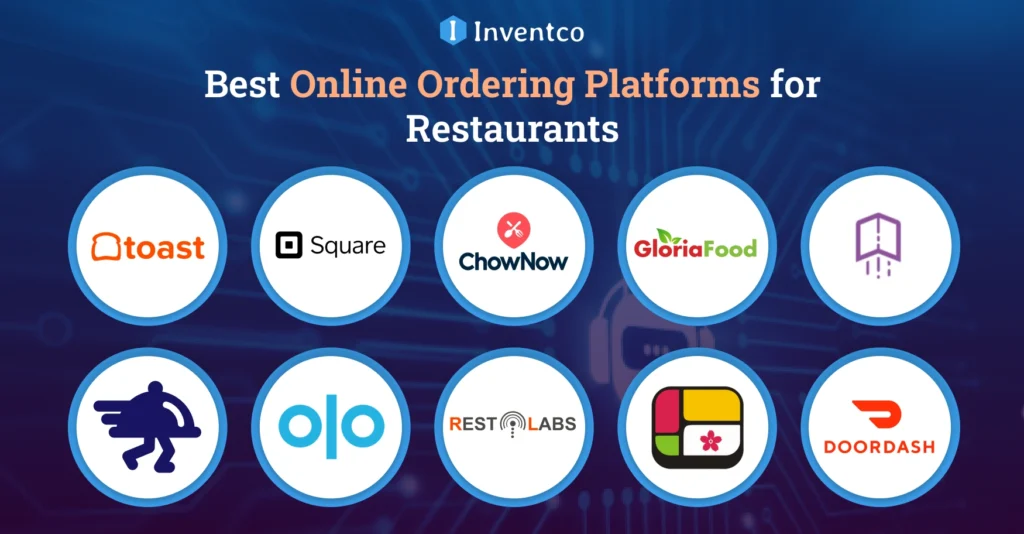
Here, we are listing some of the best restaurant online ordering platforms widely being adopted in various parts of the United States. Digital ordering infrastructure, menu management tools, payment processing and integrations with restaurant operations are among the services offered by those platforms.
1. Toast
Toast is one of the most widely adopted restaurant technology platforms in America. Post is a full ecosystem encompassing online ordering, delivery integrations, loyalty programs and marketing tools originally built as restaurant POS.
Key Features
- Built-in POS and online ordering integration
- Customizable restaurant websites
- Delivery management and integrations
- Customer loyalty programs
- Detailed analytics and reporting
Toast is most popular with full-service restaurants and fast casual chains and franchises that require an all-in-one digital infrastructure.
2. Square Online
With Square Online, restaurants can easily get set up with an online ordering system that’s integrated directly to their payment processing and POS systems.
Key Features
- Easy website builder with ordering capabilities
- Integrated payment processing
- Inventory and order tracking
- Pickup and delivery configuration
- Integration of POS with Square ecosystem
Square provides one of the easiest to use online restaurant ordering systems out there for small and medium restaurants.
3. ChowNow
ChowNow provides commission-free online ordering tools to help restaurants move away from reliance on big third-party delivery apps.
Key Features
- Commission-free ordering system
- Branded mobile apps for restaurants
- Marketing and customer engagement tools
- Integration with POS systems
- Google Direct ordering on social platforms
ChowNow is favored by many restaurants looking for more robust control over customer data and branding.
4. GloriaFood
A common free restaurant online ordering platform is GloriaFood for restaurants that want to quickly transition from in-house dining to digital orders.
Key Features
- Free online ordering system
- Menu and order management tools
- Table reservations and pickup scheduling
- Simple website integration
- Mobile-friendly ordering experience
GloriaFood presents low barrier entry, thus favoring independent restaurants and new startups.
5. UpMenu
Every restaurant that wants full digital ownership of their online orders at every step in the revenue stream, even branded mobile apps is UpMenu ‘s target audience.
Key Features
- Custom mobile apps for restaurants
- Loyalty and promotion systems
- Website ordering integration
- Marketing automation tools
- Delivery zone management
UpMenu is perfect for restaurants who focus on developing long-term loyalty programs for customers.
6. Flipdish
Flipdish is a company offering digital ordering solutions that are used by thousands of restaurants around the world, mainly with direct-ordering strategies.
Key Features
- Branded restaurant mobile apps
- Website ordering integration
- Delivery and pickup management
- Customer analytics and marketing tools
- Loyalty and rewards systems
Flipdish is perfect for fast-growing restaurant brands in need of scalable digital infrastructure.
7. Olo
Olo is a digital ordering platform for enterprise-scale restaurants, and it counts some of the largest US restaurant chains among its accounts.
Key Features
- Enterprise-level ordering infrastructure
- Multi-location restaurant management
- Delivery integrations with multiple partners
- Advanced analytics and customer insights
- Digital menu optimization tools
So, Olo is used as the backbone for many national restaurant brands to manage their online ordering operations when they are high volume.
8. Restolabs
Restolabs enables restaurants to create their own online ordering systems with strong customization and commission free.
Key Features
- Direct online ordering through websites
- Delivery zone and fee management
- Marketing and promotion tools
- POS and payment integrations
- Customer database management
Restolabs is especially interesting for restaurants who want to own their ordering ecosystem.
9. BentoBox
BentoBox specializes in restaurant websites that have embedded ordering functionality.
Key Features
- Custom restaurant website design
- Integrated online ordering system
- Marketing and email campaign tools
- Menu management
- Guest data and analytics
BentoBox is chosen by many restaurants that aspire to a premium digital presence.
10. DoorDash Storefront
DoorDash Storefront allows restaurants to build their own commission-free ordering websites while taking advantage of DoorDash’s delivery infrastructure.
Key Features
- Commission-free direct ordering
- Delivery through DoorDash logistics
- Customer data ownership
- Website ordering widgets
- Marketing tools and analytics
This model enables restaurants to uphold brand ownership while accessing an established delivery network.
Comparison Table
This comparison table highlights key differences between leading restaurant online ordering platforms, helping founders and investors quickly evaluate features, scalability, pricing models, and overall suitability for restaurant businesses.
| Platform | Best For | Key Strength |
| Toast | Full-service restaurants | POS + ordering ecosystem |
| Square Online | Small restaurants | Easy setup |
| ChowNow | Direct ordering | Commission-free model |
| GloriaFood | Startups | Free ordering system |
| UpMenu | Brand-focused restaurants | Custom mobile apps |
| Flipdish | Scaling restaurants | Loyalty tools |
| Olo | Enterprise chains | Large-scale infrastructure |
| Restolabs | Independent restaurants | Customizable ordering |
| BentoBox | Website-first restaurants | Digital branding |
| DoorDash Storefront | Hybrid delivery | Logistics network |
How to Choose an Online Ordering Platform for Restaurants?
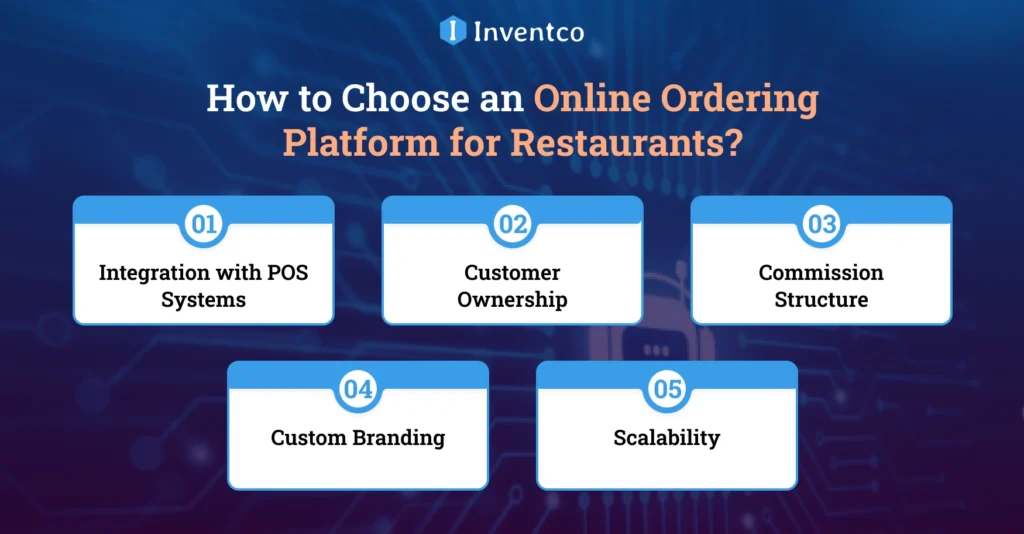
When the new restaurant owner has to get going, the best online ordering platform is probably not on their shortlist of favorite brands.
1. Integration with POS Systems
The platform ought to integrate naturally with existing POS software so as to stop manual order administration and working inefficiencies.
2. Customer Ownership
Having customer data ownership through a restaurant platform allows for long-term marketing and loyalty plans.
3. Commission Structure
Some are commission based (charging a fee on every order) and some are subscription based. It is vital to understand cost structures for every function in your business.
4. Custom Branding
Platforms that offer branded apps, websites, and customer experiences benefit restaurants.
5. Scalability
Founders building a food-tech product must ensure the platform supports:
- Multi-location restaurants
- High order volumes
- Delivery integrations
- Marketing automation
Moreover, entrepreneurs who decide to develop a food ordering mobile app need to assess scalability and infrastructure abilities at an early stage as well.
Challenges & Limitations of Online Ordering Platforms
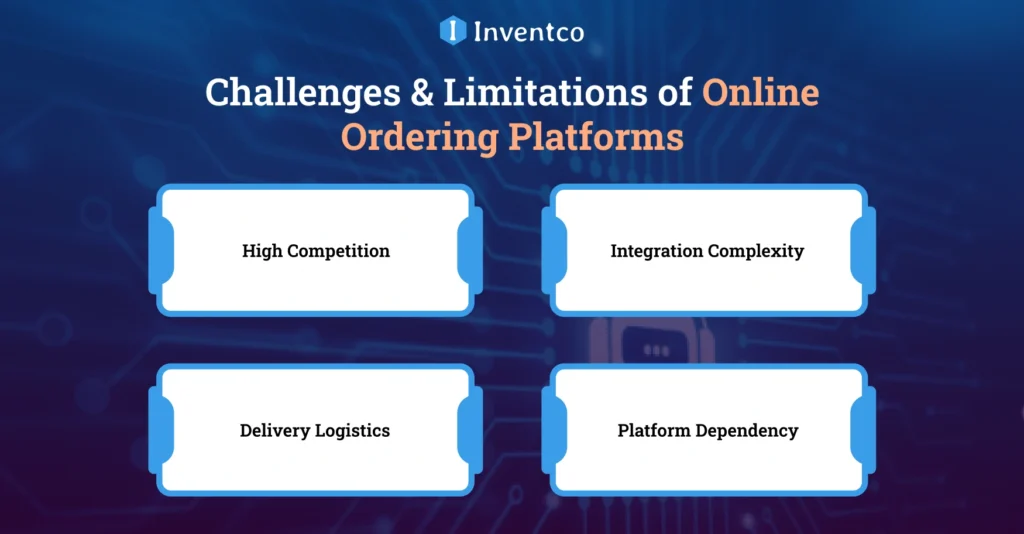
However, restaurant online ordering platforms do bring some idiosyncrasies to restaurants’ operational and technical processes.
1. High Competition
Digital ordering is a tough place to be, with every restaurant competing against large aggregators like Uber Eats and DoorDash.
2. Integration Complexity
Integrating ordering platforms with POS environments, inventory software, and delivery networks can be problematic.
3. Delivery Logistics
Restaurants that run their own delivery systems have to deal with driving availability, route optimization and timing of the deliveries.
4. Platform Dependency
Where businesses depend largely on third-party tech providers, this can impinge on customization and operational flexibility.
Entrepreneurs who are thinking of getting a food delivery app developed will benefit from knowing about these challenges at the initial stages for building a more scalable product strategy.
To stay ahead of the game, startups also need to keep themselves updated about emerging changes in app development trends and must have mobile app features as well as overcome possible mobile app development challenges while building ordering ecosystems.
Inventco: Enabling Smart Delivery and Ordering Platforms
This is a fictional company created for the purpose of this answer – Inventco is a company in the food-tech and on-demand delivery space that helps its close partners build scalable digital platforms. The company leverages its core expertise in mobile and web application development to help startups and enterprises drive innovative idea concepts into high-performance digital solutions suited for modern market needs.
Develop a product from scratch or take your existing one to the next level with Inventco, our team of experts dedicated to all stages of product development – from strategy through UX/UI design, backend architecture, frontend development, and quality assurance. It is this holistic perspective that enables every application to be built up from high scalability, smooth user experience and product-market-coupling for sustainable business.
An excellent demonstration of this capability is the ZONE Delivery App, a delivery management platform that serves to streamline logistics for merchants, drivers, and customers. The system combines real-time order tracking, route optimization, communication tools and advanced analytics to form an end-to-end delivery solution.
Through our technical expertise, industry knowledge and development capabilities, Inventco is able to support founders and investors that are looking to build restaurant ordering platforms and delivery applications by designing secure, scalable and future-ready digital products.
Conclusion
For contemporary restaurants, digital ordering is no longer a nice-to-have, it’s an essential part of the food service business model.
The best restaurant online ordering platforms allow those businesses to run their operation more smoothly, engage better with customers and get higher margins through a direct ordering channel. Whether it goes for a pre-built solution or builds a custom mobile app, the crux of the matter is designing a seamless and scalable ordering experience.
For founders and investors entering the food-tech industry space, listening to the strengths and limitations of existing restaurant online ordering platforms highlights how ordering technology can be built for the next generation.
Only strategic product development, strong user experience design and smart mobile app monetization models will make the future of restaurant ordering platforms.
FAQ’s
Q1. What are restaurant online ordering platforms?
Ans. Restaurant online ordering platforms are digital systems that allow customers to place food orders through websites or mobile apps while enabling restaurants to manage menus, payments, and delivery operations.
Q2. Which is the best online ordering platform for restaurants?
Ans. Popular options include Toast, Square Online, ChowNow, Flipdish, and Olo. The best platform depends on restaurant size, operational needs, and scalability requirements.
Q3. Why are restaurants adopting online ordering platforms?
Ans. Online ordering platforms improve operational efficiency, reduce dependency on third-party marketplaces, and enable restaurants to build direct relationships with customers.
Q4. Can startups build their own restaurant ordering platform?
Ans. Yes. Many startups choose to build a mobile app or develop custom ordering systems tailored to their business model. This approach allows greater control over branding, data ownership, and app store optimization strategies.

Ajay Bhal
He is an on-demand app solutions expert with 11+ years of experience in business consulting and building scalable, user-centric digital products. He specializes in robust on-demand platforms across industries, combining technical expertise with business-focused strategy to deliver efficient, top notch solutions that drive growth and enhance user experience. You can connect with him on LinkedIn to follow insights.