The growth of digital communities, along with users’ expectations for real-time, immersive interactions, is driving demand for social media app development services. In 2026, social media apps in the USA have evolved far beyond basic communication tools. These social media platforms have a full ecosystem driven by AI-powered discovery, creators’ monetization models, flexible privacy controls, social live commerce, and short video formats.
In this highly competitive market, where social media apps garner the most engagement, it has never been more important for founders and investors to identify the factors that drive sustained growth in apps. In addition to user acquisition, active competitors in the social media landscape provide their users with scalable architectures, regulatory preparedness, and innovation to enhance features that facilitate communication across age demographics, devices, and audiences.
This guide examines the best social media platforms in the U.S. by analyzing adoption trends, ranking methodology, and real-world performance indicators. It also explores how leading apps translate product strategy into measurable impact, helping decision-makers identify where market opportunity aligns with strong execution and future-ready development.
Market Stats of Social Media App Development
The social media app development market in the United States consists of rapidly scalable, compliant, AI-led engagement apps from a social media user adoption perspective.
- The overall social networking market was valued at around $95.8 billion in 2025 and is projected to reach $221.4 billion by 2030, growing at a CAGR of ~14%.
- U.S. social commerce sales alone are expected to surpass $100 billion in 2026, nearly doubling from earlier years.
- The social media advertising market is forecasted to grow from $136.05 billion in 2025 to $152.14 billion in 2026, reflecting continued investment by brands in social channels.
- As of early 2026, global social media usage surged to ~5.66 billion users, roughly 69% of the world population, indicating continued adoption and network effects.
For founders, these numbers reinforce one point: building a social platform today requires deep technology, compliance readiness, and long-term scalability.
How We Identified the Leading Social Media Platforms in the US?
Constructing a strategy to identify social media platforms best suited for evaluation in the USA was based on real-world social media usage and on the maturity of these platforms relative to evolving digital trends for social media users. Defining our method of ranking social media platforms in the USA is based on the way social media platforms in the USA function in today’s digitally advanced social media world, based on user interaction, social media technology integration, and social media platform business model sustainability.
Our Evaluation Framework Included:
- User Engagement and Experience: In this case, the evaluation focuses on how users engage/ interact on each platform. This includes onboarding, personalization, and usability across platforms on multiple devices. Intuitive experiences leading to engagement in social media use increased the evaluation.
- User Base and Market Potential: In this case, the number of users on each platform was examined, as were the number of users in the USA, which platforms were used most often, which were used most among young users, and which social media platforms were examined.
- Potential of the Content of the Platform and Monetization: In this case, content creator and user entrepreneurial options with regard to content monetization were examined, e.g. advertising, subscription monetization, social commerce, and the level to which a platform is built socially (as in social level of commerce).
- Social Potential and Market Demand: Automation in social media usage, platform overall implementation across multiple user devices and platforms (including Edge, iOS, and other mobile operating systems), secure systems, and the social media usage data privacy of users.
- Social Validity, Market Trust, and Use of the Platform: In this evaluation, the platform’s social media users were examined in the digital user market, along with their perceived influence and the platform’s overall digital brand.
Incorporating these parameters, we pinpointed platforms that have been valuable, innovative, and reliable, resulting in a well-balanced and forward-looking list of the best social media applications in the United States for the year 2026.
Top Social Media Apps in the USA
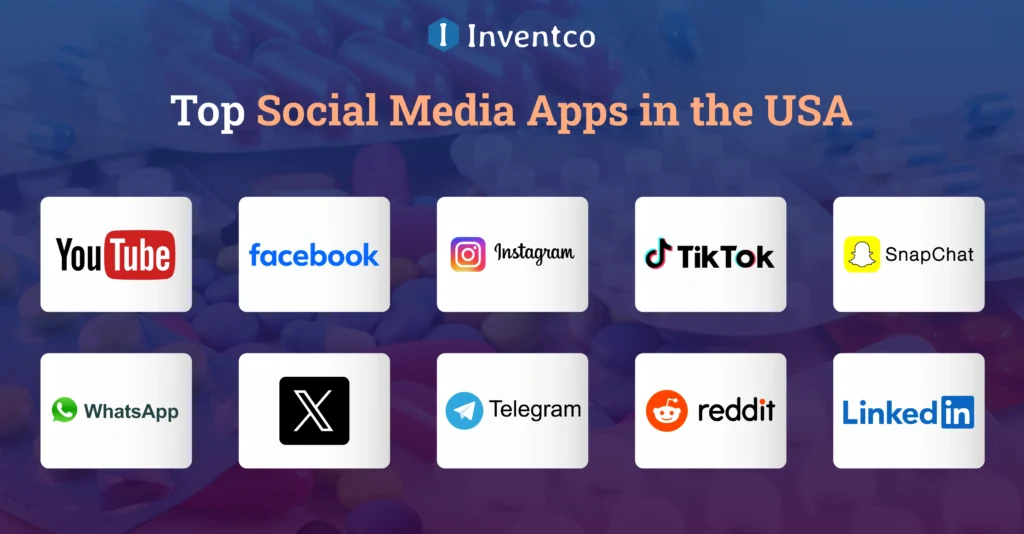
The social media landscape in the United States of America is highly developed and competitive, and it varies with changes in innovation, policy, and scale. Today’s leading social media applications are more than just networking applications. They have become ecosystems driven by sophisticated algorithms, creator economies, and accessible platforms across multiple devices.
The following social media applications are the best in the social media landscape, based on real-world use, number of active users in the United States, depth of engagement, potential to scale, and their ability to sustain a business. Each social media application is evaluated to provide potential investors and founders with insight into its performance and the competitive benchmarks needed for new applications.
1. YouTube
YouTube is the most popular video-based social media platform in the USA, offering a variety of content types, including videos of any length, live videos, and shorts. YouTube offers one of the most comprehensive monetization systems and creator economies, making it a unique advertising platform. Because of YouTube’s AI-based advertising, creator app monetization, and a focus on sustaining revenue, YouTube is the model platform that other social media platforms hope to replicate.
Main Features
- Videos of any length and Shorts
- Creator monetization and ad systems
- AI-based advertising and content recommendation systems
Pros
- YouTube has a very large audience in the USA.
- Monetization and advertising systems on YouTube promote revenues for creators and businesses.
Cons
- Competing for audience attention is very difficult.
- The number of videos on YouTube is increasing.
Best For: Video creators, businesses, and media brands that monetize content on YouTube should find it ideal.
2. Facebook
In the USA, Facebook is the social media platform with the 2nd-largest audience. More than 2.9 billion people use Facebook’s Groups, Marketplace, and other community-building features. Facebook’s audience targeting, ad features, and advertising integration with Instagram, WhatsApp, and the other Meta platforms push user engagement.
Main Features
- Facebook Groups, Marketplace, Events, Pages
- Audience targeting and Advertising
- Instagram, WhatsApp, and Meta platform Advertising
Pros
- Users of all ages use Facebook.
- Facebook allows businesses to analzye their audiences.
Cons
- Users under 18 use Facebook the least.
- Businesses worry about audience privacy when advertising on Facebook.
Best For: Audience building for Facebook is ideal for businesses and customers.
3. Instagram
Instagram is a visual social platform focused on reels, stories, and user-generated engagement. Well-developed brand partnerships, social commerce, and AI content integration make Instagram a top social media platform for customer engagement in the U.S. It offers a wide range of engagement options.
Key Features
- Stories, reels, brand shopping, and user created content.
- Tools for creator monetization
- Content driven by AI
Pros
- High customer engagement
- High popularity with younger users
Cons
- Algorithm dependency for reach
- Competitive creator environment
Best For: Influencers, brands, and lifestyle engagement.
4. TikTok
TikTok has the most user engagement of any social platform. Its AI content recommendation engine drives increased sessions and engagement for short-form videos. TikTok demonstrates how strategic, user-focused personalization can drive growth and engagement.
Key Features
- Creator partnerships and monetization through video content.
- Fast-paced videos.
- Algorithms driven by trends.
Pros
- High engagement
- Complete domination among Gen-Z and teens
Cons
- Changes in social and political norms
- Fast-paced trends can kill an account
Best For: Creator-based communities and social media with the potential for viral engagement.Snapchat
5. Snapchat
Snapchat remains a top choice for young people and Gen Z, who often use the app for private, temporary communication. Snapchat has several popular design features, such as AR lenses, stories, and a messaging-first approach, that promote a social media experience centred on frequent, immersive visual interactions.
Main Features
- Ephemeral messaging and Stories
- AR lenses and filters
- Private-first communication model
Pros
- Innovative AR capabilities
- Strong daily engagement
Cons
- Lower engagement from older users
- Reduced monetization techniques
Best For: New social apps for younger audiences and private messaging.
6. WhatsApp
WhatsApp is a messaging-centric social platform with a focus on privacy, reliability, and end-to-end encryption with strong adoption in the USA for personal and group communications, demonstrating the value derived from trust-based, low-friction social ecosystems with scalable infrastructures.
Key Features
- Encrypted messaging
- Voice and video calls
- Community and group functionalities
Pros
- Perceived trust and high security
- Reliable and straightforward user experience
Cons
- Content discovery is limited
- Uncertain monetization
Best For: Messaging-centric social ecosystems
7. X
As a platform for real-time information and conversations, X is primarily focused on news, media, and public discourse. X’s IM is centered on its speed and visibility.
Key Features
- Post and display trends in real time
- Advertising on a subscription basis
- Engagement in news and opinions
Pros
- Prominent participation in media and politics
- Rapid and extensive information flow
Cons
- Inadequate content moderation
- Unpredictable user sentiment
Best for: Platforms focused on news and discussions
8. Telegram
With its channels, groups, and broadcast messaging, Telegram can facilitate large-scale communities. Its privacy policies, cloud-based technology and flexible API make it appealing to community-centric and content distributing platforms that desire scalability with less reliance on algorithms.
Key Features
- Broadcasts and channels for large groups
- Access via cloud, any device
- Extensive API
Pros
- Excellent community scalability
- Privacy settings and controls are great
Cons
- U.S mainstream adoption is still lacking
- Discovery capabilities are rudimentary
Best for: Platforms with community-led and broadcast priorities.
9. Reddit
Topic-based communities with peer moderation and deep, long-form discussions are core mobile app features of Reddit. This platform typically features authentic content and deep engagement, which can provide insights for founders developing social platforms around specific interests.
Key Features
- Community structure via subreddits
- Moderation by users
- Ability to have lengthy discussions
Pros
- Highly authentic and engaged niche markets
- Excellent loyalty within communities
Cons
- New users must invest time to learn how to navigate
- Moderation is more variable for each community
Best for: Platforms focused on interests and discussions.
10. LinkedIn
The USA’s largest professional social network is LinkedIn, which focuses on career advancement, B2B networking, and recruiting. Due to trusted identities, a professional environment, and subscription-based monetization, LinkedIn is a great example of success in niche-focused platforms.
Key Features
- Networking with professional profiles
- Hiring features and job postings
- Advertising and content for B2B
Pros
- Audience for LinkedIn is of high-value professionally
- Strong revenue through subscription monetization
Cons
- Engagement is lower when casual
- Limited variety of content on platform
Best for: Social platforms focused on B2B networking and professional networking.
Largest & Biggest Social Media Platforms by User Base
Facebook, YouTube, Instagram, and TikTok continue to dominate the social media landscape in the USA, ranking highest and holding the largest market share across diverse demographics. These platforms illustrate what it takes to build a social media app that achieves scale, engagement, and long-term user retention.
- Large and active communities in the U.S. that lead to consistent and prolonged daily usage
- State-of-the-art recommendation algorithms that improve content and user retention
- Sophisticated advertising and monetization systems that create several revenue opportunities
- Accessibility on all platforms (iOS, Android, web)
These factors create the benchmark for the industry in social media performance, monetization, and scalability. For entrepreneurs and investors assessing the potential to develop applications that compete with the top ten social media apps, these platforms set the operational and technological benchmarks that must be met to be competitive in the U.S. market by 2026.
How to Choose the Best Social Media App for Your Needs?
The social media landscape is dynamic, and choosing the right platforms requires thorough planning, with a focus on long-term growth, especially in the U.S. market.
Some of the key considerations include:
- Target Audience: It is important to identify the users the platform is created for. Defining the target market as teens, businesspeople, content creators, or specific niches will help build a focused community and greatly improve engagement.
- Engagement Format: Choose the primary interaction type, such as short-form video, messaging, community forums, or live-streaming, based on user engagement and consumption patterns.
- Scalability & Compliance Readiness: Assess the ability to scale and sustain the U.S. data privacy, moderation, and regulatory pipeline while maintaining data confidentiality and security.
- Monetization Strategy: Align revenue strategies, advertising, subscriptions, and the creator economy with user expectations and the platform’s development stage to build a sustainable app monetization model without compromising the user experience.
- Long-Term Differentiation: Focus on distinctive value rather than feature copying to achieve a favorable and sustainable market position.
Identifying the leading social media models helps understand market gaps and opportunities without clashing with major players.
Case Study: Wegram App by Inventco
The Wegram app was designed and built by Inventco, an award-winning mobile app development company known for its highly scalable and high-performing digital solutions. Wegram fosters customer satisfaction by enabling them to engage, secure messages, and interact through community-centered features. Wegram is built on highly modular, scalable, and cloud-ready technology frameworks to deliver the best customer engagement experience.
The company offers customers the ability to interact and communicate via secure, real-time messages and adaptable technology systems. Wegram built its infrastructure on a cutting-edge technological system to ensure its clients remain competitive in a rapidly changing social environment. Wegram optimizes its systems using state-of-the-art cloud platforms compliant with U.S. data governance policies to ensure optimal system usage.
Wegram highlights the importance of excellent company execution and solid product strategies. Wegram is an excellent example of a social networking company that turns social ideas into a fully functioning platform. Users of Wegram can trust the platform to meet their social networking needs without system downtimes, data breaches, or operational weaknesses.

Conclusion
The continual evolution of user needs brings a clear gap in the U.S. social media landscape, which is most dominated by a few big players. These gaps create opportunities for more focused, strategically developed social media platforms. Apps that have an in-depth understanding of behavioral and engagement data and how to convert it into features and functionality are best placed to compete against superficial socio-technical hybrids.
From an investor’s and founder’s perspective, sustainable success requires developing compliant, scalable technologies, integrating long-term product roadmaps with privacy, moderation, and performance needs, and partnering with social media app development service providers to mitigate risks and shorten time-to-market.
Upcoming platforms, whether aiming for community building, social commerce, or creator monetization, will not succeed by merely imitating prior platforms. Rather, success will stem from the ability to execute, the strength of their architecture, and the ability to earn and sustain users’ trust.
FAQ’s
Q1. What are the most popular social media apps in the USA?
Ans. Facebook, YouTube, Instagram, TikTok, and Snapchat consistently rank among the most popular social media apps in the USA due to massive user bases, advanced features, creator ecosystems, and strong engagement across multiple age groups.
Q2. Which are the best social media platforms for startups to study?
Ans. Startups should study TikTok, Discord, and Reddit because they demonstrate strong community engagement, scalable architectures, creator-driven growth, efficient moderation models, and clear monetization pathways applicable to emerging social media platforms in competitive global markets.
Q3. Are social media apps still a good investment in 2026?
Ans. Yes, social media apps remain strong investments in 2026 as AI personalization, creator economies, and social commerce expand revenue potential, while scalable infrastructure and regulatory compliance reduce long-term operational and market risk for investors.
Q4. How long does it take to develop a social media app?
Ans. A scalable social media app typically takes six to twelve months to develop, depending on features, security requirements, AI integration, compliance needs, and cross-platform complexity, for launch in the highly regulated U.S. market.
Q5. What makes a social media app successful today?
Ans. Successful social media apps combine strong user trust, engaging content formats, effective moderation, privacy-first data practices, reliable performance, and scalable backend systems that support rapid growth without degrading experience or platform stability over time.
Q6. What monetization models work best for social media apps?
Ans. Common monetization models include advertising, creator revenue sharing, subscriptions, virtual goods, and social commerce, with successful platforms carefully balancing revenue generation to avoid harming user experience, long-term engagement, and platform trust, retention, and growth.
Q7. What is the average cost to build a social media app?
Ans. The cost to build a social media app typically ranges from $10,000 to $100,000+, depending on features, platform choice, scalability requirements, design complexity, and development location.
Q8. How should founders choose a social media app development partner?
Ans. Choosing the right development partner involves evaluating technical expertise, scalability experience, app security practices, industry knowledge, and post-launch support to ensure your social media platform is built for growth, compliance, and long-term success in markets.

Ajay Bhal
He is an on-demand app solutions expert with 11+ years of experience in business consulting and building scalable, user-centric digital products. He specializes in robust on-demand platforms across industries, combining technical expertise with business-focused strategy to deliver efficient, top notch solutions that drive growth and enhance user experience. You can connect with him on LinkedIn to follow insights.