The global used car market is already approaching a multi-trillion-dollar scale and is projected to cross $2.5 trillion by 2030, reflecting steady growth driven by affordability, supply constraints, and shifting consumer behavior. At the same time, the modern car buyer now completes the majority of their research on mobile, long before stepping into a dealership.
This creates a clear structural gap: demand has moved online, but much of the transaction experience still hasn’t. That gap is where the real opportunity sits.
For founders and investors evaluating the space, buy-and-sell used-car app development is not speculative, it is a direct response to a measurable behavioral shift. Today’s consumers expect transparency in pricing, verified vehicle history, seamless communication, and transaction-level convenience when dealing with high-value assets like vehicles.
Where most products fail is in misjudging the scope. Many teams still build for listings, not transactions. A classifieds-style interface with static listings and a contact button is no longer competitive. Modern users expect pricing intelligence, integrated financing, verified data layers, and a frictionless end-to-end experience.
This guide breaks down what actually matters, from market dynamics and feature architecture to cost structures and technology decisions, so you can evaluate, plan, and build a product that is positioned for real market adoption.
Key Takeaways
- The used-car sector in the United States sees around 40 million annual transactions, with an increasing number taking place online.
- The top five used car platforms in the U.S. market, Carvana, CarGurus, AutoTrader, Cars.com, and Vroom, all have billion-dollar valuations, which proves a good market thesis.
- Building a successful used-car app in the United States requires a strong foundation of trust, including services like Carfax/AutoCheck, verified sellers, and safe escrow payments.
- It costs between $10,000 and $35,000 to create an MVP (Minimum Viable Product) in the U.S. marketplace, with a full product expected to start around $70,000 and go upward to $1,000,000 or more.
- Regulatory compliance, titling laws, dealer licensing, lemon law disclosures, and state-specific transfer requirements must be designed into the product from day one, not retrofitted later.
- Mobile app monetization in this category extends well beyond transaction fees: financing partnerships, dealer SaaS tools, insurance integrations, and extended warranty referrals all represent significant revenue streams.
What Is Buy & Sell Used Car App Development?
Buy-and-sell used-car app development involves the design, engineering, and implementation of a solution that allows users to list, discover, evaluate, negotiate, and transact pre-owned vehicles from private sellers, dealerships, or via hybrid models.
In the US market, product expectations are well established. Carvana and CarGurus have raised the bar of convenience and trust. Buyers expect market price data (e.g., Kelley Blue Book, Black Book), real-time vehicle history (e.g., Carfax, Experian AutoCheck), real-time financing pre-qualification, and inspections, all integrated into a seamless, single interface. In 2026, meeting these expectations will be mandatory.
The true gap in strategy is between transaction-oriented ecosystems and listing platforms. Craigslist is an example of a listing aggregator. It provides visibility and generates leads. Carvana is an example of a transaction platform. It oversees the entire lifecycle, including all aspects of transaction fulfillment and buyer assurance. Transitioning to a transaction-focused system creates complexity but also provides higher margins, better user retention, and increased long-term competitive defensibility.
Market Size & Business Opportunity
The numbers clearly show why automotive marketplaces are becoming one of the most attractive digital business models today:
- The global used car market was valued at approximately $1.9 trillion in 2024 and is projected to reach around $2.7 trillion by 2030, growing at a ~6% CAGR.
- Updated estimates show even stronger upside: the market is expected to grow from ~$2.01 trillion in 2025 to $3.37 trillion by 2032, reflecting accelerated demand for affordable mobility.
- Digital transformation is accelerating rapidly: the global online car-buying market was ~$405 billion in 2025 and is expected to exceed $1.14 trillion by 2034, growing at a ~12% CAGR.
- Structural demand remains strong: ~76% of total car sales in the U.S. are used vehicles, highlighting why the resale market dominates overall automotive transactions.
The business opportunity lies beyond the transaction fee. Successful platforms monetize through advertising with dealerships that pay for premium placement, financing partnerships, inspection services, insurance referrals, and SaaS for dealerships.
This offers founders a secure way to build defensibility with trust and UX. For investors, the large TAM, digital momentum, and sustained monetization methods make used-car platform ventures attractive.
Types of Buy and Sell Used Car Mobile App Development
Choosing a business model should always come before the tech stack and app features. The US market currently has three main models.
1. Peer-to-Peer (P2P) Marketplace
Private buyers and sellers interact directly. The US more readily accepts direct transactions between dealers, but the model has deficiencies in the complexity of buyer and seller fraud. The model also faces challenges with buyer fraud. Once the buyer fraud issues are resolved, the platforms will invest in automated workflows and transaction services. An automotive-focused, trust-first P2P payment-escrow model offers a business opportunity, as Facebook Marketplace and OfferUp have informal versions.
2. Dealer-to-Consumer (D2C) Platform
Licensed dealerships and pre-owned cars can be listed on your platforms. Because dealerships have managed large inventories, they are accustomed to paying for digital distribution and can help boost your platform’s supply side. D2C models, such as AutoTrader and Cars.com, primarily offer dealer subscription packages and lead fees. Managing revenue can be challenging, but you will need to drive your dealers’ offerings.
3. Full-Stack Transaction Platform
This model, originating in the U.S. from Carvana and Vroom, is where the platform owns or controls the inventory, oversees reconditioning, arranges the financing, and delivers the car to the buyer. This is the most complicated and expensive model, but it’s also where the most consumer value is generated and where the brand moat is strongest. This model requires a dealer license in several states, a significant logistics infrastructure, and substantial working capital.
4. Hybrid Marketplace
As seen in CarGurus, both private sellers and dealerships are present on the platform. This optimizes inventory width but still requires carefully developed quality controls to maintain listing integrity and ensure the dealership experience does not undermine the trust of private-party listings. From a product perspective, finding the right balance is not easy, but those who achieve this will be in a dominant position.
How to Build a Car Selling App: Step-by-Step Process
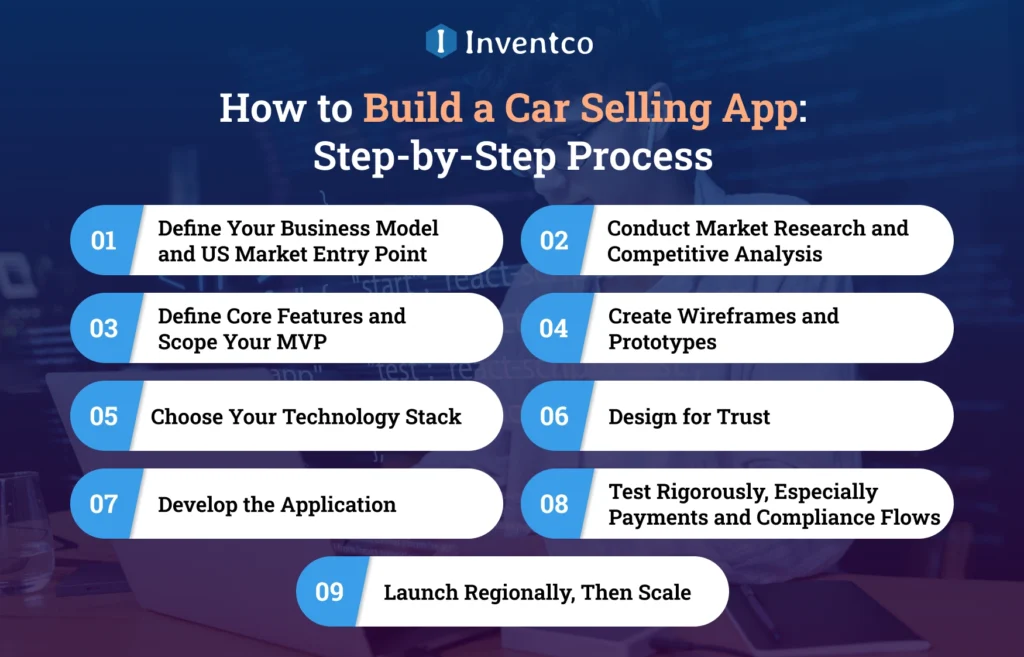
Building a car-selling app requires aligning product strategy, technology, and user expectations. From market validation to deployment, each step directly impacts scalability, user trust, and long-term transaction success in competitive markets.
Step 1: Define Your Business Model and US Market Entry Point
The US market is large enough that geographic focus is a strategic advantage at launch, not a limitation. Rather than attempting to launch nationally on day one, define a target metro or region where you can quickly build listing density and user familiarity. The Pacific Northwest, the Sun Belt, or a single major metro like Dallas or Atlanta are all viable first-market choices depending on your supply strategy.
Also, decide at this stage whether you will require dealer licensing. Listing vehicles you own or have purchased requires dealer licensing in most US states. Building a pure marketplace that connects buyers and sellers without taking title carries fewer regulatory requirements but limits your control over the transaction experience. This decision affects your cost structure, timeline, and go-to-market approach.
Step 2: Conduct Market Research and Competitive Analysis
Study the top platforms, Carvana, CarGurus, AutoTrader, Cars.com, Vroom, TrueCar, and CarMax Online, not to replicate them, but to understand where users consistently express frustration. App store reviews of these platforms are a goldmine of specific, unfiltered feedback about what buyers and sellers want that current platforms are not delivering.
Pay particular attention to the user complaints that surface repeatedly: opaque pricing, difficulty scheduling test drives, slow response times from sellers, and concerns about title transfer timelines. These friction points are your product opportunities.
Step 3: Define Core Features and Scope Your MVP
An MVP app must include at a minimum: vehicle listings with VIN-based data population, advanced search and filtering, Kelley Blue Book or Edmunds pricing integration, Carfax or AutoCheck history report access, in-app messaging, and a basic payment flow. These represent the floor of buyer expectations in the US, not a premium tier.
Advanced features, financing pre-qualification through a lending partner, inspection scheduling via Carmax-certified or third-party inspectors, dealer portal tools, and AI-powered price negotiation guidance should be roadmapped for the six-to-twelve-month post-launch period, not the initial build.
Step 4: Create Wireframes and Prototypes
App wireframing translates your product strategy into screen flows before a single line of code is written. For a used-car platform, the critical flows to wireframe include: the listing-creation experience for sellers (particularly the photo upload and VIN-decode flows), the search-to-listing-detail experience for buyers, the inquiry and negotiation flow, and the payment and title-transfer handoff.
Follow wireframes with a clickable prototype that you can put in front of real potential users, ideally both private sellers and buyer-side users, in structured research sessions. The insights you gain at this stage consistently prevent costly development rework.
Step 5: Choose Your Technology Stack
Your mobile app technology stack must be chosen with the specific requirements of the used car market in mind: VIN decoder API reliability, Carfax/AutoCheck integration, compatibility with payment processors, and the ability to handle state-specific compliance workflows. We cover the recommended stack in detail below.
Step 6: Design for Trust
In a market where the average transaction exceeds $25,000, design is not primarily an aesthetic concern, it is a trust signal. Every design decision, from the layout of a listing detail page to the copy on a payment confirmation screen, either builds or erodes buyer confidence. Invest in UX/UI design at this stage and do not compromise. Platforms that feel cheap or cluttered lose buyers at the moment of transaction, regardless of inventory quality.
Step 7: Develop the Application
Used car app development should target both iOS and Android from the start. Unlike markets where a single platform dominates, the smartphone market is split close to 55/45 between iOS and Android, and premium-income users, the demographic most likely to complete a $20,000+ transaction on their phone, index significantly toward iOS. A cross-platform app framework like React Native allows you to serve both audiences efficiently from a single codebase.
Step 8: Test Rigorously, Especially Payments and Compliance Flows
Mobile app testing in a financial transaction environment must go beyond functional QA. In the global context, you must specifically test: payment processing edge cases across multiple card networks and bank ACH flows, VIN decode accuracy across all major makes and models, Carfax API response handling and fallback states, and the title-transfer guidance workflow for the specific states in your launch market.
Security testing is non-negotiable. Your platform handles personal financial information, vehicle identification data, and payment credentials. A vulnerability at launch, or worse, a post-launch breach, is not a recoverable event for a trust-dependent marketplace.
Step 9: Launch Regionally, Then Scale
A focused regional launch is the right strategy for a used car platform. Concentrate your marketing, your seller acquisition, and your buyer growth efforts in a defined geographic area until you have achieved meaningful listing density, a threshold where buyers consistently find relevant inventory without scrolling through hundreds of mismatched listings. Only then expand the geographic footprint.
App Store Optimization begins at launch and is an ongoing investment, not a one-time setup. Your listing copy, screenshots, and keyword targeting directly influence your organic download velocity in both the Apple App Store and Google Play Store.
Must-Have Features of a Car Buy-Sell App
A successful car-buying and selling app isn’t built on listings alone, it’s built on trust, transparency, and seamless transactions. In the global market, users expect real-time data, verified history, and frictionless communication. That means every feature you build must directly support faster decisions, higher confidence, and secure transactions at scale.
Core Car Buy-Sell App Features
1. VIN-Based Listing Intelligence
Buyers can scan or enter a VIN to auto-populate vehicle details, including make, model, trim, options, and recall data, using NHTSA and manufacturer databases to ensure listing accuracy.
2. Price Benchmarking (KBB / Edmunds)
Every listing displays fair market pricing using Kelley Blue Book or Edmunds, helping buyers instantly identify deals, fair listings, or overpriced vehicles, improving decision-making confidence and purchase speed.
3. Vehicle History Reports
One-tap access to vehicle history through Carfax or Experian AutoCheck, showing accidents, title status, odometer readings, ownership history, and service records directly within the listing view.
4. Advanced Search & Filters
Users filter listings by make, model, year, price, mileage, fuel type, transmission, body style, color, seller type, and distance radius, enabling fast discovery of highly relevant vehicles within seconds.
5. Financing Pre-Qualification
Buyers access soft-credit pre-qualification through lenders like Capital One or Ally Financial, allowing them to understand budget, monthly payments, and affordability before contacting sellers.
6. Secure In-App Messaging
Encrypted messaging allows buyers and sellers to communicate without sharing personal details, maintaining privacy while preserving a complete conversation history for negotiation clarity, support cases, and dispute resolution, if needed.
7. Inspection Scheduling Integration
Users schedule pre-purchase inspections via integrations with services like CARCHEX or Lemon Squad, ensuring transparency into vehicle condition before making high-value purchase decisions.
8. Saved Searches & Price Alerts
Buyers save their search preferences and receive push notifications when matching listings appear or prices drop, increasing engagement, retention, and conversion by keeping users informed without the repeated manual effort of searching.
Advance Car Buy-Sell App Features
1. AI-Powered Pricing Recommendations
Sellers receive intelligent pricing suggestions based on comparable listings, historical sales, vehicle condition, and mileage, helping optimize listing competitiveness while maximizing sale value and reducing time-to-sell across marketplace inventory.
2. Escrow-Based Payment Protection
Secure transactions using escrow systems like Escrow.com hold funds until both parties confirm delivery, significantly reducing fraud risk and increasing trust for high-value peer-to-peer automotive transactions.
3. Offer & Negotiation Dashboard
Sellers manage offers, counteroffers, and acceptances within a structured dashboard, with automated responses and status tracking that streamline negotiation workflows and improve conversion rates across active listings.
4. Dealer Portal & Inventory Management
Dealers access a dedicated dashboard to manage inventory, bulk uploads, pricing updates, and lead tracking, enabling scalable operations and integration into existing dealership workflows for consistent listing management efficiency.
5. Fraud Detection & Moderation System
AI-driven systems detect duplicate listings, suspicious pricing, and invalid VINs, combined with manual moderation to maintain marketplace integrity, reduce scams, and protect both buyers and sellers from fraudulent activity.
6. Compliance & Title Transfer Workflow
State-specific workflows guide users through title transfer, documentation, and DMV requirements, ensuring legal compliance across jurisdictions while simplifying the most complex step in private vehicle transactions for both parties.
Tech Stack for Car Buy-Sell Mobile App Development
Building for the global market requires specialized third-party integrations beyond generic options, such as VIN decoders for vehicle databases, vehicle history APIs, payment processors, and compliance tools. Reference architecture is suggested below:
| Layer | Technology / Service |
|---|---|
| Mobile Frontend | React Native (iOS + Android from a single codebase); Expo for faster iteration |
| Backend / API | Node.js with Express or NestJS; FastAPI for ML services |
| Database | PostgreSQL for transactional data, Elasticsearch for listing search, and Redis for caching |
| Cloud Infrastructure | Amazon Web Services, EC2, RDS, S3, CloudFront CDN |
| VIN Decoder API | NHTSA vPIC API (free, authoritative), DataOne Software, or IHS Markit (Polk) |
| Vehicle History | Carfax API or Experian AutoCheck |
| Pricing Intelligence | Kelley Blue Book API, Edmunds API, or Black Book |
| Payment Processing | Stripe (primary), with ACH via Plaid |
| Escrow / Buyer Protection | Escrow.com API integration |
| Financing Integration | Capital One Auto Finance API, Ally Financial, or RouteOne |
| Maps & Geolocation | Google Maps Platform (Places, Distance Matrix, Geocoding APIs) |
| Real-Time Messaging | Twilio Conversations or Sendbird |
| Push Notifications | Apple Push Notification Service (APNs) + Firebase Cloud Messaging (FCM) |
| Authentication | Auth0 or Amazon Cognito (Google, Apple ID login) |
| Analytics | Amplitude or Mixpanel; Segment |
| Compliance / KYC | Persona or Jumio |
As for the VIN and pricing APIs, these choices are among the most critical pieces of infrastructure you will be forced to build. Your VIN API dictates how quickly a seller can create a listing. In building a pricing API, the choice you make with respect to your pricing benchmark, whether that is KBB, Edmunds, or proprietary, will ultimately dictate the level of trust your buyers will have regarding the price context you give them. The APIs you are building should rely on commercial API agreements and not free or unofficial data sources.
Used Car App Development Cost: A Detailed Breakdown
App development costs for a US-market used-car app typically range from $10,000 to $100,000+, depending on the depth of integrations required, such as vehicle history APIs, financing partner connections, and compliance workflows, as well as whether you are building for a single platform or a cross-platform mobile experience. Here is a realistic cost framework:
| Build Tier | Timeline | Estimated Cost (USD) |
| MVP: Core marketplace: listings, search, VIN decode (NHTSA), basic pricing via Kelley Blue Book, in-app messaging, basic payments via Stripe | 2 – 4 months | $10,000 – $35,000 |
| Mid-Tier: Feature expansion: Carfax integration, financing pre-qualification, inspection scheduling, dealer dashboard, seller analytics | 4 – 7 months | $35,000 – $70,000 |
| Full-Scale Platform: Advanced ecosystem: multi-region compliance, escrow via Escrow.com, AI-based pricing engine, full dealer SaaS suite, scalable iOS + Android apps | 7 – 12 months | $70,000 – $100,000+ |
Key Cost Drivers Specific to the Global Market
- Carfax or AutoCheck API licensing: The yearly price of the vehicle history commercial agreements ranges from $15,000 to $50,000+.
- KBB or Edmunds API access: APIs for pricing intelligence require a commercially negotiated agreement and licensing with KBB (through Cox Automotive) or Edmunds, which must be factored into operational costs.
- State compliance and legal review: The workflows for dealer licensing, lemon law disclosures, and title transfers differ by the launching state. While integrating the flows will incur costs, the legal review will significantly reduce the costs associated with regulatory exposure.
- PCI-DSS compliance: Within U.S. commerce, compliance with payment card data is mandatory, either through a PCI-DSS-compliant hosted payment service such as Stripe or through direct certification.
- Mobile App Maintenance cost: The app will incur a maintenance cost of 15% – 20% of the development cost per year, including ongoing maintenance, API updates, OS updates, and app security patch updates.
Top Buy & Sell Used Car Apps: What They Built and What You Can Learn
The top used car apps demonstrate how marketplaces achieve and build upon functionality focused on trust, pricing, and transactions, teaching developers how to create a large, high-conversion used car marketplace.
1. Carvana
Carvana is the most formidable example of US digital used car commerce. Decoupling the functions of inventory, purchase, reconditioning, listing, finance, and delivery enabled Carvana to completely eliminate the trust problem inherent in peer-to-peer marketplaces. Their 7-day return and 100-day limited warranty policy has addressed concerns and given purchasers an experience that’s similar to an e-commerce transaction. Further, their car vending machine locations are as much marketing as logistics, providing physical space for a brand that positions the procurement of an automobile as both simple and enjoyable.
Key Lesson for Builders
Operational bets that are the most significant, like holding inventory, offering returns, and assuring quality, are the most impactful in creating brand moats. If you are unconventional enough to master the operational challenges, fully absorbing the buyer risk will be the most effective way to achieve high conversions.
2. CarGurus
CarGurus gained a hold over the US used-car market by addressing a specific problem. They realized that customers aren’t sure if they are getting a fair price, and that uncertainty holds customers back from acting. Their instant deal rating system assures customers of their pricing. Depending on the pricing, ratings are categorized as Great Deal, Good Deal, Fair Deal, High Price, or Overpriced. This system motivates buyers and incentivizes dealers to price listings more competitively to get a Good Deal or Great Deal rating.
Key Lesson for Builders
Pricing is a significant problem for buyers. It holds back conversion on listings. If the market problem impedes participation, pricing transparency is the most critical factor.
3. AutoTrader
For over two decades in the US market, AutoTrader has been the most dominant dealer-to-consumer marketplace. They win by offering the most with their marketing machine. AutoTrader has the largest market presence and the most dealer listings. AutoTrader offers its services in packages, and customers can choose a basic listing or a more advanced pay-per-placement with lead generation.
Key Lesson for Builders
A dealer network is essential if you’re designing a D2C platform. In a dealer network, you provide the tools that the dealers need. Your marketplace operates effectively by providing adequate dealer tools, including inventory management, customer relationship management, and advanced lead management.
4. Cars.com
Starting with just online listings, Cars.com now forms part of a complete value chain in online car transactions. Cars.com not only features online car listings but also buyer financing, dealer ratings, and educational content to guide buyers before they decide to view a listing. Their content and search engine strategies have given them a strong competitive edge, making them the first choice for buyers conducting online car market research. This results in organic market penetration at minimal customer-acquisition cost.
Key Lesson for Builders
Marketplace builders should invest in research and content like Cars. There is potential to build an organic top-of-funnel that drives sustained customer acquisition without costly strategies to drive the audience to the listings. Without a content strategy, a marketplace has to rely solely on paid customer acquisition to drive top-of-the-funnel traffic.
5. Vroom
Along the lines of Carvana, Vroom is a fully online car shop focused on selling used cars to buyers across the United States. Vroom’s experience has demonstrated a viable business opportunity and outlined the execution risk of the full-stack business model. Vroom’s cautionary story is a good case study for entrepreneurs focused on the owned-inventory business model.
Key Lesson for Builders
In full-stack marketplace models, business operations are complex and asymmetrically sloped. Avoid unnecessary risk by utilizing all your available resources.
6. TrueCar
TrueCar originated from the understanding that many of the audience do not appreciate negotiation. TrueCar provided no-haggle pricing and established partnerships with certified dealers. With this network, TrueCar was able to provide many negotiating-averse, time-pressed customers with the comfort and simplicity they needed. TrueCar’s pricing model imports and pre-qualifies dealers’ pricing against marketplace data, partnering with dealers who promise pricing transparency. The model becomes a trust mechanism, eliminating the need for the platform to control dealers’ inventory.
Key Lesson for Builders
Segment your audience. The customer with negotiating power in mind and the customer with a desire for price transparency, free of negotiation, are of entirely different mindsets. With its simplistic approach that made the preferred auto shopping experience of the audience a veritable product, TrueCar was able to dominate the latter audience segment almost effortlessly.
Challenges in the Buy and Sell Used Car Mobile App Development
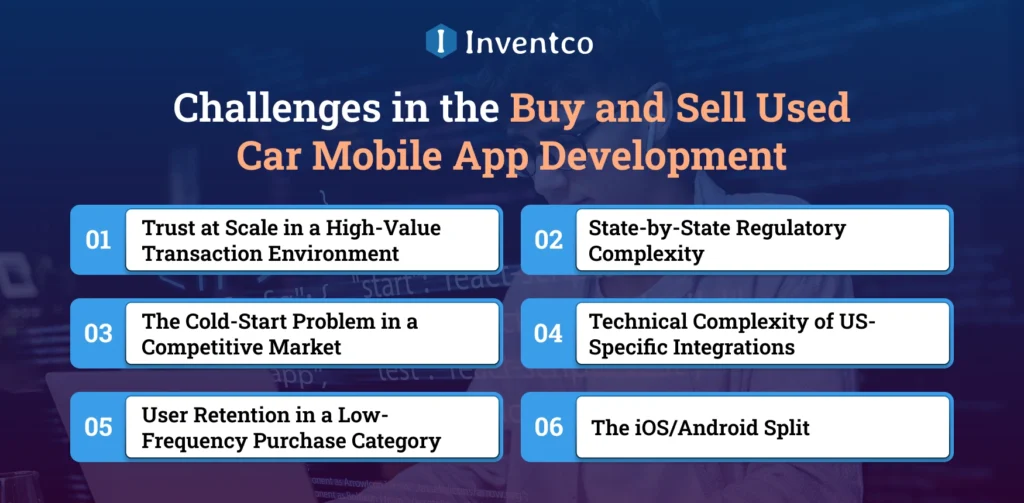
Building a used-car app involves navigating complex compliance requirements, trust issues, fragmented data sources, and high user expectations for pricing, transparency, and seamless transactions.
1. Trust at Scale in a High-Value Transaction Environment
In a market where the average transaction exceeds $25,000, trust is not a feature layer you add on top of a functional marketplace, it is the foundational product requirement. Fake listings, VIN cloning, odometer fraud, and title washing are real and recurring problems in the used car market. Your platform must invest early in identity verification (KYC), automated listing fraud detection, Carfax integration to surface title issues, and a buyer protection mechanism for high-value transactions.
Platforms that get this wrong once get written about in national consumer media. The reputational cost of a major fraud incident on an early-stage platform is typically unrecoverable.
2. State-by-State Regulatory Complexity
The United States does not have a single national framework for used-car transactions. Title transfer procedures, bill-of-sale requirements, odometer disclosure rules, dealer licensing requirements, and lemon law applicability vary by state. A platform operating in 10 states is navigating 10 different compliance environments simultaneously. Build compliance review into your product roadmap and budget for ongoing legal counsel as you expand your geographic footprint. Do not treat this as an afterthought.
3. The Cold-Start Problem in a Competitive Market
Unlike emerging markets, where digital used car platforms are relatively new, the US market already has well-resourced incumbents with large dealer networks and established consumer awareness. Launching nationally and trying to out-inventory AutoTrader or out-market Carvana is not a viable strategy for a new entrant. Geographic focus, building genuine listing density and brand recognition in a specific metro or region before expanding, is the rational alternative. Define your first market precisely and win it before you pursue the second.
4. Technical Complexity of US-Specific Integrations
The mobile app development challenges in this category are compounded by the complexity of US-specific API integrations. Carfax and AutoCheck both require commercial licensing agreements and have API terms that restrict certain use cases. VIN decoders must provide comprehensive coverage of US-market vehicles, including trim-level details and factory option data. Payment processing for high-value transactions, particularly ACH bank transfers, which are common in private-party deals, requires robust fraud-prevention logic. These integrations are not plug-and-play; they require experienced engineering and ongoing maintenance.
5. User Retention in a Low-Frequency Purchase Category
The average American buys a used car every 4 to 6 years. Building an app that users return to only at transaction moments is a fragile business model that depends entirely on paid acquisition for every conversion. Successful platforms have invested in use cases that bring users back between transactions: vehicle price monitoring for owners, insurance renewal reminders, storage of service records, and research content for buyers who are still months away from a decision. Mobile app monetization through these adjacent touchpoints is both a retention strategy and a revenue diversification opportunity.
6. The iOS/Android Split
Unlike markets where Android dominates overwhelmingly, the smartphone market is split close to 55% iOS and 45% Android, with iOS users skewing toward higher-income demographics that correlate with higher-value vehicle purchases. A used-car platform that launches on Android only or delivers a materially worse iOS experience is leaving significant revenue on the table. Design and test for both platforms with equal rigor.
Case Study: Quickly — Full-Stack Automotive Commerce App
Most automotive commerce platforms fail for one simple reason: they don’t solve the real problem, accuracy and trust at the moment of purchase. That’s exactly where Inventco stepped in to build a platform that works in real-world conditions, not just on paper.
The Challenge
The automotive parts and accessories space in North America faces the same structural challenges as used vehicles: fragmented supply, opaque pricing, and a transaction process that has historically required phone calls, in-store visits, and significant buyer expertise to navigate. Retailers lacked a scalable digital channel. Consumers lacked a trusted, organized way to find and purchase the right parts quickly.
The Solution
Our team designed and built the Quickly Mobile App, a full-stack mobile commerce platform connecting consumers with verified suppliers across a comprehensive catalog of auto parts and accessories. The platform spans engine components, electrical systems, body panels, and specialty parts, all organized and searchable by year, make, model, and VIN.
What We Delivered?
Backend
A scalable API architecture handling real-time inventory synchronization across multiple supplier catalogs, with intelligent parts compatibility logic that surfaces the correct fitment for a user’s specific vehicle configuration, reducing the most common failure mode in parts purchasing: ordering the wrong part.
Frontend
A mobile interface designed for users operating in time-sensitive conditions, at a service bay, in a parking lot, mid-repair. Every interaction was optimized for speed, large touch targets, and minimal cognitive load. The VIN-scan-to-catalog flow became the signature feature of the experience.
Software Testing
Given the platform’s financial transaction nature, we implemented layered testing covering functional accuracy, performance under concurrent load, payment security, and integrity of parts fitment data. Zero critical failures at launch.
Strategy
We partnered with the client from discovery through go-to-market, helping them sequence their supplier onboarding, define their MVP feature scope, and build a post-launch roadmap aligned to revenue milestones rather than feature completeness for its own sake.
UX/UI Design
The design system was built around a professional, tool-adjacent aesthetic that communicated competence and reliability to a technically sophisticated user base. Conversion from search to purchase improved measurably compared to the client’s previous web-based purchasing process.
The Results
Quickly launched to strong adoption in its target market, with users consistently citing the VIN-to-catalog search experience and the supplier verification system as primary reasons for continued use. The platform has expanded its supplier network post-launch and is in active conversations with regional automotive retail chains about white-label deployment.
What This Shows?
At Inventco, we bring the full stack, strategy, product architecture, UX/UI, backend engineering, frontend development, and rigorous testing to automotive commerce app development. We build for real users, real transactions, and real business outcomes, not demos.

Conclusion
The used-car market is large, is digitizing rapidly, and is still imperfectly served, even with well-funded incumbents in the field. The platforms that will win the next decade are not the ones with the most inventory or the biggest marketing budgets. They are the ones that solve the trust problem most completely, deliver the most frictionless transaction experience, and execute with discipline on a focused market entry before scaling.
Car resale app development is not a commodity project. It requires genuine product thinking, US-specific technology integrations, regulatory awareness, and a development partner who has built in high-stakes transaction environments before. The margin for error in a $25,000 transaction platform is narrow, and the competitive set is experienced.
For founders with a clear differentiation thesis and the operational discipline to execute in a defined geographic market, the opportunity is significant. For investors, the combination of a massive underlying market, an accelerating digital shift, and multiple monetization layers makes this a category worth serious attention.
The question is not whether the used car market will move further online. That trajectory is settled. The question is whether your platform will be the one American buyers and sellers trust to take them there.
FAQ’s
Q1. How long does it take to build a used car buying app for the US market?
Ans. A production-ready MVP takes 3–5 months. Mid-tier apps require 5–8 months. Full-scale platforms with compliance and AI pricing models typically take 9–14 months, depending on complexity and integrations.
Q2. What is the realistic cost of used car app development in the US?
Ans. MVP costs range from $10,000–$35,000, mid-tier from $35,000–$70,000, and full-scale from $70,000–$100,000+. Additional costs include Carfax licensing, APIs, compliance, and annual ongoing maintenance.
Q3. Should I build for iOS or Android first in the US?
Ans. Build for both using React Native. The US market is split between iOS and Android, and limiting to one platform significantly reduces reach, conversions, and revenue potential.
Q4. Is Carfax integration mandatory for a US used car app?
Ans. Yes, Carfax or AutoCheck is expected by US buyers. Without vehicle history reports, trust declines, reviews suffer, and conversion rates drop at critical points in the purchase decision.
Q5. How do used car apps handle title transfer?
Ans. Used-car apps handle title transfers via state-specific workflows, guiding buyers and sellers through DMV requirements. Processes vary by state, so apps must include forms, instructions, and compliance steps for accuracy.

Jitendra Jain
He is the CEO and Co-founder of Inventco, driving innovation in advanced computing and digital transformation. With deep expertise in modern IT ecosystems, he leads scalable, secure, future-ready solutions. His strategic leadership helps businesses accelerate growth, adopt innovation, and achieve success. You can connect with him on LinkedIn to follow his technology insights.