Digital technologies are central to our daily routines, yet many of us overlook how far they have come. What required years of development, punch cards, and monumental, room-sized mechanical marvels now occurs in days and seconds with our smart mobile devices, and with a touch of our hands. The devices respond to our commands. However, with the convenience of our technologies, an unseen movement of unencrypted data occurs, and this data is created at every single moment.
Currently, over 80% of the world’s data is unorganized across numerous platforms, including email, messaging apps, social networks, and customer service channels, and each individual data point lacks a clear purpose. Their real worth, however, is if every single one of them is collected, and data is found for them, and analyzed, describing what people are saying, what the people are feeling, what people are expecting, and what businesses need to do.
However, this is not a simple task. People do not speak in simple, direct terms. Without artificial analysis and complexity, people employ diverse, intricate means of communication. Without this analysis, there remains an incalculable void, and to abridge it, it is precisely a need. NLP, or Natural Language Processing, is applied to close this void that separates the far from the near, the text from the real meaning. NLP helps organizations to unrecognizably provide them, discover and preserve valuable real meanings that can be of value to them.
What is Natural Language Processing (NLP)?
Natural Language Processing is a subfield of artificial intelligence that focuses on understanding human language. It combines computer science, machine learning, and linguistics to enable computers to understand human language. The objectives of NLP include the following: trains computers to read and interpret, analyze and respond to human language in a way that is natural and meaningful to humans.
Currently, organizations continue to accumulate vast amounts of data through channels such as text messages, emails, social media, voice clips, videos, and documents. Companies use Natural Language Processing (NLP) to understand and manage data efficiently. These technologies evaluate communications, understand and determine the intent and context, and generate instant responses, just like a human. NLP transforms communication data into actionable insights.
Future of Natural Language Processing in Business and Technology
The acceleration in the development of Natural Language Processing (NLP) is a direct result of the growth of business text data and the need for companies to derive insights from language-based interactions. According to market research, the global NLP market is projected to nearly triple from $39.4 billion to $115.3 billion, with a 23.97% CAGR, between 2025 and 2030. This rapid adoption among players in the customer service, automation, and analytics markets confirms the NLP market hype.
The key factor in this rapid growth is the emergence of large language models (LLMs). Current NLP models (such as GPT architectures) outperform their predecessors in both language understanding and generation.
NLP models that also process images, video and audio (multimodal NLP) are also emerging quickly. These models, alongside LLMs, enhance language understanding and comprehension through simultaneous processing and analysis of diverse data types. These technologies enable a wider range of applications such as real time translations and searches.
Given the rapid advances in NLP, LLMs, and multimodal models, the business applications of intelligent automation, advanced analytics, and human-like interaction will be limitless. Language-based AI, in the form of LLMs, will be the key to the next wave of Business Innovation. Language-based AI will be the key to the next wave of Business Innovations.
How Natural Language Processing Works?
Artificial intelligence (AI) and machine learning (ML) algorithms enable the interpretation and improvement of the efficiency of Natural Language Processing (NLP) systems; therefore, it is important to first understand the basics of NLP in conjunction with AI/ML. The way language is acquired and the vast amounts of language data represent the two principle frameworks that ‘train’ NLP systems. ML algorithms help NLP systems in recognition of text patterns, context, and language prediction, along with the motive behind the text.
The ability of NLP systems to identify language abstraction is derived from training on real-world text and speech datasets. The ability to incorporate artificial intelligence is what distinguishes NLP from other computational linguistic programs. AI and NLP systems, when combined, enable the processing of written and spoken data and convert it into machine-understandable formats. Natural language processing (NLP) is composed of two fundamental phases; processing of language data, and implementing the constructed systems to learn how to analyze and respond to language.
Data Processing
Data processing is one of the earliest steps in Natural Language Processing (NLP). It is where unstructured language data is prepared and cleaned for subsequent machine analysis. At this stage the data is transformed into an algorithm ready format so that it can be analyzed, and further processed by NP software models. Identifying these patterns and features enables the model to accurately and efficiently highlight them within the text.
Some of the most important features of data processing technologies for NLP, and their strategies/ techniques at this stage are mentioned below:
1. Tokenization:
During the tokenization phase, the models break the text into smaller, more manageable units, such as words, phrases, or subwords. These units, or tokens, are the fundamental/ first structural simplifications that the models make for language comprehension and structural analysis
2. Stop Word Removal:
In this phase, the models remove so-called ‘stop words’ that are frequently used, such as ‘is’, ‘the’, and ‘and’. These carry significant less or no meaning or value to the sentence or structure, and removal of these ‘stop words’ allows the model to more efficiently analyze the meaningful components of the sentence or phrase.
3. Lemmatization and Stemming:
During the Lemmatization and Stemming phase, models or software reduce words to their root form (or their base). For example, talking, talked, and talks are all variants of the root word talk and will be reduced to the same stem form, enabling systems to identify the related meanings of these variants more efficiently and accurately.
4. Part-of-Speech Tagging:
Part-of-Speech Tagging (PoS tagging) involves labeling a word in a text with its correct part of speech. Each word in a text is labelled as a noun, verb, adjective, etc. Depending on how the word functions in a sentence. For a computer to understand the structure and context of a sentence, PoS tagging is essential.
After all text data have been processed, the data can proceed to the next step, where it is ready to be input into appropriate algorithms to explain, analyze, and produce language-meaningful outputs.
Algorithm Development
The next step in the natural language processing (NLP) process is the development of algorithms, after the text data has been processed. Meaningful results are produced so that the system can understand language, analyze data, and identify patterns through the application of algorithms. NLP uses algorithms that fall into two main categories.
1. Rule-Based System:
The system is based on rigidly defined rules, created by language experts, to enable it to understand text based on grammar, text structure, and fixed patterns. In the early ages of NLP, these systems were very common, and even today it is used in some circumstances when the structure of the text is highly predictable.
2. Machine Learning-Based System:
The machine learning-based NLP systems use statistical and data driven approaches and then learn from the large datasets. These systems do not adhere to predetermined rules. Rather, these models increase the training results by discovering patterns in the training data and adjusting to the new language data over the periods.
As machine learning algorithms become more sophisticated, NLP systems will process larger and more diverse datasets. This attribute, learning and adapting, is what allows the current NLP applications to offer accurate, contextually appropriate, and advanced human comprehension language understanding.
Applications of Natural Language Processing
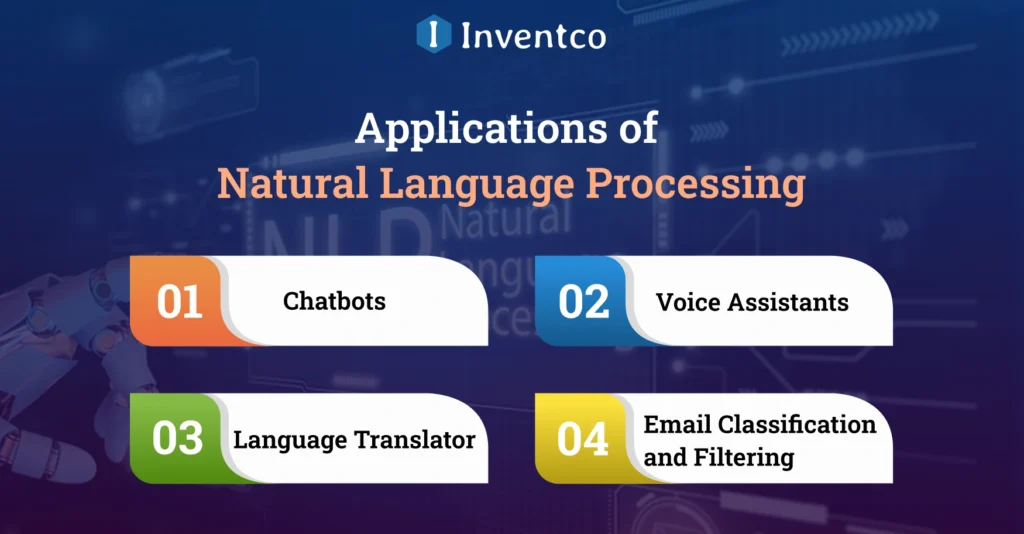
It is necessary to examine how natural language processing is integrated into real-world use cases to assess the field’s true importance. NLP continues to be a core component of numerous systems built on artificial intelligence that individuals and companies use on a daily basis.
1. Chatbots
Chatbots are among the most widely used applications in natural language processing. They employ artificial intelligence and are designed to interact with users as if they were human. More sophisticated chatbots can enter full conversations while others can only respond to specific keywords. Newer types of chatbots that use machine learning and NLP can understand user intent and sentence structure. These chatbots learn and improve with each preceding interaction, making them highly valuable and effective for implementing automated customer support, sales, and service.
2. Voice Assistants
Voice assistants are used by virtually everyone every day. Alexa, Siri, and other AI assistants can assist users with tasks by creating reminders, calling others, searching the internet, and managing calendars. Voice assistants are applications of natural language processing and they also include real time speech recognition. Voice assistants understand and respond to commands, and they do this in a highly time efficient manner.
3. Language Translator
Another remarkable usage of NLP is in Language Translation. Translation tools assist users in converting text or speech from one language to another. This enables users to communicate with people from different parts of the world, regardless of different languages. In general, translations can be error-prone, but with NLP it reduces errors in sentences, resulting in improved global communication.
4. Email Classification and Filtering
Email is among the oldest but remains one of the most effective forms of communication in the corporate world. The use of NLP to automatically classify emails that users receive into different boxes: primary, social, and promotional, and in some emails, use NLP to analyze and filter emails to reduce the volume of emails that users receive, thus improving productivity.
Challenges in Natural Language Processing
Although the development of Natural Language Processing (NLP) has changed the way machines comprehend the human language, they still encounter numerous obstacles, both technical and practical. When developing software with AI capabilities, these challenges must be considered when designing solutions that incorporate NLP.
1. Linguistic Diversity and Contextual Variation
Languages globally are extremely heterogeneous. Linguistic communities exhibit diversity in grammar and vocabulary and sentence structure. Additionally, sociolinguistic nuances vary across geographical regions. There are many languages and dialects across the world. Linguistic variation and diversity globally are numerous, making it difficult to design Natural Language Processing systems that function efficiently and accommodate diverse cultural adaptations and use cases.
2. Availability and Quality of Data
Any development in Natural Language Processing relies on high-quality large datasets. Data training involves exposing systems to large amounts of language in various contexts. If the training dataset contains gaps, biases, or labeling errors, the system would learn patterns that are not useful in practice, ultimately yielding faulty solutions. Ensuring diversity, quality and representation of data is a persistent and ongoing contemporary challenge in the field of Natural Language Processing.
3. Required Development Time and Resources
Considerable computational power is required to develop sophisticated Natural Language Processing (NLP) systems. Model training guides models through millions to billions of text samples. Training can be considerably less effective, and possibly inefficient, without optimized structures to facilitate training, such as distributed computing systems and high-performance Graphical Processing Units (GPUs). The training duration has been shortened by contemporary designs of deep learning models, but the remaining factors needed for large scale projects of software development in the realm of Artificial Intelligence (AI) and NLP still remain critical.
Why Choose Inventco for NLP-Powered Mobile Apps?
Inventco is a leading mobile app development company. They create intelligent apps that provide scalable and future-ready mobile solutions. Inventco builds mobile apps that understand users and automates communication. They have strong expertise in natural language processing, chatbot development, and AI software development. Clients appreciate their mobile apps personalizes user experiences. Inventco integrates AI powered chatbots and advanced features of NLP. They advance innovation with reliability. The Inventco team focuses on building long-term scalable systems and security. Inventco empowers businesses with their strong AI driven mobile apps.
Conclusion
Natural language processing (NLP) and its rapid evolution is integrated into many of the most advanced systems that people encounter, usually on a daily basis, including smart chatbots, smart speakers, virtual assistants, language-interpreting and translation systems, and automated communication systems. The sophistication and integrated intelligent systems that utilize NLP continue to transform the way people and businesses relate to each other and communicate with technology.
The goal of this article was to provide an overview of natural language processing (NLP): how it works with AI, the techniques involved, the problems it aims to solve, the real-world problems it addresses, the challenges it faces, and the future of NLP. You should now appreciate what NLP does with human language and how important it is for the development of contemporary artificial intelligence applications and the digital transformation of businesses.
FAQs
Q1. What is Natural Language Processing Used For?
Ans. NLP system is used in a wide range of areas, including mobile app development, website development, AI software development, and chatbot development. NLP is crucial for businesses that access vast unstructured datasets. NLP systems enable organizations to get valuable insights and automate tasks.
Q2. What is the purpose of natural language processing?
Ans. NLP’s major purpose is to enable computers to understand human language. Further, the system enables computers to generate text and speech that is understandable to humans. NLP is crucial for several tasks, including machine translation, speech recognition, and sentiment analysis.
Q3. What is the advantage of natural language processing?
Ans. NLP enables humans to interact with computers using their own language, and NLP-powered chatbots provide 24*7 customer support. NLP analyzes customers’ queries and replies with personalized messages. An NLP system can predict data trends, patterns, and sentiments, and then provide valuable business insights.
Q4. What are the natural language processing techniques?
Ans. Various techniques and tools work together to enable computers to understand and generate human language. Syntax and semantics, NER (Named Entity Recognition), and sentiment analysis; these are the techniques that work behind an NLP system.

Sandeep Agrawal
Sandeep Agrawal is the visionary CTO at Inventco, bringing innovation to life through his technical expertise. With a passion for cutting-edge technologies, Sandeep leads the team in developing robust solutions. His dedication and continous efforts to pushing the boundaries of what’s possible defines his role as a transformative and innovative force in the tech industry.