The use of swipes or a simple user interface is no longer a priority for dating apps. Dating apps are becoming more sophisticated. The most important factor is their use of AI in improving how users form, manage, and maintain relationships. Prior Relationship Management Systems (RMS) focused on user expectations and compatible, trustworthy, long-term relationships. RMS of the previous generation focused on transactional interactions.
The current AI dating apps represent the relationship-management systems of previous generations. Dating apps use AI to analyze user interactions, track collaborations, and improve security and the user experience. This evolution has changed how founders and product teams approach dating app development services, making intelligent systems and predictive analytics essential.
The dating application market was valued at $11.61 billion in 2025 and is projected to reach $12.52 billion in 2026. The fast adoption of AI in dating is contributing to the market’s rapid growth. The dating RMS will likely be focused on improving user engagement.
Key Takeaways
- The future of dating apps is shifting from swipe-based discovery to relationship intelligence platforms powered by artificial intelligence.
- AI in dating apps delivers the most value after the match, through behavioral learning, conversation analysis, and retention insights.
- Leading dating apps demonstrate a developing focus on compatibility, intention, and trust over volume engagement.
- Current dating apps use layered AI, where data governance, intelligence, safety, and personalization work together.
- To win and keep users, trust must be earned through ethical AI practices that address bias, governance, and emotional sincerity.
- The best dating apps use AI to enhance rather than replace human interaction.
The Shift from Discovery-Based Dating Apps to Relationship Intelligence
Dating apps have primarily centered on discovery features since their inception. Users create profiles that include various details and can filter profiles by location, photos, and preferences. For example, dating apps like Grindr used to measure their success based on the number of swipes, matches, and short-term user engagement. However, the discovery-first approach is increasingly outdated. Today, users have different expectations.
Dating applications such as Hinge have taken a different route. Hinge, for example, employs machine learning and artificial intelligence to capture and understand user activity. Hinge records user interactions, the evolution of conversations, periods of inactivity, and user prompts to quantify how users are re-engaged with the app. This data is more insightful concerning users’ compatibility than stated preferences.
Modern dating apps need to focus on enduring emotional ties rather than ephemeral attraction. AI technology integrates seamlessly with the digital world to go beyond basic matching, helping build emotional connections and transform how relationships are formed and sustained online.
Why AI in Dating Apps Matters Beyond Matching Algorithms?
For most people, the use of AI in dating apps primarily comes down to matchmaking. While other uses may be less obvious, AI has several important applications on dating apps after matches, specifically in analyzing user communication behavior.
Behavioral Learning Over Stated Preferences
Over time, AI provides matchmaking services using user data that enable analysis of how users respond to other users. These data comparisons are evident in the analysis of response times, signal response engagement, depth of interaction, message tone, use of follow-up questions, disengagement, and other aspects of user interaction. These data comparisons can be instrumental in helping dating services predict future relationships among users, far beyond the information provided during onboarding.
Conversation Intelligence
Communication and its various aspects can be analyzed to determine the level of compatibility among users. A user’s expression of interest, their response to conflict, their use of disengagement, and other aspects of communication can be important indicators for predicting future alignment among users. Communication allows dating services to focus on users who can articulate themselves and engage in effective dialogue, rather than simply using the dating platform.
Retention and Relationship Signals
Apps powered by AI are used to answer the question of why a user remains active on a dating app and also to assist in feature design that encourages the user to engage with the app in a more sustainable manner. These are strategies to reduce user churn (a nicer way of saying users leave the app), improve user confidence in the app, and increase its longevity.
AI will enable dating apps of the future to become less like matchmakers and more like matchers.
What Top Dating Apps Teach Us About the Future of AI?
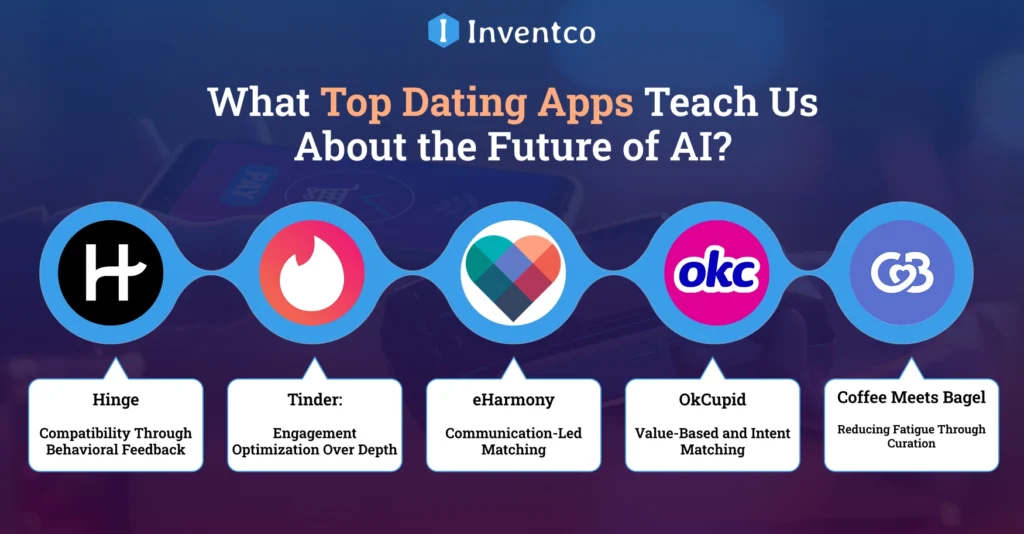
The best dating apps do not design new services, rather, they utilize AI to address old problems, such as matching, user engagement, and user trust. Each of the top dating apps employs AI in a manner common to other leading apps, which helps predict the future of dating applications.
1. Hinge: Compatibility Through Behavioral Feedback
Hinge is an AI dating app that goes beyond basic user matching by customizing its algorithms based on user behavior and post-match feedback. Platforms that build apps like Hinge often incorporate adaptive AI models, in which user engagement and feedback continuously refine compatibility scoring and recommendation accuracy.
2. Tinder: Engagement Optimization Over Depth
Tinder had a higher possibility of user activity if it employed neural networks to optimize engagement and the user interface. Platforms developing an app like Tinder often prioritize swipe mechanics and UI-driven interactions to boost activity, though relationship-building features may receive comparatively less emphasis.
3. eHarmony: Communication-Led Matching
eHarmony exhibits the opposite of positive user behavior. Their artificial intelligence analyzes a couple’s communication and behavior to inform future matches. Narrow AI in matchmaking should focus not just on who gets matched, but also on how matched users communicate.
4. OkCupid: Value-Based and Intent Matching
OkCupid is arguably the first dating app to match users based on positive intent rather than solely on behavior, visuals, and other secondary characteristics. This also exemplifies artificial intelligence as values matching other than behavioral or visual surface matching.
5. Coffee Meets Bagel: Reducing Fatigue Through Curation
Through smart matchmaking and learning user preferences, Coffee Meets Bagel shows the positive side of AI by reducing user swiping fatigue and encouraging more purposeful interactions.
What These Trends Indicate?
These applications reveal an interesting trend in the development of artificial intelligence in dating: a shift from engagement maximization to connection maximization. As this evolution continues, the cost to build dating app platforms may increasingly reflect investments in intelligent analysis of user behavior, communication patterns, and relationship goals prioritizing meaningful connections over purely transactional engagement.
The AI Technology Stack Powering the Next Generation of Dating Apps
Dating apps consist of multiple layers that serve various objectives. AI-first platforms are dating apps that incorporate artificial intelligence. Each layer helps to build trust and achieve critical objectives for scalability and the platform.
1. The Data Collection Layer
Dating apps rely on user activities to run their business and analyze user interactions. User reactions and the behavioral data captured by the app provide the raw materials for artificial intelligence and insights into users’ long-term compatibility.
2. The Data Governance Layer
From a strategic perspective, trust, compliance, and data governance are intertwined. The operational risk of data systems is converted into a strategic asset when a data-use policy is clearly articulated, data is secured, data processing is aligned with user consent, data is anonymized, and the rest of the governing policy is followed.
3. The Intelligence Layer
The best systems build actionable insights from raw data by combining machine learning, predictive analytics, and natural language processing. For compatibility prediction, engagement optimization, and risk detection, these systems continuously learn and adapt across the platform, while app store optimization ensures the product remains discoverable and competitive in digital marketplaces.
4. The Conversation & Behavioral Analysis Layer
The AI in these applications dissects the intricacies of conversations to personalize how to further engage the users. This insight allows the platform to better analyze relationship intimacy, and determine if it is simply based on superficial emotional attraction or something deeper like long-term relational equity.
5. The Trust & Safety Layer
Real-time moderation of AI involves enforcing regulatory compliance by protecting users from active fraud, deterring abusive and harmful actions, and filtering out fake accounts. This layer of applied AI is fast to protect users, comply with regulations, maintain the brand’s goodwill, and secure the online dating market.
6. The Personalization Layer
The AI optimizes match-making, the frequency of recommendations and notifications, and the flow of the user’s journey based on personalized interactions. Such a strategy improves relevance, reduces dating burnout, and enhances user longevity on the platform.
7. The Monetization Intelligence Layer
The revenue strategy shifts from visibility-based pricing frameworks to value-based intelligence. The mobile app monetization is based on user behavior predicted outcomes, relational tools, personalized insights and premium features, rather than superficial engagement metrics.
8. The Scalability & Performance Layer
Real-time processing, adaptive system architecture, and cloud-based technology enable dating platforms to seamlessly grow and continue to support sophisticated AI workloads without compromising user experience.
These elements contribute to the functionality of AI dating platforms and facilitate the creation of significant relationships while establishing and maintaining trust and growth over time.
Understanding the Most Impactful AI Features in Dating Apps in 2026
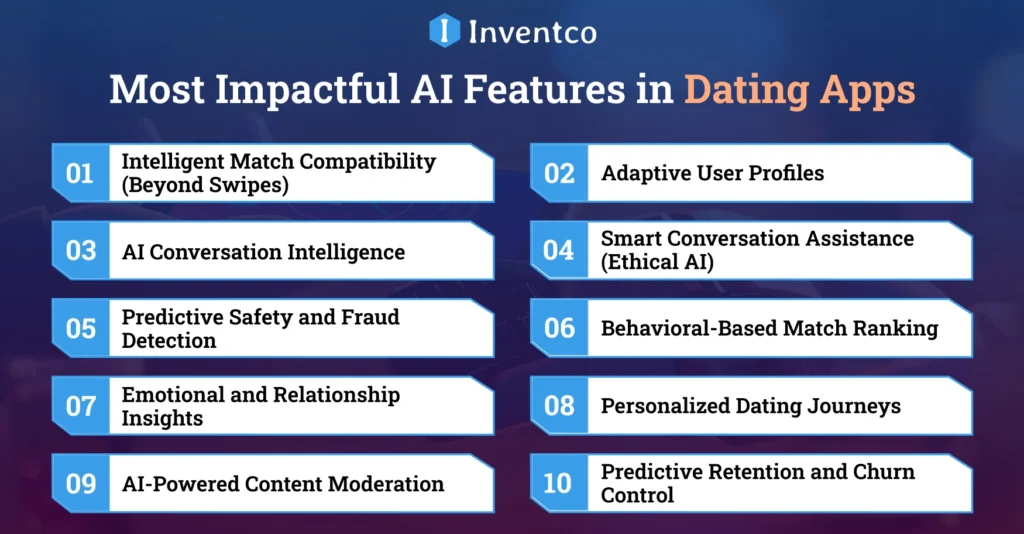
In 2026, AI-powered dating apps have transformed how people build digital relationships by prioritizing user compatibility and safety while also increasing user engagement. This evolution has shifted platforms from swipe-based discovery systems into intelligent ecosystems, where advanced app features support long-term, meaningful relationships.
1. Intelligent Match Compatibility (Beyond Swipes)
Use of AI in dating apps works to analyze user behavior, conversation styles, emotional responses, and interaction patterns instead of utilizing simplistic features such as user photographs and relationship preferences to obtain compatibility scores in hopes for better recommendations.
2. Adaptive User Profiles
By using engagement behaviors, communication styles, and interaction histories over time, user profiles can evolve rather than relying on user declarations, providing dating platforms with more accurate reflections of who their users are.
3. AI Conversation Intelligence
Using chat-based engagement, AI can assess chat quality, sentiment, engagement depth, and response balance to deliver high-quality interactions, identify promising conversations, reduce ghosting, and improve user satisfaction, while maintaining strong app security to protect sensitive conversations and user data.
4. Smart Conversation Assistance (Ethical AI)
By providing authentic communication, AI can offer conversation assistance such as icebreakers, intelligent response suggestions, and conversation topics, helping users communicate more freely.
5. Predictive Safety and Fraud Detection
The ongoing concern about user safety on dating apps has been a primary focus. Dating apps using AI have focused on strengthening user safety by designing algorithms to detect abusive users, profile pictures, fake profiles, and scams.
6. Behavioral-Based Match Ranking
Rather than focusing on popularity, AI considers facets such as mutual responsiveness, conversation quality, and intent alignment. This way, users are shown connections that are most likely to create positive interactions.
7. Emotional and Relationship Insights
AI helps users identify patterns in relationships and better navigate the dating landscape by providing insights on the fit of the communication, the emotional availability and conflict resolution style, and potential relational break points.
8. Personalized Dating Journeys
AI eliminates dating weariness by optimizing users’ journeys and enhancing their preferences through adjustments that match quotas, increase exposure to platform features, deliver tailored notifications, and prompt engagement to maximize retention.
9. AI-Powered Content Moderation
AI moderation that works in real time helps maintain compliance with app store regulations, protect the company’s reputation, and ensure user safety on the platform by monitoring chat content, language, images, and videos to prevent the escalation of risky behavior.
10. Predictive Retention and Churn Control
To safeguard sustained engagement and revenue, AI works in real time to identify and address issues that could lead to quick disengagement, including experience resets, pauses, or better matching, to reduce dating fatigue.
The future of dating applications lies with platforms that integrate advanced AI with human elements, as such a balance fosters trust and safety and enhances relationships.
What AI Changes at the Structural Level in Dating Apps?
Artificial intelligence (AI) affects dating applications in both positive and negative ways. AI may be viewed positively by consumers because it addresses contemporary concerns about trust, relevance, and ongoing engagement, and may also replace systems consumers view negatively.
Static Profiles → Adaptive Profiles
User profiles in dating applications increasingly involve more than fixed self-descriptive bios. Dating applications now incorporate user behavior, communication patterns, and engagement histories to help focus apps on potential matches and actual personality development over time.
Swiping → Intent-Based Discovery
Endless swiping is now seen as a negative in dating applications. Dating applications that employ AI can focus on relevance, emotional readiness, and compatibility. This enhanced positive approach helps reduce user frustration. AI allows users to engage in more meaningful relationships, rather than relationships based on overabundant matches.
Manual Moderation → Predictive Safety Systems
The negative user experience with apps that use reactive moderation is being replaced by predictive AI systems that recognize and prevent harm before it becomes an issue. This approach may assist with unsupervised user safety, value retention, and future regulation.
All of the above illustrate structural shifts in design, functionality, and user experience in modern dating applications.
How AI Raises New Ethical and Privacy Challenges in Dating Apps?
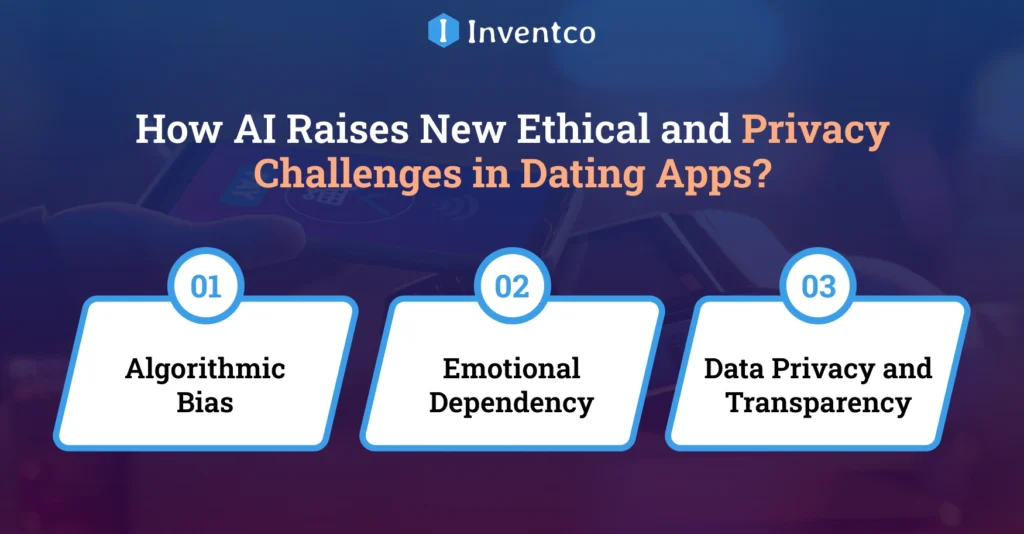
With the continued integration of AI into dating applications and the romantic friction it may cause, the potential ethical impacts of the technology will be central to the construction and governance of the applications. How AI is used will inform and shape user trust for many years to come.
1. Algorithmic Bias
AI systems function by utilizing historical data, which may reinforce social, cultural, and gender biases. Algorithms will always be biased unless corrective measures are in place. If the dataset used to train the system and correct biases has low diversity, marginalized populations may be ignored, and compatibility-based projections may be inaccurate and strained.
2. Emotional Dependency
The use of Artificial Intelligence systems to enhance communication, companionship, or other features may lead the user to become overly emotionally dependent on the system. There are important concerns over the use of AI systems and whether they would replace or support the agency of offensive and defensive human actions. There may also be concerns about the person’s emotional state, and reliance on dependent states may reduce emotional autonomy.
3. Data Privacy and Transparency
There are increased risks to data privacy as more AI systems are used on dating applications that process data, and the more sensitive the data is, the less the governing frameworks provide transparency, control, and ethical safeguards.
The continued evolution of dating applications depends on using AI to augment, rather than replace, human judgment and authentic social engagement, while carefully addressing emerging app development challenges related to ethics, bias, scalability, and user trust.
The Future of Dating Apps: A Timeline from 2025 to 2030
The future of dating apps will continue to unfold in phases, as AI use evolves from experimental features to foundational systems, building user trust, experience, and understanding of compatibility and long-term relationships.
2025 – 2026
The norm will be AI-assisted personalized matchmaking, smart moderation, and personalized user engagement. Dating apps will continue to rely on behavioral prediction, conversation analytics, and automated safety features to set new standards for user trust and relevance in contemporary dating applications.
2027 – 2028
The apps will analyze and predict users’ communication, emotional/ engagement alignment and level of interactions to worsen or improve relationship and compatibility predictions. These insights will increase user retention and improve the apps’ relationship-focused functionality, driving better interactions.
2029 – 2030
Apps will be new ecosystems with hybrid models of safe human and AI-assisted relationships. AI will adapt to the user’s decision, providing support while human control remains the final decision. These relationships will be scalable and trust based, with the complex emotional and social affordances of long-term relationships.
This acknowledgement of evolution showcases the increasing sophistication of dating apps. By harnessing AI, apps can create, strengthen, and scale user trust, sustainable connections, and meaningful relationships.
How Dating Apps Can Use AI Without Losing Human Connection?
Dating apps will always succeed because they hinge on users’ ability and need to create genuine connections. While AI can and will create efficiencies, the emotional, empathetic, and relational aspects of meaningful connections will always be driven by humans.
Increased understanding and more effective communication are two areas where AI can improve the dating app experience for users and reduce associated risks. With that said, the use of AI tools should always be to enhance communication, not to replace it.
Dating apps will be at their best when they use technology to enhance human relationships and not the other way around. The best apps will not try to replace human relationships using technology but use technology to improve human relationships.

Conclusion
The most successful dating apps are likely those that use artificial intelligence to understand user behavior and improve user safety and engagement throughout the dating process. As dating apps evolve from being solely discovery tools to functioning as relationship intelligence systems, the application of AI to understand user behavior, facilitate communication, and streamline the dating process will be highly significant.
A dating app’s success will depend on its ability to strike the right balance between smart automation and genuine human connection. In a world where ethical AI and data governance are at the forefront of new curriculum development, the dating apps that will outshine others will implement AI in a safe and responsible manner. The most successful apps will use AI to strengthen human communication and be active throughout the relationship cycle: initiation, enhancement, and extension.
FAQ’s
Q1. How does AI improve modern dating apps?
Ans. AI improves dating apps by analyzing behavior, communication patterns, and engagement signals to enhance compatibility, safety, and personalization, helping platforms support meaningful connections rather than relying solely on static profiles or swipe-based interactions.
Q2. Does AI in dating apps go beyond matchmaking?
Ans. AI in dating apps goes beyond matching by supporting conversation intelligence, predictive moderation, adaptive profiles, and retention insights, enabling healthier interactions, reduced ghosting, and long-term engagement rather than short-term activity metrics.
Q3. Why is data privacy important in AI-powered dating apps?
Ans. Privacy is critical because dating platforms handle sensitive personal data, conversations, and behavioral signals; ethical AI requires transparent governance, user consent, secure storage, and clear control over how information is collected, analyzed, and used.
Q4. How do predictive safety systems work in dating apps?
Ans. Predictive safety systems use AI to identify fraud, fake profiles, abusive behavior, and risk patterns early, enabling proactive moderation that protects users, supports compliance, and builds trust without relying on slow, reactive manual reviews.
Q5. What are adaptive profiles in AI-driven dating platforms?
Ans. Adaptive profiles change over time by learning from engagement, communication style, and behavior, allowing dating apps to reflect evolving preferences and personalities rather than fixed descriptions created during initial onboarding for better matching accuracy.
Q6. How does AI personalization reduce dating fatigue?
Ans. AI-powered personalization tailors match frequency, recommendations, notifications, and features to individual behavior, reducing dating fatigue and improving retention by delivering experiences aligned with user intent rather than generic engagement strategies used by traditional platforms.
Q7. What business benefits does AI bring to dating apps?
Ans. From a business perspective, AI supports scalability by improving retention, optimizing monetization, reducing moderation costs, and enabling data-driven decisions, helping dating apps achieve sustainable growth rather than depending on short-term acquisition spikes and volatility.
Q9. How can niche AI platforms differentiate from mainstream dating apps?
Ans. Niche platforms, including an app like Sniffies, can leverage AI to enhance location intelligence, behavioral insights, and community-specific moderation, enabling personalized experiences while maintaining safety, privacy, and contextual relevance within targeted user ecosystems.

Ajay Bhal
He is an on-demand app solutions expert with 11+ years of experience in business consulting and building scalable, user-centric digital products. He specializes in robust on-demand platforms across industries, combining technical expertise with business-focused strategy to deliver efficient, top notch solutions that drive growth and enhance user experience. You can connect with him on LinkedIn to follow insights.