In 2026, the fitness industry will be dominated by AI. The way consumers work out, recover, eat, sleep, and manage their mental well-being will be tailored by AI. Fitness and health AI solutions will produce hyper-personalized workout and recovery plans in real time, as well as offer coaching and health insights. AI will make modern wellness proactive and will personalize it with data.
As consumer expectations shift, stagnant platforms lose relevance. Fitness app development will be left behind without AI integration in the marketplace. Due to recent advancements in intelligent automation, the market has grown, and fitness app development has greatly improved. These advancements have compelled brands to develop beyond mere tracking. They are now creating AI-based ecosystems that are scalable and responsive to changes in user behavior and performance.
What might this mean for fitness and digital health in 2026? Why do innovative companies invest so heavily in AI-powered fitness apps to enhance user engagement and retention, and to achieve sustainable growth? Let’s find out.
Key Takeaways
- The fitness industry has changed by integrating predictive health intelligence rather than reactive tracking. Apps can predict injuries, offer recovery solutions, and improve overall wellness decisions.
- Hyper-personalized real-time data retention and revenue exceed static workout plans and generic fitness programs.
- In compliance, explainable AI, and privacy-first architectures shaping user adoption and brand credibility, trust is a competitive differentiator in 2026.
- Unlike traditional apps, AI fitness apps are more scalable, and have a greater lifetime value and engagement, so intelligence, not design, is the driving focus.
- The future of fitness technology is in preemptive, emotionally intelligent, autonomous AI that integrates systems of physically aligned, mentally healthy, and lifestyle adaptive ecosystems.
AI in the Fitness Industry: Market Opportunities Driving Business Growth
- The global fitness app market was valued at approximately USD 12.12 billion in 2025 and is projected to reach USD 33.58 billion by 2033, with a CAGR of ~13.4%, reflecting growing demand for digital and AI-powered fitness solutions, according to Grand View Research.
- In the U.S., the fitness app market was valued at approximately USD 4.10 billion in 2025 and is forecast to reach over USD 10.3 billion by 2033, driven by AI features and adaptive coaching.
- The broader digital health market, which includes AI-based fitness technologies, is forecast to grow significantly, with digital health services expected to climb from USD 266 billion in 2026 towards over USD 1 trillion by 2034.
What Is Artificial Intelligence in Fitness?
Artificial Intelligence (AI) refers to advanced technologies that operate with minimal human input and are guided by pre-programmed criteria. A good example of this is the Emergency Room AI, which captures, learns, and reports patterns to develop and implement strategies. In AI health and fitness, this aligns with real-time monitoring of biometric data, user behavior during workouts, and specific user preferences to deliver the most accurate, personalized recommendations.
State-of-the-art fitness applications leverage a wide range of AI technologies to deliver optimal solutions for customers. For example, machine learning (ML) is used to analyze customers’ workout histories and behaviors to optimize training plans. Posture detection, motion tracking, and performance analysis are all products of deep learning. Predictive analytics, which computer vision supports, is used to forecast fatigue and injury recovery and to provide real-time corrective action to recapture form.
All of these elements come together to support teams looking to create a fitness app that is responsive, secure, and intelligent. These AI-driven fitness applications are expected to be developed and launched in phases toward the end of 2026.
The Role of AI in Fitness App Development
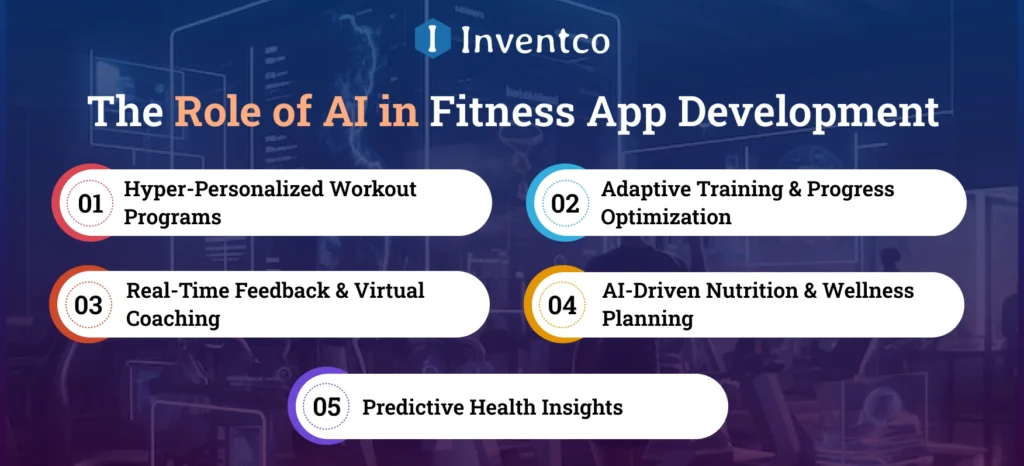
Fitness applications focus heavily on AI-driven development to deliver advanced usability, scalability, and adaptability. For example, in 2026, these factors will contribute to improving AI in fitness app development.
1. Hyper-Personalized Workout Programs
AI in fitness apps examines users’ fitness levels, goals, injury records, workout preferences, and real-time data, and adjusts or implements personalized workout plans to improve engagement, retention, and safety while boosting training results.
2. Adaptive Training & Progress Optimization
AI receives continuous updates on performance metrics and adjusts training regimen variables, such as intensity, volume, rest duration, and level of difficulty. This guarantees that training programs account for the user’s progress, recovery, and fitness goals evolves over time.
3. Real-Time Feedback & Virtual Coaching
Using wearables, motion detectors, and computer vision, AI fitness apps provide real-time feedback on posture, repetition counting, and coaching. This reduces the likelihood of injuries and enhances the accuracy and effectiveness of training.
4. AI-Driven Nutrition & Wellness Planning
AI fitness and health platforms extend their services beyond exercise. Users receive customized nutrition plans, meal plans, calorie tracking, and micro- and macronutrient calculations tailored to their goals, eating habits, dietary preferences, and wellness outcomes.
5. Predictive Health Insights
AI uses predictive analytics to identify early signs of fatigue, burnout, and declining health in the user and generates proactive recommendations to help prevent them. This allows for better training, recovery, and sustainable long-term fitness.
AI Fitness Trends Defining 2026
In 2026, innovations such as dependable AI technologies will redefine digital wellbeing by enhancing personalization, privacy, and user outcomes, setting the foundation for next-generation fitness app ideas driven by intelligent, user-centric design.
1. Generative AI Coaches
Generative AI coaches provide motivation, coaching, and guidance that are adaptable and conversational, delivered through real-time engagement and intelligent feedback. It improves accountability, coaching consistency, and individual workout improvement across multiple areas.
2. Multimodal AI
Multimodal AI analyzes voice, vision, motion, and biometrics to provide detailed insights in fitness environments. It enables real-time, contextual coaching, enhanced personalization, and improved recommendations to cover a wider range of health and fitness needs.
3. Mental Health Integration
Mental health services powered by AI integrate stress detection, sleep and mood tracking, mindfulness guidance, and mental health support into fitness apps. This fusion promotes holistic wellbeing, recovery balance, and sustainable performance beyond the confines of training.
4. On-Device AI Processing
On-device AI processing enables faster insights, reduced latency, improved reliability, and stronger data privacy by analyzing sensitive fitness information locally, minimizing cloud dependency while meeting compliance and trust expectations.
5. Explainable AI
Using AI explainable, fitness applications gain the trust of their users by offering transparent recommendations based on how the insight is created. This increases user and regulatory trust in the health-related fit-tech ecosystem.
The implementation of these AI trends enables fitness apps to become reliable health platforms that enhance global health systems with intelligent, individualized preventive health solutions.
What are the Benefits of AI in Fitness Apps?
The measurability of AI in fitness apps is where the real value lies, not in the app’s features alone. AI-enhanced fitness apps in 2026 will deliver smarter, more efficient experiences that boost output, engagement, and profitability for the business.
1. Personalization at Scale
AI enables people to receive individualized experiences. The fitness apps can provide individualized digital workout experiences by evaluating user engagement, behavior, fitness level, goals and real-time data of the users and making sure each user has a relevant, adjustable, and goal aligned digital training experience.
2. Efficiency & Time Optimization
Using AI, participants can be guided through workouts without filling out any information or making any guesses. AI will do this by providing users with smart recommendations and analyzing performance.
3. Higher Engagement & Motivation
Users are kept engaged with the app through visual progress tracking and AI nudges that motivate them to stay engaged and continue using the app.
4. Data-Driven Decision Making
The AI in fitness apps provides actionable data to help companies improve product enhancements, user personalization, and strategic growth, with a focus on user retention and mobile app features development.
Business Impact of AI Fitness Apps in 2026
By 2026, AI’s impact in the fitness industry will have changed from personalizing individual user workouts to assisting companies in achieving specific business goals. Firms are reporting better customer retention, lifetime value, and monetizing fitness services previously deemed unprofitable with the help of AI powered fitness apps.
1. Higher User Retention & Engagement
AI-powered fitness apps can personalize experiences based on user actions, performance, and goals. In machine learning, user retention occurs when apps adapt to user behavior, leading to lower churn and increased usage. Given the considerable competition in the fitness app market, retention is many times more valuable compared to user acquisition. In this regard, AI-powered retention tools are exceptional.
2. Premium Monetization Opportunities
Artificial Intelligence features, such as real time coaching and personalized meal suggestions, can increase the value of fitness apps. This allows fitness companies to create premium subscription models, which include AI features. As a result, these premium tiers substantially increase a fitness app’s average revenue per user (ARPU).
3. Data-Driven Product Optimization
The large volumes of end user data generated from fitness applications are transformed by AI into actionable business intelligence. AI provides insights into user retention and feature utilization to answer performance-related questions about the app. It is anticipated that by 2026, fitness brands that do not utilize AI will be outperformed by competitors that provide more advanced applications.
4. Scalable Personal Training at Lower Cost
From a scaling perspective, hiring human trainers is a poor choice. Thanks to AI, fitness platforms can now provide expert guidance from virtual coaches to thousands, or even millions, of users simultaneously, reducing operational costs while maintaining coaching quality.
5. Improved Brand Trust & Market Positioning
AI health and fitness platforms earn greater user trust through compliance, built-in explainable AI, and transparency into user data. Given that trust is earned by health and fitness platforms where privacy is an issue, it is of great value and leads to improved brand loyalty and increased financial growth.
6. Competitive Differentiation in Saturated Markets
The fitness app marketplace is saturated with competitors. Differentiation is founded on the ability to personalize, incorporate AI for predictive analytics, and provide holistic wellness. It is projected that in 2026, the primary point of differentiation separating superior applications from average applications will be the level of intelligence embedded in the application, rather than its design.
Challenges in the Fitness Industry Solved by AI
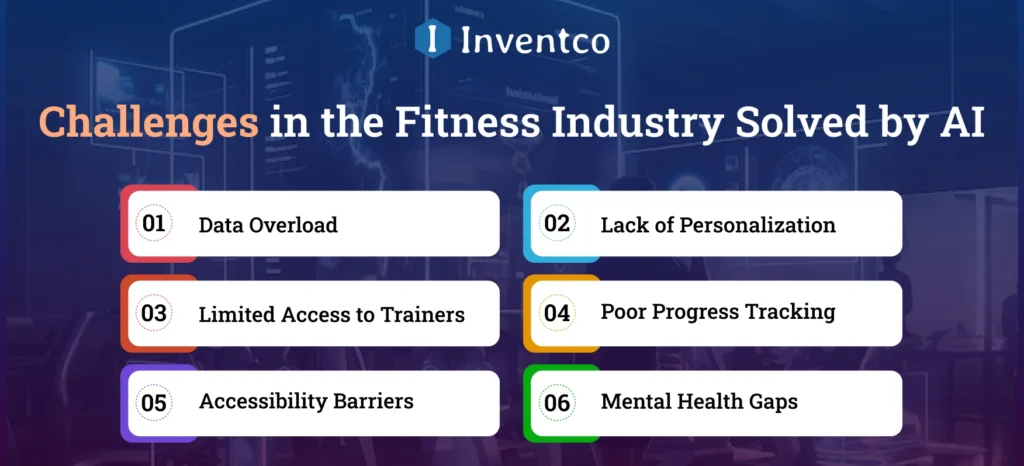
AI applications in the fitness sector are limited by fragmented datasets, standardized user experiences, and accessibility issues. However, these app development challenges can be addressed in the future by the industry, using AI to deliver intelligent, inclusive, and outcome-focused experiences for all stakeholders.
1. Data Overload
AI can answer the questions that users and businesses need to reach their goals. It equips users with answers by analyzing their activity, biomarkers, and behavior, and ascertains their performance. These answers are actionable, time effective, and focused.
2. Lack of Personalization
AI creates individualized training plans for users that take into account their goals, skill levels, injuries, training preferences, and performance metrics. Using this data, AI fitness programs enhance user engagement and retention by eliminating “one-size-fits-all” programs.
3. Limited Access to Trainers
AI-enabled virtual fitness coaching is not constrained by geography, cost, or trainer availability. Users of any skill level receive coaching that adjusts in real time and scales to any number of users. AI also trains users, providing the motivational reinforcement that many human trainers cannot.
4. Poor Progress Tracking
AI fosters long-term user engagement by helping users track their progress. Advanced dashboards allow users to visualize and understand their performance trends, strength gains, recovery cycles, and milestones, keeping them motivated.
5. Accessibility Barriers
AI enables the safest, most adaptive fitness experiences by leveraging diverse technologies to eliminate fitness barriers. AI workouts and fitness experiences empower users to participate comfortably and confidently.
6. Mental Health Gaps
Stress, sleep, mindfulness, and fitness applications provide recovery and emotional support, balanced by AI, helping overcome the mental health gaps in today’s lifestyles.
Artificial intelligence-enabled fitness apps adapt to user behaviors, achievements, and preferences. Based on machine-learning predictions of user actions, fitness apps improve user engagement and retention and help manage churn. Given the competition in fitness apps, retention becomes significantly more important than user acquisition, positioning AI retention management uniquely.
The Future of AI in the Fitness Industry
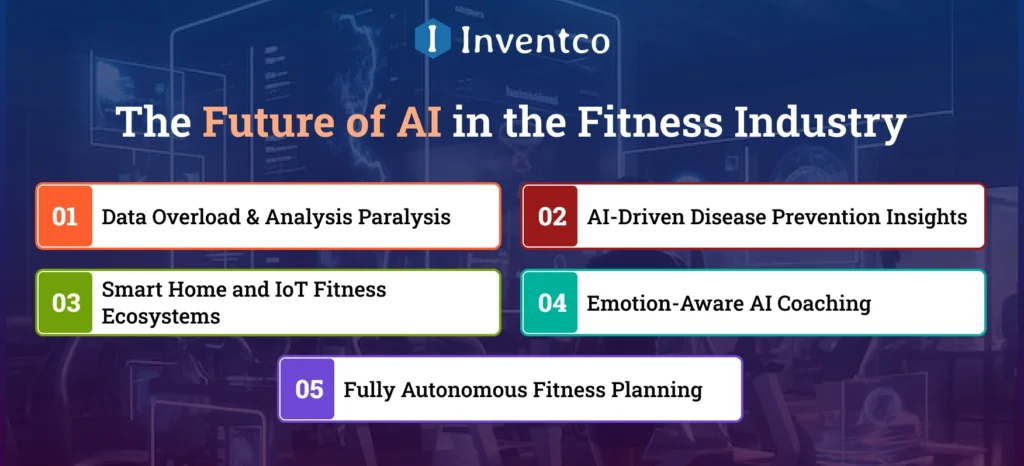
AI will most likely keep growing at health clubs, concentrating on predictive intelligence, preventive health, personalization, and innovation for developing digital health ecosystems.
1. Injury Prediction and Recovery Optimization
AI can help predict injuries and optimize recovery by analyzing movement strategies, training intensity, exhaustion, and biometric information. In this way, highly proactive adjustments can be made to workouts through safer alternatives and that means less downtime while more evidence-based fitness progress outcomes are demonstrated.
2. AI-Driven Disease Prevention Insights
By analyzing individual activity patterns, lifestyle data, and vitals, AI apps will be able to identify health risks and record changes. This will help in providing fitness recommendations aimed to reduce user health risks. Recommendations to modify habits to improve health, along with changes in monitored health variables reinforce behavioral changes for the better.
3. Smart Home and IoT Fitness Ecosystems
AI will be the bridge for fitness apps and IoT ecosystems, including smart home systems. AI will merge wearables with health sensors to automate and personalize workouts and recovery, and to monitor health smartly. Users will enjoy uninterrupted context-based experiences in integrated smart home systems.
4. Emotion-Aware AI Coaching
Adaptive coaching uses AI voice, facial expression, and behavioral signal analysis that changes based on user motivation, voice, and behavioral cues. An emotionally responsive AI that adapts during training will enhance mental resilience, relieve stress, and improve user focus.
5. Fully Autonomous Fitness Planning
AI fitness planning that fully autonomously creates, adjusts, and oversees training, recovery, and nutrition plans will be based on real-time data. Goal-oriented continuous optimization will be achieved with minimal user input and consistent improvement over time.
These developments enhance AI fitness tools as dependable health companions for safer training, proactive health management, and sustainable wellbeing on a global scale.

Conclusion
Artificial intelligence has transformed fitness from a mundane routine to a smart, personalized, and adaptive experience. AI fitness solutions go beyond customized workouts and adaptive virtual coaching to predicting and managing health trends and wellness. AI fitness now revolutionizes how people train and live a healthy lifestyle.
For businesses, investing in AI fitness applications is now a matter of survival and sustained growth as the world becomes more data-driven. The fitness industry is ready to lead the way into the future as AI technology advances toward a healthy, interconnected world.
FAQ’s
Q1. What is AI in the fitness industry?
Ans. AI in the fitness industry uses machine learning, analytics, and automation to personalize workouts, track performance, predict health risks, and deliver intelligent, data driven wellness experiences for users and fitness businesses.
Q2. How does AI improve fitness apps?
Ans. AI improves fitness apps by enabling real time personalization, adaptive training, form correction, predictive insights, automation, and smarter engagement strategies that increase retention, safety, effectiveness, and overall user satisfaction significantly.
Q3. What are the key benefits of AI in fitness apps?
Ans. AI fitness apps deliver personalization at scale, improved efficiency, higher motivation, better progress tracking, mental wellness support, and actionable insights that simultaneously enhance user outcomes and business performance.
Q4. What AI fitness trends are shaping 2026?
Ans. Key AI fitness trends include generative AI coaches, multimodal data processing, mental health integration, on device AI, explainable AI systems, and fully autonomous fitness planning for smarter wellness ecosystems.
Q5. How much does a fitness AI app cost?
Ans. In 2026, fitness AI app development typically costs between $45,000 and $100,000, plus, depending on AI complexity, features, platforms, integrations, compliance requirements, and long-term scalability needs.
Q6. What factors influence fitness AI app development cost?
Ans. Cost is influenced by AI model selection, feature scope, wearable integrations, real-time processing, platform choice, data security compliance, UI/UX complexity, and ongoing app maintenance and optimization requirements.
Q7. How does AI address challenges in the fitness industry?
Ans. AI solves challenges by converting data into insights, enabling personalization, democratizing coaching, improving progress tracking, enhancing accessibility, and supporting mental health alongside physical fitness goals.
Q8. What compliances are required for AI fitness apps?
Ans. AI fitness apps must follow GDPR, HIPAA, PCI DSS, ISO 27001, WCAG accessibility standards, and FDA or MDR regulations when medical grade AI features are involved.
Q9. What makes the best AI fitness app in 2026?
Ans. The best AI fitness apps combine intelligent personalization, real time feedback, wearable integration, transparent AI recommendations, strong data privacy, and balanced physical and mental wellness support.
Q10. What is the future of AI in the fitness industry?
Ans. The future of AI in fitness focuses on predictive health insights, injury prevention, emotion aware coaching, smart IoT ecosystems, autonomous fitness planning, and long term lifestyle optimization at scale.

Jitendra Jain
He is the CEO and Co-founder of Inventco, driving innovation in advanced computing and digital transformation. With deep expertise in modern IT ecosystems, he leads scalable, secure, future-ready solutions. His strategic leadership helps businesses accelerate growth, adopt innovation, and achieve success. You can connect with him on LinkedIn to follow his technology insights.