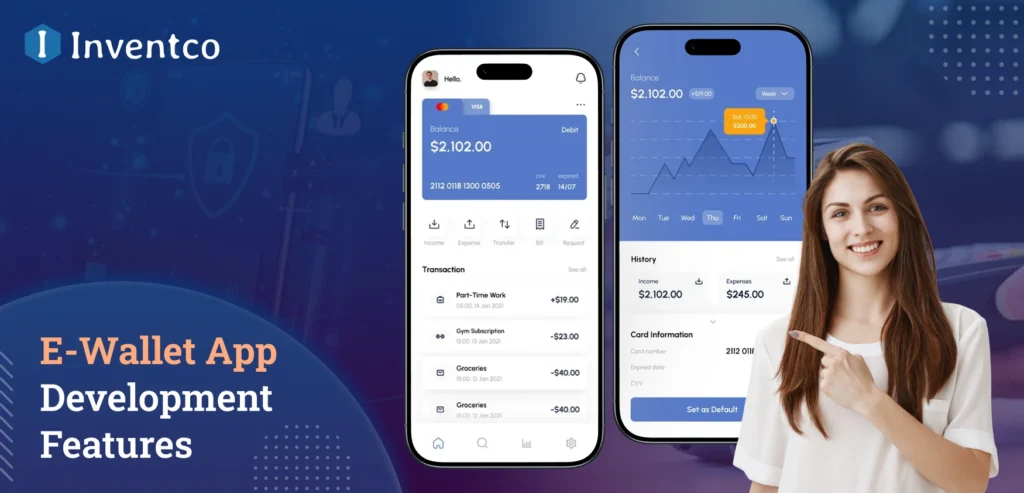
Digital Commerce is now an important part of business. Digital commerce makes each brand interaction feel either safe, trustworthy, or brand-damaging with each tap, scan, or peer-to-peer transfer. Businesses need to focus on the design, flow, and security of their payment apps to stand out from the competition and keep their customers satisfied.
A thriving e-wallet app cannot be overlooked in today’s market. According to the Global Fintech report, digital wallets handle millions of transactions every year. In today’s economy, developing e-wallet apps is critical because security, compliance, and system reliability significantly affect customer adoption, retention, and reputation.
This guide is created for founders, CTOs, and product leaders who want to make informed decisions about eWallet app development partners. The focus is on the best indicators of success in 2026: technical depth, regulatory readiness, and user-centric execution. This way, you can select a team that prioritizes sustainable growth over rapid delivery.
What is eWallet App Development?
Designing, developing, and potentially providing long-term support of the application are all part of the eWallet app development life cycle. This cycle encompasses the eWallet’s ability to help users manage and secure their financial transactions and mobile payments. Integration of features such as bill payment, loyalty cards, remittance services, person-to-person payments, and QR code or NFC transactions is part of the mobile app development process.
The futuristic eWallets of 2026 will, among other things, operate on real-time payment systems, integrate seamlessly with other systems, and maintain strict regulatory compliance. To protect customer information, we will implement strong authentication, data encryption, and secure data handling. Without disrupting legitimate transactions, the sophisticated user experience will include systems to identify and prevent illegal activities from the banking and financial services industry.
Market Snapshot: Why This Matters Right Now
Digital wallets are not just tech trends, they are an important part of the global payment ecosystem. Current market signals underscore that choosing the right development partner in 2026 requires deep technical and regulatory expertise, not merely surface-level execution.
- The global mobile wallet market is projected to reach USD 317.12 billion in 2026, reflecting strong growth in digital payments worldwide.
- More than 5.3 billion people are expected to use digital wallets by 2026, representing over half of the global population.
Key Factors to Evaluate Before Choosing an eWallet App Development Company
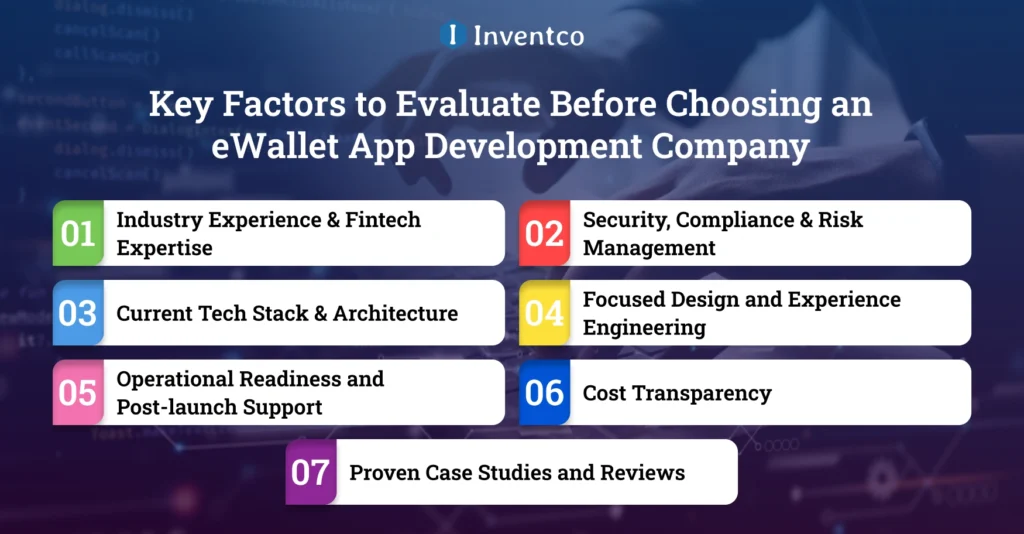
When selecting an eWallet development partner in 2026, it’s less about coding abilities and more about proven experience in fintech, regulatory intelligence, scalable architecture, and sustained operational accountability.
1. Industry Experience & Fintech Expertise
By 2026, fintech experience will no longer be optional and will be fundamental to eWallet development. Ewallet app development companies need to demonstrate the ability to build production-grade, working digital wallets (not just working prototypes). Building digital wallets does not equate to building eWallet development companies. eWallet development companies should have experience building digital wallets to understand the complexities of the eWallet development process. This understanding enables anticipation of complexities and challenges related to scalability, compliance, and fraud.
2. Security, Compliance & Risk Management
Securing eWallet platforms is the primary expectation, with a focus on full compliance with PCI DSS, GDPR, KYC, and AML. This means having real-time fraud detection, tokenization, encrypted storage, and key secure management. Expect eWallet app development companies to maintain continuous compliance and support in the evolving regulatory environment.
3. Current Tech Stack & Architecture
All aspects of an app, including performance, scalability, and future readiness, are determined by the technology stack. Beyond tools like Flutter and React Native, top eWallet app development teams implement cloud-native, API-first, event-driven architectures that enable seamless integration and high, reliable performance for transaction processing without lag. It also enables faster updates to new features. New features can also be integrated faster.
4. Focused Design and Experience Engineering
Among digital payments, the eWallet user experience is a major differentiator. A good eWallet app development company invests in user experience, usability, and frictionless testing design flows. Frictionless design flows include steps for transactions, and clear and intuitive navigation during sensitive actions like payments and KYC, and substantially improve long-term loyalty, retention and trust.
5. Operational Readiness and Post-launch Support
After eWallet app development, a good app partner stays involved well after development. Competitiveness requires post-launch support, security updates, ongoing performance monitoring, and enhancements to the eWallet app’s features. Ensure the company provides clear SLAs for the platform’s long-term maintenance, response times, and uptime.
6. Cost Transparency
Cost transparency is essential for any budgetary calculations in 2026. An honest eWallet app development company will break down its costs for you, covering design, backend development, security layers, third-party APIs, mobile app testing, post-launch support, and app maintenance costs. Timelines and deliverables are crucial in avoiding scope creep and resolving unforeseen expenditures.
7. Proven Case Studies and Reviews
In fintech, reputation is everything. Established eWallet app development companies are proud to make their verified client reviews, case studies, and actual results available to the public. Reviews from platforms like Clutch and GoodFirms detail how the company performs in areas like disbursement, communication, and commitment, which are essential for success in any project.
Why Choosing the Right eWallet App Development Partner Matters in 2026?
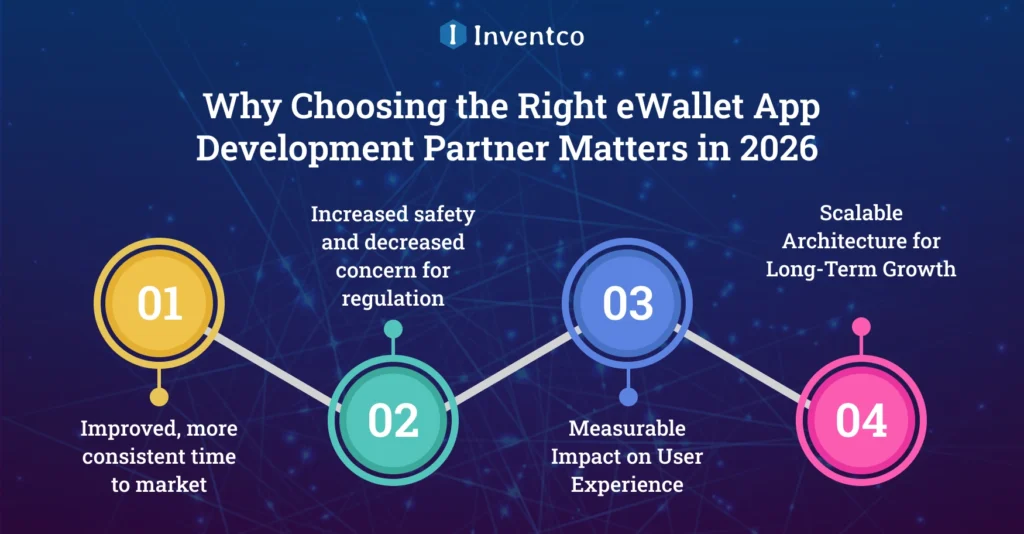
Now, choosing an eWallet app development partner is more tactical than technical. Whether you’re working with eWallet app developers in the USA or anywhere in the world, choosing the right developers will deliver top speed, security, user trust, and long-term viability for your platform.
1. Improved, more consistent time to market
In 2026, speed is measured by predictability, not haste. An eWallet app development partner will likely have more industry experience which will help facilitate the construction of new business models more reliably and develop the next set of digital payment ecosystems faster.
2. Increased safety and decreased concern for regulation
No matter where you are, digital wallets operate in a high-risk environment. An eWallet app development partner will have greater industry experience, which will help build new business models and develop the next generation of digital payment ecosystems more quickly and consistently.
3. Measurable Impact on User Experience
User experience affects wallet adoption and retention. Frictionless onboarding, authentication, and payment flows are the focus of skilled eWallet app developers. Streamlined navigation, quick, easy transactions, and fast responses drive high user engagement, lower drop-off rates, and stronger retention. In contrast, negative user experience drives uninstall rates, even with a full feature set.
4. Scalable Architecture for Long-Term Growth
The best development partners design for tomorrow’s scale, not today’s traffic. eWallets built for the future can handle more transactions, new payment rails, and cross-border activities without requiring a rewrite. This design approach minimizes future ewallet app development costs, resolves performance bottlenecks, and ensures your wallet grows with the market rather than being limited by outdated design choices.
Questions to Ask Before Hiring an eWallet App Development Company (2026)
Finding the right partner means striking the right balance between depth of technical knowledge, regulatory maturity, and operational accountability. Consider the following checklist to assess potential eWallet app developers and avoid expensive pitfalls in the future.
- Could you show us case studies of eWallet, fintech, or crypto applications, particularly production-grade case studies, which include examples of architecture and outcomes that can be measured?
- How do you maintain and adjust compliance with PCI DSS, GDPR, and KYC/AML, and monitor each separately by region?
- What protective measures (such as tokenization, key management, fraud detection and audit logging) have you built into your architecture?
- Which technologies, frameworks, and cloud services do you adopt, and how do these assist with high scalability and high transaction throughput?
- How do you manage the integration of third parties, including banks, payment gateways, identity providers, and regulatory services?
- What does your process look like from development to production release?
- Do you offer post-launch mobile app maintenance, support, and app security updates, and do you do so under defined SLAs?
- Could you break down the development costs of the eWallet app clearly, and include operational and maintenance costs which are ongoing?
- What collaboration models, communication tools, and reporting cadence do you have during development?
- How do you manage availability, time zone alignment, and the escalation of critical production issues during an emergency?
- Do you do end-to-end development in-house, or do you outsource some components?
The questions assess not just the technical expertise but also if the organization will be able to sustain a secure, scalable, and compliant eWallet platform from a long-term perspective.
Case Study: Escrow Mobile Application Built by Inventco
A premium digital marketplace needed an escrow-based payment system to protect the transactions between buyers and sellers. The marketplace needed to manage and resolve payment disputes, hold funds, and release payments based on preset instructions. Also, the system must support multiple currencies and regulatory frameworks. Given the financial and legal ramifications of escrow failure, the trust, auditability, and transparency of transactions were crucial.
Core Challenge
The key challenge was to build an escrow system that achieved regulatory clearance, financial security, and user understanding at scale. The solution also had to provide real-time fund holds, release funds conditionally based on transaction activity, and maintain a fully auditable record of every fund movement. More importantly, the system had to provide clear user threads to minimize and deter disputes while eliminating the risk of introducing friction or confusion during climactic transactions.
Inventco’s Strategic Approach
Inventco built the marketplace using a microservices architecture and an escrow ledger that is separate from the core transaction services. This separation facilitated precise reconciliation and fault isolation while ensuring financial integrity. HSM-backed key management secured the settlement keys. Also, an event-driven workflow managed fund release logic whereby disputes, confirmations, and time-based conditions triggered control actions without manual overriding.
Security, Compliance & Risk Controls
Integrated compliance is built into our system’s architecture rather than as an afterthought. The application employs PCI-DSS compliant card tokenization, KYC/AML verification, and audit logs for every escrow event. Access controls, coupled with operational, legal, and support roles, ensured that each team accessed only data pertinent to their roles, thereby streamlining regulatory reviews and internal audits.
Experience-Led Design & Integrations
From the user’s perspective, escrow interactions are simple, guided actions with backend systems that include payment gateway integrations, FX engines for currency settlement, and real-time reconciliations. Marketplace operators have complete visibility to escrow status and funds movement.
Measurable Outcomes
There is full traceability and an audit trail for regulatory compliance on holds and the conditional release of escrow.
The structured flow of evidence and automated logic on release resulted in faster dispute resolution.
There was a reduction in audit manual effort due to greater compliance certainty and an improved view of reporting and reconciliation for operational and legal teams.
How Inventco can help you in Building an E-Wallet App?
Inventco is a leading mobile app development company that has earned respect for the secure, scalable, and, most importantly, real-world-applicable fintech and digital payment solutions it provides. Inventco excels at developing platforms beyond standard coding to meet strict regulatory standards, manage high transaction volumes, and remain audit-ready on day one.
Custom solutions will always be constructed in alignment with and embedded within the company’s foundational vault of “Security and Reliability,” which includes a PCI DSS-aligned framework and KYC/AML Constant Risk Monitoring. Inventco engineers cloud-based systems that are responsive and scalable to support increasing user base, complex transactions, and diverse market expansion. These systems are designed to withstand all three tests, and the company will be with you.
The company will be with you for many years, providing the stated transparency and communication needed to support customers in a post-launch environment, focused on building a strategic partnership that will deliver sustained growth in the years to come.
Conclusion
The development of an eWallet solution involves many partners to trust, which results in a a level of risk from an operational, regulatory, and user perspective. Assuming user trust will be a reality in 2026, partners will need to understand the complexities of regulation, build trust in a digital, and understand user behavior. The right partner will shorten the time to market, and help avoid operational, legal, and regulatory risks in the future. Evaluating experience, regulatory compliance, development depth, and focus on the future will provide organizations the confidence to provide digital wallets that will be consistently updated to the ever-changing world of digital payments.
FAQ’s
Q1. How long does it take to develop an eWallet app?
Ans. Development timelines typically range from 4 to 8 months, depending on features, compliance scope, integrations, security layers, and whether the app targets single or multiple regions.
Q2. What security standards should an eWallet app follow?
Ans. A secure eWallet must comply with PCI-DSS, KYC/AML, GDPR, use encryption, tokenization, secure key management, and real-time fraud monitoring to protect transactions and user data.
Q3. How much does eWallet app development cost in 2026?
Ans. Costs vary based on security requirements, compliance regions, integrations, scalability needs, and post-launch support, typically increasing with advanced fraud detection and multi-currency capabilities. The average cost to build an e-wallet app can range from $ 10,000 to $100,000+.
Q4. Why is post-launch support important for eWallet apps?
Ans. Post-launch support ensures performance optimization, security updates, regulatory compliance changes, bug fixes, and feature enhancements—critical for maintaining trust and preventing operational or legal risks.
Q5. Can an eWallet app scale globally after launch?
Ans. Yes, if built with cloud-native architecture, modular compliance, and API-first integrations, an eWallet can scale across regions, currencies, and payment systems without major rework.
Q6. What makes an eWallet app user-friendly?
Ans. Simple onboarding, minimal transaction steps, clear payment status, fast authentication, and transparent dispute handling improve usability, trust, and long-term user retention.

Jitendra Jain
He is the CEO and Co-founder of Inventco, driving innovation in advanced computing and digital transformation. With deep expertise in modern IT ecosystems, he leads scalable, secure, future-ready solutions. His strategic leadership helps businesses accelerate growth, adopt innovation, and achieve success. You can connect with him on LinkedIn to follow his technology insights.