Chatbots have evolved from basic scripted-response systems to intelligent conversational systems for enterprise-grade applications and are capable of advanced artificial intelligence (AI), machine learning, and natural language processing (NLP) technologies. By the year 2026, businesses will have developed conversational chatbots for customer engagement, operational efficiency, and revenue driving improvements – beyond simply automation.
Modern-day AI chatbots help digitally transform businesses through personalized product suggestions, automated lead qualification, and support at all levels. This trend has resulted in the global chatbot market climbing to an estimated USD 10-11 billion by 2026 and an estimated USD 60 billion for the conversational AI market by 2032 with over 22% CAGR growth. Businesses evaluating solutions often compare the top AI chatbots available in the market before making strategic decisions.
Choosing the right chatbot is about more than technology. It is about business goals, growth strategies, user intents, and other factors. This article discusses the different types of chatbots and helps you select the right one for your business.
Key Takeaways
- In 2026, Chatbots are expected to help businesses with customer engagement, automation, revenue growth, and operational efficiency.
- The global chatbot industry is estimated to exceed USD 10-11 billion by 2026 with conversational AI expected to exceed USD 60 billion by 2032. This indicates great long-term adoption.
- There are various types of chatbots including: rule-based, AI-powered, voice BOTs, and menu BOTs. Each serves different types of business needs and operational objectives.
- Compared to rule-based BOTs, AI-powered chatbots can offer advanced personalization, continuous learning, and automation.
- Chatbots help businesses by improving operational efficiency and lead generation, and reducing costs, while providing 24/7 availability.
- When selecting chatbots, it is important to assess business objectives and data, integration availability, and long-term scalability.
- In highly competitive digital marketplaces, thoughtfully integrated chatbots can dramatically improve customer satisfaction and productivity.
AI Chatbot Market Statistics
- The global conversational AI market reached USD 11.58 billion in 2024, according to Grand View Research, with a projected CAGR of 23.7% for 2024 to 2030.
- The same report estimates over USD 41.39 billion in 2030, driven by enterprise demand for automation.
- Coherent Market Research estimates that adoption in all industries and the global chatbot market will reach USD 47.3 billion by 2032.
Before exploring chatbot categories, it’s important to understand what is AI chatbot technology is and how it differs from traditional automated systems.
What are Chatbots?
A chatbot is a software application that mimics human conversation by interacting with users and answering their queries with appropriate responses. Nowadays, businesses commonly use them on their website, mobile apps, and social media accounts.
These computer programs are used to perform a wide range of tasks, such as software navigation, customer support, personal assistance, product recommendations, and more. There are different types of chatbots, each one having its own working style.
Unlike human customer representatives, they can manage multiple interactions simultaneously, 24 hours a day, 7 days a week. The advanced versions work by analysing user data and preferences to give personalized responses.
Why Are Chatbots Important in Modern Businesses?
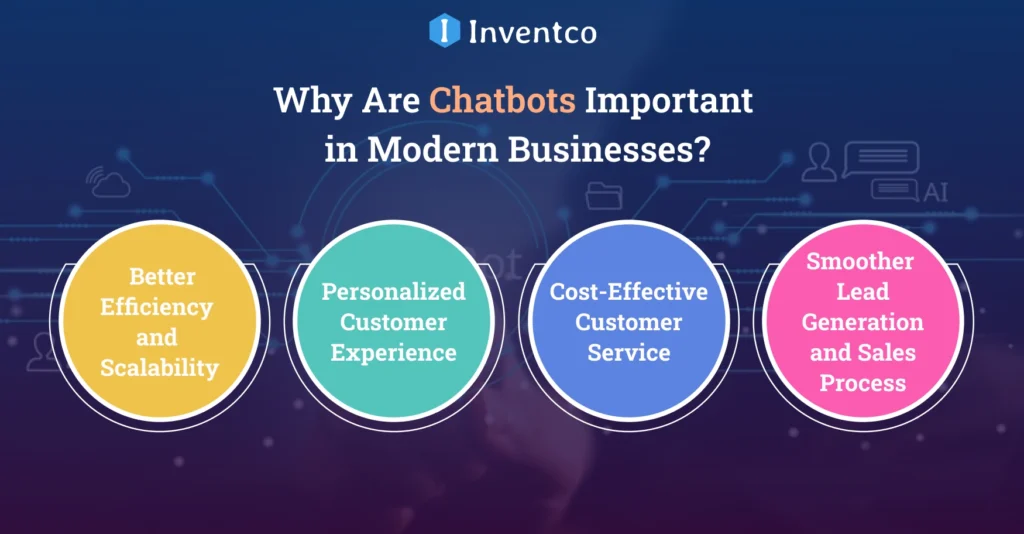
Chatbots have become an important tool for modern businesses seeking to deliver a better user experience and drive overall growth. Following proven best practices for chatbot development ensures higher performance, improved response accuracy, and long-term operational efficiency. Have a look at the reasons why opting for chatbot development services is a good investment in 2026.
1. Better Efficiency and Scalability
A common issue faced by companies is scaling customer support during peak hours. However, the software developed using best practices for chatbot development can handle multiple queries simultaneously.
It is something that human agents can’t do, and it often creates trouble for companies. Their availability ensures basic queries can be handled conveniently, while humans can manage complex tasks.
2. Personalized Customer Experience
The biggest advantage of modern AI chatbots is their ability to analyze customer behavior and give personalized interactions. For example, a customer has visited a travel website frequently for search purposes.
In that case, the chatbot will make personalized recommendations for tour plans that that particular customer often searches for. This personalized interaction won’t only ensure better engagement but also build brand loyalty.
3. Cost-Effective Customer Service
Training customer representatives is costly, but chatbot app development services help companies reduce this cost without compromising quality. These automated tools can perform a variety of tasks that minimize the workload for real representatives.
4. Smoother Lead Generation and Sales Process
There are many types of AI chatbots whose capabilities aren’t limited to answering questions; they can even work as sales assistants. They engage visitors in interactive conversations, gather customer information, and guide them until checkout.
Different Types of Chatbots with Examples
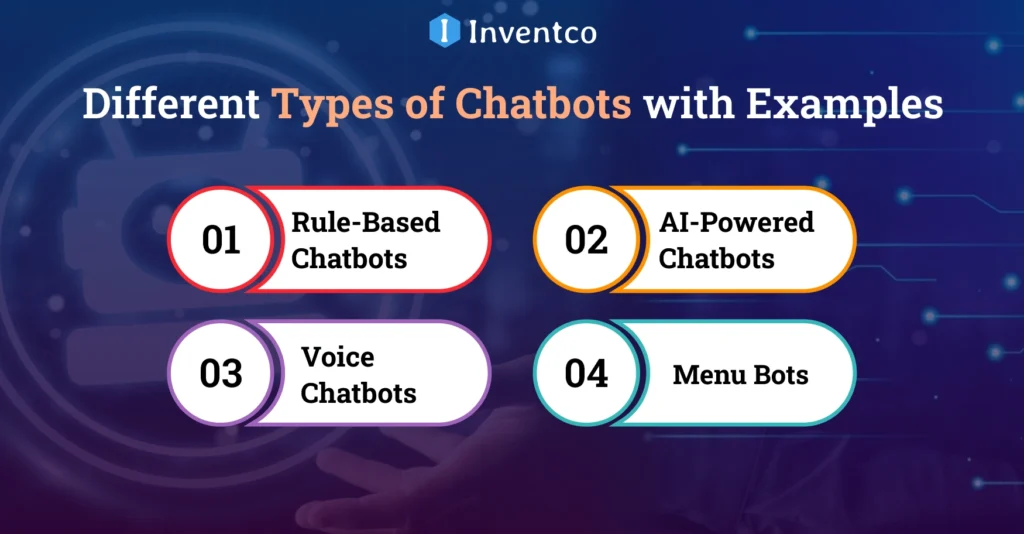
Chatbots perform a variety of tasks, ranging from making bookings to handling conventional interactions and facilitating purchases. Let’s explore various types of chatbots to find what is best for your business!
1. Rule-Based Chatbots
These chatbots operate according to a set of predefined rules and respond to specific commands or queries. They provide consistent customer service with predictable responses, ensuring highly reliable answers to common questions.
Example: If a customer asks for the best travel destinations in India, the chatbot will respond with the places the developer sets. The chatbot will follow the rule completely and respond with a particular answer.
Perfect Fit For: These chatbots are the best choice for small companies with specific goals who don’t want to offer personalized experiences.
2. AI-Powered Chatbots
These programs leverage natural language processing and machine learning to understand user queries and provide personalized responses. The biggest advantage of AI-powered chatbots is their continuous learning from interactions, which yields improved responses each time. If you’re thinking about adding this kind of chatbot to your website, it’s a good idea to first get familiar with the chatbot development process. It’ll help you make smarter choices and set things up correctly.
Example: A notable AI-powered chatbot is ChatGPT, which can perform a variety of functions, such as text-to-image prompting, voice conversations, and data analysis.
Perfect Fit For: Businesses that want to automate customer support and ensure interactive customer experience.
3. Voice Chatbots
Chatbots that interact with users using spoken language are included in this category. Voice chatbots are known for providing hands-free experiences and enabling voice recognition. Companies can provide their customers with a natural, intuitive user experience with these types of AI chatbots.
Example: Google Assistant, Alexa, Siri, and ChatGPT-4o.
Perfect Fit For: Industries including healthcare, finance, and e-commerce, as they simplify the tasks that generally need human agents.
4. Menu Bots
These are the simplest types of chatbots that present a list of options when they receive a user query. They can choose an option from the list to proceed with the conversation and access more information. Although it is a great option for getting started, response limitations can affect the user experience.
Example: The chatbots we found in restaurants like Domino’s and McDonald’s for menu selection fall under this category.
Perfect Fit For: Restaurants to place orders and make reservations.
How to Choose the Right Type of Chatbot for Your Business?
Selecting the right chatbot for your business requires careful consideration to ensure it aligns with the company’s functional requirements and customer goals. Key factors like chatbot development cost, required features, and integration capabilities should be carefully evaluated when choosing the right chatbot app development company in the USA. When selecting a chatbot, it is equally important to anticipate potential implementation challenges, including integration complexity, data security, and scalability limitations.
1. Defining Goals
The market has chatbots for almost every type of task, ranging from marketing to sales and customer service. So, the very first thing to do is identify what kind of goals you want to accomplish with the chatbot.
For example, if you want to make customer service efficient by automating customer interaction, an AI-powered chatbot will be a great choice. On the other hand, if you want to automate repetitive queries, a rule-based option might be a good choice.
2. Data Access
When selecting chatbots, businesses need to consider the kind of data your company has. If you want a chatbot to perform well, it is important for them to understand your company’s policies and service portfolio.
The selection of this tool depends on the amount of data available in your company. For instance, an online clothing store won’t need to handle as much data as an airline company running hundreds of flights daily. A rule-based chatbot might work for an online store, but it won’t be sufficient for an airline group.
3. Integration with the Present System
Understanding the level of customization needed to integrate the chatbot into your present system is very important. Evaluate the compatibility and integration capabilities with systems like CRM, helpdesk, and messaging before selecting a chatbot.
Take the help of a professional AI chatbot development company to find which type will suit your system. It is important to ensure that the integration should be properly streamlined.
Case Study: Pocket Chef – AI-Powered Recipe & OCR Platform
Inventco built Pocket Chef employing a structured, enterprise-grade product development technique with a focus on scalability, intelligent automation, and seamless system architecture. The Pocket Chef platform combines AI driven recipe generation and integrated Optical Character Recognition (OCR) technology which allows users to scan and submit ingredients for AI driven personalized meal suggestions.
In addition, the solution includes a comprehensive backend administration panel that integrates with content management systems (CMS) and other analytics (Big Data) solutions, providing a single point of operational control and performance analysis. The major challenge in development was to achieve OCR excellence and AI suggestions in real time without compromising system speed or data integrity.
To produce New Recipe Suggestions with the required level of recommendation precision, Inventco applied a combination of advanced data processing techniques, systematic ingredient mapping, and iterative algorithm development. This approach allowed the recommendation AI to operate at or above real-time performance.
The Pocket Chef solution is a state of the art, intelligent, scalable, secure and context aware recipe recommendation platform with recipe administration. The measurable enhancement of user engagement, operational effectiveness, and sustained digital scalability is available for other businesses that integrate advanced AI architecture, user experience (UX) strategy, and backend infrastructure.
Conclusion
Choosing the right type of chatbot for your business is extremely important. It is essential to make the selection after carefully evaluating the desired results. Having brief information on “how many types of chatbots are there” can help make an informed decision. Understanding how to develop a chatbot? Strategically, from goal setting to deployment, ensures sustainable results.
The integration of a perfect chatbot can transform customer interactions and streamline company processes. Overall, it is quite useful for a brand’s growth in this competitive digital landscape.
FAQs
Q1. Which type of chatbot is best for customer support?
Ans. Although it varies as per a company’s internal systems, an AI-powered chatbot is considered the ideal choice for customer support due to its ability to answer queries precisely.
Q2. What type of Chatbot is ChatGPT?
Ans. ChatGPT is a generative type of chatbot developed using a generative pre-trained transformer model with training on a terrific number of text data.
Q3. What are the different types of Chatbots in healthcare?
Ans. The major types of chatbots that can be found in the healthcare industry include informative chatbots, conversational chatbots, prescriptive chatbots, AI-powered and generative chatbots.
Q4. Do all chatbots have Operator Systems?
Ans. No, not all chatbots come with an operator system because some are based on rule-based technology, while others work on AI technology.
Q5. How to develop a Chatbot?
Ans. Developing a chatbot starts with knowing why you’re building it and what problem it will solve for your users. From there, it’s all about crafting natural conversations, choosing the right tech, and testing until it feels less like a bot and more like a helpful assistant.
Q6. What are the popular chatbots for businesses?
Ans. Some of the most well-known chatbots for businesses are Gemini, Dialogflow, Drift, Azure Bot, and Botpress.

Jitendra Jain
He is the CEO and Co-founder of Inventco, driving innovation in advanced computing and digital transformation. With deep expertise in modern IT ecosystems, he leads scalable, secure, future-ready solutions. His strategic leadership helps businesses accelerate growth, adopt innovation, and achieve success. You can connect with him on LinkedIn to follow his technology insights.