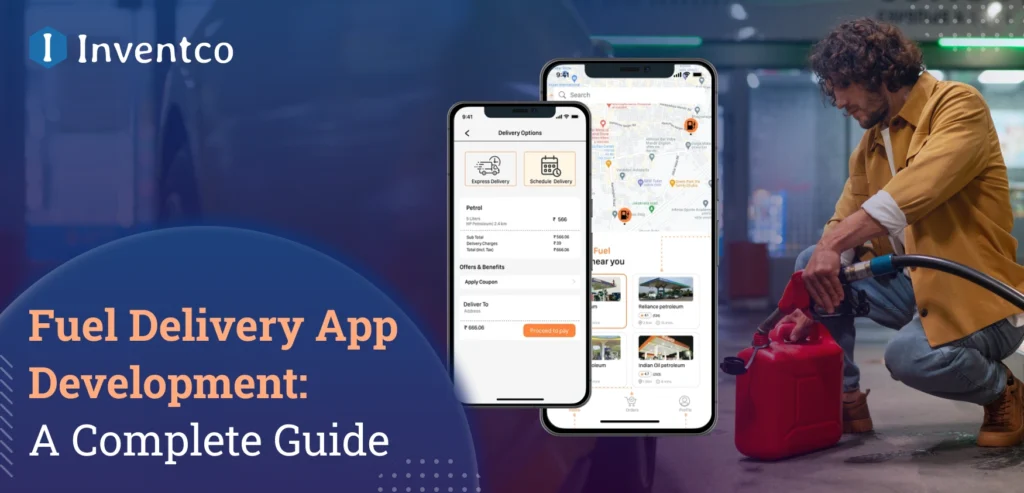
The last few years have seen rapid changes in the on-demand fuel delivery industry, driven by advances in logistics and rising consumer demand for convenience. Currently, the fuel delivery industry is valued at USD 3.5–4 billion in 2023 and is projected to reach USD 12–13 billion by 2032, growing at a CAGR of over 15%, driven by digitisation of fleets, expansion of urban mobility, and the demand for contactless services.
The United States and several leading platforms, such as Booster Fuels, EZFill, and Yoshi, have transformed the fuel delivery industry by providing on-demand fuel services to commercial fleets as well as private individual vehicles. These successful initiatives demonstrate the growing demand for these types of services.
The demand for mobile refueling services is only going to grow, and developing a fuel delivery app is a way for businesses to meet that demand. Apps can help businesses expand into on-demand services and feature GPS tracking, secure payment systems, dispatching, and fleet management. An investment in a fuel delivery mobile app is about creating a scalable logistics ecosystem that is ready for the future.
Key Takeaways
- Logistics, payment systems, GPS, tracking, and operational systems combined make up fuel-delivery apps.
- Based on context, the investment is estimated between $10,000 to $100,000+.
- Both regulatory licensing and Moving Hazardous Materials Compliance are essential.
- Fleet-centric approaches create incremental recurring revenue.
- A scalable tech framework reduces mobile app maintenance costs.
- Early traction is facilitated by strategic partnerships.
What Is an On-Demand Fuel Delivery App?
An on-demand fuel delivery app is an online platform that enables end users to order fuel for delivery to their location, rather than having to visit a fuel station. The app covers a wide range of licensed fuel suppliers and their delivery fleets. This allows users to order fuel while working at a commercial yard, job site, office complex, or even residential buildings. The app saves users time and fuel.
The platform also handles dispatch, route optimization, payment, and tracking compliance. Instead of having separate customer, driver, or admin interfaces, operational control is centralized.
With GPS tracking, cloud infrastructure, and secure payment features, these solutions improve the fuel supply chain and the last-mile delivery process. In the US and Canada, fuel delivery solutions have become a game-changer as fleet operators and businesses prioritize convenience, cost, and streamlined operations.
How On-Demand Fuel Delivery Apps Work?
Fuel delivery apps operate under a business model that focuses on hierarchy. In contrast to the customer-facing model, the backend uses advanced technology integrations to ensure safety and compliance. The technology automates invoicing and safety checks.
Step-by-Step Process
- Fuel Selection: A user selects the required fuel type and quantity in the application.
- Location Verification: GPS integration confirms the exact delivery location for more accurate routing.
- Smart Dispatch: The system assigns the closest certified and regulated fuel truck using intelligent allocation algorithms.
- Real-Time Tracking: Users and administrators can track the car’s movements in real time until its arrival.
- Secure Payment Processing: All transactions are processed via encrypted digital gateways that protect transactions.
- Delivery Confirmation: Following refilling, the system generates an automated confirmation and an electronic invoice for records, as well as documents to prove compliance.
We have designed the systems mentioned above for sophisticated routing and dispatch optimization, log coordination, regulatory compliance validations, and vault-level security. These systems shift a traditional fuel purchase into a streamlined, expandable, and sustainable data-centric logistics operation.
Types of Fuel Delivery Solutions
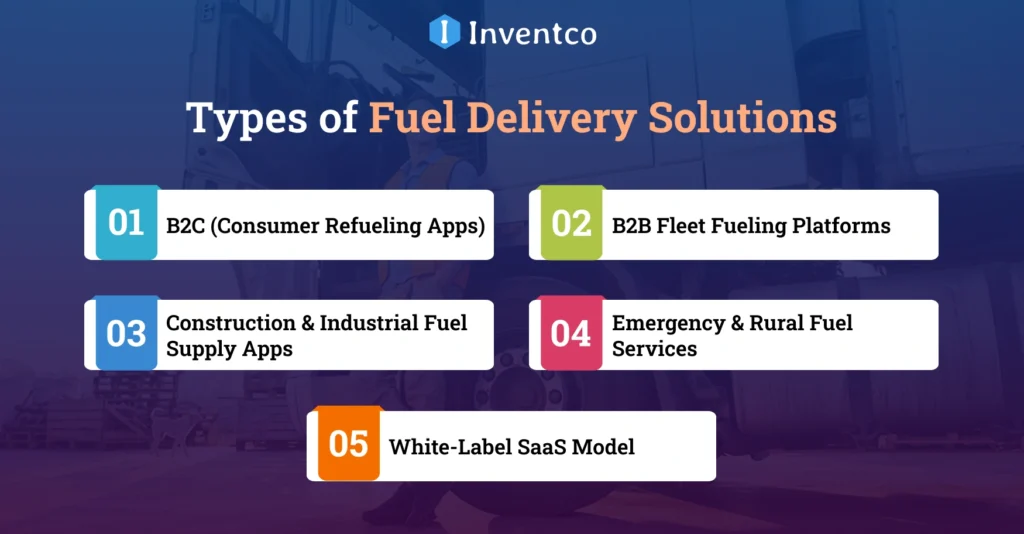
Market size, operational scope, and revenue model determine how a fuel delivery platform is built. Although different models operate similarly, some focus more on consumer convenience, while others emphasise efficiency for enterprises with high-volume contracts and tech licensing. The value of a model is determined by its alignment with the target market, operational scale, revenue model, and its effect on compliance, profit, and scalability.
Here are the main fuel-delivery models newcomers to the market should analyze.
1. B2C (Consumer Refueling Apps)
Fuel delivery services for businesses to consumers concentrate on car owners who require fuel delivery to their workplace, home, or parking space. These apps are geared towards the convenience of flexible scheduling and seamless, digital payment. The majority of revenue comes from fuel markups and delivery charges. Although margins may be low, good customer retention and subscription add-ons can boost profitability in urban markets.
2. B2B Fleet Fueling Platforms
B2B fleet fueling solutions are created specifically for logistics firms, delivery rentals, fleets, or corporate car pools. These platforms facilitate regular bulk fueling, central bill-paying, dashboards for analytics, and routing optimization. Subscription-based contracts and repeat bulk orders ensure steady cash flow. Because of the efficiency of volume and long-term arrangements, fleet strategies usually result in higher, more stable margins.
3. Construction & Industrial Fuel Supply Apps
These solutions are geared towards mining operations, construction sites, agricultural equipment, as well as industrial equipment that requires the provision of on-site gasoline. The emphasis is on large-scale delivery, compliance documents, and scheduling and dispatch management. The high volume of fuel consumption as well as the long cycle times make this sector economically attractive. However, strict safety standards and a well-organized logistical system are crucial to the success of operations.
4. Emergency & Rural Fuel Services
Rural and emergency-focused fuel delivery applications are designed to serve remote areas, such as disaster zones and regions with limited fueling infrastructure. These apps offer rapid emergency fueling to generators, vehicles, and essential services. While operational complexity can be higher due to distance and regulatory constraints, premium pricing models typically address logistical difficulties.
5. White-Label SaaS Model
A white-label SaaS model is a pre-designed fuel delivery software that regional or business owners can customize and implement under their own brand. Instead of handling fuel logistics directly, the company provides technological infrastructure, dashboards, and tools for compliance on a monthly basis. This approach is asset-light and reduces risk for operations while also generating regular SaaS revenues.
Business Models for Fuel Delivery Apps
A viable fuel delivery business is not based solely on technology; it requires the existence of a scalable, clear revenue structure. Before committing to expansion or operations, the entrepreneurs must determine how the platform can create a steady flow of cash and balance logistics costs, the cost of compliance, and customer acquisition.
Here are the most common models of monetization used in this industry:
- Delivery Fees: Charge a flat or distance-based cost per order, which guarantees immediate income for every transaction and is particularly efficient in markets that are geared towards consumers.
- Subscription Plans: Monthly or annual subscriptions with priority delivery and discounted rates or scheduled refueling provide regular income that is predictable.
- Fuel Margin Markups: Earning a profit on every gallon or litre supplied allows businesses to profit directly from transaction volume.
- Fleet Contracts: The long-term contracts with logistics firms or fleets for corporate fleets guarantee reliable, high-volume recurring revenues.
- White-Label Partnerships: Licensing of the Platform to fuel distribution companies or regional operators creates SaaS-based revenues without the need to manage the logistics themselves.
By integrating structured revenue streams with well-organized mobile app monetization plans, fuel delivery platforms can transition from transactional earnings to steady, contract-driven growth.
Steps of Creating a Fuel Delivery Application
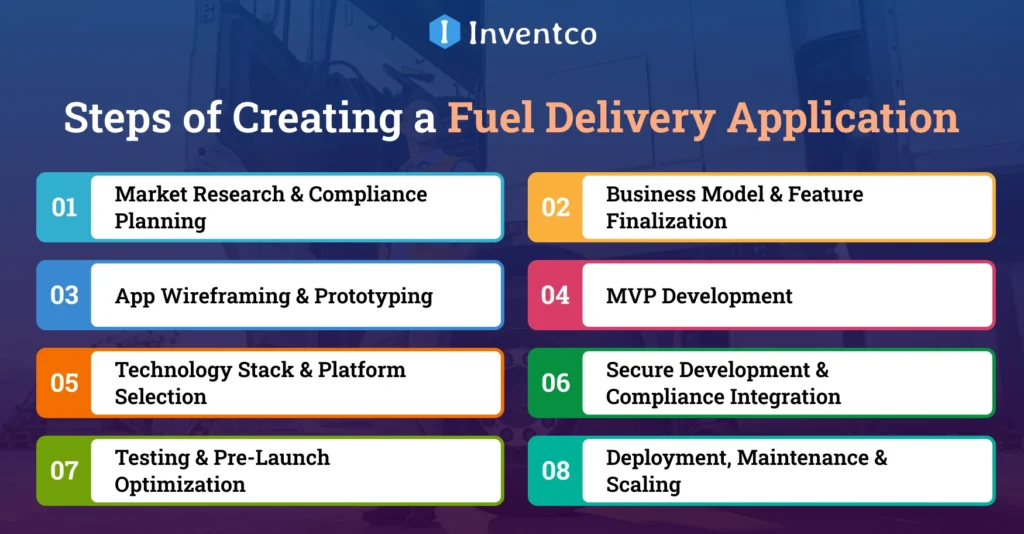
To build a scalable gas delivery application that adheres to all regulations, a detailed, structured execution roadmap must be created. An organized mobile application development process will minimize operational risk, ensure compliance, and improve return on investment. Delays, budget overages, and compliance issues will arise from failing to plan each phase with sufficient detail.
1. Market Research & Compliance Planning
In this phase, the demand, target market, competitors, price of fuel, and regulations of the region must be assessed. Founders must research the need for a business license, laws relating to the transport of hazardous materials, and the need for insurance. Identifying potential mobile app development challenges will help avoid legal issues and costly redesigns, so the redesign should be avoided until development begins.
2. Business Model & Feature Finalization
From here, the delivery logic, subscription tiers, and operational workflows are defined. Teams will specify the mobile app features that must be included in the application to meet the business objectives. Planning around the monetization of the application will sustain growth of the business and will help achieve the goals of the mobile app monetization plan that is structured and meets a balanced ratio of customer acquisition to long-term revenue goals.
3. App Wireframing & Prototyping
This phase focuses on developing wireframes. Mobile app wireframing converts concepts into visual representations that show user flows and the structure of interfaces. Building an interactive mobile app prototype will allow us to test and confirm usability and will be the last thing we do before coding starts. This phase allows us to get the stakeholders’ approval on the logic around how the user will navigate through the app, how the dashboards will be laid out, how the operational flows will be structured, and overall how we will scale the product before we get to product engineering.
4. MVP Development
The MVP mobile application will consist of the fundamental features that will allow us to order fuel, use GPS, make payments, and access an admin dashboard. Releasing a Minimum Viable Product creates the opportunity to test our product in the real world, gather customer feedback, and validate our operational processes before we scale automation.
5. Technology Stack & Platform Selection
The app technology stack we choose will influence how scalable, performant, and secure the app will be. When selecting between Android vs iOS or cross-platform deployment options based on target-market needs. The mobile app development frameworks we choose will provide a solid base for the app’s backend and allow for a strong foundation for 3rd-party integrations used for the app’s logistics.
6. Secure Development & Compliance Integration
Due to the nature of the fuel delivery platforms, which allow payments to be made and provide app users’ locations and other sensitive regulation-related information, it will be critical that mobile app security practices are used. Mobile Apps will provide users with Compliance Modules and Digital Documentation, and will have the ability to be audited to ensure that they are in line with the regulations regarding the transportation of hazardous materials and safety.
7. Testing & Pre-Launch Optimization
Thorough mobile app testing assesses features like functionality, payment security, and GPS. Performance evaluations, load testing, and usability checks help mitigate failures. Early acquisition and discoverability during competitive market launches are boosted through strategic app store optimization.
8. Deployment, Maintenance & Scaling
Post-launch, structured mobile app maintenance promises bug patching, monitoring, and feature updating. Budgeting for mobile app maintenance costs is planned strategically. Furthermore, traction increases the need for scalable infrastructure, which, coupled with data and analytics, boosts integrated performance and facilitates expansion into new territories and enterprise fleet integrations.
Note: Creating a mobile app can typically be a 3 – 6 month endeavor; variances in development time are due to complexities in the scopes of compliance, feature depths, and integrations.
Key Features of a Fuel Delivery App
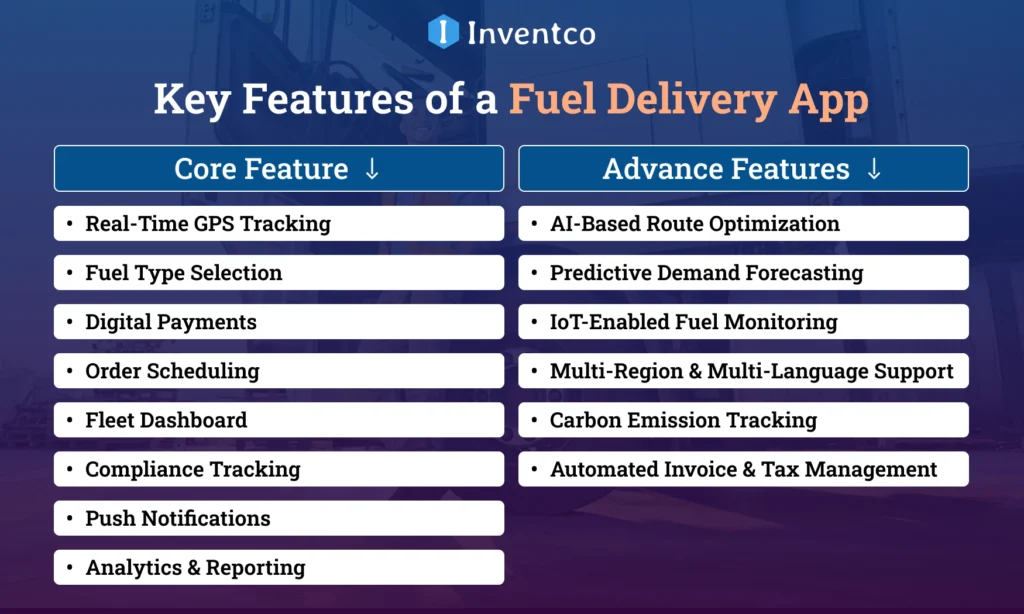
The fuel delivery application must be able to provide operational excellence, user experience, and balance the regulatory demands for the markets you are launching into. The mobile app features are the basic building blocks for an investor-ready solution, while the sophisticated features will provide you with a sustained competitive advantage in the industry.
Core Feature
These basic features provide the operational bedrock for the fuel delivery platform. They ensure that ordering and payment processes are quick and secure, while the business remains compliant and all parties have visibility into the logistics of the process in real time.
1. Real-Time GPS Tracking
This feature allows both the customer and the administrator to see where the fuel delivery truck is in real-time. This increases transparency and routing optimization, while also reducing delivery times and improving operational control of the fuel delivery trucks.
2. Fuel Type Selection
This is the option that allows the customer to choose what fuel they would like delivered, whether that be petrol, diesel, premium fuel, or some other form of industrial fuel. This will allow for better processing of the order, better pricing, and will ensure that the customer’s vehicle or machinery will be operational.
3. Digital Payments
This feature allows the customer to link their debit/credit card or digital wallet to the app, and to also link their net banking account as well as their corporate account. This feature allows the billing and invoicing process to be automated and allows for quick and easy reconciliation of the customer’s account. The billing process is secure, as they will be using an encrypted server to process the transactions.
4. Order Scheduling
This allows the customer to set times for their fuel to be delivered, whether that be in the immediate future or in the distant future, and whether that delivery needs to be done repeatedly. This feature is most beneficial to fleet operators whose vehicles require regular fueling, as it allows for better planning and operational continuity of their business.
5. Fleet Dashboard
Gives Admins the ability to manage the vehicles, drivers, delivery progress, and fuel levels. Includes functionality for real-time management, tracking, and performance visibility for making informed decisions on the operation.
6. Compliance Tracking
Digitally stores the documentation of the transportation of hazardous materials, driver certifications, and driver safety inspections. Compliance tracking reduces legal risks and the need to manually manage documentation.
7. Push Notifications
Provides real-time notifications for order confirmations, delivery dispatching, delivery updates, and payments. Push notifications increase transparency of communication and increase user engagement.
8. Analytics & Reporting
Provides analysis of order, revenue, and fleet data to reveal patterns of fuel use. Analytics and reporting help provide accurate data to help plan and optimize for the future of the operation.
Advance Features
Advanced fuel delivery app features provide a pathway for growth and a way to keep the competition at bay through the use of automation, predictive analytics, and the tracking of sustainability. When combined with more advanced controls, this will provide improved efficiency in the operation for the long-term.
1. AI-Based Route Optimization
Determines the most efficient delivery routes through the use of machine learning. This increases the capacity to deliver in a given area while also reducing fuel and time waste.
2. Predictive Demand Forecasting
Seasonal and historical data is evaluated to find patterns and spikes in fuel usage. This helps to plan the inventory and people in the fleet more accurately to forecast revenue.
3. IoT-Enabled Fuel Monitoring
Utilizes IoT technology to monitor fuel levels in the tanks and storage units. Enables automatic fuel refill requests to avoid operational interruptions.
4. Multi-Region & Multi-Language Support
To help with international expansion, there are options for localized currency, language, and region-specific compliance, providing support for scalable international growth.
5. Carbon Emission Tracking
Monitors the emissions and fuel consumption associated with delivery to aid in environmental compliance reporting and support the ESG initiatives of the enterprises.
6. Automated Invoice & Tax Management
Creates tax invoices specific to a region, connects to the accounting software, and automates billing reconciliation. This makes the financial operation easier for enterprise customers and fleet managers.
Technology Stack for Fuel Delivery App Development
For creating a scalable solution for fuel delivery, a mobile app technology stack should be chosen that allows constant monitoring and reporting of delivery status, keeps reporting and transaction data safe, allows for documentation, and provides an efficient system for reporting and tracking delivery. Infrastructure results in performance, data safety, stability, and scalability of the system for a long period of time and for all areas and regions.
Below is a commonly used technology structure for fuel delivery platforms:
- Frontend (Mobile App): Flutter / React Native
- Backend (Server-Side Logic): Node.js / Python
- Cloud Infrastructure: AWS / Azure
- Database: PostgreSQL
- Payment Gateway Integration: Stripe / PayPal / Razorpay (region-specific)
- GPS & Mapping APIs: Google Maps API / Mapbox
Selecting appropriate mobile app development frameworks ensures better maintainability, smoother updates, and optimized performance. Strategic decisions around Android vs. iOS deployment or cross-platform development should align with target-market behavior, budget, and long-term expansion plans.
Legal, Safety & Compliance Requirements
Fuel delivery is not merely a logistics company. Rather, it operates in a hazardous materials framework. The transportation of petrol and diesel requires careful consideration of safety, environmental, and transport laws. The consequences of non-compliance can lead to fines, business closure, and damage to a company’s reputation. For a business, the cost of due diligence compliance is of regulatory concern to investors.
Businesses entering this space must secure:
- Fuel Distribution Licenses: This is a license from local energy or petroleum authorities to legally store and distribute fuel.
- Environmental Approvals: Environmental clearances concerning the storage, handling, and transport of fuels.
- Insurance Coverage: Comprehensive liability coverage for hazardous materials transport, accidents, environmental damage, and third-party claims.
- Hazardous Material Transport Permits: These include permitted vehicles and licensed drivers to transport hazardous materials in a regulated manner.
The ability to control risk is a clear indication of current operational compliance and poses no risk for future compliance to the company’s investors.
Cost to Develop a Fuel Delivery App
Development investment is based on the depth of features, regulatory compliance, infrastructure, and scalability. The following provides cost estimates based on the level of detail provided to the founders and investors.
1. Basic (MVP Version): $10,000 – $25,000
A primary version is centred on essential features like ordering fuel, GPS tracking, digital payments, and an elementary admin dashboard. It is suitable for startups to experiment with market needs. The compliance module and automation functionalities are small, but operational validation is feasible with a controlled investment risk.
2. Mid-Level (Enhanced Features & Admin Panel): $25,000 – $55,000
This version also includes advanced dashboards, subscription billing, recurring schedules, reports, security reports, external integrations, and enhanced security. It allows B2C and small fleet operations. Region expansion and revenue stabilization are possible due to better UI, performance boosters, and compliance documentation.
3. Advanced (Enterprise-Grade Platform): $55,000 – $100,000+
An enterprise-level platform contains AI route planning, predictive analytics, multi-region, automated compliance, IoT, and other cloud requirements (scalability). It is for large fleets and multi-city expansion, with a focus on automation, security, performance, reliability, and long-term scalability in regulated markets.
Overall, the fuel delivery app development cost relies on the level of customization, real-time tracking, payment options, systems for compliance, and other features related to scalability. When analyzing the classic fuel retail infrastructure, the cost to build a mobile app is considerably more attractive than the costs associated with establishing and operating multiple physical fueling stations, making it an appealing asset-light investment model for founders and investors.
Mobile Fuel Delivery Business: Opportunities & Challenges
Finding a sustainable and compliant way to navigate the operational and regulatory constraints the mobile fuel delivery sector has to offer is a challenge for founders. If there is a way to balance all the different risks associated with operational execution and compliance to create a scalable business model, there is a lot of potential value to capture in this area.
1. Recurring Fleet Revenue
Fleet contracts create recurring revenue from scheduled bulk refueling contracts, providing steady income for extended time periods. Companies that provide logistics, rentals, or corporate vehicles operate on a subscription-based fueling model, which helps maintain a positive cash flow, a greater number of transactions (orders), and an enhanced customer value (lifetime value).
2. Lower Infrastructure Cost
Mobile delivery solutions create value capture opportunities with less investment needed for real estate, no retail staff, and no fixed overhead. This asset-light model provides faster time to market, more streamlined investment in technology and logistics, and overall greater flexibility for expansion and optimized use of resources.
3. Subscription Scalability
Subscriptions, whether monthly or annually, provide a predictable stream of revenue and enhanced customer retention, which ultimately increases operational predictability, strengthens the business relationship with the customer, and alleviates the business from relying on one-time transactions from a consumer.
4. Regulatory Complexity
The transportation of fuel is subject to numerous laws regarding hazardous materials, as well as environmental and transportation laws. The complex nature of regionally based compliance has the potential to significantly hinder operational expansion, thus making regulatory due diligence an operational priority.
5. Logistics Coordination
The effective and efficient management of backend systems related to inventory, fuel, driver routes, dispatch timing, and demand forecasting is essential. Poor backend management results in coordination issues that lead to fuel waste, delays in delivery, and increased operational costs, which negatively affect customer satisfaction and the bottom line.
6. Safety Compliance Risks
The delivery of fuel is an inherently dangerous activity, as the materials that are transported are hazardous. Therefore, the delivery of fuel should be conducted with strict compliance with the schedule of maintenance of the vehicle, driver training and certification, and the insurance and emergency response plans, as failure to comply can result in accidents and loss of financial and reputational damage to the company.
Fuel Delivery App Trends in 2026
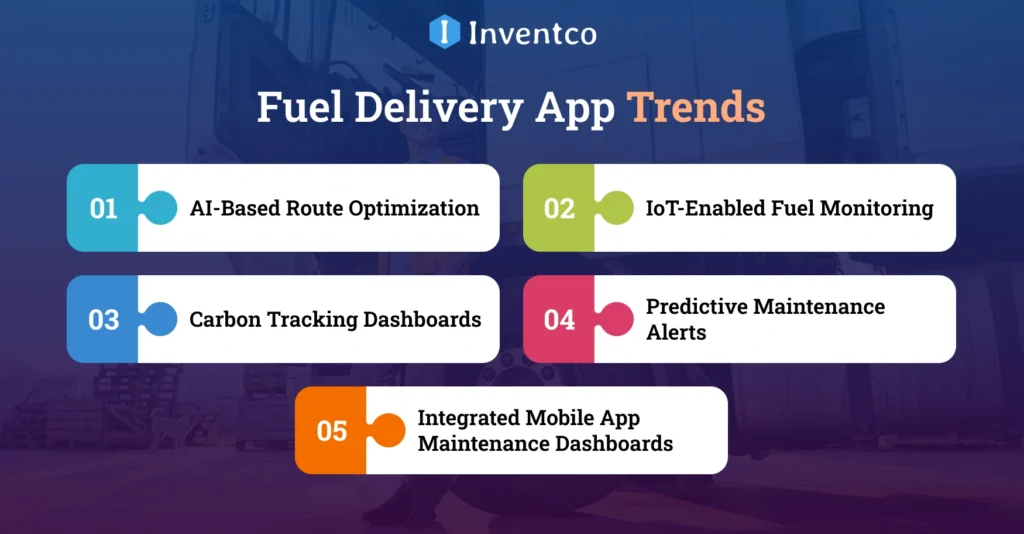
In the coming years of 2026, the fuel delivery platform will be focused on automation, sustainability, and the effective capture of data. The evaluation of the app’s convenience will no longer be the only focus of the investor; they will also assess the intelligence, compliance, and operational effectiveness of the app. The emerging data will show the key mobile app development trends of 2026.
1. AI-Based Route Optimization
Dispatch management in fuel delivery services has been transformed by the adoption of artificial intelligence (AI), as it has the capability of real-time determination of the quickest, safest, and most fuel-efficient routes. This has provided a decrease in total operational costs, improved the efficiency of delivery, minimized the waiting time, and increased the number of orders fulfilled in a day within the geographical boundaries of the services offered.
2. IoT-Enabled Fuel Monitoring
The real-time monitoring of the fuel levels of fleet tanks and storage systems can be done using IoT sensors. Automated refilling turns downtime into a predictive inventory assessment and a transparency tool for enterprise customers with large fleets of vehicles.
3. Carbon Tracking Dashboards
The tools available for monitoring carbon emissions are able to calculate the emissions from the transportation and delivery operations of fuel. These dashboards assist with ESG reporting, compliance with regulations, and the fulfillment of sustainability promises, making the platforms more appealing to eco-friendly enterprise partners.
4. Predictive Maintenance Alerts
Breakdowns are more easily prevented, repair costs are kept to a minimum, and delivery services are more easily continued due to the use of predictive maintenance alerts.
5. Integrated Mobile App Maintenance Dashboards
Modern platforms include back-end systems that monitor and analyze performance metrics for the platform and its systems. These metrics include the frequency of the system’s availability, bug occurrences, and security incidents. This analytical system for monitoring mobile apps provides better scalability, lower system maintenance costs, and provides assurance for the long-term performance of the platform.
Data intelligence, sustainability reporting, and automation are utilized to differentiate enterprise-level contracts. Platforms that integrate compliance, efficiency, and sustainability are more likely to achieve continued growth.
Conclusion
The fuel distribution sector is transforming from a traditional model, leveraging fixed, capital-intensive distribution centers, to a more flexible, digitally enabled distribution model that uses app-based logistics. Success in this new paradigm is driven by more than simply developing a distribution app. Success requires the proper regulatory approvals, intelligent dispatch, secure payment, and scalable cloud integration. When developed strategically, a fuel delivery app can drive continuous fleet revenue, subscription revenue, and long-term corporate contracts.
When evaluating prospective partners in developing on-demand distribution platforms, investors and founders should focus on technological proficiency, compliance, and operational scalability. Working with a mobile app development company like Inventco, which has experience and has been recognized for its mobile app development services, will deliver better outcomes from concept validation to app deployment.
With proper guidelines, fuel distribution platforms can become advanced, vertically integrated logistics platforms that deliver significant profitability and operational efficiency.
FAQs
Q1. How to Start a Mobile Fuel Delivery Business?
Ans. Start with market research to determine demand and competition. Develop a services business plan and target consumers. Obtain licenses and permits, created in accordance with regulations such as EPA and PHMSA regulations in the USA. Ally with fuel suppliers and invest in specially equipped vehicles with GPS and dispensing equipment. Work with a fuel delivery mobile app development firm to develop an easy-to-use app with tracking, payment, and driver management.
Q2. How Many Days Would It Take to Create a Fuel Delivery App?
Ans. A simple app with a few features (user sign-up, ordering, and basic tracking) takes 3–4 months (400–600 hours). A medium-level complexity app with real-time tracking and payment gateway integration takes 5–7 months (800–1,500 hours). Advanced apps with AI, IoT, or multi-vendor integration could take 8–12+ months (2,000+ hours). Hiring a well-structured development partner like Inventco can help deliver it on time.
Q3. Is Fuel Delivery a Good Business?
Ans. Yes, the fuel delivery industry has wonderful growth prospects, with the market expected to increase from $3.5 billion in 2023 to $12.7 billion by 2032 (15.4% CAGR). The increasing need for convenience and car ownership supports profitability. Low competition, diversified revenue streams (commissions, subscriptions, ads), and a strong app guarantee success.
Q4. What Are the Legal Requirements for a Fuel Delivery Service?
Ans. Obey legislation such as the USA’s EPA’s Fuels Regulatory Streamlining and PHMSA’s Hazardous Materials Regulations. Secure licenses to store and transport, and have vehicles inspected to ensure safe use. Seek legal professionals for on-location inspections (e.g., Transport Canada’s regulations within Canada).
Q5. How to Monetize a Fuel Delivery App?
Ans. Earn income from delivery commissions, unlimited refueling subscription plans, and in-app ads. Charge a premium for high-end features such as priority delivery or analytics. Use discounts and loyalty programs to enhance retention. Make strategic partnerships with corporate clients for bulk fuelling of fleets.

Ajay Bhal
He is an on-demand app solutions expert with 11+ years of experience in business consulting and building scalable, user-centric digital products. He specializes in robust on-demand platforms across industries, combining technical expertise with business-focused strategy to deliver efficient, top notch solutions that drive growth and enhance user experience. You can connect with him on LinkedIn to follow insights.