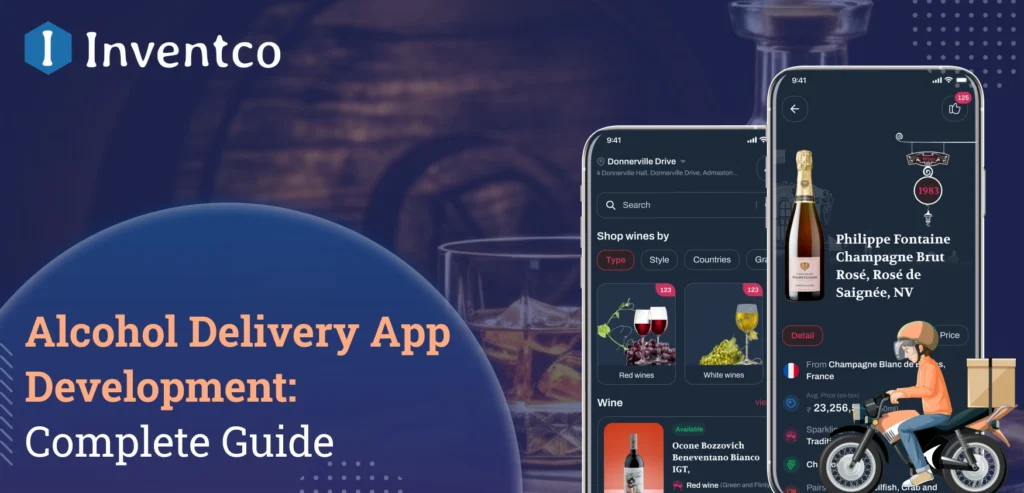
The way consumers buy essential goods, including alcohol, has been transformed by online commerce. Even though traditional liquor selling is still the primary way alcohol is sold, the ability to digitally order and get alcohol delivered is also quickly increasing in popularity due to the convenience of mobile ordering and changing regulations. For both founders and investors, the development of alcohol delivery apps is no longer considered a niche market but rather a segment of the economy experiencing rapid growth.
The alcohol e-commerce market has been growing at a staggering rate of 13.48% and is expected to grow from $65.37 billion in 2026 to $122.35 billion in 2030. This consistent growth is due to an increase in demand to purchase alcohol online, as well as improvements in alcohol delivery of alcohol. To be successful in creating an alcohol delivery app, you need a compliance plan, a payment plan, an acquisition plan, and an architecture plan. This blog focuses on cost, business model, and competitive advantage analysis of alcohol delivery apps for the year 2026.
Key Takeaways
- Consumer behavior has driven alcohol delivery to become a much more popular, mobile, and easy-to-use product in the on-demand, growing commerce world.
- The promising investment potential stems from the anticipated growth of the global alcohol e-commerce market, which is expected to reach $122.35 billion by 2030.
- The global alcohol e-commerce market will be governed by several factors, including licensing, geo-restrictions, and age-gate compliance.
- When creating a development roadmap, a structured outline is preferable as it minimises risk and improves time to return.
- Demand is best proven through MVP-first development strategies before making any investments in scaling.
- Scalability, security, and performance of the e-commerce platform can be best assured by the right technology stack.
- Customer, administrator, and delivery core modules will outline and enhance operational efficiency.
- The anticipated development cost of the global alcohol e-commerce platform is estimated to range from $10,000 to $100,000+, depending on the complexity.
- Global alcohol e-commerce platforms will require security, testing, and maintenance. This is essential for the platform’s operational stability over a prolonged period.
- Compliance, scalability, and a successful go-to-market strategy will be further enhanced through a development partnership with a qualified and experienced firm.
Why Invest in an Alcohol Delivery App Development in 2026?
Over the last decade, different parts of e-commerce have innovated in different ways. Sales of alcohol online have also changed. Over the years, consumer behavior, changes in logistics, and advancements in digital technology have changed how alcohol is sold online.
Mobile alcohol-selling apps have created a marketplace for the selling of alcohol via apps that consumers can access from anywhere and anytime. Due to this convenience, demand for alcohol delivery apps continues to grow.
There are many reasons for the development of smoke and liquor delivery apps in 2026. It allows an iteration of mobile app development, and from that, a highly iterative process employing the person-based method to encourage participation, self-monitoring and feedback, action planning, identifying change, and providing normative feedback.
Key Points to Invest:
- Growing Demand for On-Demand Convenience: Alcohol delivery apps are making the purchase and delivery of alcoholic beverages more convenient for users.
- Higher Revenue Potential: Digital platforms enable dynamic pricing, subscription models, promotional campaigns, and cross-selling opportunities.
- Improved Customer Retention: Mobile apps improve the means of advertising, personalized suggestions, and target ads, for the purpose of increasing the means of repeat purchases.
- Expanded Product Visibility: Applications offer broader inventory exposure than physical shelf limitations.
- Operational Efficiency & Tracking: Enhanced transparency and user trust are achieved through integrated logistics and real-time tracking.
- Competitive Differentiation: Enhanced brand positioning in a tech-saturated retail ecosystem is achieved through a robust digital presence.
Investing in an alcohol delivery platform in 2026 goes beyond digitization of liquor sales. It also spans the construction of a compliant, scalable, and data-driven commerce model focused on sustainable long-term growth.
How On-Demand Liquor Delivery Apps Work?
When using an on-demand liquor service, customers encounter an experience that ensures the platform is both consumer-friendly and regulatory-compliant, and that it has thought through all parts of the process. Here is an example of how the system works.
- Account Setup & Age Verification: The customer registers and uploads a government-issued ID. Age is verified using the ID. Only customers of permitted age can use the app.
- Location & Store Matching: Once the system detects the customer’s location, it displays liquor stores that can legally and geographically deliver to the customer’s location.
- Product Browsing: The customer interface allows customers to browse, select, and add items to the cart to purchase.
- Secure Checkout: Payments can be made through the customer interface using encrypted gateways. Taxes and fees are automatically added to the cost of the products to comply with state and local regulations.
- Order Confirmation & Dispatch: Stores are responsible for processing orders and assigning a courier. The app optimizes routing to help couriers deliver promptly.
- Delivery & Final ID Check: When the courier arrives, they must check the customer’s ID before the liquor can legally be transferred to the customer. Proof of delivery is also needed to ensure regulatory compliance and for app analytics.
These methods have provided customers with a unique and safe experience that can be easily adjusted to meet changing regulations and customer needs.
Alcohol & Liquor Delivery App Development Process
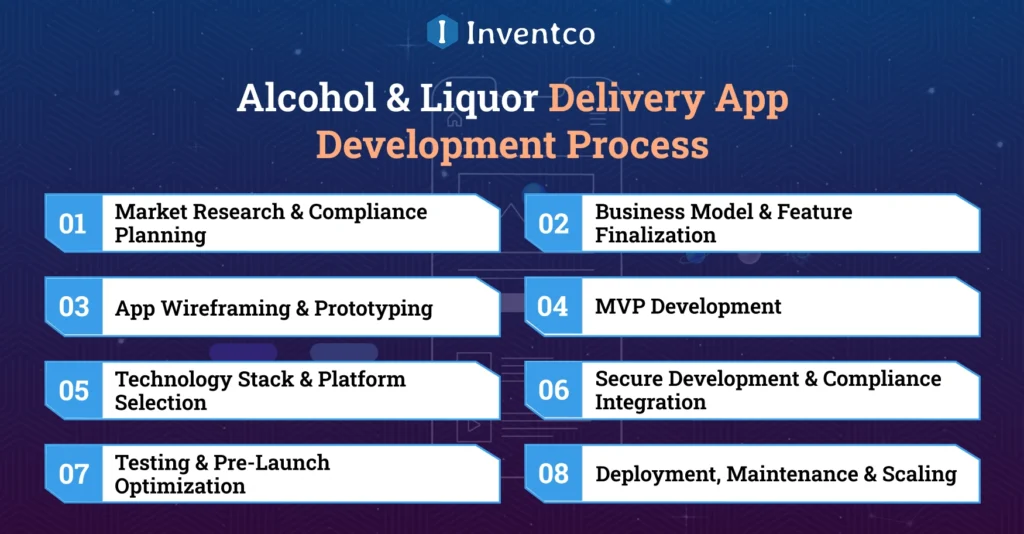
The development of an alcohol delivery app requires a bit more than just an ordering interface. In addition to coding, you need to look into securing your operating systems, understanding the relevant regulations, and planning for long-term operations. For investors and founders looking to build a mobile app in this market, cost-benefit analysis and regulatory compliance can be simplified with a well-documented process.
Below is a step-by-step app development process to create an alcohol delivery app:
1. Market Research & Compliance Planning
To understand the market for alcohol delivery, the applications, regulations, and laws need to be researched and understood before building begins. The regulations surrounding alcohol delivery applications include licensing, delivery permissions, taxes, and age verification.
In addition to understanding this for the market, you also need to understand your competitors. Many founders underestimate these early mobile app development challenges, which can delay launch timelines if not addressed proactively.
2. Business Model & Feature Finalization
After compliance is out of the way, it is time to define operational workflows and revenue streams. For long-term mobile app monetization to succeed, a combination of commission-based revenue, subscription plans, and promotional placements is required.
After understanding the compliance side of alcohol delivery applications, you can define the operational flows. This is important for the development of features such as signature verification, vendor geo-fencing, payment security, and delivery tracking. This can help eliminate unnecessary feature development.
3. App Wireframing & Prototyping
Before development begins, app wireframing and prototyping will structure user journeys, the navigation hierarchy, and key compliance touchpoints. This provides a visual blueprint for stakeholders for alignment on functionality and workflow.
An interactive app prototype mimics actual user engagement, allowing the team to validate the engagement features, refine UI/UX recommendations, and close any identified gaps. This minimizes expensive revisions, quickens the process of getting approvals, and guarantees development commences with a clear vision of the product to be developed.
4. MVP Development
Starting with an MVP mobile app allows founders to establish a market presence faster and test potential customer engagement. The version should include the basics: user registration with age verification, product browsing, secure checkout, vendor confirmation, and delivery tracking.
This approach optimally utilizes available initial resources to offer the mobile app at the earliest time and obtain customer engagement feedback before scaling the offering and features.
5. Technology Stack & Platform Selection
The selection of the mobile app tech stack will determine the best options for performance and scalability. Using Node.js or Python on the backend, combined with the cloud, will guarantee dependability during peak engagement.
The decision of whether to develop a native or a cross-platform application depends on your targeted market. Conducting an analysis of user behavior across Android and iOS apps in your market is essential. To simplify development costs and maximise the targeted application performance, use mobile app development frameworks such as Flutter or React Native.
6. Secure Development & Compliance Integration
There is no doubt that security is a cornerstone of development for alcohol commerce platforms. The principles of integrating encryption, secure payments, and User Identity verification should be based on mobile app security practices.
Compliance logic, including geo-restrictions and automated tax calculations, must be embedded into backend workflows from the start. This stage forms the technical foundation of the entire mobile app development process.
7. Testing & Pre-Launch Optimization
Your mobile application will never be in front of your target audience until it is thoroughly tested. Mobile app testing is structured to assess the application’s performance, stability in the user environment, compliance with specified requirements, and the completion of an authenticated payment in the portal.
This ensures that the application has undergone functional testing, load testing, and usability testing under expected high user volume, and that a security assessment has been completed to remediate security issues.
Identifying issues before the application is launched will reduce operational risk and enhance your business’s reputation. Addressing these issues will help develop a clear marketing strategy and App Store optimization to increase your application’s reputation and ensure a successful launch.
8. Deployment, Maintenance & Scaling
Following the app launch, the focus shifts to ongoing enhancement. Continuous updates, monitoring app performance, and adding vendors are key to long-term scalability. Proactive mobile app maintenance identifies and manages regulatory changes, security updates, and feature enhancements. Mobile app maintenance costs should be part of operational planning for investors.
The delivery of alcohol and liquor entails a unique blend of commerce, compliance, and logistics. With a strong development roadmap, the challenges can be turned into opportunities.
Technology Stack for Liquor Delivery App Development
Selecting the right Mobile App Technology Stack is critical for scalability, compliance, and long-term performance. The infrastructure must support secure payments, real-time inventory sync, geo-location controls, and high transaction volumes.
Below is a structured overview of the recommended technology components for a liquor delivery platform in 2026.
- Frontend (User App): Flutter, React Native, Swift (iOS), Kotlin (Android)
- Backend Development: Node.js, Python (Django), Ruby on Rails
- Database: PostgreSQL, MongoDB, MySQL
- Cloud Infrastructure: AWS, Microsoft Azure, Google Cloud
- Payment Gateway Integration: Stripe, Razorpay, PayPal
- Real-Time Tracking: Google Maps API, Mapbox
- Authentication & Security: OAuth 2.0, Firebase Auth, SSL Encryption
- Admin & Vendor Panel: React.js, Angular, Vue.js
- Push Notifications: Firebase Cloud Messaging (FCM), OneSignal
- Analytics & Monitoring: Google Analytics, Mixpanel, New Relic
A well-defined stack ensures faster development cycles, reliable performance, and easier mobile app maintenance post-launch. Founders should align technology choices with their target market, compliance requirements, and long-term scalability goals before committing to development.
Benefits of Alcohol App Development
The development of alcohol delivery apps enables legally operating businesses to pursue new digital opportunities, streamline existing processes, maintain legal compliance with alcohol sales, and achieve positive financial returns through recurring, scalable, demand-driven commerce.
For Customers
- Convenience: Customers can place orders from home, which cuts down on travel time and wait time.
- Easy Browsing of Products: Easily find your favorite drinks with search and filter options.
- Availability 24/7: Order anytime, even when the store is closed.
- Real-Time Tracking: See where your order is at all times.
- Secure Payments: Customers can make payments securely through digital wallets.
- Deals and Offers: Customers can see their historical purchasing offers to earn rewards.
For Businesses
- Increased Market Access: Easily sell to customers nationwide.
- Better Management: Streamlined management of stock, inventory, orders, and operations.
- Customer Loyalty: Real-time analytics and customer information are more useful.
- Retention: Offers and rewards programs for customers.
- Improved Customer Support: Real-time order tracking, user feedback, and multiple customer service channels.
- Low Operational Costs: Increased automation reduces operational demand
Types of Alcohol Delivery App Development Solutions
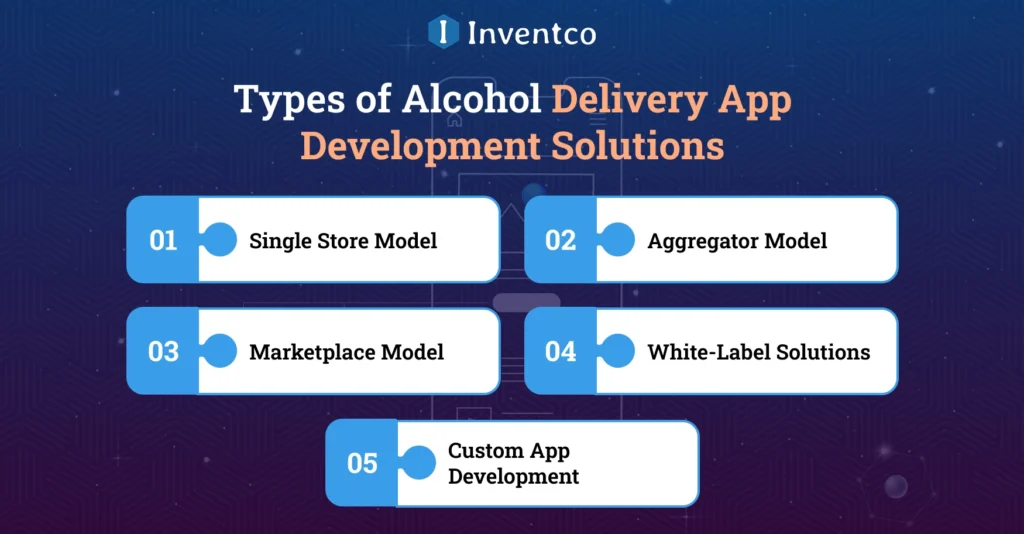
Choosing the right development model depends on your business size, development budget, and business growth goals. Here are some top types of alcohol delivery app development models you should consider:
1. Single Store Model
This option is for liquor retailers looking to digitize their stores. It emphasizes the brand and helps them build relationships with their customers by managing inventory, taking orders, and handling local delivery for one store only. This option is most suited to smaller and medium-sized retailers.
2. Aggregator Model
With this aggregator model, the app is just a conduit for taking orders and is paid a commission per order. As such, the vendors are responsible for all the inventory and order fulfillment, and the app developer is only responsible for the order-taking system.
3. Marketplace Model
This is the most sophisticated and developed model. It integrates all the other models and enables customers to view and compare products, set prices, and access consolidated inventory. This model is perfect for fast expansion across several cities.
4. White-Label Solutions
With white-label solutions, time and development costs are reduced. However, this model still allows the owner to tailor it to a business, controlling its appearance and features.
5. Custom App Development
Custom-built solutions cater specifically to particular operational, regulatory, and scalability needs. This option is best for businesses that want to maintain complete control over features, integrations, and long-term growth plans.
Key Features of a Successful Liquor Delivery App
The success of a liquor delivery app depends on the features strategically placed across the customer, admin, and delivery panels. This ensures that the app is compliant, operationally seamless, financially secure, and offers a good user experience.
1. Customer Panel
The customer panel is the heart of any liquor delivery app and is intended to provide a seamless, easy-to-navigate shopping experience. The following features should be incorporated to ensure a positive customer experience throughout the mobile app development process.
- User Login/Registration: Users must be able to register and gain access to the app securely with mobile phone numbers, email addresses, or by logging in to a social network.
- Age Verification: Upon confirmation of identification or date of birth, the app ensures that users who are below the legal age for consuming alcohol do not gain access.
- Product Search by Filters: Facilitates customer search and item discovery by allowing filtering within specified parameters such as brand, category, price, and alcohol type.
- Real-Time Tracking: Once an order is dispatched and en route to the customer’s address, the customer can track it.
- Multiple Payment Options: Customers can pay via cards, wallets, or cash on delivery.
- Saved Orders: Users can simply save and re-order previous purchases or items they like.
- Rating and Reviews: Users can provide feedback on products and services, helping other users.
- Push Notifications: Users can see changes to their orders or get notified about new products or special offers.
2. Admin Panel
The Admin Panel offers complete control over the platform, operations, inventory, and user management. Here are some of the must-have mobile app features in the Admin Panel.
- Dashboard: Central view of the system status, income, user activities, orders, and other metrics.
- Manage Listings: Rectify product availability, pricing, product descriptions, and business descriptions.
- Order Management: Numerous customer orders can be tracked, managed, and their status updated.
- Customer Analytics: Providing lots of information on user habits, demographics, purchase patterns, and behavior will help to guide business decisions.
- Payment Management: Issues related to payment complaints, refunds, transactions, and payment gateway issues can be managed.
- Reports: This feature provides a detailed growth report on the company’s performance, which includes information on sales and inventory.
3. Delivery Panel
The delivery panel is designed to help delivery personnel manage orders efficiently, enabling them to reach customers in a timely manner. Here are some core features of the delivery panel.
- Delivery Login: Delivery personnel have individual logins to complete their assigned tasks.
- Accept/Reject Orders: Delivery personnel can choose whether to accept or reject an order at their discretion.
- Order History: Maintains a record of previous deliveries in order to trace issues and monitor individual performance.
- Check Earnings: Provides access to delivery personnel’s earnings and completed deliveries.
- Route Optimization: Suggests the most efficient routes to minimize time and fuel consumption.
- In-App Chat: Provides a communication channel between clients and delivery personnel.
- Status Update: Allows delivery personnel to change the order’s status from pickup to delivery.
Legal & Compliance Requirements for Alcohol Delivery Apps
Establishing an alcohol delivery app requires a comprehensive compliance management strategy. Given that regulations vary by jurisdiction, businesses may need to modify their operations to comply with each jurisdiction’s licensing, distribution, and compliance requirements.
Below is a digest of the most important elements concerning the law:
- Licensing & Permits: License requirements differ for retail, distribution, and marketplace activity. Only work with liquor vendors who have operational licenses to avoid compliance issues.
- Age Verification Compliance: Implement a digital ID check during registration and conduct secondary ID verification for delivery.
- Geo-Restriction Controls: Implement geofencing technology to restrict deliveries to legally defined and approved delivery zones and to avoid cross-border delivery issues.
- Taxation & Financial Compliance: Automate the calculation of excise, sales, and value-added taxes, and service legislation, as required across different jurisdictions. Maintain accurate billing records and a reporting system for compliance.
- Data Protection & Security: Compliance with all financial and consumer protection legislation requires the encryption of payment information and the appropriate protection of Personally Identifiable Information (PII).
- Delivery Regulations: Ensure that all delivery staff are trained to comply with the relevant delivery control, licensing, and transfer requirements.
Long-term usability potential is enhanced by eliminating legal risks through the development of a comprehensive compliance framework.
What is the Cost to Develop a Liquor Delivery App?
The estimated cost of developing a liquor delivery app ranges from $10,000 to $100,000, depending on various strategic and technological factors. Factors such as your business objectives and goals, your compliance complexity, and your scalability requirements influence the cost; therefore, it is a range, not a fixed investment.
Key Cost Drivers
- Type of technology and approach to development (native or cross-platform).
- Set of features and their customization.
- Development of the app on a single platform (backend, iOS, Android, or both).
- Infrastructure/backend and its integrations.
- Compliance and security of the app.
- Location/Expertise of the development team.
- Complexity of UI/UX and requirements of higher branding.
Estimated Cost Range for Alcohol Delivery App Development:
The average investment expected in 2026 will range from $10,000 to $100,000+, depending on anticipated complexity and scope.
Basic App: $10,000 – $25,000
Beginner apps can include mobile app features such as user registration, age verification, product lists, secure payment systems, and a fundamental order tracking system. Such apps are developed for startups to try out a single-market model.
Mid-Level App: $25,000 – $55,000
Mid-Level apps are best for apps targeted at multiple regions. They can have loyalty systems, reviews and ratings, push notifications, vendor dashboards, etc. This is best for growing companies in a target area that covers multiple regions.
Advanced-Level App: $55,000 – $100,000+
These apps offer the best experience by including features such as live tracking, AI recommendation systems, automation, route optimization, store management, and advanced security. They are best for big businesses to create an enterprise app
Cost to build a liquor delivery app by Type
| Type of App | Estimated Cost | Time to Develop |
| Ready-Made App | $10,000 – $15,000 | 4–6 weeks |
| Single Store App | $15,000 – $25,000 | 2–3 months |
| Aggregator App | $30,000 – $60,000 | 3–5 months |
| Marketplace App | $70,000 – $100,000+ | 6–8 months |
The final cost to build a mobile app should align with your growth strategy, compliance obligations, and long-term scalability goals.
Challenges in Alcohol Delivery App Development
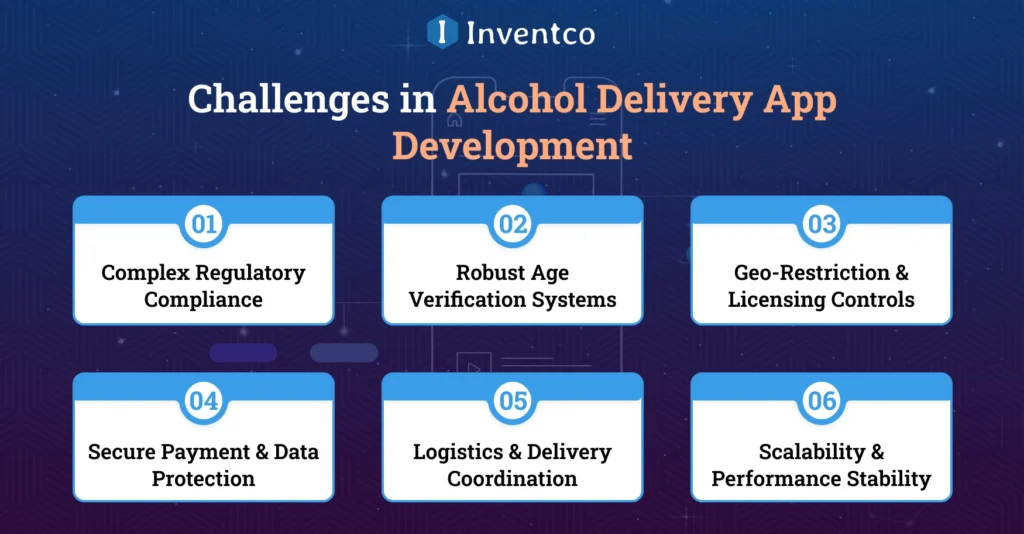
Building an alcohol delivery platform is more complex than standard app building. It encompasses regulatory understanding, operational accuracy, and extensive security systems. Below are six of the most significant mobile app development challenges in this industry:
1. Complex Regulatory Compliance
There is a wide range of alcohol-related legislation, licensing, taxation, delivery areas, and age limit laws that vary by state and by country. Not adhering to the laws and regulations of the area can lead to fines and/or suspension of business services.
2. Robust Age Verification Systems
To ensure adult access to the application, secure verification of a government-issued ID is required not only to register, but in many jurisdictions to also complete a delivery. The development of an age verification system that does not negatively affect the ease of use of the application is a significant challenge.
3. Geo-Restriction & Licensing Controls
The development of an alcohol mobile application that contains a geo-fenced delivery area is required to keep delivery restrictions in place to honor the rules of each region.
4. Secure Payment & Data Protection
All mobile applications that process payments and use personal information must include encryption and fraud prevention to secure this information.
5. Logistics & Delivery Coordination
The development of an efficient system that tracks delivery in real time, optimizes delivery routes, and holds delivery partners accountable for their performance is necessary to ensure customer satisfaction.
6. Scalability & Performance Stability
When demand for alcohol delivery services grows, the mobile application must continue to operate with the same ease and efficiency to ensure customer satisfaction and maintain the same region. Stability must be created outside of peak delivery hours to ensure the application can handle the same volume of service requests.
Future Trends in Alcohol & Liquor Delivery Apps
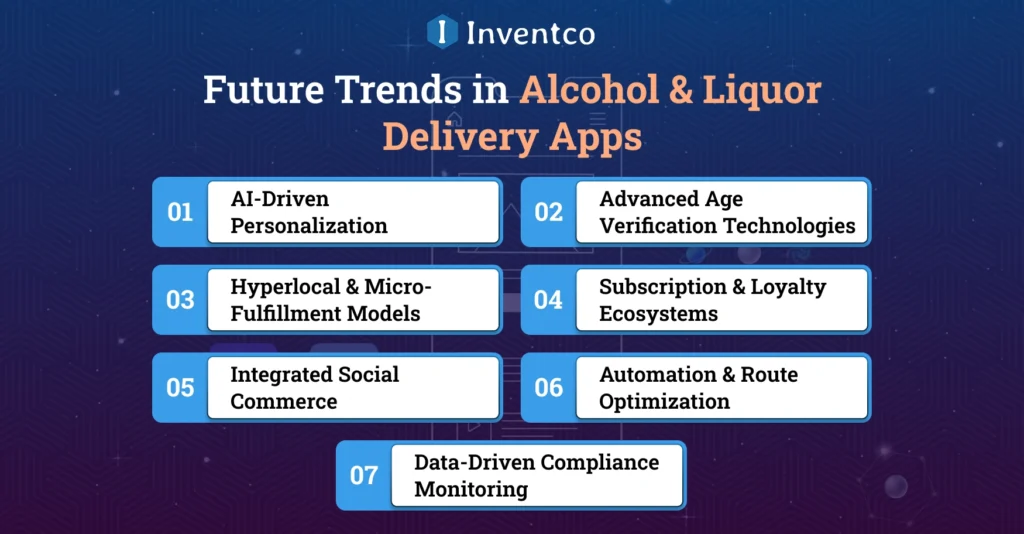
Continuous changes in app development, changes in consumer behavior, and changes in regulatory structures have given birth to new approaches in alcohol delivery apps. To help alcohol delivery startups and businesses stay relevant to market app development trends, it’s helpful to use existing patterns that tend to create long-lasting solutions.
1. AI-Driven Personalization
Smart technology enables more accurate recommendations based on purchasing histories and preferences. The use of predictive technology will continue to increase as alcohol delivery apps develop.
2. Advanced Age Verification Technologies
Real-time facial recognition and biometric identification tools provide more accurate age verification.
3. Hyperlocal & Micro-Fulfillment Models
Micro-warehousing and localized partnerships are shifting market expectations in major metropolitan areas. Increased service standards result from faster delivery speeds.
4. Subscription & Loyalty Ecosystems
Membership subscriptions that provide discounts, early access, and exclusive product launches are helpful for predicting future revenue.
5. Integrated Social Commerce
Over the last few years, apps have begun incorporating social sharing and promotional events and using influencers to increase the use and activity within apps.
6. Automation & Route Optimization
The use of AI for dispatching ensures operational costs are reduced, delivery efficiency is increased, and tracking is more accurate in real-time.
7. Data-Driven Compliance Monitoring
Automated compliance dashboards will assist businesses in monitoring licensing, taxes, and compliance reporting.
Founders who incorporate new technologies and evolving regulations into their business models will be better able to accelerate growth in the emerging alcohol delivery marketplace.
How Can Inventco Help in Alcohol Delivery App Development?
Alcohol delivery businesses can consult with Inventco for digital solutions built for regulatory compliance, operational efficiency, and long-term sustainability. Inventco’s understanding of website and on-demand app development helps entrepreneurs convert their ideas for regulated commerce into safe and ready-to-go, revenue-generating apps. Every project starts with an outline of technology to aid in the implementation of business and regulatory compliance for the location.
Inventco’s team of designers, engineers, and third-party specialists builds seamless solutions for all alcohol delivery technology needs, including UI/UX, backend systems, and third-party systems. They implement critical solutions for age-restriction-compliant payment systems, GPS tracking for location delivery, and systems for receiving customer reviews to create the best possible browsing experience for safe transactions and optimal order processing and management.
Inventco designs and develops apps for both the Android and iOS platforms. This results in both devices having equivalent and consistent, user-friendly experiences. Designers and developers are able to work with clients to build apps for continuous operational and system sustainability.
Alcohol delivery apps can grow by integrating Inventco’s technology and compliance expertise, enhancing delivery operations while ensuring high safety and compliance with the law.
Conclusion
Creating a successful alcohol delivery application requires more than mere technical skills in app development. Partnering with a seasoned app development firm like Inventco enables one to build an alcohol delivery application that achieves corporate objectives and gives customers a smooth and delightful experience.
Successful alcohol delivery app development requires understanding the current and potential future market and customer needs, as well as the regulatory constraints and requirements you must operate within. Now is the time to build and improve on Demand Delivery Apps. Regardless of whether you are a new player looking to enter the market or a more established player looking to optimize your value proposition, selecting the right alcohol delivery app development partner is key to your success.
FAQs
Q1. What is the alcohol delivery trend?
Ans. Driven by mobile app development technology and shifting consumer behaviors, the alcohol delivery trend focuses on convenience, digital presence, safety, and rapid access. Customers may now purchase alcohol online more easily due to the rise of smartphones and fast internet connectivity. Online alcohol sales are viewed as a way to capitalize on the sector’s potential for profit.
Q2. How much time does it take to develop an Alcohol Delivery App?
Ans. The time to develop an alcohol delivery app depends on a number of factors like technology used, features, platform (Android/iOS), tech stack, special requirements, and development location. The basic app can be developed in 4-6 weeks. Mid-level apps usually take 2-5 months to complete, and Advanced-level apps can take 5-8 months. For more details, you can connect with our support team.
Q3. Do you offer White-label alcohol delivery app solutions?
Ans. Yes, Inventco offers White-label alcohol delivery app products that are completely customized. As per the needs and scenarios, specific features can be added to provide a specialized solution.
Q4. Is it legal to operate an alcohol delivery app?
Ans. Yes, it is legal to operate an alcohol delivery app. However, it must adhere to regional and federal alcohol regulations, which include various factors like licensing, permit to transfer alcohol, and age verification.
Q5. What makes Inventco the best for alcohol delivery app development?
Ans. Inventco is one of the leading alcohol delivery app development companies because of our industry knowledge, customized development services, and specific solutions for specific problems. We provide a reliable system designed to satisfy the demands of alcohol delivery companies.
Q6. How does an alcohol delivery app work?
Ans. Customers use the app to place their orders by browsing a large selection of offerings. Several integrated alternatives are used to safely make payments. For prompt delivery, the order is forwarded to the closest liquor store. Orders are delivered by verified delivery operators that are linked with real-time tracking and provide progress updates.

Ajay Bhal
He is an on-demand app solutions expert with 11+ years of experience in business consulting and building scalable, user-centric digital products. He specializes in robust on-demand platforms across industries, combining technical expertise with business-focused strategy to deliver efficient, top notch solutions that drive growth and enhance user experience. You can connect with him on LinkedIn to follow insights.