Thinking of creating a Mobile app MVP? Right now is the best time to make a confident and strategic decision. With new integrations of AI and digital payments, on-demand services, and increased smartphone use, the global mobile application market was valued at around $313.88 billion in 2025 and is projected to reach approximately $357.58 billion in 2026. Mobile applications are a necessity, not an option, for any digital business model across all industries.
With rapidly growing demand, there are a few factors to consider. The competition is fierce, and thousands of apps are launched daily, but only a small number achieve sustainable traction. The primary reason for start-up failure is a lack of market demand.
MVP app development is essential for strategy. MVPs save time and money by proving the idea is worth pursuing before fully developing the app. It also allows for testing, collecting feedback, and optimizing. Financial risks also decrease. The market is there, but the real question is whether your idea solves the problem the market has.
This guide is a step-by-step guide to defining the core features, building, measuring, validating, and planning for growth. If you want to capture a share in a billion-dollar market, this is where you start. Let’s get started.
Key Takeaways
- The global mobile applications market is projected to exceed USD 780 billion by 2029. This indicates the need for validation before scaling the applications.
- It is estimated that 42% of startups fail due to a perceived lack of market demand. This demonstrates why the development of a Minimum Viable Product (MVP) is critical in establishing a mobile application market.
- An MVP (Minimum Viable Product) is designed to address a single primary issue by incorporating a few selective features to determine user demand.
- MVP development results in feedback-driven iterations, lower initial investment, and a quicker time-to-market.
- Build your MVP after identifying a real market gap and before fully committing to development, to validate the idea.
- Success increases through defined processes for outlining user engagement, research, market testing, and launches.
- Clean Code, the right technology stack, and a user-centered design will promote usability and provide a roadmap for future scalability.
- The continuous refinement of the product-market fit through testing, analytics, and user feedback will guide future roadmaps.
- Attracting potential investors with MVP-first strategies showcases engagement and demand.
- Strategically scaling through phased feature releases, optimization, and version upgrades will crowd your MVP.
- Creating the right technology framework, user experiences, and feedback-aligned design walls will ensure that the fallacy of treating MVP development as a way to build less won’t occur.
- Creating a sustainable build and a smarter framework for MVP development will also reduce uncertainty about future growth and ensure scalability.
Mobile App Market Outlook (2026 & Beyond)
The Mobile app industry is changing rapidly. With the increasing use of smartphones and a variety of app monetization options, this market’s growth is phenomenal. With the targeted use of mobile applications, the growth of this market and user mobility are essential to the development of any product.
- With a growth rate of 14%+, the mobile app market is expected to reach $626 billion in 2030. USD 252.89 billion is the value of the mobile apps market in 2023.
- Given the continued rise in adoption and use, estimates predict that the mobile apps industry will grow to $378 billion in 2026.
- There is a 15% increase in the estimated value of the mobile apps market, from $330 billion in 2026 to $1 trillion USD in 2034, indicating a massive opportunity for innovation and monetization.
- In 2026, the estimated value of global spending by app consumers, including in-app purchases and subscriptions, will reach $233 billion. The value of the monetization channels will continue to grow.
What Is an MVP?
The MVP app stands for Minimum Viable Product, the most basic version of your app that gives real value to users. MVP is designed to solve the core problem, with just enough features to engage early adopters, validate your concept, and gather feedback for your app.
“As you consider building your own minimum viable product, let this simple rule suffice: remove any feature, process, or effort that does not contribute directly to the learning you seek.” – Eric Ries, The Lean Startup.
In this phase of mobile app development, launching an MVP gives you an upper hand to test user behavior, verify demand, and iterate based on feedback, all without spending your whole app budget.
With the help of an MVP app, you get real insights early, which helps you avoid wasting resources on unnecessary features that have no use in your mobile app and also minimizes risk while learning what your users truly want.
MVP App Meaning Simplified:
- Minimum: Just enough features to solve the core problem.
- Viable: Usable and valuable to early adopters.
- Product: A tangible mobile app, not a mockup or pitch deck.
Why Build an MVP App?
Are you still confused about whether creating an MVP for mobile apps is worth the effort and time? Here’s why it’s not just smart, it’s a must-have. An MVP mobile app can help you validate your idea in the early stage of your mobile app development by releasing a fully working app to users.
This helps you to get honest, practical feedback right from the start. Instead of investing heavily in full-scale development, you can save time and money by focusing only on the needed features that actually help your app users. The MVP app also gives you the chance to test your mobile app idea in the real world and make data-driven choices for the betterment of your business app.
Moreover, early results can attract possible investors and show market demand for your product. Most importantly, it gives you quick development so your app grows in line with user standards and helps your app model to become a giant.
When Is the Right Time to Create an MVP?
Timing is everything in mobile app development, and knowing when to build an MVP app can undoubtedly impact your app’s success. So, how do you know that this is the right time to create an MVP mobile app?
Make it clear that if you’ve found a unique problem that is genuine or have spotted a market gap, or are unsure about your app’s potential, this is the perfect time to introduce your Minimum Viable Product. An MVP app allows you to test your idea in the real world, whether this problem is real or not, before you commit to a full-fledged mobile app.
This method is particularly great for:
- Startups in the early stages of app development that are trying to validate their idea quickly.
- Entrepreneurs seeking product-market fit without draining resources.
- Businesses looking to try features, receive user feedback, and improve their strategy before growing.
Simply, if you want to move forward with confidence, avoid unnecessary risks, and make smart decisions based on real user data, then building a mobile app MVP isn’t just a good idea; it’s a must.
Step-by-Step Process to Develop an MVP App
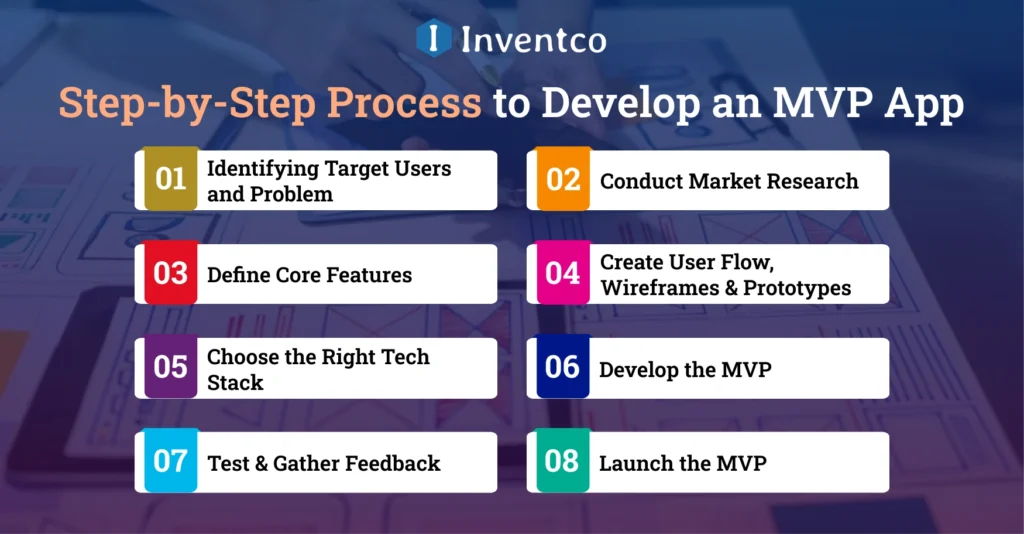
Here’s your complete step-by-step roadmap for creating an MVP in mobile app development. This is designed to guide you all the way from concept to launching your MVP app, with clarity and confidence, so let’s start:
Step 1. Identifying Target Users and Problem
The first step in developing an MVP mobile app is to understand your target audience, then filter out the audience and identify your ideal user who is perfect for your idea. Ask yourself:
- Who is my ideal user?
- What specific problem am I solving for them?
Creating detailed profiles of the users helps you to figure out their pain points, which allows you to customize your MVP app to meet their challenges. The main motto should be apparent and provide a user flow that is straightforward and useful, which provides key functions in the most user-friendly way.
Step 2. Conduct Market Research000
The next step is to conduct market research, which is very useful for you when you develop your MVP app; it’s like planning the route before your journey.
- Market demand and new app development trends
- Competitors and their app features
- User complaints and feature holes in current solutions
You can use tools for your market research, such as Google Trends, App Annie, and Statista, which help you find your niche target audience and how your product can fill the market gap. This market research gives you important and useful insights that guide your mobile app development process, ensuring your MVP meets the real market needs and makes your app stand out from your competitors.
Step 3. Define Core Features
The next step in creating an MVP mobile app is to define your core features. In this part of the MVP app development, your goal is to identify the must-have features in the mobile app that solve the user’s real problems and support your overall mobile app MVP strategy.
Use a feature ranking grid to organize features:
- Must-Have
- Should-Have
- Nice-to-Have
By this step, you can match each needed feature with your users’ needs, which maintains simplicity and usability of your app without sacrificing its value.
Step 4. Create User Flow, Wireframes & Prototypes
It is one of the most important stages when you develop an MVP mobile app, where your app relies on the user navigation and usability of your MVP app. In this step of your mobile app development, you can create an app flow that displays your user flow within your app and enables users to efficiently utilize all the basic features in your MVP app.
Once you have decided on your MVP app user flow, you can continue with mobile app wireframing. The wireframe is the skeletal framework of the MVP app, by which you can understand the function and structure of every screen of your app. Use these wireframes to create your own prototypes, interactive mockups of your app that you can use for testing the usability of your app.
Wireframing and Prototyping Recommended Tools:
- Figma
- Adobe XD
- Sketch
Step 5. Choose the Right Tech Stack
Choosing the right mobile tech stack for your MVP app development is a must. It can save time and cost in your app development, depending on market demand.
Consider the following essential factors:
- Development Speed: How much time does your app development team take to create an MVP app and deploy it?
- Future scalability: Ensure that you select the right tech stack, which must support high user demand and modern features.
- Availability of Developers: Ensure that there are skilled and dedicated developers available to hire for your chosen mobile app tech stack.
Popular MVP tech stacks include:
- Frontend: For the MVP app, people often choose Flutter and React Native, as these tech stacks are well-suited to cross-platform development, making them the best way to build your MVP on all platforms in less time.
- Backend: For the backend, Node.js, Firebase, and Django are the best choices for the MVP, as they offer flexibility, scalability, and ease of mobile app maintenance.
Choose the right tech stack, and your app is future-flexible and performant, which allows you to get the most out of it. With the right choice, you can save hours of refactoring in the future and ensure your app can scale with your business.
Step 6. Develop the MVP
Once your MVP app foundation is built, it’s time to create your MVP mobile app. No matter whether you are thinking of creating an Android app development, an iOS app development, or a cross-platform app, you need to follow agile development methodologies, which are essential for a successful MVP app.
Below are some key tips that you should keep in mind to keep your development on track:
- You need to follow the step-by-step MVP mobile app development process, which helps you plan your strategy so your mobile app development team can execute it more easily and review your progress regularly.
- Ensure that your codebase is clean and lean, so that you can minimize technical debt and simplify future updates.
- Make sure that you prioritize feature completion and functionality over perfection, especially in the early stages of your MVP mobile app development.
By following this approach for your MVP mobile app, your app remains agile and user-friendly, which helps you to deliver a high-quality product that addresses user needs while reducing time to market.
Step 7. Test & Gather Feedback
One of the most crucial steps in MVP app development is mobile app testing, not just to check the box, but also to ensure your MVP meets user expectations and performs seamlessly. For this, you need to conduct several mobile app testing processes.
- Functional Testing: Confirms that all features work as intended without bugs.
- Usability Testing: Checks how intuitive and user-friendly your app is.
- Analytics Tracking: Monitors user behavior, revealing friction points and usage patterns.
Tools to assist you include:
- Mixpanel: Advanced user analytics.
- Hotjar: Heatmaps and behavior insights.
- Google Firebase Analytics: Real-time data and crash reports.
These testing tools help you redefine your app based on actual user interaction, which allows you to prioritize your MVP app features, improve UX, and optimize your roadmap for future updates. The end goal? You get a polished, feedback-driven mobile app MVP that is built stronger with every iteration, powered by insights from smart mobile app testing.
Step 8. Launch the MVP
The final and essential moment has come to launch your app, but in a strategic way. To launch your MVP mobile app instead of a mass rollout, you can start with a targeted launch to beta testers, early adopters, or closed user groups. With this approach, you can maintain control over the app flow, gain valuable insights that are easy to monitor and implement as needed, and evaluate mobile app security measures to ensure data protection, compliance readiness, and system stability before a wider public release.
Innovative launch strategies include:
- Promoting within niche social communities and mailing lists.
- Leveraging platforms like Product Hunt for visibility.
- Gathering feedback and real-time usage data immediately.
- Sticking to a clear and concise MVP launch plan.
Once you’re confident in your MVP app’s performance and stability, you can proceed to publish it on the App Store or submit it to the Google Play Store. At this stage of your MVP mobile app development, the release model helps ensure your product is battle-tested before reaching a wider audience. This is also the right time to focus on app store optimization, including keyword refinement, compelling app descriptions, optimized visuals, and user review management to improve discoverability.
Benefits of Building a Mobile App MVP
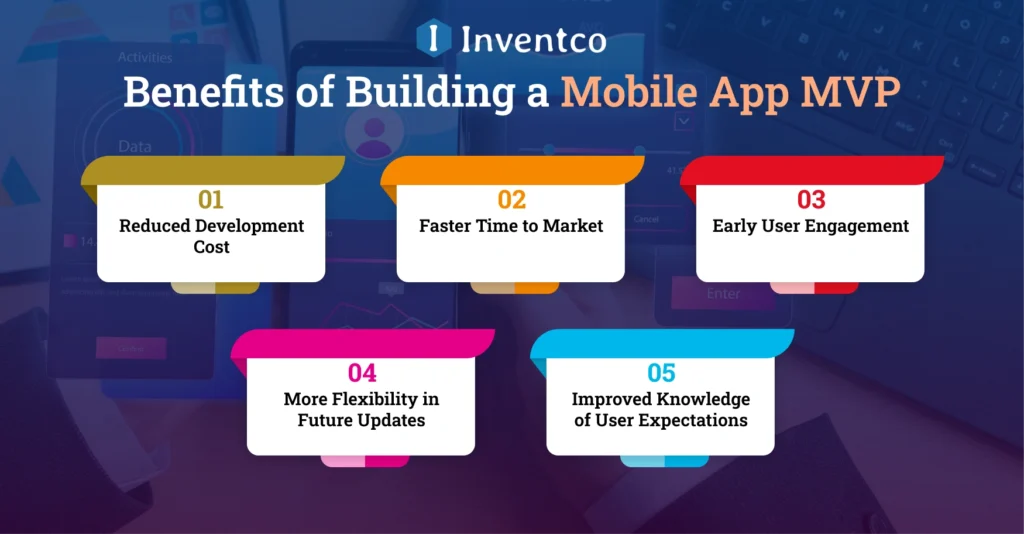
Creating a Minimum Viable Product (MVP) is not just a strategic move, but it is also a wise and favourable move in terms of investment, especially in a highly competitive market like Android and iOS app development.
Developing an MVP has the following benefits for your app journey:
- Reduced Development Cost: You may greatly reduce your original development costs by focusing solely on essential features. You stay clear of spending on features that may not be needed.
- Faster Time to Market: You can compare your MVP product with a fully developed product. An MVP app allows you to start faster and begin connecting with a real audience.
- Early User Engagement: With early user engagement, you can receive instant feedback from the actual users, helping you understand what your users want and refine your app experience.
- More Flexibility in Future Updates: With a simpler basic version, you can simply change and improve your app based on feedback without completely redoing it.
- Improved Knowledge of User Expectations: By finding user behavior, preferences, and market demand, an MVP helps developers make more informed decisions about future developments.
While you develop an MVP in the initial stage, it sets a strong user base for the success of a flexible, effective, and user-focused mobile app.
MVP App vs Full-Fledged App: Which One Should You Build First?
Whenever you are planning to create a mobile app, one thing always comes to mind: whether you choose to create an MVP app or develop a full-fledged app, which defines your project’s success.
Here is a quick comparison between the MVP app and the full-fledged app, which helps you decide.
| Criteria | MVP App | Full-Fledged App |
| Development Time | Short (1–3 months) | Long (6+ months) |
| Cost | Low to Medium | High |
| Features | Core features only | Comprehensive features |
| Feedback Opportunity | High (early feedback) | Low (after full release) |
As per my recommendation, you should always start with an MVP in mobile app development. MVP allows you to test your idea with minimal risk, get user feedback early on, and make data-driven improvements before you invest heavily in your app. This approach is efficient for both platforms, whether it is for an iOS app or an Android app, where time-to-market and flexibility are critical.
Famous Examples of MVP Apps That Made It Big
There are so many apps that you use on a daily basis that start as a simple MVP app. The founders of these top apps are focusing on solving a key problem, testing them on real users, and improving their mobile app features and functionality based on user feedback.
Here is the list of the top mobile apps that started as an MVP:
| App Name | Initial MVP Focus |
| Airbnb | The Airbnb founder started a simple website where you can rent an air mattress from the founder’s apartment. |
| Dropbox | The initial MVP of Dropbox was a demo video showcasing seamless file syncing, which they used to get massive sign-ups and validate the demand. |
| Instagram launched its MVP as a photo filter and basic sharing. | |
| Exclusive network for Harvard students | |
| Internal SMS platform called “Twttr” | |
| Uber | Black car service only in San Francisco |
| Spotify | Desktop-only music streaming for select users |
| Zappos | The founder took pictures from shoe stores and sold them online |
| Basic profiles and network connections | |
| Virtual pinboard for collecting and sharing images |
These MVPs validated their ideas, gathered traction, and scaled smartly.
Top Mistakes to Avoid While Building an MVP App
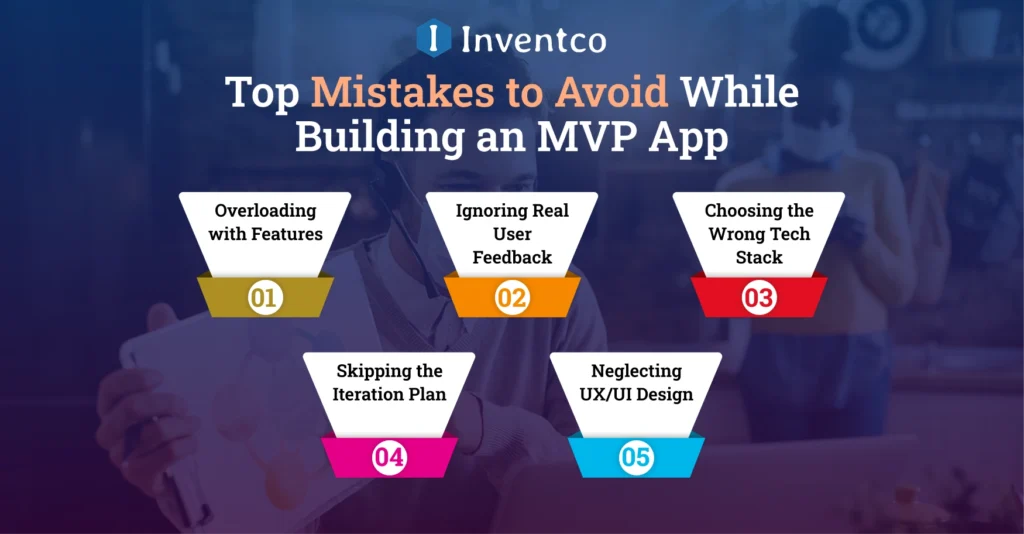
Creating an MVP is the best move in mobile app development, but only if you do it right. Many businesses face issues because they have overlooked the basic essentials of an MVP:
Here are some top mistakes that you need to avoid while creating an MVP app for your business:
- Overloading with Features: You need to focus on the core features and functionality of your MVP app that really solve the real problem, as adding too many features will increase development costs and time, delay launch, and reduce your app’s value proposition.
- Ignoring Real User Feedback: User feedback is the key to the success of your MVP app. Avoid relying solely on assumptions and listen to users, and iterate accordingly.
- Choosing the Wrong Tech Stack: When selecting a tech stack, ensure that it aligns with your scalability goals, app development budget, and the availability of skilled mobile app developers. Choosing the wrong or poorly designed tech can cause you long-term complications.
- Skipping the Iteration Plan: Building an MVP mobile app is not the end; it is the start of your business app. You need to plan updates based on user feedback and user analytics to stay reliable for your app users.
- Neglecting UX/UI Design: If you neglect the UI/UX, that simply means you are compromising your user experience. The MVP app also needs a smooth user experience and a clear mobile app interface to capture users in the early stage.
Avoiding these key mistakes ensures your MVP mobile app lays a strong foundation for your business success.
How Much Does It Cost to Build an MVP App?
The cost of mobile app development depends on the features, location, and complexity of the app.
Mobile app development cost range:
- For a fundamental MVP, the estimated cost range is $5,000 to $50,000.
- Complex or scalable app costs are higher.
The overall price is also affected by factors such as the chosen tech stack, the UI/UX design, and third-party integrations. The cost depends on whether you want to work on iOS app development, Android app development, or both. Use cost calculators or talk to experienced coders to get a good idea. A good idea is to start with a learning class. This helps you identify the scope of your app, rank the most critical features, and make an MVP development cost estimate that fits your business goals.
How to Measure Your MVP App’s Success?
The success of the app isn’t just about the downloads. To effectively measure your MVP app’s impact, focus on key performance indicators that reveal real user engagement and satisfaction.
Track The Following Metrics:
- Active Users: The number of users regularly interacting with your app.
- Retention Rate: How many users return over time.
- Feedback Quality: The usefulness and sentiment of user reviews and suggestions.
- Net Promoter Score (NPS): Measures how likely users are to recommend your app.
- Revenue: If your app generates income, monitor earnings closely.
These metrics guide you in refining your mobile app MVP development, prioritizing updates, and confirming product-market fit. Consistently monitoring and analyzing these indicators sets the foundation for your app’s long-term success.
What If Your MVP App Succeeds? Here’s What to Do Next
If your MVP app gains popularity and shows good results, congratulations! But remember, the MVP is just the starting place, not the end destination. To build on your success, focus on ongoing improvement.
First, iterate based on user feedback. Listen closely to what people love and what app development challenges they face. Use this knowledge to improve current features and fix problems quickly.
Next, add new features gradually, choosing those that fit with your users’ wants and business goals. Avoid rushing to include everything at once; smart, phased updates help maintain stability and user happiness.
Additionally, improve your app’s performance to ensure a smooth and enjoyable experience, especially as your user base grows. Finally, begin planning version 2.0: a more polished, scalable app that builds on your MVP’s foundation and delivers greater value.
How Can Inventco Help You Build a Powerful MVP App?
At Inventco, we believe that safe mobile app MVP development is rooted in successful product iterations. Rather than simply writing code, we help mobile app development clients think beyond their initial ideas to construct outcomes, validate their market, and define the scope of their future mobile development projects.
Inventco is the only mobile app development company that provides MVP-identified consulting and structured product discovery workshops, complete life cycle development, and custom UX/UI design development that is beneficial to in-app users and the market. Inventco creates its MVP with future iterations and analytics integration in mind.
Whether focusing on commercial or technical requirements, Inventco is an app development company that creates value and upholds transparency. Inventco aims to provide a user-defined MVP build that comprehensively meets commercial development and long-term profitability requirements. With Inventco, users have a mobile development partner that is committed to delivering a legally safe, user-centered MVP.
Wrapping Up
Creating an MVP app is the most innovative way to validate your idea quickly, reduce development costs, and accelerate your time-to-market. Instead of aiming for a perfect, feature-heavy product from the start, focus on building a minimum viable product that delivers real value to users. An MVP allows you to test your concept, gather essential feedback, and make informed improvements without wasting resources. By adopting a lean approach, you reduce risk and increase your chances of success. So, go lean, go smart, and prioritize building the right MVP first to lay a strong foundation for your app’s future growth.
FAQ’s
Q1. What is MVP in mobile app development?
Ans. MVP (Minimum Viable Product) is the simplest version of an app that includes only core features. It’s used to validate your idea and gather user feedback quickly.
Q2. How long does it take to create an MVP app?
Ans. It usually takes 1 to 3 months, depending on the app’s features, tech stack, and the development team’s speed.
Q3. How much does MVP mobile app development cost?
Ans. Costs range from $5,000 to $50,000, based on complexity, platform, features, and development location.
Q4: What are the must-have features in an MVP app?
Ans. Core functionality, simple UI, user onboarding, feedback mechanism, and basic performance tracking tools like analytics.
Q5. What’s the difference between an app prototype and an MVP?
Ans. A prototype is a clickable design mockup; an MVP is a working app with essential features ready for real user testing.

Jitendra Jain
He is the CEO and Co-founder of Inventco, driving innovation in advanced computing and digital transformation. With deep expertise in modern IT ecosystems, he leads scalable, secure, future-ready solutions. His strategic leadership helps businesses accelerate growth, adopt innovation, and achieve success. You can connect with him on LinkedIn to follow his technology insights.