The way fans watch sports has changed for good. Cable bundles are losing ground every year, while mobile-first audiences expect instant access to live matches, replays, and real-time stats from wherever they are. As audiences shift to digital sports, there has been an explosion of investment in OTT services, regional leagues, and independent sports. These entities want to get their audiences and revenue without having to share them with a traditional media outlet.
The statistics for investment in sports streaming say it all. The 2023 global estimate of sports streaming was $33.9 billion, and if it keeps growing at the current 12.6% growth rate, it will surpass $68 billion by 2030. In the US, live sports audiences exceed the traditional pay-TV audience. While football maintains its lead in revenue sports, audiences in the UK, Australia, and especially in India have been focusing on Cricket.
A burgeoning market does not guarantee success. Research shows that more than half of all sports viewers experience some sort of inconvenience while trying to view live streams. Almost 30% of those inconvenienced do not view sports events simply because they do not have a subscription to the platform that is airing the event. For investors and entrepreneurs, the lack of friction for potential spectators is where value is created.
This guide explains what developing sports streaming apps looks like in 2026, including which apps to build, which features retain fans, how to estimate costs and timelines, the investment pay-off opportunities, how to plan for obstacles, and more.
Key Takeaways
- Live streaming app development typically costs between $10,000 and $100,000+, depending on streaming infrastructure, feature scope, and platform coverage.
- The global sports streaming market is growing at a double-digit pace, with fans actively seeking flexible, on-demand access over traditional cable.
- Features like adaptive bitrate streaming, multi-angle viewing, real-time stats overlays, and DRM-protected content separate a competitive app from a basic one.
- A phased build covering discovery, design, backend and CDN integration, testing, and launch generally takes four to nine months.
- Hybrid monetization combining subscriptions, advertising, and pay-per-view consistently outperforms single-revenue models in sports streaming.
- Partnering with an experienced development team reduces risk around latency, scalability, and content licensing compliance.
What Is Sports Streaming App Development?
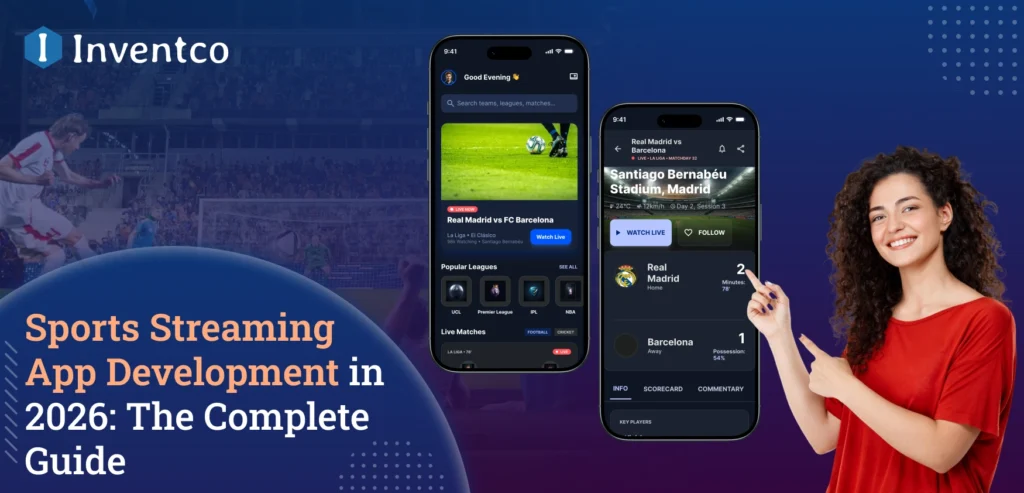
Sports streaming app development refers to building a live streaming mobile app, web, or connected TV apps that offer direct-to-viewers live and on-demand sports content that bypasses traditional cable or broadcast offerings. In order to achieve this, sports streaming apps require the infrastructure of video streaming coupled with sports functionality like adaptive audio and video, live scoring, camera angle switching, real-time stats, and dynamic feeds.
Unlike the development of traditional entertainment video streaming apps, sports video streaming apps are built against time. For viewers, nothing is more frustrating than a delayed video stream for that last-minute sports goal or a key play. As a result, sports teams that set out to design a live sports streaming app quickly learn that the first design priority will always be latency. Low-latency video and audio, instant notifications of game events, and real-time sports data integration are app development prerequisites, and no longer “nice-to-have features.”
Why Is 2026 the Right Time to Invest in Sports Streaming App Development?
A number of elements are aligning to make 2026 the most opportune year yet to attract investment in sports streaming.
- Fragmented media rights are pushing fans toward direct-to-consumer apps: As exclusive broadcasting rights are further split across different platforms, fans are increasingly interested in purchasing dedicated apps that provide access to their preferred leagues, teams, or tournaments.
- Faster mobile networks have removed the buffering excuse: It is very important for network providers to understand that even a few seconds of delay can entirely change the viewing experience for sports fans.
- Regional and niche sports are becoming commercially viable: Markets in the US, India, the UK, and Australia have demonstrated that sports previously considered too regional for the major broadcasters can sustain an audience when streamed using the proper application.
- Hybrid monetization has matured: Advertisers increasingly value live sports inventory for the same targeting and attribution capabilities they get from other digital channels, which means ad-supported and hybrid models can now generate meaningful revenue alongside subscriptions.
- Fan engagement expectations have risen: Sports apps need to incorporate more features and more ways to engage the viewer beyond simply streaming content.
Together, these shifts mean the market is rewarding well-built, purpose-specific sports apps over generic streaming platforms. This app development trend toward direct-to-consumer sports platforms shows no sign of slowing, which is precisely the opening founders and investors should be evaluating now.
Types of Sports Streaming Apps You Can Build
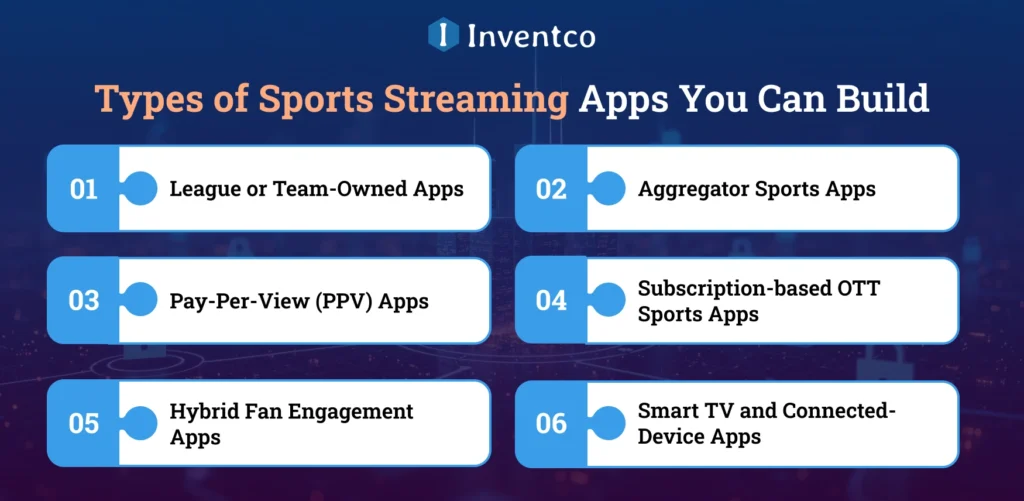
Knowing your audience and your business model immensely helps you to identify which sports streaming application you wish to develop. The major types you can choose from are:
- League or team-owned apps: These applications are built by specific leagues or clubs to sell match tickets directly to their fans. These are usually built to cater to news and fan community features.
- Aggregator sports apps: These applications cater to sports fans who are not limited to one league. These are used to collect streams, scores, and highlights of multiple sports and leagues.
- Pay-per-view (PPV) apps: Designed for single-event sports streaming such as boxing, MMA, and other selected high-profile matches that users will pay to view as one-time events rather than a subscription.
- Subscription-based OTT sports apps: Sports apps that are on-demand for users for a subscription fee to access content within a certain period or for a certain number of matches or leagues.
- Hybrid fan engagement apps: These types of apps are used to further engage users in the app beyond the streaming of the match by integrating live fantasy sports as well as betting and social features.
- Smart TV and connected-device apps: These apps are built specifically to operate sports streaming on the big screens. These are usually built in conjunction with a mobile application.
Each of these types of sports streaming apps requires different considerations for how they will impact cost, infrastructure, and licensing. This helps narrow down your options early in the build process.
Must-Have Features of a Sports Streaming App
Regardless of which type of sports streaming app you build, certain features have become non-negotiable for fan retention and platform credibility. When you map out mobile app features for a sports platform, the table below is a useful starting checklist.
| Feature Category | Key Features | Why It Matters |
| Streaming Core | Adaptive bitrate streaming, multi-CDN delivery, low-latency live playback | Ensures smooth video playback across different network conditions and reduces viewer drop-offs during live events. |
| Content & Engagement | Multi-camera angles, instant replays, live stats overlays, push notifications | Delivers an immersive viewing experience and keeps fans actively engaged throughout the event. |
| Personalization | Favorite team and league feeds, personalized highlights, watch history | Improves user retention and watch time by serving content tailored to individual preferences. |
| Monetization | In-app subscriptions, ad insertion, pay-per-view checkout | Creates multiple revenue streams and maximizes earnings from different audience segments. |
| Security & Compliance | DRM content protection, geo-restriction, secure payment gateways | Protects content rights, secures transactions, and maintains compliance with licensing requirements. |
| Performance & Access | Offline downloads, multi-device sync, smart TV support | Enables seamless viewing across devices and locations, increasing platform adoption and loyalty. |
Building all of these from day one isn’t always necessary, many successful sports apps launch with a focused feature set and expand based on real usage data, an approach that also keeps initial development costs in check.
Step-by-Step Process to Develop a Sports Streaming App
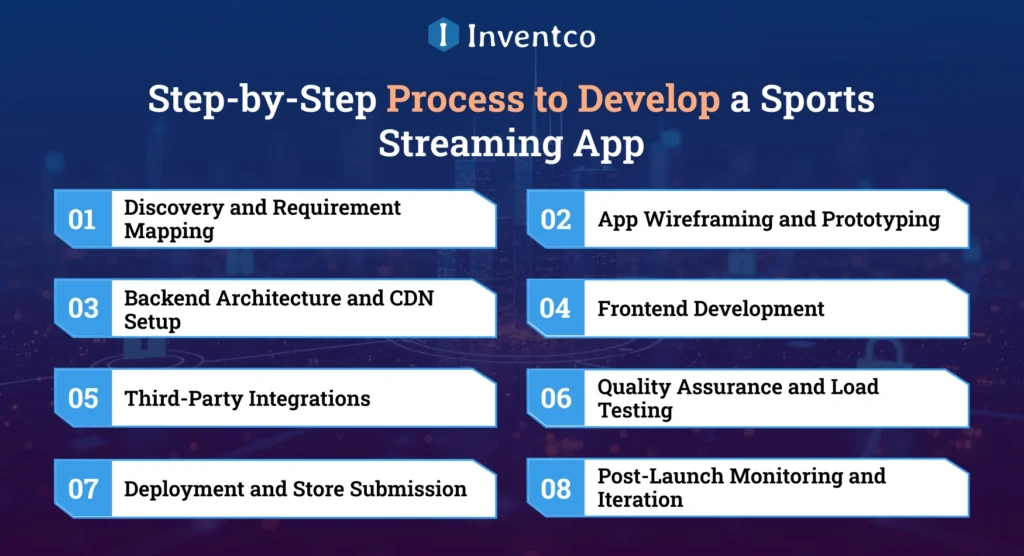
The mobile app development process for sports streaming follows a fairly predictable structure, even though specifics vary by project scope.
1. Discovery and Requirement Mapping
The first step in the project is to identify the audience, the sports, the geography, the monetization, and the licensing. The teams look at the streaming infrastructure, the sports data, and the APIs that are available for integration. They evaluate these to understand if the platform can provide compliant content and if the platform is sustainable for the business.
2. App Wireframing and Prototyping
With app wireframes and interactive prototypes, the development team and stakeholders can see the design and user journey. The team and stakeholders can validate and make suggestions for the design of the platform, including how to access live streaming and content, the platform’s interactive features, and user engagement features.
3. Backend Architecture and CDN Setup
A robust backend powers content delivery, user management, subscriptions, and metadata handling. Developers configure video encoding workflows, cloud infrastructure, databases, and content delivery networks to ensure secure, scalable, and low-latency streaming performance for viewers across multiple regions and varying network conditions.
4. Frontend Development
Frontend development transforms approved designs into a functional mobile application. Using native or cross-platform mobile app development frameworks, developers build responsive interfaces, optimize user experiences, and ensure compatibility across devices. Early platform prioritization helps streamline testing efforts and accelerate deployment to the most valuable audience segments.
5. Third-Party Integrations
Integrations connect the app with essential external services, including sports data feeds, payment processors, content protection systems, analytics platforms, and notification services. These tools enhance functionality, simplify operations, improve app security, and provide the real-time insights necessary to deliver an engaging sports viewing experience.
6. Quality Assurance and Load Testing
To ensure the application holds up in the real world, exhaustive quality mobile app testing is done. Quality testing is done on multiple features like streaming, subscriptions, notifications, and user experience, but done in simulations of traffic peaks. This helps discover performance limitations, and as a result, the application avoids outages in the real world, and the quality of user experience is maintained.
7. Deployment and Store Submission
The application is now ready to be submitted to all the app stores after the last set of checks are done. Developers verify that all the rules and compliance requirements of the app store have been observed, the app store listing has been optimized, all settings in the app have been done, and the release has been checked. A well-done launch helps with approval and makes the app more visible.
8. Post-Launch Monitoring and Iteration
After the application is launched, streaming, user, and engagement metrics are continuously monitored. This data assists in deciding which updates to perform and which bugs to prioritize. Improvements to the application help increase retention and revenue, and maintain a competitive user experience.
The typical time frame for this sequence is four to nine months. However, time is most impacted by how many features are requested, how many application store platforms are targeted, and the complexity of the data services and licensing integrations.
Sports Streaming App Development Cost in 2026
Founders researching the cost to build a mobile app in the sports category quickly find that streaming infrastructure adds a layer of expense general apps don’t carry. Cost is rarely a single number, it’s a range shaped by app type, streaming infrastructure, and how many platforms you’re launching on simultaneously. For sports streaming app development, that range typically falls between $10,000 and $100,000+, broken down below by project complexity.
| Project Tier | Typical Scope | Estimated Cost Range |
| Basic / MVP | Designed for market validation, this version typically includes a single-platform application for either iOS or Android, live video streaming capabilities, basic score updates, push notifications, user registration, and essential content management features. | $10,000 – $25,000 |
| Mid-Range | A more feature-rich solution supporting both iOS and Android platforms. It generally includes multi-CDN streaming, real-time statistics overlays, user profiles, personalized content feeds, subscription management, advertising integrations, and improved scalability for growing audiences. | $25,000 – $60,000 |
| Advanced / Enterprise | Built for large-scale operations, this tier supports multiple platforms including mobile devices and smart TVs. Features often include DRM protection, multi-camera viewing, advanced personalization, fantasy sports or betting integrations, AI-driven recommendations, and enterprise-grade infrastructure. | $60,000 – $100,000+ |
Several factors push costs toward the higher end of this range: the number of concurrent viewers the infrastructure must support, the complexity of sports data and licensing integrations, multi-language and multi-region support, and the depth of personalization features. An MVP mobile app focused on a single platform remains the fastest, most cost-efficient way to validate demand before committing to a full build.
Monetization Models for Sports Streaming Apps
Picking the right mobile app monetization strategy is just as important as choosing the right app technology stack, since both factors influence whether the app survives the initial funding stage.
- Subscription Video on Demand (SVOD): Users subscribe and pay a set price to access content for a defined time period. This model is particularly appealing when app developers and content providers are able to deliver a steady stream of sports content to app users.
- Advertising Video on Demand (AVOD): Revenue is generated from ads placed before, during, or after a content stream. This model reduces the barrier to entry for the fans and is successful for applications that focus on coverage or reach, as opposed to a premium application.
- Pay-Per-View (PPV): Fans buy access to a content stream for a single, special event. This model is successful for events that have high demand for a single date, such as combat sports or highly anticipated matches.
- Freemium with In-App Purchases: Users can access core content, such as scores or highlights, at no charge. However, paid access is required for features that provide a replay of the event or that allow viewing with no ads.
- Fantasy Sports and Betting Integrations: Where regulated, in-app placement of licensed betting and fantasy leagues provides a partnership that generates revenue and increases user engagement during live events.
- Hybrid Models: The most successful sports apps do not rely on a single monetization model. The blended model that uses a base subscription with a limited ad model and selective pay-per-view monetization for premium sports content is the optimal model.
Key Challenges in Sports Streaming App Development & How to Solve Them
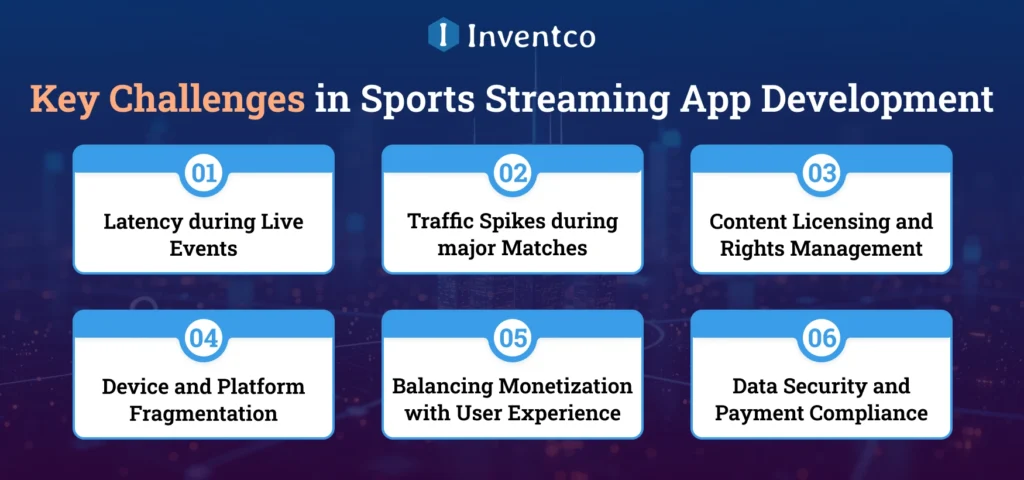
Building a live streaming app has its own unique challenges. Many fall outside the same category as typical video streaming. Not all challenges for app development are exclusive to sports, but are particularly important for cases involving the delivery of live media.
1. Latency during Live Events
Users may be frustrated by a handful of seconds of buffering if they are also viewing the event over social media. Frugal implementations of streaming services are often required to be updated to include low-lag streaming and multi-CDN services.
2. Traffic Spikes during major Matches
Viewership may increase exponentially for certain events. During these times, services can become unavailable. Build and test systems that will scale to accommodate these anticipated loads.
3. Content Licensing and Rights Management
Obtaining the right to broadcast specific content and adequately enforcing geographic restrictions may be more of a challenge than the actual implementation of the service. Begin with legal services and include geo-fencing in the initial development.
4. Device and Platform Fragmentation
Fans expect a consistent experience across phones, tablets, smart TVs, and browsers, each with different playback capabilities. Choosing a cross-platform framework with native performance tuning reduces long-term mobile app maintenance overhead.
5. Balancing Monetization with User Experience
Overloading the app with ads or paywalls early can drive fans away before the platform builds loyalty. Phasing in monetization gradually, supported by usage data, tends to outperform aggressive monetization from day one.
6. Data Security and Payment Compliance
Subscription and pay-per-view transactions require secure, compliant payment processing across regions, alongside DRM protection that satisfies rights holder requirements.
For an experienced development partner, these are not problematic concerns, although they need to be addressed at the architectural level, as opposed to being layered in during development, which is a common problem that occurs within self-funded and under-scoped projects.
Popular Sports Streaming Apps to Take Inspiration From
Looking at established platforms offers a useful benchmark for what fans now expect by default.
- ESPN built its app around a deep content library spanning multiple sports, paired with live scores, personalized notifications, and a strong on-demand highlights library that keeps fans engaged outside live match windows.
- DAZN focused heavily on combat sports and football, proving that a subscription model built around specific high-demand sports categories can scale internationally without covering every sport under one roof.
- FuboTV positioned itself as a cable replacement specifically for sports fans, bundling live channels with cloud DVR functionality and showing how a hybrid live-plus-on-demand structure can target cord-cutters directly.
- Disney+ demonstrated how regional sports, particularly cricket, can drive massive simultaneous viewership and become a flagship use case for scalable streaming infrastructure during major tournaments.
These platforms differ widely in scope and sport focus, but they share common technical foundations, reliable low-latency streaming, strong personalization, and monetization flexibility that any new entrant should treat as a baseline rather than a differentiator.
How Long Does It Take to Develop a Sports Streaming App?
Development timelines vary by scope, but most sports streaming apps follow a predictable pattern. Building a focused MVP with single-platform streaming and basic features usually takes around 3 to 4 months from discovery to deployment. An MVP with cross-platform app streaming, subscription monetization, and stats integrations usually takes around 5 to 7 months. Full-featured apps that support multiple platforms and include integrations for streaming with multiple cameras, support for DRM, online fantasy, or betting may take longer than 8 to 9 months, especially if licensing negotiations are conducted at the same time.
For this category of app, potential clients would like to know how long it would take to develop the app. The answer would be that the time it takes to develop a mobile app, is the least of their concerns, especially if they take into account how long it will take to secure the licensing and all of the integrations, since the time it will take to integrate payment systems, sports data, third parties, and DRM systems would take the longest as compared to all of the development activities done in-house.
How Inventco Helped You in Your Sports Streaming App Development Journey?
At Inventco, sports streaming projects start with the same question every serious investor asks first: what does this platform need to do on its best day, during the championship final or the series decider, without breaking? Our team architects for low-latency delivery and traffic scalability from the discovery phase, rather than treating it as a post-launch fix.
More than having the technical ability to build, Inventco collaborates with founders on monetization strategy and helps them determine what mix of subscription vs advertising vs pay-per-view will work best for the sport and audience, and what the best geographies will be for each. We have built multi-CDN streaming, integrated DRM for licensed content, connected sports data APIs, and developed cross-platform solutions for mobile and Smart TVs.
For founders interested in the streaming space, the value of an experienced technology partner is most apparent in what does not happen: no streaming crashes at peak viewership, no gaps in licensing, and no expensive rebuilds due to the initial architecture not being planned with growth in mind. This is what Inventco aims to accomplish for all of its sports streaming projects, be it a dedicated application for a specific region, or a global, multi-sport application.

Conclusion
Sports streaming is no longer a side bet for broadcasters; it’s becoming the primary way fans engage with the leagues, teams, and events they care about, and the market data backs that shift clearly. For founders and investors, the opportunity is real, but it rewards platforms built with the right technical foundation from day one: low-latency streaming, scalable infrastructure, thoughtful monetization, and features that match what fans now expect as standard rather than premium.
Live streaming app development costs can span from $10,000 to $100,000 and more, hitting varying scopes, ranging from a small regional sports MVP to a competing multi-sport, large-scale app across all platforms. The key differentiator that ignites a launch as opposed to a stalled one is never budgetary alone, but rather the planning of the architecture, licensing, and monetization done pre-development. If you are considering this opportunity, the ideal tech partner will ensure that the MVP will take four months to create, rather than a year to rebuild.
FAQ’s
Q1. How much does it cost to build a sports streaming app?
Ans. Sports streaming app development typically costs between $10,000 and $100,000+, depending on platform coverage, streaming infrastructure, and feature complexity such as DRM, multi-camera support, and personalization.
Q2. How long does it take to develop a sports streaming app?
Ans. A basic MVP usually takes 3 to 4 months, while a full-featured, multi-platform app with advanced integrations can take 8 to 9 months or more, depending on licensing and third-party dependencies.
Q3. What is the best monetization model for a sports streaming app?
Ans. Most successful sports apps use a hybrid model combining subscriptions, advertising, and pay-per-view access rather than relying on a single revenue stream, since this spreads risk across different fan price sensitivities.
Q4. Do I need DRM for a sports streaming app?
Ans. Yes, if you’re streaming licensed content. DRM protection is typically required by rights holders and is essential for maintaining compliant licensing agreements and protecting content from unauthorized redistribution.
Q5. Should I build for mobile first or include smart TV support at launch?
Ans. Most founders start with mobile (iOS and Android) to validate demand quickly and cost-effectively, then expand to smart TV and connected devices once usage data supports the additional investment.
Q6. What makes sports streaming app development different from regular video streaming apps?
Ans. Sports apps require low-latency live delivery, real-time stats integration, and infrastructure that can handle sudden traffic spikes during major matches, demands that go well beyond what a standard on-demand video app needs to support.

Ajay Bhal
He is an on-demand app solutions expert with 11+ years of experience in business consulting and building scalable, user-centric digital products. He specializes in robust on-demand platforms across industries, combining technical expertise with business-focused strategy to deliver efficient, top notch solutions that drive growth and enhance user experience. You can connect with him on LinkedIn to follow insights.