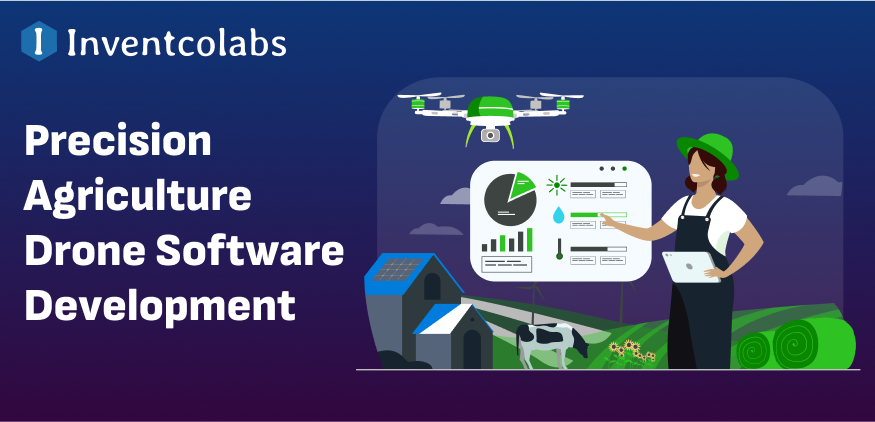
In 2026, agricultural practices are not driven solely by gut instinct or seasonal patterns. Today’s farming work is driven by real-time analytics, automation, and smart mobile technologies. Climatic variability, rising operational costs, limited manual labor, and sustainability demands are forcing the farming and agribusiness sectors to fundamentally change how they plan, monitor, and control agricultural activities.
Consequently, agricultural mobile app development is not an area of research and development that can be put off. Mobile applications allow farming to become more efficient, resilient, and data driven. Farming is more effective across rural communities.
In response to the increasingly complex needs of the agribusiness sector, the development of agricultural mobile applications that businesses offer is integrating artificial intelligence, the Internet of Things, cloud technology, and data analytics to create effective, extensible, and resilient mobile applications. These applications provide real time information to the farmer and support the goals of precision farming and sustainability.
This overview document describes the process of agricultural mobile application development, the applicable technologies, the many challenges that accompany the development, the costs, and the means by which the appropriate choice of mobile applications development firm can help to sustain farming practices and increase productivity past the year 2026.
Table of Contents
Key Statistics Driving Agriculture Mobile App Development in 2026
In 2026, mobile app development for agriculture is accelerating as digital agriculture markets grow rapidly, driven by data, automation, and farming technologies.
According to Grand View Research, the long-term forecast projects that the farm management software sector will exceed USD 10 billion by the early 2030s and continue to grow robustly.
The digital farming software market (a broader segment that includes mobile and analytics platforms) is expected to grow from about USD 8.15 billion in 2025 to USD 9.48 billion in 2026, with continued expansion to beyond USD 16 billion by 2030.
These Agritech trends reflect the accelerating adoption of mobile, data, IoT, and software tools that underpin modern agriculture mobile app development and related services.
What Is Agriculture Mobile App Development?
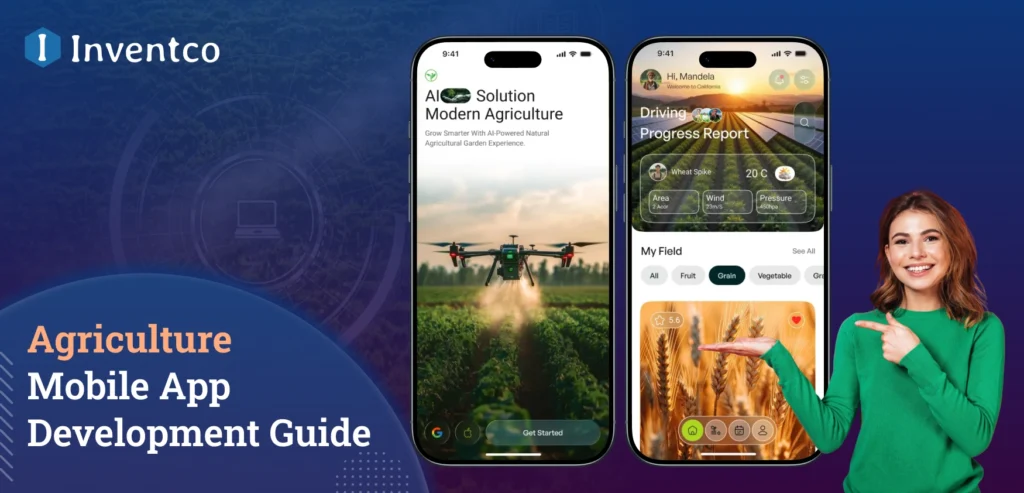
Mobile agriculture app development is the process of creating smart mobile solutions that enable farmers and agribusinesses to effectively run their operations using smart data, automation, and real time insight. In 2026, these applications will help modern farmers plan, monitor, and make smarter decisions at every stage of the farming process.
With the development of agriculture mobile apps, farmers will have the ability to monitor the health of their crops and soil, livestock and equipment, irrigation and fertilization schedules as well as access real-time weather forecasts and market prices all from the comfort of their mobile devices. This will help to manage operational risks, optimize the use of resources and improve the productivity of the farm.
Modern agriculture app development also includes integrating other modern technologies, such as cloud computing, IoT sensors, AI analytics, and GPS mapping for farming, to provide precise, actionable insights in real time, even in rural areas with poor connectivity. In short, agricultural application development is the transformation of traditional farming into smart farming, creating sustainable operations to meet the needs of 2026 and beyond.
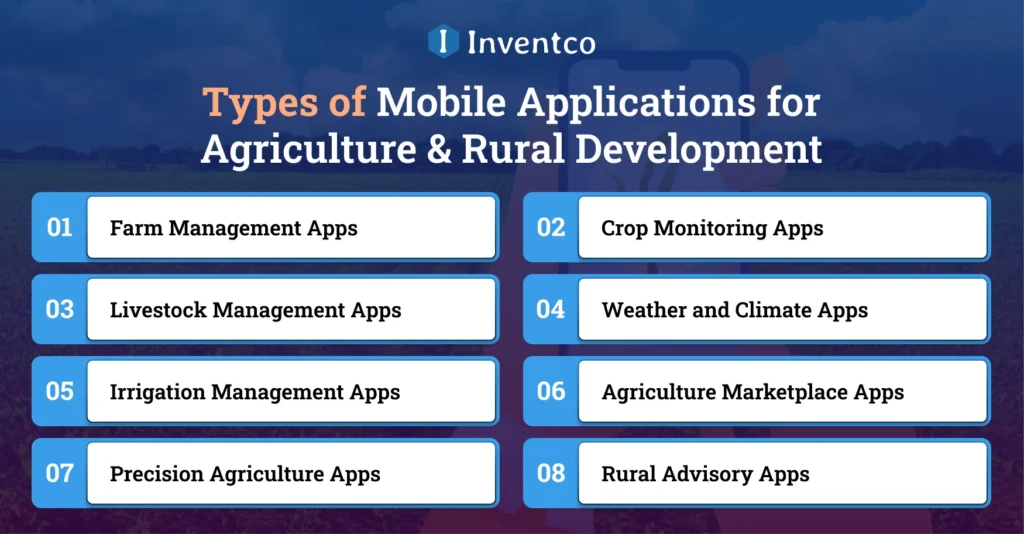
Types of Mobile Applications for Agriculture & Rural Development
Mobile applications for agriculture and rural development are designed to improve the agricultural value chain’s productivity and sustainability. It also helps make better, more informed decisions. Mobile technology and data-driven intelligence help solve a range of farming and rural development challenges.
1. Farm Management Apps
Farm management apps are excellent examples of mobile app development for agriculture. They help farmers in centralizing operations and also help in scheduling and managing the completion of tasks. They also help manage inventory, monitor finances, and analyse various parameters.
2. Crop Monitoring Apps
Modern farm applications for agricultural mobile app development help monitor crops. They use AI and analytics to assess soil health, predict yields, take data-driven decisions, and detect diseases more efficiently.
3. Livestock Management Apps
This type of agriculture mobile app helps in the improvement of animal welfare, productivity and compliance when developing advanced livestock of rural scalable solutions development and app agriculture managing systems. They are used for health monitoring, feeding schedules, breeding records, and movement tracking.
4. Weather and Climate Apps
Weather and Climate Apps are used to analyse climate and historical trends. They use data to analyse climate risk, and the alerts are spontaneous. They hold the forecast data. The data they hold is used to plan farming activities. The development of mobile applications in agriculture requires improvements in services.
5. Irrigation Management Apps
Irrigation Management Apps monitor soil moisture, employ automation to schedule watering, and use sensor data to streamline and optimize water usage while reducing waste. This innovative technology helps sustain the global development of mobile apps designed specifically for modern farming.
6. Agriculture Marketplace Apps
Agriculture Marketplace Apps streamline and optimize the connection between farmers, buyers and suppliers. These digital platforms offer transparent pricing, secure payments, logistics coordination, and market access, all tailored to the development of mobile apps for rural agriculture.
7. Precision Agriculture Apps
Precision Agriculture Apps utilize cutting-edge technologies such as GPS, drones, the Internet of Things (IoT) sensors, and data analytics to fully develop and optimize all aspects of farming. These apps increase crop yields while minimizing the negative effects of farming on the environment through the smart development of mobile apps for farming and agriculture.
8. Rural Advisory Apps
This is one of the most unique types of ruler advisory app which integrate community engagement, expert consulting, and localized training. They assist farmers in adopting best-practice decision-making through strengthened mobile apps for agricultural ecosystems, sustainable scaling, and improved construction practices globally in 2026.
Key Features of Agriculture Mobile App Development
Modern Agricultural Mobile Apps of 2026 focus on secure, scalable, data driven farming, rural connectivity, and decision making.
Must-Have Features of an Agriculture App
User Authentication & Role Management: User authentication and role-based access control build trust and secure access and protection of sensitive data related to farming, defining access permissions and data, thereby fostering trust in the mobile app development process and collaborative platforms in agriculture.
Weather Forecasting & Alerts: Weather alerts and forecasting functionalities of mobile app development in agriculture collaborate with environment management to offer localized climate updates, real time alerts, and predictive analytics, thereby facilitating operational planning.
Crop and Field Data Management: Management of field and crop data in an agriculture mobile app centralizes the soil, crop, and farming input records, facilitating data driven operations, analysis, and reporting for efficient real time decision making.
GPS-Based Land Mapping: GPS based Mapping of Land supports mobile app development in agriculture to visualize accurately the field boundaries, crop zones, and farm assets to plan and allocate resources optimally.
Push Notifications: Push notifications in agricultural mobile app development create responsive ecosystems for rural populations and improve operational farming by delivering timely updates, alerts, and task reminders to increase completion and productivity.
Offline Access for Rural Areas: Remote farming communities can benefit from offline farming applications that provide critical features without needing an Internet connection. This value proposition offline features for farming applications outlines can help farmers stay reliable on features that support rural farming communities and inclusive mobile apps for agriculture development.
Multi-Language Support: Support for multiple languages enhances the usability of the farming mobile application by providing support in users’ local language. Such features help foster adoption and increase the accessibility and confidence of farming communities and multiple users of farming mobile app development solutions.
Advanced Features of the Agriculture App
AI-Based Crop Disease Detection: Advanced mobile apps for farming use artificial intelligence (AI) to detect crop diseases. This technology analyzes and identifies images and data for the purpose of risk mitigation and enhanced yield.
IoT Sensor Integration: The integration of Internet of Things (IoT) sensors enables automation in modern farming apps and enables accurate, timely decision-making. This is because the sensors collect real-time information, including data on soil, moisture, and weather.
Drone Data Processing: Analysis of data acquired from drones helps in providing and developing mobile apps for smart agriculture by providing large-scale farming the ability to monitor, map, and assess the health of crops using actionable information from aerial images.
Predictive Yield Analytics: Mobile applications in agriculture also aid in sustainable farming by providing predictive analytics of yields, which assess both historical and current data to assist in the optimization of inputs and the forecasting of production.
Smart Irrigation Automation: Insightful irrigation automation eliminates excess resource use and increases efficiency on a global scale through mobile apps for farming by automating analytics and sensor data.
Market Price Forecasting: Using platforms for the development of farming apps, forecasting of market prices analyzes the trending and demand data, which provides farmers with the ability to make timely decisions with regard to selling to maximize profitability and minimize risk.
Blockchain-Based Traceability: Traceability on a Blockchain strengthens transparent supply chains by securely recording various data points in the production process. This strengthens food safety as well as compliance and trust through the development of agriculture-based mobile applications in international markets.
Carbon Footprint & Sustainability Tracking: Tracking of carbon footprint and sustainability measure the impact of emissions and the consumption of resources. This supports eco-friendly farming, as well regulatory compliant and responsible agriculture-based mobile application development in line with global standards.
These mobile app features define next-generation mobile app development services for agriculture in 2026.
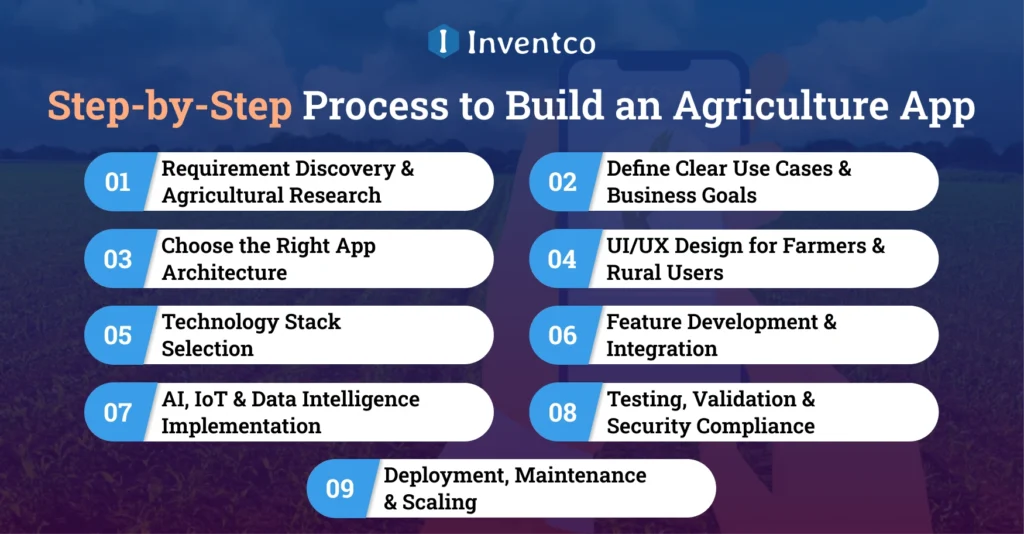
Step-by-Step Process to Build an Agriculture App
To build a successful agriculture app in 2026, one must take a structured approach, balancing technology, the needs of real farming, scalability, and the trust required to develop modern, mobile agriculture apps.
Step 1: Requirement Discovery & Agricultural Research
Understanding real farming challenges is the first step in agriculture app development. This can be done through research and field studies, followed by stakeholder interviews. Understanding real farming challenges helps in the development of agriculture apps, and aligns the app’s development with regional farming practices and sustainability.
Step 2: Define Clear Use Cases & Business Goals
Setting the app’s objectives is important for its successful use. Define if the app will provide crop monitoring, irrigation management, or provide access to a marketplace. Use case mapping will assist the development service for the agriculture mobile app in defining targeted functionalities, determining the app’s success, and providing sustainable value to farmers and agribusiness stakeholders.
Step 3: Choose the Right App Architecture
Select the most appropriate structure for an agriculture app. It has to be scalable and secure. A cloud-native architecture, along with a modular design, is recommended to ensure good performance, data integrity, and the app’s future expandability as IoT, AI, and precision farming technologies evolve.
Step 4: UI/UX Design for Farmers & Rural Users
We understand that user experience design revolves around three main principles: simplicity, accessibility, and visibility. A mobile app for agriculture built for rural and agrarian societies that simplifies digital literacy, supports the use of a local language, works offline, and has easy-to-navigate workflows is most likely to be widely adopted.
Step 5: Technology Stack Selection
Frontend, backend, database, and cloud service options each offer unique trade-offs in terms of efficiency and stability. A tech stack that contains a strong set of cloud offerings is best for the development of applications for rural and agricultural use more because it promotes the optimal use of the cloud for real-time data, mobile app integrations, and data security.
Step 6: Feature Development & Integration
At this stage, the focus is on the development of key and additional functionality, such as the management of crops, alerts about the weather, GPS navigation, and the linkage of the app to the Internet of Things. The construction of mobile agriculture apps by a development firm is best when it is done with experienced organisation.
Step 7: AI, IoT & Data Intelligence Implementation
The most sophisticated and advanced agriculture applications incorporate the use of AI, which is used to identify and analyze diseases, predictive analytics, and IoT sensors that provide real-time situational awareness. These capabilities, when integrated into data driven decision support systems, result in smart farming, resource optimization, and higher productivity.
Step 8: Testing, Validation & Security Compliance
The discipline that best describes sufficient mobile app testing for functionality and performance is called app security. Assurance that security measures have been taken and that compliance is the final agency required to build trust and reliability.
Step 9: Deployment, Maintenance & Scaling
Post-launch, developers need to be ready for ongoing monitoring, updates, and support. A professional agtech app development company builds long-term partnerships to support app maintenance, scalability, and new feature development, helping farmers adapt to evolving needs in 2026 and beyond.
This systematic mobile app development process transforms agri-tech mobile app development into a dependable, scalable, and future-focused solution, equipping farmers with digital tools that enhance productivity, sustainability, and long-term growth in modern agricultural systems.
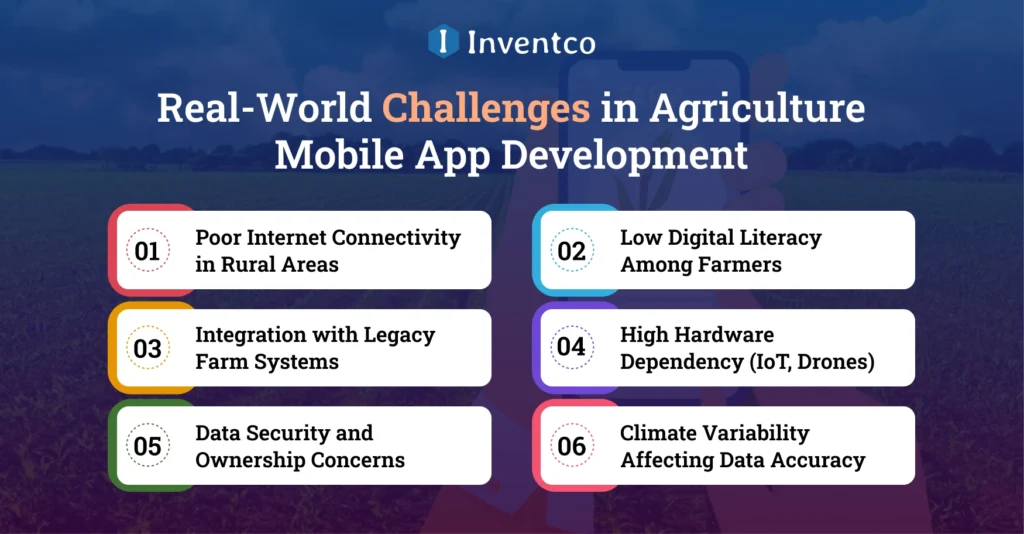
Real-World Challenges in Agriculture Mobile App Development
Despite rapid digital adaptation, development of mobile apps in agriculture remains complicated by rural infrastructure, user behavior, tech reliance, and data trustworthiness, positioning expert-driven, context-aware application development in agriculture as a necessity for 2026.
1. Poor Internet Connectivity in Rural Areas
Because rural areas often have little or no internet access, real-time data retrieval, app updates, and cloud storage pose challenges for mobile development in agriculture. This means solutions for mobile apps in agriculture need to facilitate the usage of applications and data storage offline, and need to be designed to synchronize data intelligently.
2. Low Digital Literacy Among Farmers
Because the user of the app in agriculture will very often be a farmer, and many of them have no experience in utilizing digital tools, it becomes a necessity that mobile apps in agriculture be designed to have simple, user-friendly interfaces, and to provide easy navigation, and to be accompanied by visual guides in the language of the region in which the app is going to be used.
3. Integration with Legacy Farm Systems
In today’s digital age, many farm operations are still in the 20th century and are fully dependent on outdated (both manually and digitally) systems and equipment. These systems make the agriculture application development process very complicated.
4. High Hardware Dependency (IoT, Drones)
The development of mobile apps in agriculture is heavily reliant on the use of drones, sensor systems, and the Internet of Things (IoT). However, most small and intermediate corporate agriculture companies are unable to afford, maintain, or fully utilize these systems.
5. Data Security and Ownership Concerns
Agricultural applications collecting sensitive data raise the issues of misuse, privacy, and ownership, which makes the need for guaranteed authentication, data encryption, and policies regarding the data collected being made clear, crucial for the development of trust of these platforms.
6. Climate Variability Affecting Data Accuracy
When climate conditions are unpredictable, they can adversely affect the accuracy of sensor readings, forecasts, and analytics. This requires the use of agricultural mobile app development services, adaptive models, historical data validation, and real-time adjustments.
Responsive agriculture app development companies will seamlessly address these app development challenges through offline-first design, farmer-first UX, robust security, and adaptable, real-world, agricultural-scale solutions.
Technology Stack Used for Agriculture Mobile App Development
For 2026, agriculture mobile app development will centre on a robust, scalable, and secure technology stack that enables real-time data processing, offline functionality, IoT integrations, and sophisticated analytics. This technology stack will ensure reliable performance in rural areas while enabling smart, data-driven farming operations.
Layer
Technologies Used
Frontend
React Native, Flutter, Swift, Kotlin – used to build responsive, high-performance mobile interfaces for farmers and agribusiness users
Backend
Node.js, Python, Java, Django – power business logic, APIs, scalability, and real-time data processing
Database
PostgreSQL, MongoDB, MySQL – manage large volumes of structured and unstructured agricultural data securely
Cloud Infrastructure
AWS, Google Cloud, Azure – enable scalable hosting, high availability, and secure data storage
IoT Integration
MQTT, AMQP, REST APIs – support seamless communication with sensors, devices, and smart farming equipment
PostGIS, QGIS, and Mapbox – provide GPS-based land mapping, field visualization, and precision farming insights
Security
OAuth 2.0, SSL, Data Encryption – protect sensitive farm data and ensure secure user authentication
Benefits of Mobile App Development in Agriculture
Mobile applications for development are changing the farming industry by improving data driven practices, efficient management of resources, and advanced decision making in agri-tech and rural ecosystems.
1. Increased Crop Yield and Efficiency
Mobile software for farming allows the precise monitoring of more crops, optimizing inputs and improving the productivity of farming by using real time insights and automation through advanced and precise farming.
2. Reduced Water, Fertilizer, and Labor Costs
Smart Apps for Extreme Farming reduce the waste of expensive resources like water and labor through better optimized planning of irrigation and fertilization, and improved resource allocation.
3. Faster Decision-Making with Real-Time Data
Access to immediate data allows the farmer to take action more quickly related to unanticipated weather, crop issues, changing market conditions and other variables utilizing farming mobile applications.
4. Better Risk Management and Forecasting
Advanced analytics and predictive tools help farmers anticipate climate risks, disease outbreaks, and yield variations, enabling proactive planning and reduced losses.
5. Improved Sustainability and Compliance
Mobile farming applications promote sustainable practices by monitoring resource use, less harm to the environment and more compliance with industry standards and farming practices.
6. Enhanced Farmer Profitability
Agricultural apps facilitate improved resource allocation and focus, more effective data driven decision making in agri-tech, and better access to market resources enabling sustained profitability of the farming operation.
Cost & Timeline Overview for Agriculture Mobile App Development
It is no stretch of the imagination that the timeline and overall budget of the development of the mobile app are mostly based on app complexity, how deep each feature is, what technologies they integrate, and where the development is taking place. The cost to build an agriculture app can range between $10,000 – $1,00,000+. Below is a clear breakdown of common development models to help you plan effectively.
Basic farming applications typically possess essential functions such as user authentication, management of secure data fields and crops, data management, weather management, task management, and scheduling, and management of offline user access. The development of this model is typically more geared towards smaller scale farming businesses and those that are startups and are in the process of, or want to, digitize the functions and operations of the business without incurring a large expense.
2. Mid-Level App with IoT and GPS ($25,000 – $60,000 | 3–5 Months)
Apps of this level provide operational functionality for integrating IoT (Internet of Things) sensors, GPS (Global Positioning System) tracking and mapping of fields or land, and real-time monitoring, and can provide the user with notifications through advanced analytics and push notifications. These applications provide a more sophisticated farming experience and are better suited to IoT sensor-driven farming businesses, as well as more sophisticated operational or agribusiness endeavours.
These advanced agricultural applications also include AI-based disease diagnosis, analytics of predicted crop yields, automated smart irrigation, processing of drone-captured data, and integration with agricultural marketplaces and/or blockchain technologies. The operational complexity of this solution is more geared towards large scale farming businesses and/or data driven businesses. The scope of the application’s features, the use of AI, and several geographic development variables will likely determine the final costs.
How to Choose the Right Agriculture App Development Company?
Understanding the proven company experience for the development of agriculture or rural-centred applications is the first step in starting to choose agriculture app development companies. It is essential to consider companies with an in-depth understanding of agricultural workflows, challenges, and seasonally dependent tasks, rather than focusing solely on generic mobile development tasks.
Having proven experience in the development of agriculture-rural centred apps along with the necessary technical skills such as proven expertise in IoT, AI, and GIS, and the ability to design apps for offline and low bandwidth environments, is the second step in choosing agriculture app development companies. When developing agricultural mobile apps, the design for the development to be scalable and to possess secure architecture is important in ensuring that the app offers reliable functions in a variety of regions, as well as in regions that have low infrastructure.
Equally important are transparent pricing, clear timelines, and dependable post-launch support. A trusted partner like Inventco, recognized as a top mobile app development company, stands out from competitors by offering services that align mobile technology with the realities of agriculture and the available technology to realize the business’s strategic goals. They offer mobile apps that are technological Agriculture App Development.
Conclusion
By 2026, sophisticated mobile applications will continue to revolutionize the operational procedures of agriculture by creating smarter, data-driven, and resilient agriculture systems. Data-driven mobile applications empower farmers to monitor and manage their resources, respond to changing weather patterns, and mitigate operational challenges. Mobile applications are vital tools for helping farmers manage operational challenges.
Digital agriculture solutions are no longer optional. Defending agriculture’s productivity, sustainability, and profitability against challenges is increasing, expanding the decision-making capabilities of farmers, positioning agriculture mobile app solutions. Precision farming and real-time data integrated agriculture mobile applications and analytics will provide focused decision-making to help optimize agriculture mobile applications.
However, solutions to challenges and opportunities depend on the type of mobile app development company chosen. Mobile app development solutions are to be partnered with organizations versed in agriculture mobile app development, such as Inventco. Your agriculture mobile app will be developed with real-world agricultural technological solutions, combined with mobile app analytics, technology, and expertise, to deliver mobile apps that foster sustainability, innovation, and economic development in agriculture. The development of agricultural mobile apps will drive economic development, innovation, and sustainability in the agricultural ecosystem.
FAQ’s
Q1. What is agriculture mobile app development and why is it important in 2026?
Ans. Mobile app development for agriculture involves building digital solutions that help farmers manage crops, livestock, weather, and resources on mobile devices. In 2026, it is essential for improving efficiency, sustainability, and data-driven decision-making.
Q2. What types of farms can benefit from agricultural mobile applications?
Ans. Small, medium, and large farms can all benefit from agriculture mobile applications. These apps are scalable and can be customized to support individual farmers, agribusinesses, cooperatives, and large agricultural enterprises.
Q3. Can agriculture mobile apps work in rural areas with poor internet connectivity?
Ans. Yes, modern agriculture mobile app development services focus on offline-first design, allowing farmers to access critical features without an internet connection and to synchronize data automatically when connectivity becomes available.
Q4. What technologies are commonly used in agriculture app development?
Ans. Agriculture app development typically uses technologies such as IoT sensors, GPS mapping, AI and machine learning, cloud platforms, and mobile frameworks to provide real-time insights and automation.
Q5. How much does it cost to develop an agriculture mobile app?
Ans. The cost of agriculture mobile app development depends on app complexity, features, AI integration, and development region, typically ranging from basic apps to advanced AI-driven solutions for large operations.
Q6. How long does it take to build an agriculture mobile application?
Ans. Development timelines usually range from 2 to 9 months, depending on requirements, feature depth, integrations, testing needs, and scalability planning for future expansion of agriculture technology.
Q7. How do agriculture apps help improve sustainability and reduce costs?
Ans. Agriculture apps optimize water use, fertilizer application, and labor management through data and automation, reducing waste while supporting sustainable farming practices and long-term environmental responsibility.
Q8. How do I choose the right agriculture app development company?
Ans. Choose a company with proven agriculture or rural app experience, strong expertise in IoT and AI, scalable architecture, transparent pricing, and reliable post-launch support to ensure long-term success.
Jitendra Jain
He is the CEO and Co-founder of Inventco, driving innovation in advanced computing and digital transformation. With deep expertise in modern IT ecosystems, he leads scalable, secure, future-ready solutions. His strategic leadership helps businesses accelerate growth, adopt innovation, and achieve success. You can connect with him on LinkedIn to follow his technology insights.