![Fashion App Development: The Complete Guide for Brands and Startups [2026]](https://www.inventcolabssoftware.com/blog/wp-content/uploads/2025/07/Blog-Banner-10-1024x493.webp)
Fashion businesses are now embracing digital transformation with the mobile-first approach. Innovative mobile solutions are now essential to how consumers discover, shop, and engage with brands. The ability for apps to facilitate social commerce, on demand delivery, and AI entailed personalisation, delivering unparalleled competitive advantages.
There’s no denying the potential opportunity that the development of fashion apps for mobile commerce provides for both the new investor and the established fashion brand. The development of mobile apps provides the ability to facilitate brand loyalty, customer retention, and increased conversion rates.
The goal of this guide is to assist in the development and scaling of a fashion application for the year 2026. The entire scope of the desired target market and type of app to underpin the development, costs involved, and various operational methodologies will be covered in this guide.
Key Takeaways
- Fashion app development is a high-growth opportunity driven by mobile-first behavior, AI personalization, and increasing demand for seamless digital shopping experiences.
- Different types of mobile apps can achieve different levels of elasticity, and have an impact on functions and audiences for the fashion industry, there is heightened competition.
- Having an approach to developing mobile apps that is structured minimizes development from the initiation, to the launching, to the scaling of the mobile apps.
- MVP mobile apps provide a means for the rapid authentication of concepts and the means for the collection of user feedback to facilitate alterations to the apps in order to enhance user behavioral interactions.
- With the mobile application industry’s incorporation of AI, AR, and secure payment systems mobile recommender systems are imperative. They significantly help change and improve user behavior, user retention, and user interactions.
- Understanding mobile app development cost helps founders allocate budgets effectively, avoid hidden expenses, and plan scalable solutions aligned with business growth.
- The speedy and timely resolution of problems surrounding the comprehensive and mobile application development practices among competitors is demonstrated by the digital evolution of the fashion industry.
- Invest in the development of fashion apps to improve the quality of mobile applications and the rapid increase of the return on investment for startups and enterprises.
Why the Fashion App Market is Booming in 2026?
The fashion app ecosystem is expanding at an unprecedented pace, driven by mobile-first consumer behavior and evolving digital expectations.
- The global fashion eCommerce market is expected to reach approximately $997 billion in 2026, with strong mobile-first growth across regions.
- The market is projected to exceed $1.2 trillion by 2027, growing at a steady pace driven by digital adoption and mobile commerce expansion.
- By 2030, global fashion eCommerce revenue is forecasted to surpass $1.6 trillion, highlighting long-term scalability and strong investment potential.
- Mobile commerce continues to dominate, with over 67% of consumers purchasing fashion products via mobile devices, reinforcing the shift toward app-based shopping experiences.
For investors, this signals a strong ROI landscape. For founders, it highlights the urgency to invest in fashion ecommerce app development that aligns with modern user behavior.
Types of Fashion Apps You Can Build
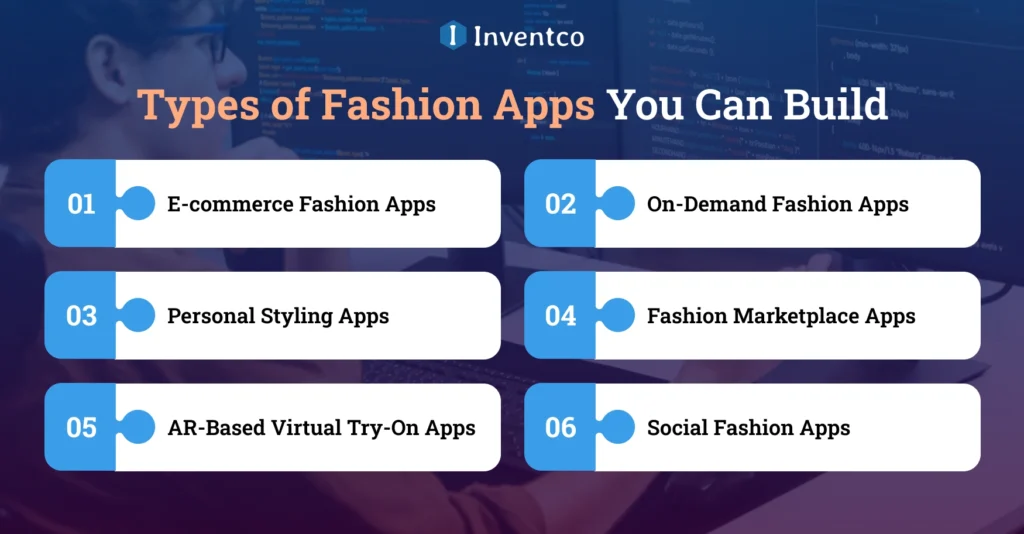
Understanding the right app model is critical before starting your development journey. Based on the current app development trend, here are the most impactful types:
1. E-commerce Fashion Apps
E-commerce fashion apps are traditional online shopping platforms that allow users to browse catalogs, add products to carts, make secure payments, and track deliveries, offering a seamless mobile-first shopping experience for modern fashion consumers.
2. On-Demand Fashion Apps
On-demand fashion apps enable users to instantly order outfits, book personal stylists, or rent clothing for specific occasions, providing convenience, speed, and personalized experiences that align with evolving consumer expectations and mobile-first shopping behaviors.
3. Personal Styling Apps
Personal styling apps use AI algorithms or expert stylists to recommend outfits based on user preferences, body type, and trends, helping users make confident fashion choices while enhancing engagement through tailored and data-driven experiences.
4. Fashion Marketplace Apps
Fashion marketplace apps are multi-vendor platforms that connect independent designers, fashion brands, and customers, enabling product discovery, competitive pricing, and broader selection while supporting scalable business models and increased revenue opportunities for entrepreneurs.
5. AR-Based Virtual Try-On Apps
AR-based virtual try-on apps use augmented reality technology to allow users to visualize clothing, accessories, or makeup on themselves in real time, reducing purchase hesitation, improving confidence, and increasing conversion rates significantly.
6. Social Fashion Apps
Social fashion apps combine social networking features with shopping, allowing users to share outfits, follow influencers, discover trends, and purchase directly, creating community-driven engagement and enhancing brand visibility through user-generated content and interactions.
Choosing the right model depends on your app monetization strategy, target audience, scalability goals, and long-term business vision, ensuring your fashion app aligns with market demand while delivering sustainable growth and competitive advantage.
How to Build an On-Demand Fashion Store App: Step by Step
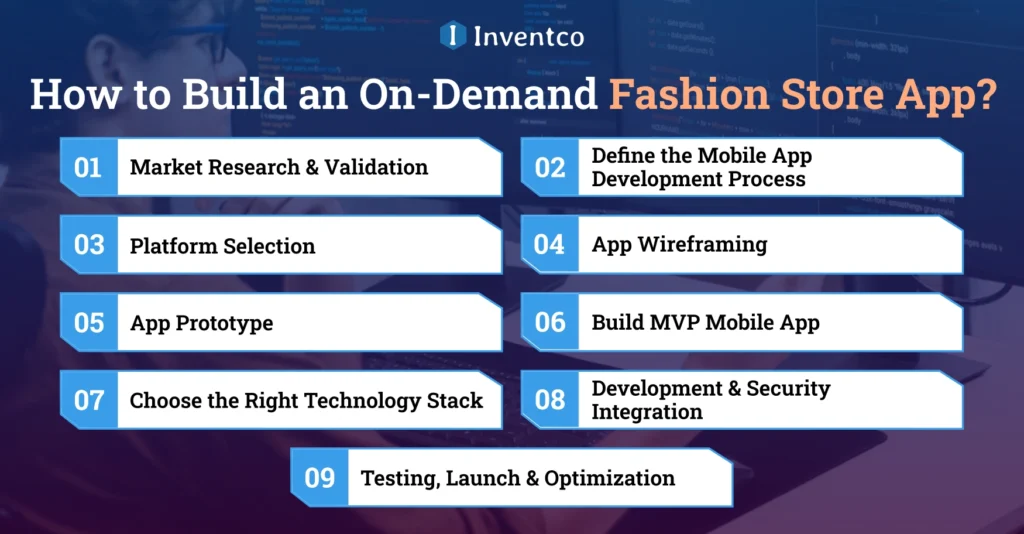
Building a scalable fashion app requires a structured approach that aligns business objectives with technical execution, ensuring efficient development, optimized performance, and long-term success while meeting evolving user expectations and market demands effectively.
1. Market Research & Validation
The first step in developing a fashion app is conducting extensive market research and identifying a niche, a target customer, and competitors in the fashion app market. In the research process, it is necessary to analyze the behavior, preferences, and pain points of the customer to identify the existing solutions in the market that have not been addressed.
The entrepreneur should establish the validity of the app idea through market research, surveys, customer interviews, and competitor benchmarking. This first step will allow the founder to minimize risk, develop a strong value proposition, and ensure that the fashion app development strategy aligns with market expectations, establishing a solid foundation for the business to enable it to scale and be successful for the long term in competitive digital marketplaces.
2. Define the Mobile App Development Process
Clearly outline the complete mobile app development process, including project scope, timelines, milestones, and resource allocation. Define your product roadmap, feature priorities, and development phases to ensure smooth execution. Establish clear communication between stakeholders, designers, and developers to avoid delays and confusion.
A well-defined process enables better decision-making, cost control, and faster time-to-market. For founders and investors, this structured approach ensures transparency, scalability, and alignment between business objectives and technical execution throughout the fashion app development lifecycle.
3. Platform Selection
The decision of Android Vs iOS or cross-platform is critical as it impacts the app’s audience, performance, and cost of development. Analyze target audience, demographics, geographical markets, and user behavior. iOS has users who spend more, whereas Android has a greater market reach. With cross-platform development, you can save on development costs. The appropriate platform choice improves user experience, engagement, and return on investment, which is critical for startups on their fashion mobile app development journey.
4. App Wireframing
This process gives you the ability to create visuals that show the different parts that make up your application. You can also show the layout of the parts and how the parts will work, starting from the development phase. The application wireframing process will allow you to define how users will interact with your application. Mobile app wireframing also makes sure that users of the application will not have any problems navigating the application.
Development teams have increased collaboration with the teams that create the schematics. If the process is done correctly, the app development process will be able to pinpoint shortcomings in the development and be able to provide solutions that will and can save money. The development wireframing process focuses on people who will use the application. It will create a customer satisfaction application that allows users to engage with the application.
5. App Prototype
When developing an application, a mobile app prototype provides an example of the application to the stakeholders. The stakeholders will be able to engage with a mock version of the application in order to stimulate real use of the application. The stakeholders will be able to provide their input on how the application can be improved prior to the application being developed. The first steps of the development process include identifying fundamental parts of the application and addressing the overall design.
Addressing these parts before the application development can be used to promote the application in order to create increased interest in the application. This process can be used to show potential investors how refined the application is before they spend their capital on the application to increase the development process.
6. Build MVP Mobile App
An MVP mobile app gives you a chance to test your business idea in the real world without sinking your entire budget into development. Focus your budget on the app’s core functionalities to address your target user’s most significant pain points. This will allow you to gather meaningful user feedback, evaluate user engagement, and quickly identify areas in need of improvement.
MVP development reduces risks, accelerates time-to-market, and provides valuable insights for future enhancements. For founders, it is a strategic way to build mobile app solutions efficiently while optimizing resources and ensuring scalability based on actual user demand.
7. Choose the Right Technology Stack
Selecting the right mobile app technology stack is critical for building a scalable, secure, and high-performing fashion app. Choose modern mobile app development frameworks, programming languages, and backend technologies that align with your app’s requirements and growth plans.
Consider factors like performance, scalability, integration capabilities, and maintenance when making decisions. A well-chosen tech stack ensures faster development, smoother performance, and easier upgrades. For investors, it also indicates long-term sustainability and the ability of the platform to adapt to evolving market and user demands effectively.
8. Development & Security Integration
While developing a mobile app, integrate solid features, good functionality, aesthetically pleasing designs, and most importantly, solid mobile application security. Protect the end-user’s sensitive information through data encryption and secure, industry-compliant authentication methods.
Mobile app security must be pervasive throughout the entire process and embedded in the application to keep and build trust. The code must also be kept quality and the application must be optimized. For fashion application developers, providing innovative solutions while keeping the user’s information secure through appropriate measures is critical and increases the application brand’s trust in the competitive digital ecosystem.
9. Testing, Launch & Optimization
Prior to launch, do a full round of mobile app testing to ensure that it works the way it is intended to across all devices, platforms, and user cases. Fix issues and improve all elements of the app. Employ App Store Optimization techniques to ensure that your app gets located and downloaded. After the app has officially launched, continue mobile app maintenance and monitoring on the app to ensure that it is working as intended, as a result of user input.
Long term app maintenance costs need to be budgeted for in order to continue to grow and maintain the fashion app. This is the most important phase, as it will ensure that your app will continue to be in good standing after the fashion app has been released.
This outlined series of steps is the best way to ensure that the mobile app solution that the founders are working towards is aligned to be highly scalable, secure, and investment ready, while also balancing all three elements of technology, user experience, and business strategy.
Must-Have Features of a Successful Fashion App
Fashion apps require simple but advanced functionality if they want to capture customer engagement, retention, and business growth.
1. AI-Based Product Recommendations
AI product recommendation analyzes user patterns, behaviors, and browsing preferences to make product suggestions and personalize the user experience. AI product recommendation increases user engagement and conversion rates as well as assists users in discovering and locating products that suit their preferences.
2. Advanced Search & Filters
Search and filter functionality allow users to find products easily and quickly. Search and filter functionality increases overall user experience and usability.
3. Virtual Try-On (AR/AI)
The use of augmented reality and AI allows users to virtually try on clothes as if they were in a fitting room. Virtual fitting room technology decreases buyer’s remorse, increases buyer’s confidence, and increases user engagement and conversion rates.
4. Secure Payment Gateways
With safe payment options users can purchase items with their preferred payment method. Having options for safe payment increases user trust.
5. Real-Time Order Tracking
With order tracking users are able to see information related to their order, from the confirmation of their purchase to the order’s delivery. Having access to information related to their order increases user trust.
6. Wishlist & Personalization
The Wishlist and personalization features let users save their favorite items, receive personalized recommendations, and enjoy tailored experiences which boost engagement, repeat purchases, and long-term customer loyalty.
7. Social Sharing Integration
Social sharing integration enables users to share products, outfits, or purchases on social media platforms, increasing brand visibility, driving organic traffic, and leveraging user-generated content to enhance engagement and influence buying decisions.
8. Push Notifications
Push Notifications are used to increase engagement through personalized offers, new arrivals, and order status updates which drives retention and repeated purchases.
9. Multi-Language & Currency Support
For global customers to feel comfortable and have better access to mobile apps, Multi-language and Currency Support are crucial features. This will also boost conversions to the app.
These key mobile app features increase engagement, improve user retention, and increase conversions. This will lead to long term success and growth.
Fashion App Development Cost: What to Budget in 2026
The mobile app development cost for fashion applications depends on multiple variables, including feature complexity, design requirements, technology stack, and the geographic location of your development team. Knowing how to use cost distribution allows founders to define their plans and distribute their resources to avoid financial challenges during the dev and scaling stages.
1. Basic App ($10,000 – $30,000)
A basic fashion app typically includes essential features such as product listings, simple navigation, user registration, and secure checkout functionality. It is ideal for startups testing initial concepts through MVP mobile app development. Limited integrations and minimal design customization keep costs lower while enabling faster market entry and early user feedback collection.
2. Mid-Level App ($30,000 – $70,000)
Mid-level apps are able to give personalized recommendations and enhance the overall experience. They also have a user interface, real-time tracking, and multiple payment integrations. This level of apps is able to support better user engagement and overall scalability. Due to the positive impact on customer retention, this level is best for fast growing start ups looking to improve and expand their functionality.
3. Advanced App ($70,000 – $100,000+)
Advanced fashion apps allow streamlining and automation of the following systems, complex back systems, a very secure premium user experience and very high scalability. They are best suited for high growth start-ups and enterprises. Advanced apps have competitive differentiation and innovative tech that are richly featured to deliver the best user experience.
Key Cost Factors:
- Features and integrations
- UI/UX complexity
- Development frameworks
- Backend infrastructure
- Third-party APIs
- Ongoing Mobile App Maintenance
A well-planned budget ensures long-term scalability, operational efficiency, and sustainable growth while minimizing hidden costs and enabling businesses to adapt effectively to evolving market demands and user expectations.
Key Challenges in Fashion App Development
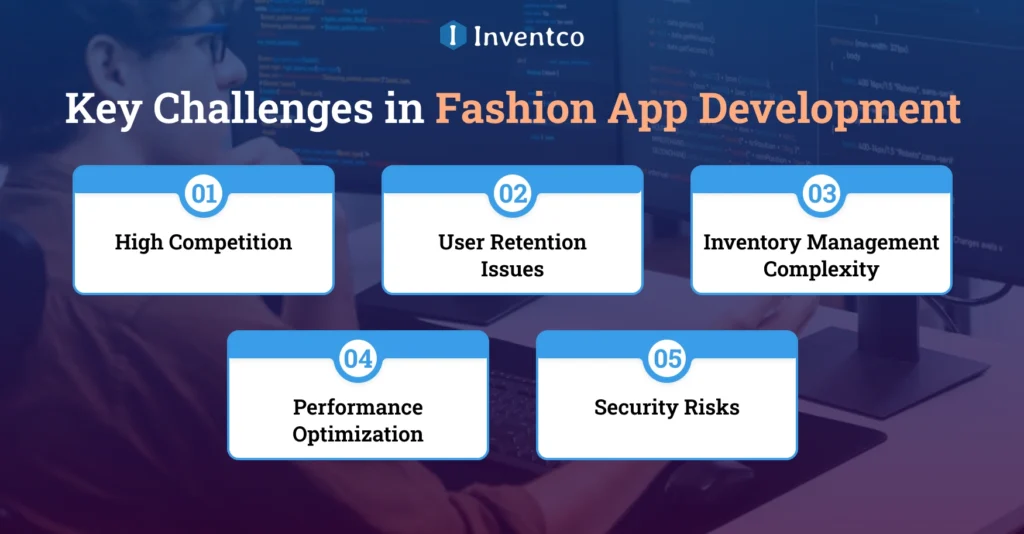
Despite strong growth potential, businesses must address several critical mobile app development challenges that can impact performance, user experience, and scalability, and the overall user experience of businesses that increase the challenges of success.
1. High Competition
It is difficult for newcomers to establish a user base and build user trust. By concentrating on a specific niche and developing a strong brand identity with a unique and valuable proposition, you establish your app and attract a well-defined target audience.
2. User Retention Issues
Fashion apps frequently experience loss of interest and user abandonment. This is a common problem in the industry. The incorporation of personal engagement, loyalty programs and specific notifications can consistently add value to users.
3. Inventory Management Complexity
Handling large inventories across multiple categories, sizes, and vendors creates operational inefficiencies and errors. Solution: integrate real-time inventory management systems that synchronize stock levels, reduce discrepancies, and ensure accurate product availability for users.
4. Performance Optimization
Slow interfaces and lagging applications adversely affect user experience, leading to loss of interest and app abandonment. This can be resolved by creating scalable cloud structures, optimizing codes, and utilizing lightweight frameworks to increase performance across devices.
5. Security Risks
Fashion apps process sensitive user and payment data, making them vulnerable to cyber threats and breaches. Solution: implement end-to-end encryption, secure authentication, and compliance standards to protect data, build trust, and ensure a safe user environment.
Developing fashion apps while tackling these mobile app development challenges with proactive measures ensures enhanced scalability, increased user engagement, decreased operational risks and heightened competitiveness of the product, achieving sustainable growth in a fast-evolving digital marketplace.
How to Choose the Right Fashion App Development Company?
Choosing a mobile app development company for your fashion business is a decision that will affect your company’s performance, scalability, and ROI for years to come. Most of the time, app development companies offer a range of development capabilities, but for founders and investors, development capabilities should align with business development as well.
When choosing a mobile app development company, the first thing you should look for is the years of experience. Most mobile app development companies favor one industry over others, so make sure your company favors the fashion industry. An app development company that has a strong portfolio in the development of fashion store apps will be better positioned to create a stylish, user-friendly app that will yield the desired results. Many fashion store app developers design their apps to look good but not necessarily perform well.
Next, assess technical expertise. The company should be proficient in AI-driven personalization, AR-based features, and scalable architecture to support future growth. Transparent pricing, clear timelines, and consistent communication are essential to avoid unexpected risks and delays.
Equally important is post-launch support. Reliable maintenance, performance monitoring, and updates ensure your app remains competitive and secure over time.
When partnering with app developers, not only does the development time decrease, but the quality of the product, the experience for the consumers, and the success of the company in general, all improve.
Fashion Store App Development: A Real World Case Study
A good example to analyze how strategic execution affects measurable results would be one of the most recent solutions created by Inventco. It would be the Lavender app, an ecommerce platform for gifting that has a lot of similarities with a generic fashion commerce experience.
Overview
Lavender is a mobile app that enables users to select gifts like flowers, chocolates and more that can be customized with ribbons, casings, notes, etc. Users can add items to a favorites list, create and manage a shopping cart, and choose to have their gifts delivered on a specified schedule. Overall, the platform provides a shopping experience similar to the requirements of current mobile fashion store applications.
Challenges
- Users are limited in their engagement, resulting in low online conversion rates
- Product recommendations are not personalized
- Poor mobile experience that affects user retention
Solution
- A mobile architecture that allows for personalization and advanced recommendations
- Intuitive UI/UX with simple and efficient navigation and checkout.
- The ability to track orders in real time and the ability to apply promotional features, such as discount codes
- Applied effective Mobile App Monetization strategies to increase revenue opportunities
Results
- 3X increase in user engagement
- 40% improvement in conversion rates
- 2X growth in repeat purchases
Key Takeaway
This case gives evidence that a strong user-focused approach for fashion ecommerce app development that incorporates personalization, a seamless user experience, and scalable technology can greatly improve user engagement and conversion and positively impact the business on a larger scale.
Conclusion
In a world of mobile interactions, technology-driven approaches to consumer engagement are most effective. For investors and founders, this domain offers numerous potential avenues, but optimal methods, implementation, and technological underpinnings are essential.
The choice of app modality, mobile application development costs, and multifaceted technical hurdles are all interconnected factors to successful outcomes over time.
With attention to user experience and smart app architecture, innovative fashion technology platforms that deliver sustained growth, user engagement, and enhanced profitability can be established.
FAQ’s
Q1. How long does fashion app development take?
Ans. Fashion app development typically takes three to nine months, depending on features, complexity, integrations, and team expertise. MVP mobile app development can reduce timelines while enabling faster validation and market entry.
Q2. What is the best platform for fashion apps?
Ans. The best platform depends on your target audience, but combining Android Vs iOS through cross-platform development ensures wider reach, better performance, faster deployment, and improved return on investment for startups.
Q3. How do fashion apps generate revenue effectively?
Ans. Fashion apps generate revenue through multiple Mobile App Monetization models, including commissions, subscriptions, in-app purchases, advertisements, and premium services, helping businesses diversify income streams and maximize long-term profitability.
Q4. Is AI important in fashion app development?
Ans. AI plays a critical role in fashion app development by enabling personalized recommendations, demand forecasting, chatbots, and virtual try-ons, significantly improving user engagement, retention, and conversion rates across mobile platforms.
Q5. What is the average mobile app development cost for fashion apps?
Ans. The mobile app development cost for fashion apps ranges from $10,000 to $100,000+, depending on features, complexity, design, integrations, and ongoing Mobile App Maintenance requirements for scalability and long-term performance.
Q6. What are the biggest mobile app development challenges in fashion apps?
Ans. Common mobile app development challenges include high competition, user retention, scalability, security concerns, and inventory management, which can be addressed through robust planning, advanced technologies, and continuous optimization strategies.
Q7 . Can startups build a fashion app with a limited budget?
Ans. Startups can build mobile app solutions on a limited budget by starting with MVP mobile app development, focusing on essential features, optimizing resources, and scaling gradually based on user feedback and market demand.

Ajay Bhal
He is an on-demand app solutions expert with 11+ years of experience in business consulting and building scalable, user-centric digital products. He specializes in robust on-demand platforms across industries, combining technical expertise with business-focused strategy to deliver efficient, top notch solutions that drive growth and enhance user experience. You can connect with him on LinkedIn to follow insights.