Building a grocery delivery app in the year 2026 is more of a strategic business decision than a tech decision. With consumers seeking rapid delivery, personalized experiences, and frictionless mobile experiences, understanding the overall investment required is essential before a single line of code is written. Businesses today want clarity, not guesswork, about what it takes to create a scalable grocery delivery service.
Development costs vary widely because modern grocery apps are increasingly complex. With features such as real-time order tracking, smart inventory management, secure digital payments, and personalized recommendations, the budget will be affected. Furthermore, other considerations will make pricing more about informed planning and less about a fixed figure, such as platform selection, third-party integrations, and the app’s future scalability.
In this guide, we’ll help you set your grocery delivery app development cost expectations for 2026. We’ll help you better understand the cost drivers for your grocery app and define the optimal trade-offs across performance, user experience, and cost-to-grow over time.
Key Takeaways
- In 2026, the grocery delivery app development will cost you differently based on the features you want, the platforms you want to build on, and where you want to grow it in terms of scalability. It’s not a fixed price.
- Basic apps are significantly cheaper than advanced apps, which have AI implemented and provide real-time analytics.
- The app’s complexity, integrations with third-party systems, payment processors, analytics, real-time recommendation features, AI, and the overall user experience will increase costs.
- Deciding on a tech stack and whether to use iOS, Android, or cross-platform development is essential, as it affects timelines and budgets.
- Planned long-term costs impact maintenance, updates, cloud infrastructure, and scaling features.
- An experienced development partner minimizes risks, rework, and overall development costs.
Global & Regional Market Stats (2026 Outlook)
The online grocery market continues to grow rapidly in 2026, driven by shifting consumer behavior and digital convenience. Here are some market stats of grocery delivery:
- The global online grocery market is expected to surpass US$1 trillion in revenue by 2026, driven by continued digital adoption and convenience-led shopping.
- In 2025, the online grocery market was valued at approximately US$663 billion, setting the stage for steady expansion into 2026 and beyond.
- From 2026 to 2033, the global online grocery market is forecast to grow at a CAGR of ~21.8%, reaching over US$2.22 trillion.
How Much Does It Cost to Build a Grocery Delivery App?
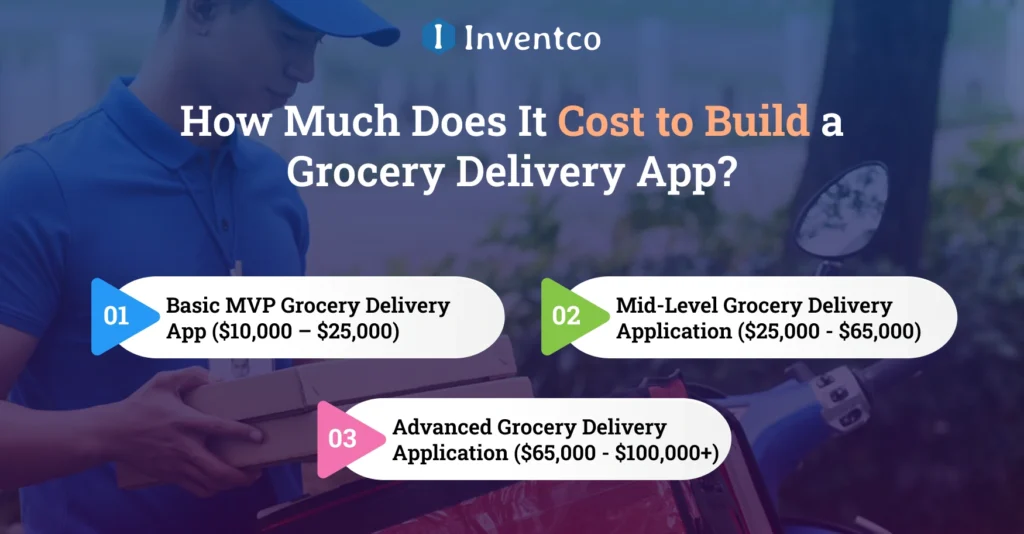
The average cost to create a grocery delivery app ranges from $10,000 to $100,000+. The range is based on the app’s features, scope, and long-term business goals. For example, a simple grocery delivery minimum viable product (MVP) will cost less, whereas building an enterprise-grade platform with advanced automation and meeting all business goals will cost more than $100,000. Rather than focusing narrowly on price, businesses should consider what they are building, for whom, and the product’s future at scale.
| App Type |
Description |
Estimated Cost Range |
| Basic MVP | Core features like login, product listing, cart, checkout | $10,000- $25,000 |
| Mid-Level App | Real-time tracking, advanced search, multiple payments | $25,000- $65,000 |
| Advanced App | AI recommendations, analytics, automation, scalability | $65,000- $1,00,000+ |
1. Basic MVP Grocery Delivery App ($10,000 – $25,000)
Startups trying to validate their ideas quickly and cost effectively will especially appreciate a basic MVP grocery delivery app. It includes core components such as user login and registration, product listings, basic search, cart management, and a simple checkout process. This version focuses on the platform’s core functionality first, rather than advanced customizations, enabling the business to collect user feedback faster. While the app is limited in scalability and personalization, the MVP is a strong option for validating your idea before making more substantial investments or proceeding with further development.
2. Mid-Level Grocery Delivery Application ($25,000 – $65,000)
A mid-level grocery delivery application has a greater sophisticated user interface as well as a greater optimize control operational system. In addition to core features, it offers real-time order tracking, advanced search and filtering, order history, multiple payment options, and push notifications. These features improve operational control and customer engagement. This level is appropriate for growing companies because it offers regional and local competition that is reliable and scalable.
3. Advanced Grocery Delivery Application ($65,000 – $100,000+)
An advanced grocery delivery application is designed for scale, automation, and sustained growth. Personalized, AI-driven recommendations, sophisticated analytics dashboards, automatic inventory systems, and role-based admin control for cloud systems. Designed for sophisticated users and operational systems, this version is tailored to unique user systems. In 2026, amid intensified competition in on-demand grocery, the advanced app offers the greatest competitive advantage but requires the highest initial investment compared to other grocery delivery systems.
The creation of a grocery delivery application should be viewed as a strategic investment rather than a one-time cost. With the right focus and balance across planning, feature prioritization, and development partner selection, costs can be managed while ensuring positive outcomes for scalability, security, and success. In a competitive on-demand marketplace by the year 2026, the most important element will be developing the right app, rather than the cheapest one.
Key Factors That Influence Grocery App Development Cost
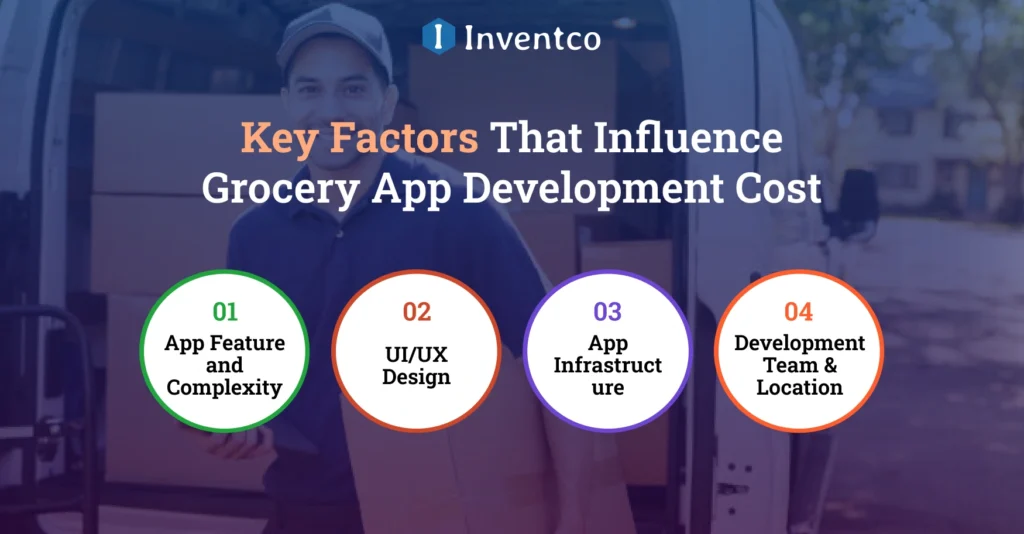
The top grocery delivery app is built at considerable expense because the various parts of the process are complex, time-consuming, and resource-intensive. In the delivery service business, it is crucial to understand how these factors affect the budget and resource allocation for continued service to be offered:
1. App Feature and Complexity
Creating a grocery delivery app in 2026 will be easier and faster, requiring fewer resources to mobile app features such as user registration, product lists, and order tracking. Conversely, building more complex features such as AI recommendations, analytics, and automation will be more resource-consuming and time-consuming.
2. UI/UX Design
Today’s users need to be guided throughout the app and find it easy to visually engage with it. An innovative app that is visually appealing requires an advanced app designer, and this effort will translate into greater time and cost for the project.
3. App Infrastructure
Built to last, the app’s cost will be incurred in the components added to ensure the app’s continued performance and reliability. The integrity and performance of the app will be built from the more advanced components such as cloud services and safety systems.
4. Development Team & Location
There is a global variation in the costs associated with the development process, depending on the region. Development teams based in North America and Europe tend to be more expensive to employ, with teams based in Asia generally being less expensive.
Case Study: ZONE Delivery App by Inventco
Inventco collaborated with ZONE to create a scalable, real-time delivery management platform for merchants, drivers, customers, and delivery companies. The solution comprises bespoke mobile applications and robust web dashboards that consolidate order management, driver management, payout management, and performance analytics into a single, unified system. Through the Local Gateway API, Inventco created seamless custom third-party integrations with delivery automation for platforms like WooCommerce and Shopify. With real-time tracking, route optimization, in-app communication, support for multiple languages, and enterprise-grade security, ZONE partners with businesses to streamline logistics, lower operational costs, and provide scalable, faster, and more transparent delivery experiences.
Why Partner with Inventco for Grocery App Development?
With Inventco, modern technology, strategic thinking, and proven delivery come together to help companies build scalable grocery apps for 2026 and beyond. Inventco leverages cutting-edge mobile app development expertise to prioritise mobile app security, user experience, and performance. Our team develops platforms with smart integrations, cloud-first module design, and feature rich architectures. With extensive industry experience, we help businesses and transform concepts into reliable products with positive business impact and sustained profitability.
Conclusion
There is no definitive cost to build a grocery delivery app because it depends on the selection of platforms, the features to include, and the complexity of the app. There needs to be clear planning and appropriate budgeting to build a solution, whether for a lean MVP or an enterprise-grade solution. With the right development partner, prioritizing features and planning for an enterprise-grade solution or a lean MVP are crucial to successful investment in 2026. When a business understands its expense components, it enables better, informed decision-making aligned with its long-term expectations.
FAQ’s
Q1. How much does it cost to build a grocery delivery app in 2026?
Ans. In 2026, grocery delivery app development typically costs between $10,000 and $100,000+, depending on features, platform selection, scalability needs, and whether the app is an MVP or enterprise-level solution.
Q2. What factors most influence grocery delivery app development costs?
Ans. Key cost factors include app features, UI/UX design quality, platform choice, backend infrastructure, third-party integrations, security requirements, and the development team’s experience and geographic location.
Q3. Is it cheaper to build a grocery delivery app as an MVP?
Ans. Yes, building a grocery delivery app as an MVP reduces initial costs by focusing on essential features, allowing businesses to validate the idea before investing in advanced functionality and large-scale infrastructure.
Q4. Are there ongoing costs after launching a grocery delivery app?
Ans. Yes, ongoing costs include mobile app maintenance, cloud hosting, security updates, feature enhancements, performance optimization, and customer support, which should be planned as part of the long-term budget.
Q5. How can businesses reduce grocery app development costs in 2026?
Ans. Businesses can reduce costs by prioritizing essential features, choosing scalable technology, using cross-platform development, and partnering with an experienced development team that minimizes rework and delays.

Ajay Bhal
He is an on-demand app solutions expert with 11+ years of experience in business consulting and building scalable, user-centric digital products. He specializes in robust on-demand platforms across industries, combining technical expertise with business-focused strategy to deliver efficient, top notch solutions that drive growth and enhance user experience. You can connect with him on LinkedIn to follow insights.