The acceleration of IoT technology integration into business processes is driving digital transformation across almost every industry. Industries are using IoT applications to enable smart, automated systems for industrial activities, managing processes in real time, improving operational efficiency, and enhancing the end-user experience.
This expansion of IoT into actionable business processes is due to recent advancements in Artificial Intelligence, cloud computing, and new edge technologies. IoT technology is now available and has become a business necessity for operational efficiency.
The rapid expansion of IoT technology raises the question of what the actual cost for developing IoT business applications will be in 2026. The investment will be determined by the complexity of the application, the types of devices to be integrated, the desired level of scalability, and the business’s long-term objectives.
This is why we present a comprehensive guide to IoT application development costs broken down into factors that may influence the cost, costs that may be overlooked, and strategies that will assist the organization in developing cost-effective, scalable, and is aligned with future requirements for IoT business applications.
Key Takeaways
- IoT app development cost in 2026 typically ranges from $10,000 to $100,000+, depending on complexity, integrations, and scalability requirements.
- Basic apps are cost-effective for startups, while advanced IoT ecosystems require higher investment but deliver long-term ROI and competitive advantage.
- Certain project types greatly influence overall costs; smart home, healthcare, industrial IoT, wearables, and smart city solutions can vary in costs based on their features and scalability.
- App complexity, the number of integrated devices, the cloud infrastructure required, security, scalability, and regulation compliance cost concerns are primary cost drivers.
- Costs related to cloud hosting, maintenance, and security are often excluded from estimates and can add 30-50% to the overall project investment. Hidden costs include security and API updates, management, and scaling.
- Strategic planning and the right development partner can optimize costs while balancing performance and security against scalability.
- Investments in IoT should encompass a long-term perspective to facilitate growth and evolving business needs on top of the integrated circuitry.
- A well-structured IoT system not only provides in-depth instant information but also improves efficiency and fosters modernization.
Market Trend of IoT in 2026
The IoT ecosystem continues to expand rapidly, driven by enterprise adoption and advancements in AI, cloud, and edge computing.
- The global IoT market is projected to surpass $1.3 trillion in 2026, driven by widespread enterprise adoption and connected infrastructure growth.
- The market is expected to grow from $1.05 trillion in 2026 to over $5.5 trillion by 2034, reflecting strong long-term expansion.
- Industrial IoT (IIoT) alone represents a $500+ billion segment, growing rapidly due to automation and predictive maintenance demand.
This growth signals a strong opportunity but also increased competition, making cost-efficient, scalable development more important than ever.
How Much Does It Cost to Develop an IoT App?
The costs of IoT application development in 2026 is expected to range from $10,000 to $1,000,000+, based on the development’s scale, complexity, and the business’s goals. IoT app developers must communicate to their founders and investors that the cost of IoT app development is variable based on features, integrations, and required long-term scalability.
Basic IoT Applications ($10,000 – $25,000)
Basic IoT applications can be used by startups testing initial product concepts or by companies developing an application with limited functionality to enter the market. It handles simple device integrations, simple dashboards, and minimal cloud computing. This lower cost range still needs to address concerns about security, ease of use, and the ability to scale in the future to avoid increasing costs with upgrades or rebuilds.
Mid-Level IoT Solutions ($25,000 – $60,000+)
Mid-level IoT solutions offer real time data processing, cloud computing, API integrations, and the ability to analyze users. These solutions are for growing businesses that want to improve user experience and operational efficiency. With the increase in complexity of the solutions, the costs of IoT app development increase but also give an increase in performance, scalability, and the return of the investment over time.
Advanced IoT Ecosystems ($60,000 – $1,00,000+)
Advanced IoT ecosystems incorporate sophisticated enterprise-grade ecosystems. They offer large scale operation capabilities such as AI analytics, predictive maintenance, multi device synchronisation, and advanced security. User investment is significantly increased, but such platforms offer powerful levels of automation and data driven results. For investors, this kind of development enables scaling, gaining a competitive edge, and ensuring sustained business growth within connected ecosystems.
The total cost to develop IoT solutions is largely influenced by the overall complexity of your envisioned product. Developing an IoT connected app is entirely different from building an IoT solution consisting of analytics, automation, and enterprise integrations.
IoT App Development Cost by Project Type
Cost estimates for developing IoT applications across different project types help firms make focused investment decisions. For 2026 and beyond, most projects are expected to fall in the $10,000 to $100,000+ range, depending on prevailing complexity, the number of desired integrations, and future scalability options.
1. Smart Home Apps ($10,000 – $30,000)
Smart home IoT applications are designed for home automation and allow users to control multiple devices including lights, thermostats, and security systems from a single app. These applications require the latest app development technologies to ensure flexible system architecture for future integrations and simplified user dashboards. App development costs at this level require a higher level of investment to accommodate the number of systems to be integrated, the desired response speed, and the user experience.
2. Healthcare IoT Apps ($20,000 – $45,000)
These applications are designed for IoT-enabled solutions for remote patient tracking, automated alert systems, and real time health monitoring. Such applications require high levels of data processing accuracy, robust security measures, and compliance with prevailing laws to be considered for IoT development. Though such applications are costly to develop, they are highly rewarding in improving patient health and health management.
3. Industrial IoT (IIoT) ($70,000 – $1,00,000+)
Predictive maintenance, process automation, and asset tracking are examples of Industrial Internet of Things (IIoT) solutions that assist big enterprises. These apps merge with enterprise sensor and machinery ecosystems. Construction costs are scalable, as processing and analytics are handled in multiple domains; however, strong ROI is guaranteed with optimized operational functions and reduced downtime.
4. Wearable IoT Apps ($25,000 – $70,000)
Wearable IoT apps run on smartwatches or fitness bands, enabling activity tracking, health monitoring, and fitness analysis. They need an intuitive UI and precise data sync for real-time tracking, analytics, and a sustained increase in user engagement which increases costs.
5. Smart City Solutions ($65,000 – $1,00,000+)
Public safety, energy management, and smart traffic management are examples of IoT solutions for smart cities. These solutions require complex integrations and real-time processing. As a result, the financial commitment is significant, but the urban environment and sustainability of cities will benefit.
This breakdown helps founders align their IoT project cost with business goals and scalability expectations when planning to build a mobile app.
Factors That Influence IoT App Development Cost
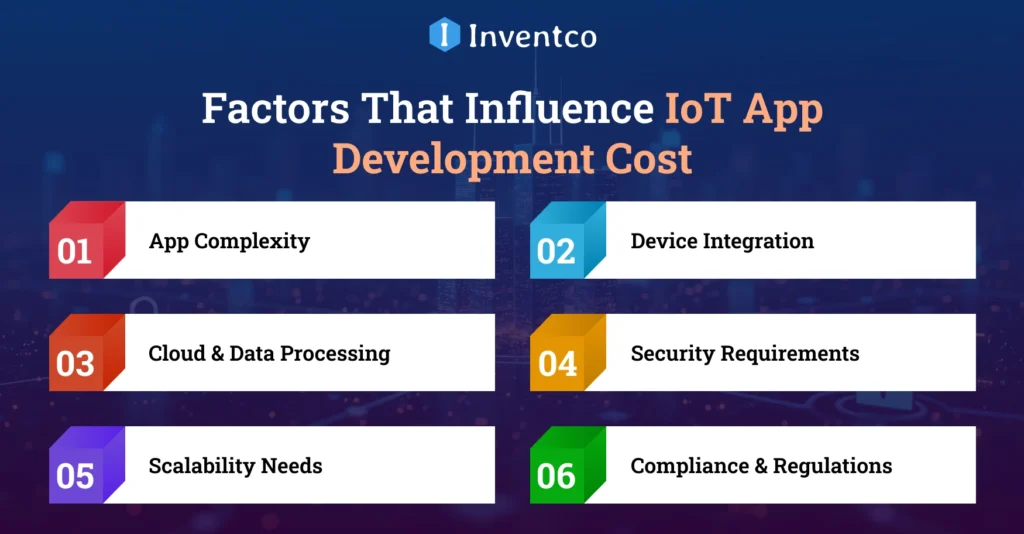
Understanding the key drivers behind IoT app development cost helps businesses plan budgets effectively and avoid unexpected expenses during development and scaling.
1. App Complexity
The more complex the IoT app is, the longer it will take to develop, the more sophisticated its architecture will be, and the higher the development costs will be. Advanced mobile app features such as automation, analytics, and AI capabilities require more resources, significantly increasing overall IoT development costs.
2. Device Integration
The combination of many IoT devices, sensors, and hardware systems can contribute to complexity of engineering. More effort put into development, testing, and continuous optimizing is needed to ensure communication around devices, to ensure their compatibility, and to optimize their performance. This can further increase the project’s total costs.
3. Cloud & Data Processing
The majority of IoT applications are cloud-based. For their data processing and storage, and for real-time analytics, IoT apps rely on the cloud for everything. The costs for cloud storage drive up the costs for processing and storage and for the cloud architecture needed to apply to it.
4. Security Requirements
Security is one of the major cost factors in IoT app development. Data exchange between devices and servers is continuous. Therefore implementing encryption, data authentication, and other measures is time-consuming. This is especially true for sensitive apps, such as those in the healthcare sector.
5. Scalability Needs
Creating a scalable IoT solution means the app can manage growth in users, devices, and data volumes over time. This means that more advanced architectural design is necessary to reduce future redesign costs.
6. Compliance & Regulations
Legally, multiple IoT applications must adhere to industry-specific standards and regulations. To develop new regulation-compliant applications, extensive documentation, testing, and feature development are required, as well as maintaining the application’s operational and legal functionality, which increases costs.
Hidden & Long-Term Costs in IoT Projects
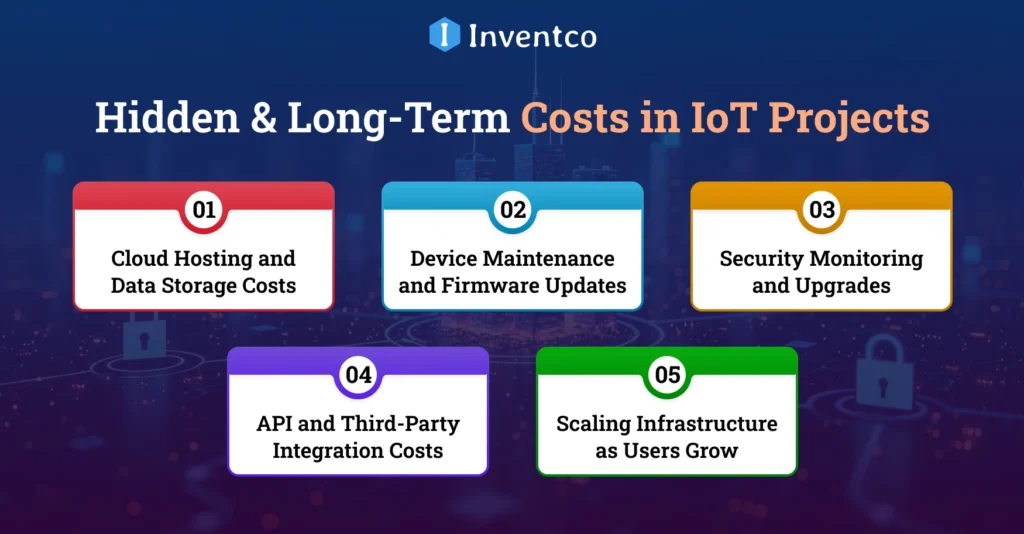
Building a mobile app entails expenses beyond the initial cost. Businesses, too, must consider the ongoing costs that will add to the total cost of IoT projects over time.
1. Cloud Hosting and Data Storage Costs
IoT applications generate massive volumes of data that require continuous storage and processing. The more data that is stored the more the costs to host that data in the cloud. Meaning that the more data we have, the more we will have to spend to optimize the data. This causes an incremental increase in the costs of running the application which setup the cloud hosting in the first place.
2. Device Maintenance and Firmware Updates
Each remote IoT device will need to be managed and maintained in order to ensure that the device is operating effectively and that the device is up to date from a security perspective. To implement updates and ensure effective device management, additional technical staff will need to be hired to monitor and maintain devices regularly.
3. Security Monitoring and Upgrades
In order to ensure that security threats are minimized, continuous monitoring of security will be required. In addition, security updates will need to be implemented, security vulnerabilities will need to be patched, and security compliance audits will need to be conducted to maintain user trust and data integrity.
4. API and Third-Party Integration Costs
The inability to have app content without third party APIs is another downside of mobile applications. Most analytics, payment processing, and communication capabilities require proprietary third party APIs. Each mobile application must use proprietary 3rd-party APIs to function.
5. Scaling Infrastructure as Users Grow
With the rise of user adoption, IoT impacts the number of devices and amount of data created. IoT systems must scale. Infrastructure development, performance, and uptime continue to require additional investment, making costs of long-term scalability a priority.
These types of costs account for 30–50% of total lifetime costs, underscoring the need for strategic planning.
Note: Understand the real challenges of IoT implementation and explore effective solutions to overcome them with confidence.
How Inventco Delivers End-to-End IoT Solutions That Scale?
Inventco applies a systematic, outcome-oriented methodology to IoT app development. With an emphasis on production-ready ecosystems, our team improves real-world business outcomes and delivers measurable results. With deep domain expertise and a strong understanding of connected technologies, the team ensures every solution is aligned with real-world business objectives and measurable outcomes
Inventco handles everything from initial client discovery to architecture, planning, implementation, and optimization. Inventco’s development framework improves efficiency and reduces overall development costs. Reliability, scalability, and high performance are provided across all use cases with our secure, real-time cloud data processing and device integration.
Inventco focuses on long-term value creation. Rather than developing standalone solutions, our team builds flexible adaptable IoT systems that meet their clients evolving business requirements. In addition to supporting continuous innovation of clientele, this specific business model significantly reduces development costs of future iterative improvements.
Inventco combines strategic development with technical expertise to enable a more rapid launch of client systems to market while protecting client budgets and positively influencing investor confidence. This implementation reduces operational risk and supports a desired growth trajectory in a competitive IoT market.

Conclusion
By 2026, IoT will continue its impact in changing how organizations function, how they compete, and how they scale. IoT app development will continue to vary in price, but building apps for security and scalability that focus on business goals and the marketplace will continue to prove most valuable.
By understanding the variables on the costs, anticipating the hidden costs, and choosing the most suitable development method, organizations will be in the position to make high return investments. An IoT solution that has been thought through will provide better ways of doing tasks, better ways for the end user, and better ways of achieving goals in the marketplace as the marketplace becomes even more inter-connected.
Ultimately, success will not lie in building an IoT application but will lie in the impact the IoT application brings to the organization. The ideal application will streamline processes in the organization, enhance the organization’s ability to meet market demands, and provide a structure for the organization to continue growing in and maintaining its position as an industry leader.
FAQ’s
Q1. How much does it cost to develop an IoT app in 2026?
Ans. The IoT app development cost in 2026 typically ranges between $10,000 and $1,00,000+, depending on application complexity, device integrations, cloud infrastructure, security requirements, and long-term scalability goals defined by businesses and investors.
Q2. What factors influence IoT development cost the most?
Ans. Key cost drivers include application complexity, number of connected devices, cloud infrastructure, data processing requirements, security implementation, scalability planning, and compliance needs, all of which directly impact development effort, timelines, and overall investment.
Q3. Is IoT app development more expensive than mobile app development?
Ans. Yes, IoT app development is generally more expensive than traditional mobile apps due to hardware integration, real-time data processing, security requirements, and infrastructure complexity, making development and maintenance more resource-intensive and technically demanding.
Q4. How can startups reduce IoT app development cost?
Ans. Startups can reduce IoT development cost by building MVPs, prioritizing essential features, using scalable cloud solutions, leveraging existing frameworks, and partnering with experienced developers to minimize rework and optimize long-term investment efficiency.
Q5. What are the hidden costs in IoT projects?
Ans. Hidden costs include cloud hosting, data storage, device maintenance, firmware updates, security monitoring, API subscriptions, and infrastructure scaling, which can add 30–50% to total IoT project costs over the product lifecycle.
Q6. How long does it take to develop an IoT app?
Ans. IoT app development typically takes three to twelve months, depending on project complexity, number of integrations, features, and testing requirements, with advanced enterprise solutions requiring longer timelines for deployment and optimization.
Q7. Why is scalability important in IoT app development?
Ans. Scalability ensures IoT applications can handle increasing users, devices, and data without performance issues. It prevents costly redesigns, supports business growth, improves user experience, and ensures long-term sustainability in competitive markets.

Sandeep Agrawal
Sandeep Agrawal is the visionary CTO at Inventco, bringing innovation to life through his technical expertise. With a passion for cutting-edge technologies, Sandeep leads the team in developing robust solutions. His dedication and continous efforts to pushing the boundaries of what’s possible defines his role as a transformative and innovative force in the tech industry.