Globally, the fintech ecosystem is undergoing significant change. The demand for advanced tech-driven loan lending app solutions is rising as fintech apps expand quickly because they facilitate decision-making and speed up loan approval. Slower reviews, stringent screening, and little personalization are all problems with the antiquated traditional banking system.
It appears to be a high-growth, legal opportunity for investors and founders who want to create the best loan lending apps. In order to ensure that your development is built with secure architecture, regulatory alignment, cost clarity, and long-term scalability that will generate long-term return for your business, work with an experienced provider of loan lending app development services. The cost, features, and other aspects of creating a money lending app are covered in this guide.
Important Takeaways
- One fintech opportunity with significant growth that requires a lot of compliance is digital lending.
- Competitive advantage is fueled by embedded finance models and AI-based credit scoring.
- Data security and sound underwriting logic cannot be compromised.
- Capital exposure is decreased by using an MVP-first approach.
- Features, compliance layers, and integrations all affect cost.
- Interest margins, processing fees, and premium services are examples of app monetization models.
Overview of the Loan Lending Market
According to an industry report, the digital lending market is expected to grow at a compound annual growth rate (CAGR) of 18%, reaching $25 billion by 2026. The loan lending market statistics listed below may help you decide whether to invest in the development of a loan lending app.
- The market for digital lending platforms was estimated at USD 10.55 billion in 2024 and is projected to grow at a compound annual growth rate (CAGR) of 27.7%, reaching USD 44.49 billion by 2030.
- According to GII Research, the digital lending market is estimated to be worth $507.27 billion in 2025 and is expected to grow at about 11.9% per year, reaching $890 billion by 2030.
- According to a Sky Questt report, the fintech lending market was estimated at approximately USD 1159 billion in 2024 and is expected to grow at a compound annual growth rate (CAGR) of approximately 27.4%, reaching over USD 8000 billion by 2032.
How does an app for lending money work?
Before you spend money on app development, you need to know how loan lending apps work. The best loan app works in a safe, organized, and automatic way. Here is how the money lending app works, step by step:
- User Onboarding and KYC Verification: The first step in the loan lending app process is to register users. To follow the rules, users must give personal information and complete KYC.
- Credit Assessment: After a user signs up, the system checks the borrower’s trustworthiness using a standard credit score and other information, such as their income trends and transaction records.
- Evaluating Loan Eligibility: The system will decide the loan limit, interest rate, and term based on the user’s data screening.
- Offer Generation: Once the system has chosen the eligible user, they will get personalized loan offers on their mobile app. These offers will include fees, repayment plans, and terms and conditions.
- Signing the Digital Agreement: After the user agrees to the plan, they need to use the private e-signature technology to finish signing the secure digital agreement and agree to all the terms and conditions.
- Fund Disbursement: The loan amount will be sent to the user’s bank account using safe payment methods built into the system.
- EMI Tracking and Repayment: The loan lending app sends users EMI alerts, keeps track of payments, and manages transaction records so that the service runs smoothly and users don’t miss any EMIs.
What kinds of loan apps are there?
There are a lot of different types of loan lending apps, and knowing about them will help you pick the best one for your business. Here are some of the most popular types of loan apps:
1. Apps for Personal Loans
This kind of money-lending app is for people who need help with personal expenses like school, medical, or travel costs. These apps let people ask for loans, keep track of their payments, and keep an eye on their own money.
2. Apps for Business Loans
This kind of money lending app is made for people who own small businesses or are entrepreneurs. These lending app solutions help businesses with their financial needs, such as expanding, getting working capital, and more. This fintech app has special features for businesses, such as quick approvals, flexible repayment options, and financial tools made just for businesses.
3. Apps for Car Loans
The auto loan app is one of the hardest types of loan landing apps to use. This app is for people who want to get a car loan. This kind of loan app makes it easier to apply for and get approved for a loan. Users can look into different loan options, figure out interest rates, and then send in the necessary paperwork for a smooth car financing process.
4. Apps for Mortgage Loans
People who want to buy or refinance a home can get home loans more easily with mortgage applications. They usually give you tools to figure out how much your mortgage will cost, keep track of your application status, and handle documents quickly.
5. Apps for Peer-to-Peer (P2P) Lending
Borrowers can connect directly with individual lenders through P2P lending apps, which makes an open lending platform. Customers can borrow money or invest money, and they often have more options than banks do. This is how the idea of lending through a community-driven model came about.
6. Apps for Microfinance
Microfinance apps give out small loans to help entrepreneurs and people in developing countries who need a little extra money. They usually focus on making sure everyone has access to credit, even people who don’t have traditional banking connections.
Key Features Required in a Loan Lending App
In the ever-changing world of financial services, creating a loan application that works well for users requires a carefully thought-out mix of new mobile app features. These are the features that every mobile app should have:
1. User-friendly Interface
An intuitive and simple user interface is vital for any loan application. Ensure that users can easily navigate through the app and that applying for a loan is simple.
2. Secure Authentication
Use robust authentication systems to protect your users’ information and ensure the trustworthiness of your app. Two-factor authentication is an excellent example of how to provide an additional level of protection.
3. Credit Scoring and Risk Assessment
Incorporate credit score and risk analysis techniques to determine a borrower’s creditworthiness. This ensures the responsible conduct of lending and minimizes the chance of default.
4. Document Verification
Allow users to upload documents securely. According to the mobile application development firm, you must implement an authentication process to verify the information provided, thereby reducing the risk of fraud.
5. Loan Calculators
Give users tools to calculate loan amounts, including interest rates, loan terms, and repayment plans. Displaying this information transparently helps customers make informed choices.
6. Notification and Alerts
With push notifications and alerts, users will stay up to date on the status of their applications’ upcoming payments and any other important updates.
7. Electronic Signatures
Allow users to sign loans electronically, easing the approval process and reducing paperwork. Therefore, consult experts on how to include these features when hiring a mobile app developer.
8. Payment Gateway
Integrate a safe and reliable payment gateway to facilitate smooth transactions. Numerous payment and automated options can enhance user convenience, thereby strengthening the trustworthiness of the P2P lending application development project.
9. Customer Support
Integrate a robust customer service system that includes chatbots and live agents to quickly respond to customer queries.
10. Regulatory Compliance
Check that your app is compliant with the regulations governing financial transactions in your intended market. This includes laws on data protection and other regulations relevant to building user confidence.
These are a few of the essential features needed to create an app for loan lending that will bring more profits and success for your company after you have a better understanding of the features that can be incorporated into the development of loan lending apps and how to go about the process of developing an app.
Advanced Features of the Loan Lending App
There is a growing need for loan lending applications from customers due to the rising number of loan lending applications. Current popular industry features include automation by AI, compliance intelligence, and prevention of fraud.
1. AI-Powered Credit Decision Engine
It is a sophisticated characteristic of a money lender application that evaluates conventional credit scoring metrics alongside other financial data, behavioral data, and transactional data to provide instantaneous credit limit decisions.
2. Automated KYC & AML Compliance Engine
With the loan lending application, this advanced feature automates the verification of the user’s identity, the authentication of documents, the screening of sanctions, and anti-money laundering verification to ensure compliance with the regulations, decrease the amount of manual and paperwork, and increase the effectiveness of risk management.
3. Fraud Detection & Transaction Monitoring System
With this feature your app can detect suspicious activities, detect anomalies in transactions, prevent financial losses, and flag high-risk behavior patterns
4. Smart Loan Offer Personalization Engine
With this feature in your application, it is possible to detect and recognize unusual and suspicious behavior, provide preventative measures against financial loss, and identify and respond to high risk behavioral patterns.
5. Intelligent EMI Auto-Debit Scheduler
With this advanced personalization engine, it assesses the profile of the borrower, the financial history, and behavioral patterns to provide a tailored experience by personalization of loan amounts, interest rates, and repayment tenure, User experience and conversion rates are enhanced with this.
6. AI Chatbot with NLP Support Engine
This feature allows the automation of payment scheduling, the creation of debit mandates that recur, the sending of smart reminders, and the provision of predictive alerts. This significantly reduces the occurrence of missed payments, enhances the efficiency of collections, and stabilizes the cash flow.
AI Chatbot with Embedded NLP Support Engine AI Chatbot with NLP Support Engine allows you to streamline operations by managing customer queries without deploying any staff. It provides loan status feedback and repayment instructions to customers, as well as onboarding assistance. This increases customer engagement while lowering operational costs.
Loan Lending App Development Process
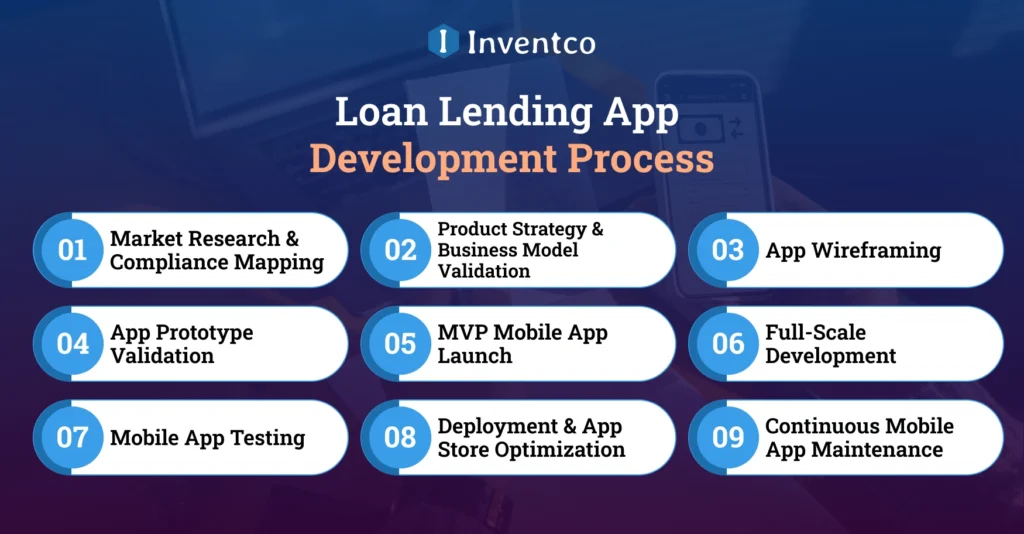
To build a mobile app, you need to follow a structured mobile app development process that ensures scalability, stability, and regulatory compliance. Here is the step by step process to build a loan lending app:
1. Market Research & Compliance Mapping
As for the app development process, this is the first step to start with. It entails the search for the target audience, their needs, the relevant licensing obligations, and applicable regulations. Having detailed KYC, AML, and data protection standards embedded into the architecture of the app greatly reduces legal risks. In case certain structure of process models have to be restructured in the subsequent development phases of the platform life cycle, you will save a significant amount of money.
2. Product Strategy & Business Model Validation
This stage involves defining revenue streams, underwriting logic, interest models, capital structure, and risk management frameworks. This is one of the most curious stages, as it lays the groundwork for the future of your business. This is combined with scalability planning and financial modeling as part of your business process. This sets the requirement for sustainable margins and operational efficiency over the long term, before any technical work on your loan lending app begins.
3. App Wireframing
Mobile app wireframing is the next step in the loan lending app development process, a visual guide of the user journey, starting from the dashboard and going all the way to the loan application. Providing the app wireframe gives you a view of the proper layout structure of your mobile app. Early-stage wireframing reduces design friction, aligns the expectations of stakeholders, and saves costly design revisions by identifying gaps in user flow before the app development process begins.
4. App Prototype Validation
An intuitive mobile app prototype simulates the real user experience and validates the features and workflow of your mobile app. With the loan app prototype, feedback from your app test users and stakeholders can be used to enhance the usability of your mobile app. The development phase of your app’s prototype, minimizes the technical rework required, and ensures your mobile app is compliant with borrower expectations.
5. MVP Mobile App Launch
By developing an MVP mobile app, you can minimize the development cost as you can test your basic features like KYC verification, credit assessment, registration, loan approval, and repayment tracking. By testing your product in the real market you can go for full scale app development with advanced features and feedback.
6. Full-Scale Development
Once you’ve validated the MVP, you can move on to full-scale development and add features like fraud detection, AI underwriting, stronger app security, and multi-bank systems. Also, implement the next level infrastructure for enhanced scalability, performance optimisation and cloud deployment to handle increased transactions and geo-expansion.
7. Mobile App Testing
Rigorous mobile app testing for your loan lending app guarantees reliability, security, and regulatory compliance. In addition, mobile app testing identifies bugs that can alter user engagement and allows the application to perform under high streams of transactions, safeguard user sensitive data, and stay in the good books of the regulatory authorities before making the app public.
8. Deployment & App Store Optimization
The app launch entails all activities involved in making an app available for installation from an app store. After presentation of the app, the developer must carry out app store optimization so that the visibility of the app can be enhanced using key phrases, metadata, and appraisal reports of your loan lending app.
9. Continuous Mobile App Maintenance
Continuous mobile app maintenance is a must for loan lending apps which includes security updates, compliance monitoring, performance optimization, server management, feature upgrades, and bug resolution. With continuous system monitoring, ensure stability, adapt to regulatory changes that erode user trust, and support sustainable platform growth.
Ongoing mobile app maintenance entails the maintenance of the loan lending application and includes bug fixes, updates on features, security, performance, servers, and compliance. Mobile applications that monitor the operating system remain stable and support sustainable growth of the platform.
Technology Stack Used for Loan Lending App Development
Choosing the right mobile app tech stack is important for building a secure, scalable money-lending app. Here is the technology stack for the loan lending app:
- Frontend: React Native, Flutter, Swift (iOS), Kotlin (Android)
- Backend: Node.js, Python (Django), Java (Spring Boot)
- Database: PostgreSQL, MongoDB
- Cloud: AWS, Google Cloud, Azure
- Payment Integration: Stripe, PayPal, Plaid
- AI/ML: TensorFlow, Scikit-learn
- Security: OAuth 2.0, SSL encryption
You need to choose the tech stack according to the selection of the platform Android and iOS, or for a cross-platform app. In 2026, many startups and founders are choosing cross-platform frameworks among modern mobile app development frameworks to reduce costs.
How Much Does Loan Lending App Development Cost Over Time?
The cost to build a loan lending app can range around $10,000 – $1,00,000+, as it can vary on several factors such as features, complexity and others.
Estimated Cost & Timeline
| App Complexity | Estimated Cost (USD) | Development Time |
| MVP | $10,000 – $25,000 | 3–5 months |
| Mid-Level App | $25,000 – $60,000 | 5–8 months |
| Enterprise-Grade | $60,000 – $1,00,000+ | 8–14 months |
Moreover, the cost to build a mobile app depends on third-party integrations, features, scalability, and security and compliance layers.
Common Challenges in Loan Lending App Development
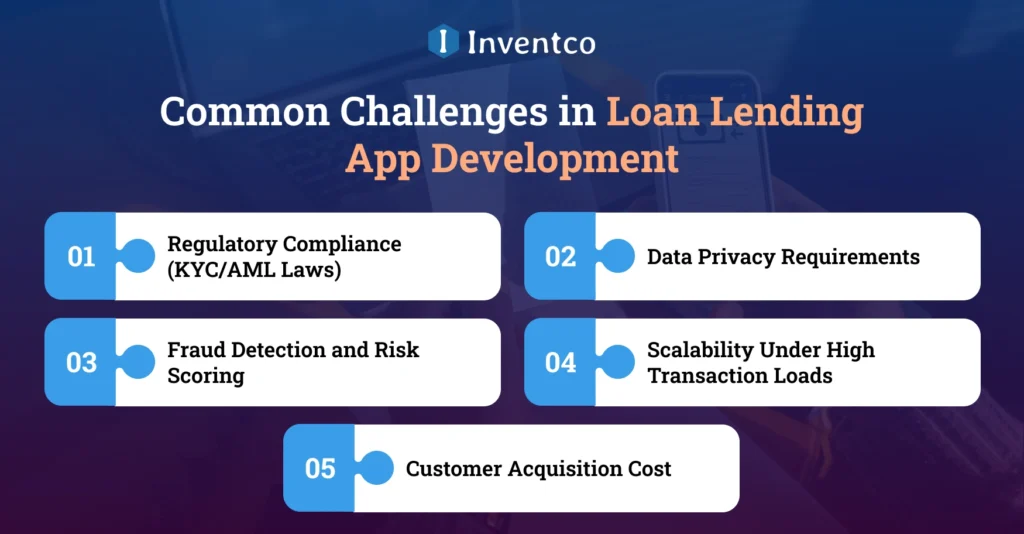
While developing a loan landing app you face several mobile app development challenges, which may delay your development and cause you some extra bucks, so knowing common app development challenges help you to avoid mistake while building a money lending app:
1. Regulatory Compliance (KYC/AML Laws)
Integrating KYC/AML, and other local financial guidelines is still a moving target when it comes to compliance. Inadequate integration of identity verification, reporting, and auditing mechanisms can result in a loss of money, the inability to continue operating and, most importantly, the loss of trust from your customers.
2. Data Privacy Requirements
Lending apps will require compliance with a number of data protection laws. As a result, your app must have a way to ensure that user data is protected through secure storage, encryption, the ability to manage user data, and the ability to control the consent through which data is collected.
3. Fraud Detection and Risk Scoring
A money lending application cannot be safe without developing a fraud detection and risk scoring system, which requires sophisticated analytics, behavioral monitoring, and the application of machine learning.
4. Scalability Under High Transaction Loads
As they grow, one of the most common problems that lending apps encounter is managing large quantities of applications, repayments, and credit checks. App Downtime, sluggish processing, and poor user experience are often the result of poorly constructed mobile app infrastructure.
5. Customer Acquisition Cost
Marketing is essential when trying to acquire customers/buyers. This is especially true when trying to acquire true, qualified borrowers. This becomes especially evident given that the app has just launched, and that the capital is beginning to burn while the app is still in its early stages.
How to Choose the Right Loan Lending App Development Company?
Choosing the most suitable partner for the development of loan lending apps will have a direct impact on the regulatory compliance, long term returns, and adaptability of your business. In a highly regulated industry such as Fintech, your development partner needs to have an understanding of compliance, risk assessment, and safe design. Hence, the development partner must have worked on financial systems and have an understanding of KYC, Anti Money Laundering (AML) and data protection regulations of various jurisdictions.
In addition, the development partner needs to have skills in artificial intelligence (AI), machine learning (ML), underwriting systems, fraud detection, and secure cloud systems. Security certifications, reasonable pricing model, and a clear development plan (roadmap) reflect the maturity of the development partner. The development partner should also provide templates and systems that are ready for audit, and frameworks that enable the development partner to meet the standards of the investors in terms of performance metrics.
Post-launch support is equally important. Continuous updates, regulatory monitoring, performance optimization, and mobile app maintenance ensure sustainable growth. Inventco, recognized as a leading mobile app development company, combines fintech expertise, compliance-focused development, and scalable technology solutions, making it a strategic partner for founders seeking long-term value creation.
Future Trends in Loan Lending App Development
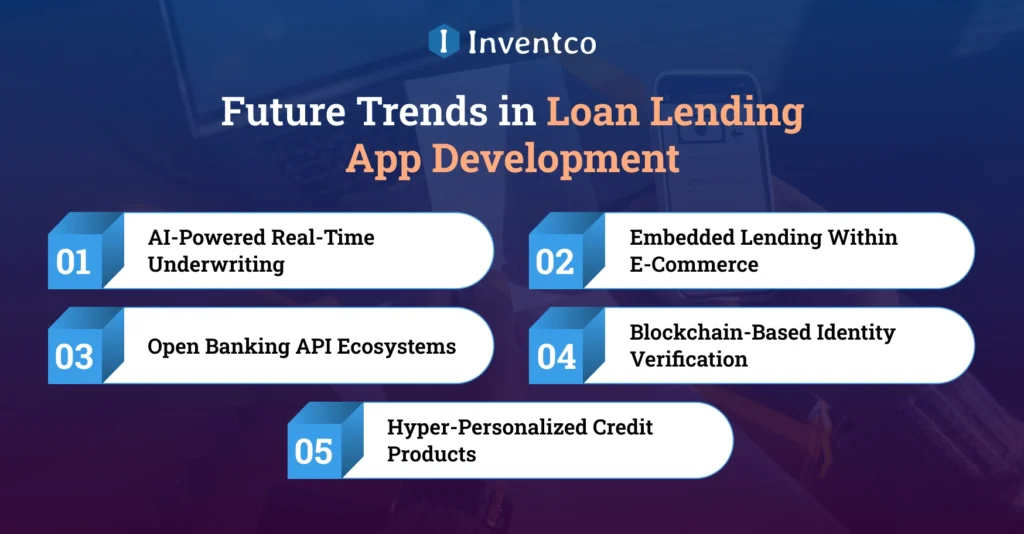
The new loan lending applications look to incorporate smart technology to automate and streamline the lending process, embedded ecosystems to further assist necessary integrations, new and innovative applications to help refine compliance and regulatory processes, and innovative uses of technology to aid decisioning parameters through data.
1. AI-Powered Real-Time Underwriting
AI-driven real-time underwriting leverages machine learning, behavioral analytics, and alternative data sources to assess borrower risk instantly, enabling faster approvals, dynamic pricing models, reduced default rates, and enhanced operational efficiency across digital lending platforms.
2. Embedded Lending Within E-Commerce
Embedded lending integrates credit options directly into e-commerce checkout flows, allowing customers to access instant financing at the point of purchase. This seamless experience increases conversion rates, merchant partnerships, and revenue opportunities for fintech lenders.
3. Open Banking API Ecosystems
Innovative uses of technology (open banking of financial products and services) drive value and differentiation. Open banking allows financial products and services to be more integrated, affecting credit scoring and other innovative lending techniques like the use of instant credit.
4. Blockchain-Based Identity Verification
The use of blockchain technology for identity verification allows for decentralized validation and improved trust. This technology allows for compliance processes to be more streamlined and reduces the incidence of fraud. Improved trust with the use of blockchain technology also encourages loan applications to be more compliant with identity checks that banks and other financial services providers may be concerned about.
5. Hyper-Personalized Credit Products
Hyper-personalization focuses on predicting customers’ financial behaviors using data analysis and machine learning to determine a customer’s optimal loan amount, interest rate, and repayment duration, and customizing financing offering to increase customer engagement, loyalty, and lifetime value.
As fintech evolves, platforms that build mobile apps with scalable infrastructure, advanced analytics, and a compliance-first architecture will achieve sustainable growth and need to know mobile app development trends, competitive differentiation, and long-term investor confidence in increasingly regulated global markets.
Conclusion
The digital credit space is moving away from branch-based, manual underwriting and toward automated, AI-based evaluation models. Compliance, data, and seamless user experience will be the determining factors for founders of money-lending apps. The development of sophisticated loan-lending apps requires regulatory compliance, adaptable frameworks, and ongoing revenue or profit models. With the right strategy and appropriate technology, funding apps can achieve stable profit generation and perpetual growth of your company’s valuation.
FAQ’s
Q1. How do money lending apps make money?
Ans. Money lending apps generate revenue through interest spreads, processing fees, late payment penalties, subscription models, and partnerships. Advanced platforms also monetize via data-driven underwriting services, cross-selling financial products, and embedded finance integrations.
Q2. What is the average loan lending app development cost?
Ans. The loan lending app development cost typically ranges from $10,000 to $1,00,000+, depending on features, compliance requirements, integrations, security layers, AI capabilities, and whether you launch an MVP or an enterprise-grade platform.
Q3. How long does it take to develop a loan lending app?
Ans. Development timelines usually range from three to nine months. MVP versions can launch within twelve weeks, while full-featured platforms with compliance integration, AI underwriting, and multi-platform deployment require extended development cycles.
Q4. Is loan lending app development profitable in 2026?
Ans. Yes, digital lending remains profitable in 2026 due to growing credit demand, AI-based risk modeling, and embedded finance ecosystems. Success depends on regulatory alignment, capital structure optimization, and scalable underwriting systems.
Q5. What compliance requirements apply to lending apps?
Ans. Lending apps must comply with KYC, AML, data protection regulations, consumer credit laws, and jurisdiction-specific licensing requirements. Regulatory compliance directly impacts architecture, onboarding workflows, reporting systems, and long-term operational scalability.
Q6. What technologies are used in loan lending app development?
Ans. Loan lending apps use cross-platform frameworks, cloud infrastructure, AI/ML underwriting engines, encrypted APIs, payment gateways, and secure databases. Scalable backend architecture ensures transaction reliability and regulatory reporting accuracy.
Q7. Can startups launch a lending program quickly?
Ans. Yes, startups can launch quickly by building an MVP, integrating third-party KYC providers, using cloud infrastructure, and adopting ready-made payment gateways. A phased rollout reduces capital exposure and accelerates market validation.
Q8. What factors influence money lending app development cost?
Ans. Development cost depends on feature complexity, regulatory compliance layers, AI underwriting logic, integrations, geographic expansion plans, infrastructure scalability, and ongoing maintenance requirements across Android, iOS, and web platforms.

Jitendra Jain
He is the CEO and Co-founder of Inventco, driving innovation in advanced computing and digital transformation. With deep expertise in modern IT ecosystems, he leads scalable, secure, future-ready solutions. His strategic leadership helps businesses accelerate growth, adopt innovation, and achieve success. You can connect with him on LinkedIn to follow his technology insights.