The global eCommerce ecosystem is entering a new phase of acceleration. The new phase is fueled by mobile-first buying habits, AI-driven personalization, and new, aggressive pricing strategies. Temu is not just an ordinary player in this phase, it is changing how consumers think about price, product discovery, and mass engagement.
This phase of eCommerce also presents a unique opportunity to investors and founders to create next-generation commerce platforms. These platforms should be data-driven and have the ability to sustain growth and success globally. However, succeeding in this space is not about cloning features. It is about having a well-defined plan.
If you are considering how to create a shopping app like Temu, it is important to keep in mind the need to develop a platform that is sustainable, offers value, and can be built upon in the future.
We provide a step-by-step guide covering feature development, market analysis, platform development, business model analysis, and financial model analysis. We aim to provide you with a fully developed guide and the means to take a well-researched position with your financial commitment.
Key Takeaways
- An in-depth analysis is required to build a shopping app like Temu. Such analysis should be centered around the technologies of the platform, the design, and the strategies developed for revenue generation and growth.
- Ensuring an ultra-low pricing model, successfully gamifying their platform, utilizing artificial intelligence to personalize user experiences, and optimizing their global supply chain gives Temu an edge as a benchmark for competitors in eCommerce.
- An MVP model allows a founding team to limit their financial exposure, validate their idea, shorten their time-to-market, and simultaneously continuously iterate and enhance their product using user-behavior data.
- To facilitate sustainability and scalability within a platform, a multi-revenue model, including, but not limited to, indirect and direct sales, advertising, commission, subscription, and data sales models, become necessary.
- Defining a budget and scope will ensure an efficient and timely development process; however, with a budget between $10,000 and $100,000, a phased approach to development will be an easier pill to swallow.
- A commerce platform’s traffic volume is a direct correlation to its optimum technology stack, therefore the careful selection of a development partner, as it pertains to performance, security, and scalability, is important.
- To maintain a competitive edge in the global eCommerce market, constant improvements, maintenance, and user engagement are necessary.
Market Stats: How Big Is Temu & the Shopping App Market?
The rise of Temu highlights how disruptive pricing and supply chain optimization can quickly capture global market share.
- Global mobile commerce sales are forecasted to exceed $7 trillion by 2027, highlighting the rapid shift toward app-based shopping experiences
- Temu surpassed 1 billion global app downloads by 2025, making it one of the fastest-growing eCommerce apps worldwide.
- The Temu platform reached over 416 million monthly active users globally, reflecting massive adoption across the US, Europe, and emerging markets.
- Temu generated approximately $15.1 billion in gross merchandise value (GMV) in 2023, showing strong early-stage revenue scalability.
These numbers clearly indicate that investing in shopping apps like Temu is not just viable—it’s highly profitable when executed right.
What Makes Temu Different from Traditional Shopping Apps?
Temu Shopping has quickly risen to prominence in the global marketplace. Their innovative eCommerce model aims to capture market share rather than short-term profits. The company uses a dynamic pricing structure based on consumer behavioral patterns, vertical direct sourcing and sophisticated supply chain management in order to optimize engagement and maximize demand for the company’s products.
1. Ultra-Low Pricing Strategy
Temu Shopping uses a vertical, direct-sourcing model. Because the company eliminates middlemen and sources products from manufacturers (instead of distributors) Temu Shopping is able to offer lower prices than other direct-from-manufacturer shopping applications.
2. Gamified Shopping Experience
Most other eCommerce applications do not employ interactive gamification shopping elements. Temu Shopping of course is not like most other applications. Temu Shopping engages customers by offering spin-to-win and other shopping-related games. The shopping games increase the time customers spend in the application, the frequency with which they return and the total amount of shopping-related activities.
3. Aggressive User Acquisition Strategy
Temu Shopping provides a platform for customers to share their shopping experiences with others in order to encourage them to purchase items. The company uses deep discount strategies to promote this behavior. Temu Shopping’s customers are incentivized to share links via social media. Customers can win prizes by doing so. Other customers are motivated to share links and purchase items.
4. AI-Powered Personalization
Temu Shopping uses Artificial Intelligence to customize and optimize its customers shopping experiences. Each customer’s shopping behavior data and analytics are used to personalize product recommendations. Better recommendations result in less shopping cart abandonment and increased purchase rates.
5. Cross-Border Supply Chain Optimization
With integrated global sourcing and logistics, Temu has access to cost-effective manufacturing sources and competent delivery systems. This model of cross-border manufacturing promotes cost and operational elasticity.
Why This Model Works?
These app development trends come from the interaction of all the components. Temu is much more than a shopping app. It’s a hyper-optimized ecosystem for data-driven growth, designed to drive user acquisition, user engagement, and user transaction all at once.
For enterprise clients looking to build an app similar to Temu, it is vital to understand this ecosystem to build a competitive platform.
Step-by-Step Process to Build a Shopping App Like Temu
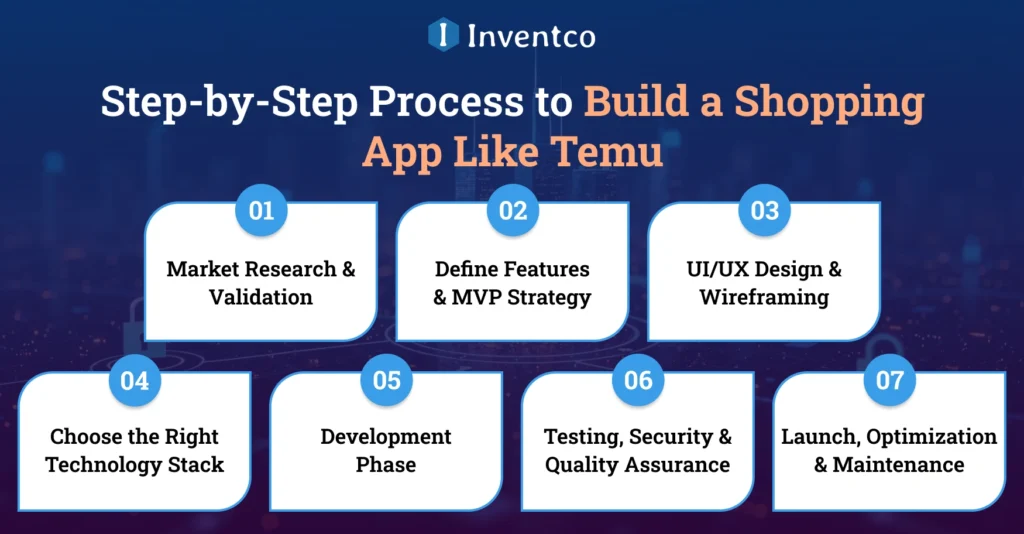
Creating a scalable high-performing e-commerce app like Temu will require a structured and strategic development approach. All phases are critical inclusion to ensure app performance, increase user engagement, and fosters sustained business growth.
1. Market Research & Validation
The first step to building a shopping app is conducting thorough market research to determine your intended audience, their buying habits, and what they are willing to spend. Evaluate competitors, and research shopping apps like Temu to determine what they do well and what they do poorly. Validate your business idea using surveys and feedback to gauge demand. Establishing a well-researched framework will reduce uncertainty and improve decision-making. It will also serve as a guide to the features users require, rather than what developers assume.
2. Define Features & MVP Strategy
Don’t create a fully loaded shopping app right away. Start with an MVP app (Minimum Viable Product). For a shopping app that includes key app features like product listings, search, a shopping cart, and a checkout process. That would be enough functionality to hit the market, post your MVP and gather user feedback. A defined MVP will help create a framework to manage your development budget and guide what future features to build. The framework will be based on user needs.
3. UI/UX Design & Wireframing
Every shopping app must have a flawless and intuitive user experience. You should begin with app wireframing and app prototyping to lay out user journeys, navigation and interface structures. Your designs should be clean, responsive, and stimulating. They should make finding the product and the checkout process as easy as possible. A strong UI/UX design will lead to greater user satisfaction and with that, conversion rates, and retention will improve. Along with that, drop-offs will also be less.
4. Choose the Right Technology Stack
To ensure your app can withstand high traffic, support real-time updates, and scale in the future, the right technology stack will be crucial. There should be a strong, secure backend and a smooth, responsive frontend that works across all devices. A well thought out plan that includes your mobile app frameworks and tools will improve long-term goals without accumulating technical debt. This reduces growth with poor system updates.
5. Development Phase
The development stage consists of the designing of the frontend and backend structures, integrations with APIs, setting up the payment systems and the third party services. This includes the designing of the core functions of the app and the testing of the app functions in real world situations. They should decide if the app should be designed for Android, iOS, or if they should go for cross platform development (in case they want the app designed for more than one operating system). This will affect the overall cost, performance and scalability of the app. The organized development approach will meet the execution efficiency and the overall business goals.
6. Testing, Security & Quality Assurance
Hyper mobile app testing must be done before launch. This is due to hyper testing of the functionality, performance, and mobile app security of the system, the app designers and developers hyper test the usability of the system, the load the system can accommodate and the vulnerabilities of the system. The system is vulnerable, which affects the trust users will have in the system and the ease of the transactions. The designers and developers of an app should decide to do the testing regularly to ensure the app continues to have a good state. The app’s costs would be lower if the designers and developers tested it regularly.
7. Launch, Optimization & Maintenance
Once your mobile app is up and running, your number one priority is the app’s launch, alongside your App Store Optimization (ASO), marketing, and user acquisition campaign. However, launching your app is the easy part; what’s more important is the ongoing mobile app maintenance. This is how you will continue to stay ahead of the competition. You should be monitoring user patterns, soliciting feedback, and continually releasing updates to improve the app’s performance and features. Regular updates will keep your app functioning, and your app will be secured and aligned with user demands and the state of the market.
Business Model Behind a Shopping App Like Temu
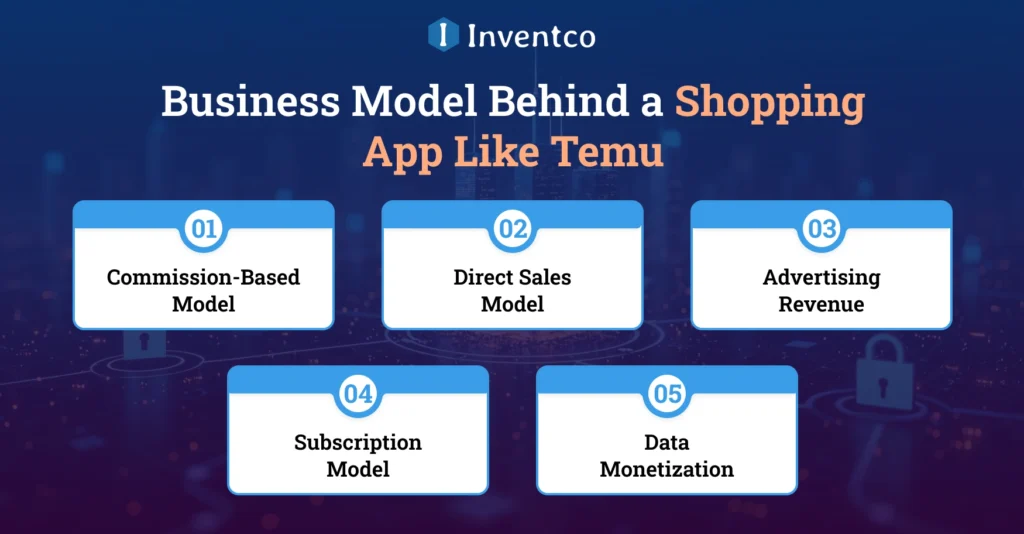
Success from shopping apps like Temu stems from sophisticated app monetization strategies instead of steering from cost or focusing on simplistic user adoption. Most people building apps like Temu should be able to understand these revenue streams to build on for future sustainable growth.
1. Commission-Based Model
Each seller on the marketplace must pay Temu a percentage of every sale they make, which creates revenue for Temu without the costs of holding or buying any inventory. They also encourage more sellers to join the marketplace, further increasing product diversity.
2. Direct Sales Model
Temu has the ability to control the pricing of the products, as well as maintain a higher profit margin by eliminating the middleman. They also create competitive pricing by sourcing products from manufacturers in bulk. This means they also determine the pricing of the products which they sell on their platform competitively.
3. Advertising Revenue
Brands and sellers pay for sponsored listings and featured placements, increasing product visibility while creating a high-margin revenue stream that scales with platform traffic and user engagement growth.
4. Subscription Model
This is a great way to retain customers and improve customer experience. When users pay monthly to access better delivery services, access to deals, and discounts, the business gets a stream of revenue and also gets the people what they want, which is a better shopping experience.
5. Data Monetization
The platform utilizes user behavior and transaction data to inform brands and sellers on how to improve their marketing and inventory tactics, simultaneously creating another revenue stream for the platform.
How Much Does It Cost to Build an App Like Temu?
Building a Temu-like app involves significant variability across factors such as features, scalability, user experience, and backend systems. Therefore, from a founder and investor standpoint, costs should be less of a focus. Instead, it is more important to design a solution that builds value over time through strong performance and the opportunity to grow.
Most businesses in 2026 are predicted to use a phased development approach, starting with a strong MVP. This is prioritizing development over user growth. Based on existing benchmarks in the market, the cost to build a mobile app is expected to fall between $10,000 and $100,000+.
Cost Segmentation Based on App Complexity
- Basic MVP App ($10,000 – $40,000): The basic features are product listings, a search function, a cart, and a checkout function. The value is in entering the market to test the idea.
- Mid-Level App ($40,000 – $70,000): This encompasses improvements to the UI/UX, creation of user accounts, incorporation of payment functions, and the addition of basic engagement and performance analytics.
- Advanced App ($70,000 – $100,000+): This will include ability to make real-time recommendations based on AI, real-time tracking, the ability to support multiple vendors, and a scalable cloud based backend to manage user load.
Top Shopping Apps Like Temu
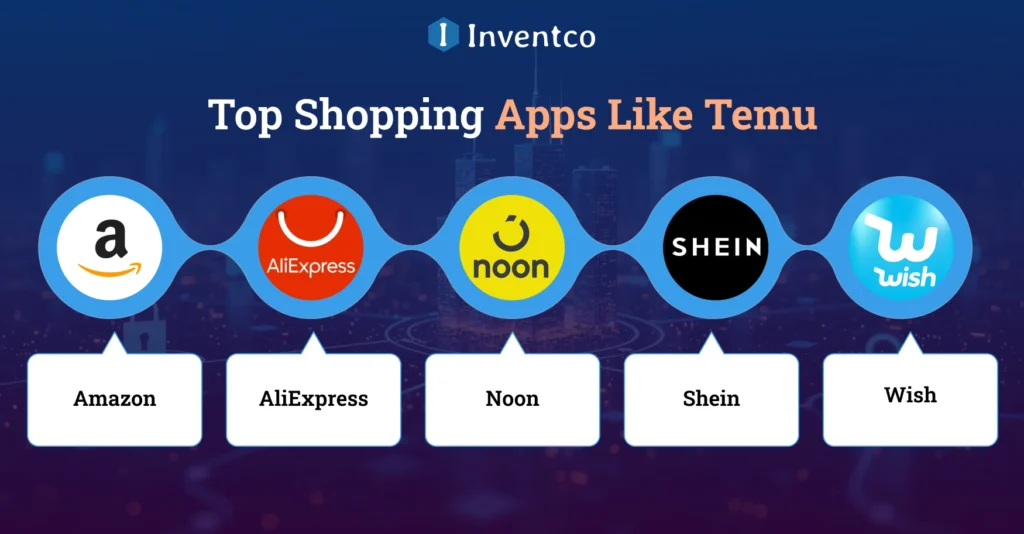
Many users are searching for apps like Temu. The paradigm shift Temu brought was integrating the in-app shopping experience with social media. For apps such as Temu, it is important to look at emerging markets in the United States and the UAE. These apps have demonstrated success when working with the right price points, as well as user engagement strategies.
1. Amazon
Amazon leads in the US and UAE markets. It provides reliable customer service and rapid shipping as well as a vast catalog of items, making them a worthy competitor of any e-commerce business.
2. AliExpress
AliExpress is known for being one of the most affordable e-commerce websites, and this is a large part due to their model of having users connect with global suppliers and manufacturers, like Temu. This model works very well in the UAE due to the price sensitivity of the consumers.
3. Noon
With one of the most localized approaches in the Middle East, Noon is one of the first to successfully implement fast delivery. Their regional focus allows them to prioritize customer experience and engagement, helping them to compete with global markets.
4. Shein
Shein is one of the leading fashion companies worldwide, making it a strong competitor in this mobile-first market. The large number of users is due to casting trend driven marketing. This is particularly successful with the younger crowd.
5. Wish
With a focus on budget-conscious consumers, Wish sells steeply marked down items, which are sourced from a variety of global locations. Wish’s deal-driven strategy, along with a gamified shopping experience, is similar to Temu’s user engagement strategies.
Key Insight: Studying apps like Temu helps founders analyze regional and global pricing, logistics, and user experience. Each of these apps has created a combination of strategies that can be used to develop a scalable and competitive business model.
Note: Planning to shop online in Dubai? Check out this blog to find the Top shopping apps in Dubai and choose the best one for your needs.
Why Partner with Inventco to Build Your Shopping App?
Selecting the right mobile app development company significantly impacts your app’s scalability, performance, and future ROI. With Inventco’s technical and business-centric approach to problem solving, we provide solutions based on the current market needs and user expectations, as well as the founder’s goals. Our approach shifts the mindset of founders from simply building an app, to establishing a scalable digital commerce ecosystem.
Inventco carries out all the components of the app development process, including planning, UX/UI design, custom front and back end development, and software testing. Every phase of the development cycle is oriented towards the performance, security, and user experience of the application, allowing the business to deploy applications that are highly reliable and capable of performing multiple transactions.
Inventco exemplifies all the attributes of a mobile application development business by its continued development of Lavender, a mobile application development business flower and chocolate gifting eCommerce platform. The application creates an optimal and user-friendly shopping experience by allowing customers to browse and select items, add gifts to carts, customize gift wrapping, and choose gift delivery dates. Customers are offered an integrated promo code, which increases shopping cart conversions.
Inventco’s real-world applications reveal customer-oriented solution engineering professionalism with seamless functionality, extensible, back-end systems, custom optimization of payment systems, and checkout processes as well as operational excellence with focus on sustained growth, value, agility, and profitability in balanced performance.
Conclusion
The development of a shopping application like Temu requires a well-defined business plan, scalable systems, and a user-centered approach. All aspects of the app, platform performance, and pricing strategies, should be in sync with market demands.
Personalization using artificial intelligence and AI-powered sourcing systems provides a competitive advantage. It enables the development of a holistic ecosystem center where technology, user-engagement, and growth-focused retention converge.
The opportunity for investors and founders is substantial. Your app can be made to operate and deliver optimal business outcomes by collaborating with a performance-focused company like Inventco.
FAQ’s
Q1. How to develop a shopping app like Temu?
Ans. Start with detailed market research, define an MVP, design intuitive UI/UX, select a scalable technology stack, develop core features, test thoroughly, and launch with continuous optimization strategies for performance and growth.
Q2. What is the cost to build an app like Temu?
Ans. The cost typically ranges between $10,000 to $100,000 depending on features, complexity, integrations, and scalability requirements, while advanced apps with AI, automation, and global infrastructure may exceed this estimated development budget.
Q3. What features are required in a Temu-like app?
Ans. Essential features include product listings, advanced search, shopping cart, secure payments, order tracking, user accounts, seller dashboards, admin panel, AI recommendations, and gamification elements to enhance engagement and retention.
Q4. What is the business model of Temu?
Ans. Temu operates using a multi-revenue model including commissions from sellers, direct product sales, advertising placements, subscription benefits, and data-driven insights, ensuring scalable revenue generation while maintaining competitive pricing for users.
Q5. How long does it take to build a shopping app like Temu?
Ans. Development usually takes around four to nine months depending on app complexity, feature set, team size, and whether you begin with an MVP approach or build a fully scalable platform initially.

Ajay Bhal
He is an on-demand app solutions expert with 11+ years of experience in business consulting and building scalable, user-centric digital products. He specializes in robust on-demand platforms across industries, combining technical expertise with business-focused strategy to deliver efficient, top notch solutions that drive growth and enhance user experience. You can connect with him on LinkedIn to follow insights.