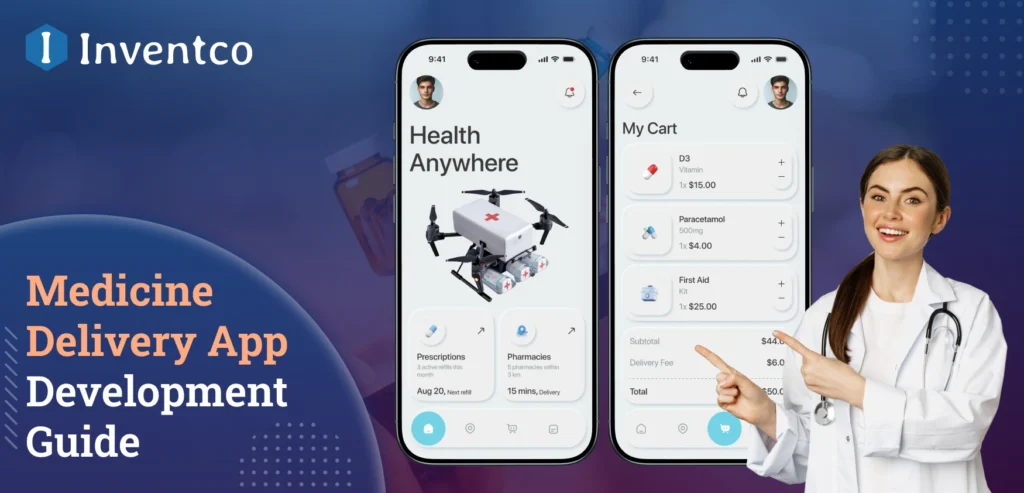
The digital healthcare landscape is on a steep growth curve, and medicine delivery app development stands at the heart of this transformation. The global e-pharmacy market alone is projected to hit about $177.8 billion in 2026, with forecasts indicating exponential growth through the decade as consumers increasingly prefer online access to medicines. Meanwhile, the broader digital health market is expected to reach roughly $491.6 billion in 2026, driven by telemedicine, wearable integrations, and mobile delivery platforms.
For founders and investors, success in this space depends on more than just convenience. Working with a trusted Healthcare app development company ensures that your platform meets regulatory requirements, handles prescriptions accurately, keeps data secure, and integrates smoothly with delivery and pharmacy systems. These factors build user trust and long-term engagement.
This medicine delivery app development guide explains how to develop a medicine delivery app, covering planning, features, business models, and the cost to develop a pharmacy delivery app. With mobile healthcare adoption rising and regulatory clarity improving, now is a strong time to invest in online medicine delivery app development that drives growth and delivers value.
What Is a Medicine Delivery App? How It Works
A medicine delivery app is a secure digital healthcare platform that enables users to upload prescriptions, order medicines online, and receive doorstep delivery from licensed pharmacies. From a business and technology standpoint, a professional medicine app development service connects pharmacies, logistics providers, payment systems, and regulatory workflows into a single, scalable ecosystem designed for compliance and operational efficiency.
How the Medicine Delivery App Works?
Step 1: Prescription Upload or Medicine Selection
Users must either upload a photograph of the prescription or select a prescription-exempt medicine.
Step 2: Pharmacy Verification & Compliance Check
A pharmacy connected to the app verifies that the prescription and all other regulatory requirements are accurate and that the medicine is in stock.
Step 3: Order Processing & Dispatch
After receiving payment, the pharmacy processes the order and packages the medicine to give to one of the app’s delivery partners.
Step 4: Real-Time Tracking & Notifications
Users are notified of the order status and can track it in real time.
This is how medicine delivery apps work. It enables regulatory compliance, order fulfilment, and a streamlined user experience.
Popular Types of Pharmacy Delivery Apps in Digital Healthcare
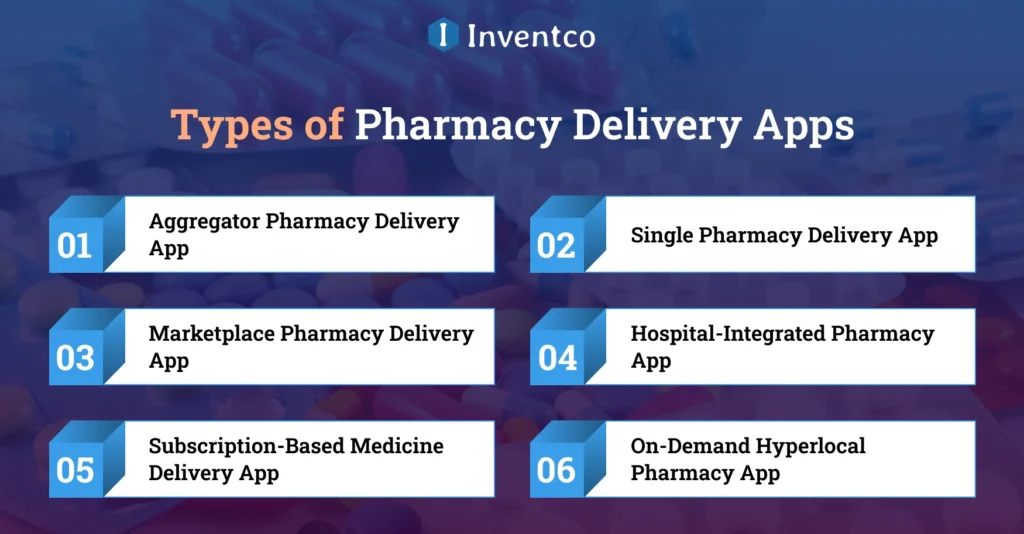
While building a medicine delivery app, one of the most important considerations is selecting an app model, as it will affect all development costs, scalability, regulatory compliance, operational complexity, and more. Here are six pharmacy delivery app models aligned with current healthcare business models.
1. Aggregator Pharmacy Delivery App
This model provides an interface to customers for multiple local pharmacies. Thus, there is greater availability of medicine, quicker delivery, and reduced inventory risk, which is ideal for startups in competitive marketplaces.
2. Single Pharmacy Delivery App
This model is owned and operated by a single pharmacy brand. Thus, it focuses on brand loyalty, controlled inventory, and direct customer relationships. It is ideal for pharmacies that are digitally expanding.
3. Marketplace Pharmacy Delivery App
In a marketplace model, pharmacies, diagnostic labs, and healthcare service providers are in the same ecosystem. This model has cross-selling potential, but it is also the most complex in terms of compliance and system integration
4. Hospital-Integrated Pharmacy App
With this model, apps are designed to integrate with hospital pharmacies. Thus, in addition to outpatient services, these apps can provide prescription fulfilment for inpatients. There is high accuracy in prescription fulfilment and compliance with regulatory guidelines, but it also involves complicated approval processes.
5. Subscription-Based Medicine Delivery App
This model is suited for ongoing chronic care as well as for recurring prescription refills. Automated payments for scheduled refills are offered. This approach improves patient adherence and creates consistent, recurring revenue streams for the business.
6. On-Demand Hyperlocal Pharmacy App
This model is centred on on-the-spot order delivery. It collaborates with local pharmacies to provide the same day or instant delivery of prescribed medications. It focuses on a streamlined approach to operational logistics and on real-time inventory adjustments.
Each of these medicine delivery app models has its own unique set of pros and cons that affect aspects of regulation, scalability, and return on investment over time in the development of mobile apps for the delivery of prescribed medications.
Key Features for Medicine Delivery Apps
While analyzing the various aspects of developing a medicine delivery app, investors and founders take into account regulatory compliance, automation of workflows, the security of data, and scalability. There is a great emphasis on operational risk, sustainable growth of medicine delivery, and the mobile app user experience.
Must-Have Features in Your Medicine Delivery App
- User Registration & Profile Management: Sign-up and log-in features, as well as profile management. Users should be able to save their prescriptions, delivery addresses, and order history.
- Prescription Upload & Verification: Users should be able to upload prescriptions, with a verification backend to ensure compliance with regulations and the pharmacy.
- Medicine Search & Categorization: A smart search should have filters, categories, and brand or generic alternatives to make medicine discovery easier.
- Doctor-Prescribed & OTC Segregation: To avoid regulatory compliance issues, there should be a clear demarcation for prescription-required products and over-the-counter products.
- Secure Payment Integration: Users should be able to pay in multiple ways, with end-to-end encryption to ensure their financial information is safe and to earn their trust.
- Order Tracking & Status Notifications: Users should be able to track the entire order in real time and receive push notifications, SMS, or email updates regarding the order and the delivery status.
- Delivery Address & Slot Management: Users should be able to select a delivery address and schedule a delivery time to enhance their convenience.
- Customer Support & Helpdesk: A prescription, order, or refund-related inquiry should have in-app chat or ticket support for assistance.
Advanced Features for Medicine Delivery Apps
- AI-Based Prescription Validation: AI technology can assist to minimize the amount of manual work required to verify the presence of mistakes, duplicate orders, or invalid prescriptions, thus lowering the effort required.
- Subscription-Based Medicine Refills: For patients with long-term conditions, automated recurring orders improve medication adherence and create consistent revenue.
- Real-Time Inventory Sync with Pharmacies: Immediate inventory synchronization to avoid stock shortages and cancelled orders.
- Regulatory Audit Logs & Reporting: Detailed logs of transactions and prescriptions to assist with audits and compliance with legal regulations.
- Smart Medicine Recommendations: Based on the user’s prescription history, the app will recommend substitutes or related products.
- Hyperlocal Delivery Optimization: Lowered delivery expenses and improved speed of delivery because of optimized routing technology.
- Multi-Pharmacy Management Dashboard: Allows managers to manage multiple pharmacy partners from a single backend dashboard.
- Data Analytics & Performance Insights: Sophisticated analytics for the trend of orders, user interaction, and the prediction of stock.
For app developers and their investors, these app features help with trust, adherence to regulations, and optimized operations, proving their importance when developing a delivery app for the future-focused, scalable healthcare system.
Tech Stack Required for Medicine Delivery Mobile App Development
Selecting the right technology stack is a critical decision in medicine delivery mobile app development, as it directly impacts performance, security, scalability, and long-term maintenance costs. A well-optimized tech stack ensures regulatory compliance while enabling seamless integrations among pharmacies, logistics, and payment systems.
| Layer | Technology Options |
| Frontend | React Native, Flutter |
| Backend | Node.js, Django, Spring Boot |
| Database | PostgreSQL, MongoDB |
| Cloud Infrastructure | AWS, Azure, Google Cloud |
| APIs | REST, GraphQL |
| Payment Gateways | Stripe, Razorpay |
| Security | OAuth 2.0, SSL, HIPAA-compliant encryption |
| Analytics & Monitoring | Firebase, Mixpanel |
The proper selection of technology augments the overall adaptability of the platform, the modification of the development plan to the pace of changes in the healthcare industry, the increase in users, and the mitigation of the costs associated with the development of an initial medicine delivery app.
Step by Step process to Develop a Medicine Delivery App
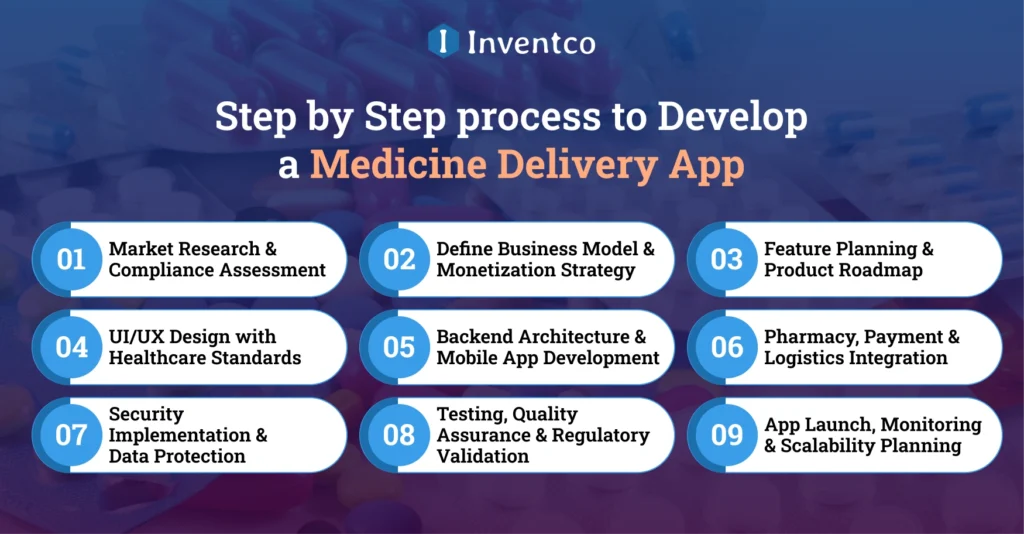
Building a scalable, compliant medicine delivery platform requires a well-defined, regulation-first development roadmap. Below is the app development process:
Step 1: Market Research & Compliance Assessment
Study the target user characteristics, the delivery of medicine via app competitors, and platform analytics. Simultaneously, identify the healthcare-specific laws, prescription regulations, and data privacy laws in the defined geography. Building a legal framework up-front minimizes the risk of costly app changes and aligns operational and legal compliance with non-compliant app delivery of medicines.
Step 2: Define Business Model & Monetization Strategy
Determine the revenue model for the medicine delivery app and identify the target customer. Within the parameters of your growth objectives, choose an appropriate model, such as an aggregator, marketplace, subscription model, or a single-pharmacy model. Specify the revenue streams as direct sales, subscriptions, partnership models, or white-labeling. This app monetization strategy is directly tied to the features added to the app, the platform architecture, and the return on investment in the later stages of medicine delivery app development.
Step 3: Feature Planning & Product Roadmap
Determine the advanced and core mobile app features needed for future scaling and the current launch. For the MVP, focus on prescription management, payments, compliance, and order tracking. Founders create medicine delivery roadmap structures, enabling the launch of delivery apps with a core operational focus and feature expansions.
Step 4: UI/UX Design with Healthcare Standards
Design user journeys for patients, pharmacies and delivery. The interface should focus on prescription uploads, medicine and order tracking, simplicity, and accessibility and clarity. UX focused on healthcare lowers errors and increases user trust and adoption rates for online delivery apps.
Step 5: Backend Architecture & Mobile App Development
Create a backend system that securely manages user data, transactions, and inventory. Develop mobile apps with scalable frameworks such as Flutter and React Native. This is the tech core of the delivery app, impacting performance, reliability, and scalability.
Step 6: Pharmacy, Payment & Logistics Integration
Merge delivery partners, licensed pharmacies, and secure payment gateways into a single workflow. Critical in order routing, payment confirmation and real time inventory control. Integration of third parties is operationally efficient and reduces the medicine delivery ecosystem.
Step 7: Security Implementation & Data Protection
Build enhanced protective frameworks by implementing a balanced app security model that includes encryption-based storage, access controls, secure authentication, and continuous technical checks. Align services with local HIPAA regulations to ensure medical data protection, giving both investors and clients confidence in the platform’s security foundations.
Step 8: Testing, Quality Assurance & Regulatory Validation
Execute a holistic app testing strategy covering functionality, performance, security, and regulatory compliance. Validate prescription accuracy, payment workflows, and delivery tracking under real operational stress to ensure the medicine delivery app is fully regulatory-ready and resilient to service interruptions.
Step 9: App Launch, Monitoring & Scalability Planning
Monitor users’ operational, behavioral, and performance metrics after deploying the app across relevant app stores and cloud infrastructure. Ongoing app maintenance ensures system stability and feature optimization, while effective app store optimization improves visibility and adoption. With this approach, founders can scale compliant, investor-ready medicine delivery apps built for long-term growth.
How Much Does It Cost to Develop a Medicine Delivery Application?
When building apps for medical delivery, the price depends on the technical complexity, compliance requirements, and the depth of the features. The cost to build a medicine delivery app can range between $10,000 to $100,000 and up. Being aware of price levels will help founders and investors make better budgets and align apps with long-term growth for better ROI.
Cost Breakdown by Development Level
MVP Medicine Delivery App: $10,000 – $25,000
It is focused on building a core feature set that includes simple user tracking, prescription uploads, medicine ordering, a basic payment system, and order tracking. This version is recommended for startups that want to quickly test their margins and see if the market will sustain their investment, and it also meets the basic compliance requirements.
Mid-Level Medicine Delivery App: $25,000 – $60,000
Building a mid-level app is focused on more advanced UX design, Multiple pharmacy integrations, and on the other side of the spectrum, real time inventory updating, delivery partners system and security of the app. This tier app is suitable for operational scaling beyond pilot markets.
Advanced Medicine Delivery App: $60,000 – $100,000+
Advanced solutions costs include the ai based apps, subscription based refill systems, and operational scale logs. The apps also include advanced tech such as enterprise level security, an analytics app, and are developed for large-scale regional-based structural investments and long term growth for investors.
Key Factors Affecting Medicine Delivery App Development Cost
- App Complexity and Features: More advanced features and automation increase development time and cost.
- Compliance Requirements: Healthcare regulations like HIPAA, as well as local pharmacy laws, will dictate some of the architecture and security costs.
- Third-Party Integrations: Integrating payment processors, logistics APIs, pharmacy system APIs, and analytics tools will increase overall development costs.
- Platform Selection: Which platforms you choose to develop for (iOS, Android, or both) will affect your development costs and timelines.
- Maintenance and Cloud Infrastructure: Long-term costs will include cloud costs, server hosting, scalability plans, and ongoing update costs.
In a highly competitive healthcare market, accurately estimating app development costs for a medicine-delivery app will help create a sustainable product roadmap, optimize costs, and deliver solid ROI over time.
Benefits of Medicine Delivery App Development
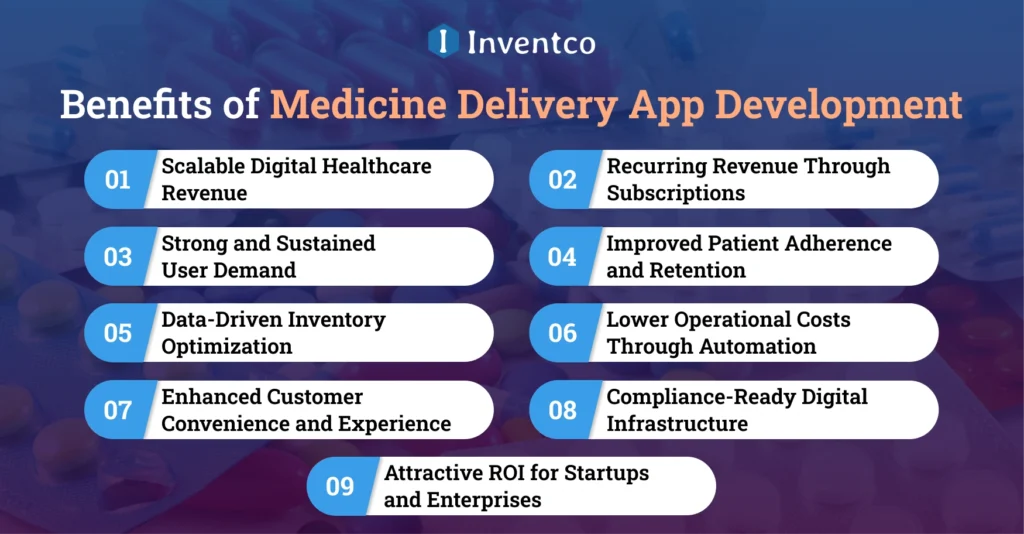
Developing medical delivery apps helps startups and other healthcare businesses achieve operational and commercial benefits. Below are the top benefits that help drive revenue growth, ensure compliance, and enable scalability.
1. Scalable Digital Healthcare Revenue
Delivery of medicine through apps helps scale easily across geographies and cities without operational expenditure. Automating workflows and utilizing cloud services helps businesses expand their customer base while maintaining their services.
2. Recurring Revenue Through Subscriptions
Refilling subscriptions to deliver medicine to patients with chronic illnesses creates a constant income stream through recurring revenue. This mobile app revenue model and the decrease in customer churn make it particularly appealing for investors to develop medicine delivery apps.
3. Strong and Sustained User Demand
Consumer behavior that emerged during the global pandemic shifted towards the use of digital services in health and medicine. Access to on-demand medicine delivery is a service people need, and both urban and suburban areas show high use of it.
4. Improved Patient Adherence and Retention
Patients are more likely to stick to their prescribed medication with automated reminders and refill subscriptions. This starts partnerships with patients and leads to service retention.
5. Data-Driven Inventory Optimization
Pharmacies get real-time orders and usage data to optimize forecasting. More accurate forecasting means fewer stockouts, less waste, and greater operational efficiency across the medicine-delivery ecosystem.
6. Lower Operational Costs Through Automation
Manual processes for order automation, prescription verification, and delivery tracking increase operational costs. More automation in these processes means greater accuracy, lower operational costs, and enhanced profitability in mobile applications for medicine delivery.
7. Enhanced Customer Convenience and Experience
Users get greater satisfaction with the medicine delivery app when they can receive their orders, track them in real time, and pay digitally. Of these three factors, the most significant is delivery, which also encourages more repeated use.
8. Compliance-Ready Digital Infrastructure
Good medical delivery applications are built to include regulatory steps, logs, and secure data processes. This helps reduce legal exposure and build trust with regulators, partners, and investors.
9. Attractive ROI for Startups and Enterprises
Medicine delivery applications are attractive to both enterprises and startups in the healthcare sector because they can achieve high returns on investment. This is possible because they have large, scalable infrastructures for the different monetization models and high customer retention.
Today, top medical delivery apps have strong commercial and growth potential, making them a strong digital healthcare solution.
Pharmacy Delivery App Business Models
Choosing a business model is important when building an on-demand medicine delivery app, especially in a startup ecosystem, as it influences revenue, growth potential, and investor interest. The following describes four universal business models for pharmacy delivery apps, used by digital health care businesses globally.
1. Commission-Based Marketplace Model
As users make orders through the app from different pharmacies, the pharmacy delivery app earns a commission on each successful order. The app owner does not have to manage any inventory. This model allows rapid scaling and is well-suited for businesses in the startup phase, especially when growing across multiple locations.
2. Subscription-Based Revenue Model
A user subscribes for a preset fee and receives scheduled medicine refills and delivery as they become a part of a prioritized queue. This model assures steady, consistent revenue, improves patient adherence, and increases customer lifetime value, making it an attractive option for long-term investment.
3. Private-Label Pharmacy App Model
In this model, the app is created exclusively for a single pharmacy or a chain of pharmacies and marketed under the pharmacy’s brand. This model increases brand loyalty and gives pharmacies full control over operations and direct access to customers, without paying commissions to intermediaries.
4. B2B Pharmacy Logistics Platform Model
This model centers on providing logistics, inventory management, and fulfillment services tailored to pharmacies and healthcare providers. Revenue streams can come from service fees, contract agreements, or SaaS subscriptions, resulting in stable, scalable B2B revenue.
Founders can better align medicine delivery app development with market realities, operational execution, and long-term strategy by offering diverse growth options and monetization pathways, an approach increasingly informed by insights from pill reminder apps and their user engagement models.
Future Trends in Medicine Delivery App Development
The current digital healthcare revolution is the backbone of developing the next generation of medicine delivery platforms. Founders and investors of these platforms need to become familiar with the latest technologies that will shape the differentiation, compliance, and scalability of mobile medicine delivery applications through 2026 and beyond.
1. AI-Powered Prescription Analysis
An AI in a healthcare app is currently streamlining the prescription evaluation process by identifying errors and potential adverse drug interactions, thereby reducing the need for manual evaluation, increasing accuracy, improving compliance, and reducing order processing time.
2. Hyperlocal 30-Minute Medicine Delivery
The ability to deliver medicine from a network of local pharmacies is a perfect example of a hyperlocal fulfillment model. Optimized logistics and immediate inventory access will remain important competitive advantages in the urban healthcare landscape.
3. Blockchain-Based Prescription Security
The transparency, trust, and fraud prevention offered by blockchain technologies can record and track prescription transactions with unique, non-spinable, and unalterable records, providing users, regulatory bodies, and pharmacies with enhanced trust and security.
4. IoT-Enabled Cold-Chain Monitoring
Temperature-sensitive medicines are monitored using IoT sensors during storage and delivery. To maintain drug effectiveness, comply with guidelines, and minimize pharma logistics costs, real-time notifications are issued.
5. Telemedicine and E-Prescription Integration
Users can communicate with physicians and receive digital prescriptions in real time, enabling direct integration with telemedicine platforms. There is an uninterrupted experience that fuses care and delivery.
6. Predictive Analytics and Demand Forecasting
The advanced analytics of the medicine sector can determine and mitigate shortfalls in stock by predicting demand, optimizing, and reducing inventory. At scale, the data-driven predictive analytics improves operational efficacy and profit margins.
Collectively, these predictions and trends will accelerate the development of medical delivery applications, enabling platforms to deliver increasingly rapid, secure, and smart healthcare solutions.
Why Invest In An On-Demand Medicine Delivery App?
The value of investing in on demand medicine delivery can be proved by considering the current environment of growing digitization of global healthcare, the increase in elderly populations around the world, and the rapid improvement of global regulations on the delivery of healthcare services. On demand delivery of prescriptions solves a persistent and critical need in the marketplace, thus creating a demand for this service, regardless of economic conditions.
From a health investor’s standpoint, there are positive delivery medicine application fundamentals, including growing usage, increased customer loyalty, heightened customer retention, and the ongoing potential for diverse monetization. The methods of on demand prescription delivery, including predictable ordering, subscription-based filling, and other elements of scalable digital frameworks, continue to improve the overall health tech and medicine delivery investment.
Real-World Challenges Faced While Developing a Medicine Delivery App
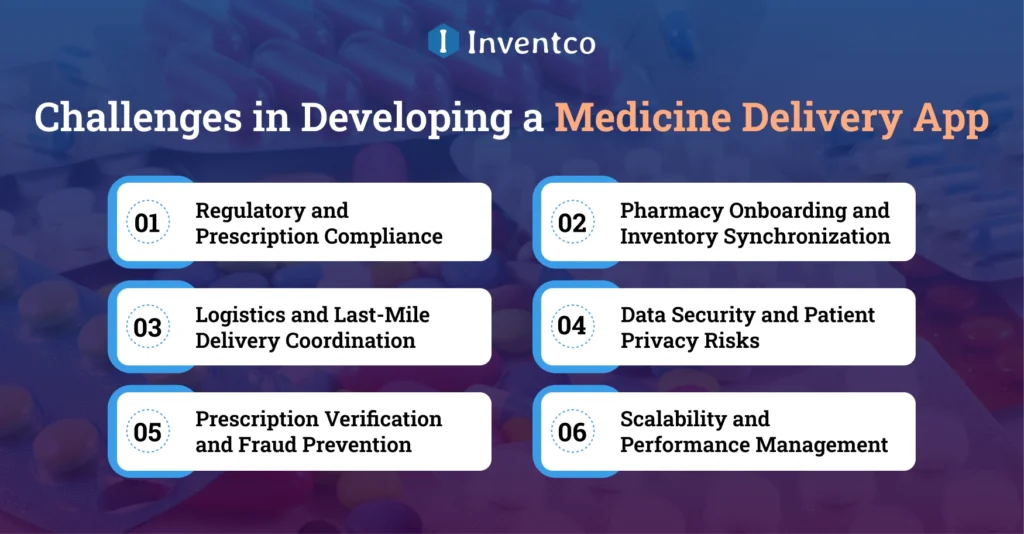
The development of a scalable/compliant medicine-delivery application must consider both operational and regulatory challenges. The following illustrates the top app development challenges and the impact of development on the application’s overall execution and scale.
1. Regulatory and Prescription Compliance
The worldwide delivery of health services and the associated regulations are still evolving. This involves partnering with specific licensed pharmacy(s), prescription auditing, and adherence to regulations governing the services. Non-compliance with these regulations can be detrimental to service delivery and thus a legal risk to the company.
2. Pharmacy Onboarding and Inventory Synchronization
Ongoing onboarding of various pharmacies and the upkeep of real-time inventory synchronization is a multifaceted endeavour, and a lack of inventory data synchronization could lead to failed orders, negative user experiences, and operational inefficiencies.
3. Logistics and Last-Mile Delivery Coordination
Seamless logistics integration is necessary to facilitate the delivery of medical supplies. Customer satisfaction is at risk, as delays, route optimization, and reliance on partners can be detrimental.
4. Data Security and Patient Privacy Risks
Delivery apps for medication use sensitive personal and medical information. The consequences of data breaches or the violation of applicable data protection regulations can be severe for the organization, making secure authentication and data encryption necessary.
5. Prescription Verification and Fraud Prevention
Without effective systems to verify prescriptions, the risk of fraudulent prescribing persists. However, approximately manual checks can further lengthen the order processing time, and addressing this conflict remains a major technical challenge.
6. Scalability and Performance Management
Ensuring app performance, server stability, and quick response times is increasingly difficult as user demand puts downward pressure. Poor scalability planning can lead to revenue losses due to system downtime.
Persistent challenges can be mitigated by integrating the best solutions early on in the development process. This approach enables the efficient market launch of a reliable, investor-ready platform for medication delivery.
Why Trust Inventco for Medicine Delivery App Development?
Inventco is a top mobile app development company specializing in healthcare-focused digital solutions built for compliance, scalability, and performance. We have extensive expertise in managing pharmacy workflows, prescription validation, health data privacy, and healthcare-grade security, ensuring compliant, regulation-ready platforms are delivered on the first day of service.
We develop a combination of architecture and design that is centred around the user, resulting in a development approach that is scalable. This results in seamless integrations across pharmacies, logistics partners, and payment systems. Regardless of whether Inventco is building an MVP for a start-up or a complete enterprise solution, the company prioritizes performance, high availability, and a future-ready infrastructure aligned with the client’s long-term growth objectives.
With proven ability to deliver secure platforms in the digital health industry, Inventco partners with the founders of firms and other investors to simplify their intricate ideas around health care and transform them into high performing delivery apps for the health care sector. Our partners consider us a technology partner for innovative health care solutions, a result of their focus on quality, compliance, and return on investment.

Conclusion
Compliance-driven opportunities within the rapidly evolving digital health care ecosystem underscore the importance of developing platforms that provide on-demand, internet-accessible health care services and support the management of chronic illness. These services are viewed as essential to modern consumers.
Founders can develop medicine-delivery platforms by focusing on secure system architecture, regulatory alignment, and scalable business models to build platforms that users can trust and that investors can meet their expectations. Compliance-first development reduces operational risk and enables faster growth within and across regions and healthcare networks. This combination of Compliance-first development lowers operational risk and enables faster growth within and across regions and healthcare networks.
With the appropriate technological strategy and a reliable development partner, money delivery apps can produce consistent revenue, sustain long-term growth, and positively impact the healthcare system. This combination of stability, growth potential, and societal value makes medicine-delivery apps an excellent choice for digital healthcare investments.
FAQs
Q1. How long does it take to develop a medicine delivery app?
Ans. Medicine delivery app development usually takes between three to six months. The timeline depends on app complexity, required features, regulatory compliance standards, third-party integrations, and whether the product is built as an MVP or full-scale platform.
Q2. Is medicine delivery app development legally compliant?
Ans. Yes, medicine delivery apps can be legally compliant when developed in accordance with regional healthcare regulations, prescription validation rules, pharmacy licensing requirements, and data protection laws such as HIPAA or applicable local healthcare compliance frameworks.
Q3. Can startups afford on-demand medicine delivery app development?
Ans. Startups can afford on-demand medicine delivery app development by launching an MVP with essential features first. This approach minimizes initial investment while validating market demand before scaling functionality and expanding operations.
Q4. What features are essential in a medicine delivery app?
Ans. Essential features include secure user registration, prescription upload and verification, medicine search, payment integration, order tracking, notifications, and customer support. These features ensure regulatory compliance, user trust, and smooth operational workflows.
Q5. How much does it cost to build a medicine delivery app?
Ans. The cost to build a medicine delivery app typically ranges from $10,000 to $100,000 or more. Pricing depends on features, compliance requirements, platform selection, third-party integrations, and long-term scalability needs.
Q6. Can medicine delivery apps integrate with pharmacies and logistics partners?
Ans. Yes, modern medicine delivery apps are designed to integrate with licensed pharmacies, inventory systems, and logistics providers. These integrations enable real-time stock updates, order processing, delivery tracking, and operational efficiency at scale.
Q7. Is a medicine delivery app scalable for future growth?
Ans. A well-designed medicine delivery app is highly scalable when built on cloud infrastructure, with a modular architecture and automation. This allows businesses to expand user bases, add pharmacies, and enter new regions without performance issues.

Jitendra Jain
He is the CEO and Co-founder of Inventco, driving innovation in advanced computing and digital transformation. With deep expertise in modern IT ecosystems, he leads scalable, secure, future-ready solutions. His strategic leadership helps businesses accelerate growth, adopt innovation, and achieve success. You can connect with him on LinkedIn to follow his technology insights.