
The U.S. is seeing increased demand for medicine delivery through mobile apps. According to Fortune Business Insights, the global e-pharmacy market is projected to reach USD 177.79 billion by 2026, with North America accounting for more than 50% of the total market share, driven largely by U.S. adoption. Due to the rapid medicine delivery app development services aligned with U.S. regulations, consumers are increasingly accessing digital healthcare. As pharmacies, healthcare stakeholders, and venture capitalists focus on digital distribution solutions, they are replacing traditional delivery-of-medicine channels with delivery-of-medicine apps.
With increased access to delivery-of-medicine apps, consumer expectations are rising, with greater emphasis on the speed of access and delivery. ResearchAndMarkets reports that the online pharmacy market is growing at a CAGR of over 17% through 2026, fueled by demand for faster prescription fulfillment, home delivery, and mobile-first healthcare access. Businesses are being compelled to transform the way healthcare is provided by the increasing volume of prescriptions, the management of chronic diseases, regulatory compliance requirements, and the need to track the real-time status of their orders. Consequently, the delivery-of-medicine apps in the USA are an emerging major investment opportunity rather than merely a digital ancillary service.
Increasingly, venture capitalists and business founders are being compelled to build delivery-of-medicine apps that require far more than a simple order app. It also requires a system that is HIPAA-compliant, has a secure e-prescribing and prescriptions system, closed pharmacy and delivery logistics, and the capacity for on-demand pharmacy delivery nationwide. Speed, trust, and cost-effectiveness are the systems that are best positioned to create a competitive advantage.
This document details the major players in the United States medicine delivery app marketplace, the primary drivers of adoption, and the characteristics that foster economic gain. Additionally, the document outlines the rationale for prioritizing this sector by healthcare companies and investors, the competitive advantage of having a medicine delivery app in the United States, and the economic sustainability, customer retention, and profitability that a delivery app provides.
Top Medicine Delivery Apps in the US
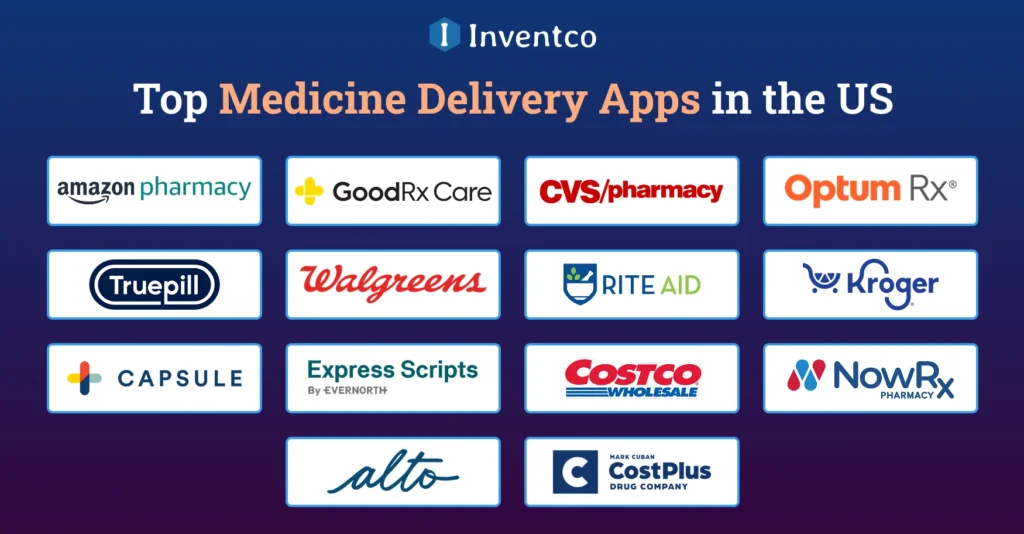
The United States digital healthcare sector’s accelerated development has created an opportunity for healthcare app development for medicine delivery. These apps have evolved from basic ordering applications into a more complex system. These apps have evolved into integrated compliance ecosystems with ordering and delivery components.
Given the importance of understanding the primary delivery applications in the United States, a comprehensive medicine delivery app outlines the corresponding functionalities of these applications. The following section outlines the operating functionalities of the dominant medicine delivery apps and their industry-shaping characteristics.
1. Amazon Pharmacy
Amazon Pharmacy is a digital-first medicine delivery service characterized by transparency, speed, and high patient engagement. It innovatively eliminates the need to visit a pharmacy by providing same day delivery and real-time engagement with a pharmacist. Alto’s model offers a strong example for businesses looking to create a medicine delivery app by enhancing user experience through better pharmacist accessibility and optimized logistics, allowing it to stand out in densely populated urban markets with efficient online medicine delivery.
Key Features:
- Support for insurance and Medicare
- Savings for Prime members
- Automated prescription refills
- Nationwide delivery
Best For: Founders and investors with a focus on large-scale pharmacy operations with significant logistics components.
2. OptumRx
As a pharmacy benefit manager with integrated mail-order and specialty pharmacy services, OptumRx works closely with health insurers and employer plans to keep costs down, support medication adherence, and manage chronic prescriptions. The focus of OptumRx is on enterprise solutions, demonstrating its provision of large, integrated healthcare systems with compliant, scalable delivery solutions.
Key Features:
- Integration with insurers
- Chronic medication management
- Mail-order services
- Support for employer health plans
Best For: B2B healthcare platforms and delivery systems that are closely integrated with insurance.
3. Rite Aid
Rite Aid merges a nationwide retail pharmacy delivery footprint with digital prescription management. Customers may refill, track and receive prescriptions digitally while accessing stores. This model illustrates the transformation of legacy pharmacy brands to omnichannel medicine-delivery applications in the U.S. markets.
Key Features:
- Integration of retail and digital services.
- Management of prescription refills.
- Scheduling of deliveries.
- Reminders for medication.
Best For: Retail pharmacy chains that offer digital delivery.
4. Express Scripts
Express Scripts focuses on pharmacy benefit management and prescription order fulfillment for a high volume of prescriptions. The primary focus is on affordable prescription orders, mail delivery, and adherence to long-term prescriptions. It provides services to millions of insured patients, exemplifying how sustained chronic care management, as a form of centralized medical delivery, adheres to the regulatory requirements of state and federal laws governing health care.
Key Features:
- Prescriptions via mail
- Programs for cost optimization
- Partnerships with employers
- Monitoring of adherence
Best For: Chronic care delivery platforms and large populations with health insurance.
5. Alto Pharmacy
Alto Pharmacy is a digital-first medicine delivery service characterized by transparency, speed, and high patient engagement. It innovatively eliminates the need to visit a pharmacy by providing same day delivery and real-time engagement with a pharmacist. Alto’s model provides a noteworthy example of enhancing the user experience by improving pharmacists, accessibility and optimizing logistics, thereby standing out among competitors in densely populated urban regions through the delivery of online medicine.
Key Features:
- Pharmacist support via chat
- Same day delivery
- Prescriptions digitally
- Tracking of orders in real time
Best For: Premium delivery services in urban centers.
6. GoodRx Care
GoodRx Care combines telehealth, prescription delivery, and price transparency into one seamless service. Customers can communicate with providers, order prescriptions, and have them delivered. This service exemplifies the integration of telehealth and pharmacy delivery, improving access, affordability, and ease of use within the digital health continuum.
Key Features:
- Telehealth access
- Real-time drug price comparison
- Prescriptions with discounts
- Integrated delivery options
Best For: Those sensitive to cost and needing telehealth services.
7. Truepill
Truepill is a backend pharmacy fulfillment and logistics for several digital health providers. Rather than business to consumer models, it integrates prescription, adherence, and delivery fulfillment through APIs. Truepill is an exemplar of scalable, regulation-compliant, infrastructure-first app development for on-demand medication delivery and white-label healthtech partnerships.
Key Features:
- API integrated fulfillment
- Built-in compliance
- White-label solutions
- Logistics support across the US
Best For: Healthtech companies needing tailored prescription delivery solutions.
8. Kroger Pharmacy
Kroger Pharmacy is on-demand prescription delivery embedded within its retail and grocery ecosystem. Customers can manage their meds and everyday items in one place, driving operational efficiencies and maximized engagement. This use case illustrates how grocery-backed pharmacy delivery apps optimize existing infrastructure to improve medication delivery while increasing convenience and retention.
Key Features:
- Integration of pharmacy and grocery services
- Effortless prescription refills
- Delivery and in-store pickup
- Grocery and pharmacy loyalty programs
Best For: Pharmacy and grocery retail delivery integrations.
9. Costco Pharmacy
Costco Pharmacy prioritizes efficiency in bulk buying and budget Mail-order prescription deliveries. Their Mail-order prescription service transparency and pricing give insight into how cost-leader pharmacy apps can operate without fierce digital marketing. This model trusts and values long-term customers in pharmacy delivery app ecosystems.
Key Features:
- Price competitiveness
- Mail-order deliveries
- Focus on generics
- Nationwide service
Best For: Value-oriented cost delivery systems.
10. Mark Cuban Cost Plus Drugs
Mark Cuban Cost Plus Drugs is a prime example of pricing disruption in online pharmacies. It delivers generic drugs and practices radical transparency in pricing. By removing middlemen, this platform directly lowers consumer costs. It also exemplifies a lean model for medicine delivery, in which trust, affordability, and supply-chain simplicity drive adoption over speed and premium mobile app features.
Key Features:
- Pricing Radically Transparent
- Generics with low margin
- D2C delivery
- Simple digital order
Best For: Pharmacy delivery startups with premium affordability.
11. CVS Pharmacy App
The CVS Pharmacy App integrates digital prescription management with CVS’s nationwide healthcare network. Users can refill prescriptions, schedule deliveries and access some clinical services. This app exemplifies how vertically integrated healthcare systems can use pharmacy delivery apps to enhance consumer retention and inter-service cross utilization over time.
Key Features:
- Prescription management
- Home delivery
- Clinic integration
- Insurance support
Best For: Healthcare businesses creating ecosystem-oriented delivery applications.
12. Walgreens Pharmacy App
The Walgreens Pharmacy App facilitates digital prescription monitoring, refill, and delivery services, thanks to Walgreens’ extensive retail network. It combines digital convenience with physical-store access, exemplifying how legacy pharmacy brands transform into scalable medicine-delivery applications while remaining compliant with regulations and providing services nationwide.
Key Features:
- Same-day delivery
- Prescription refill reminders
- Retail integration
- Insurance integration
Best For: Nationwide omnichannel pharmacy delivery models.
13. Capsule
Customer experience, proactive communication, and fast delivery are key attributes to Capsule’s pharmacy services. It primarily operates in the United States’ big cities and streamlines the pharmacy process by engaging an on-staff pharmacist and optimizing logistics. Capsule is an exemplar of how service-focused medicine delivery applications maintain strong retention and brand loyalty in competitive urban healthcare markets.
Key Features:
- Free same-day delivery
- Availability of a dedicated pharmacist
- Insurance integration
- Real-time delivery updates
Best For: Customer-centric D2C pharmacy platforms.
14. NowRx
NowRx is an on-demand pharmacy delivery platform focused on operational efficiency. Its rapid prescription fulfillment is complemented by partnerships with nearby pharmacies. Their platform demonstrates how logistics-focused medical delivery applications enable same-day delivery in metropolitan areas that lack immediate access to essential medications.
Key Features:
- Delivery when requested
- Integration with nearby pharmacies
- Quick order completion
- Ability to track orders
Best For: Platforms with a primary focus on rapid processing and local delivery.
Comparison Table – Top Medicine Delivery Apps in the US (2026)
| App Name | Delivery Model | Insurance & Pricing Support | Strategic Use Case |
| Amazon Pharmacy | Standard home delivery (2–5 days) | Insurance, Prime discounts | Long-term prescriptions at the national scale |
| Alto Pharmacy | Same-day (select metro areas) | Insurance-supported | Speed-focused urban medicine delivery |
| Capsule | Same-day, scheduled delivery | Insurance-supported | Customer experience–driven pharmacy services |
| CVS Pharmacy App | Same-day or mail-order | Full insurance integration | Integrated healthcare and pharmacy ecosystem |
| Walgreens Pharmacy App | Same-day or mail-order | Full insurance integration | Nationwide omnichannel access |
| Mark Cuban Cost Plus Drugs | Standard shipping (3–7 days) | No insurance, transparent pricing | Affordable generic medication delivery |
| Express Scripts | Mail-order fulfillment | Insurance-driven | Chronic care and enterprise prescription management |
| GoodRx Care | Variable (partner-based) | Partial insurance + discounts | Price-sensitive and telehealth users |
Why This Comparison Matters in 2026?
From the dual standpoints of an investor and a founder, medicine delivery apps in the USA have begun competing in more complex areas, including delivery models, compliance depth, insurance alignment, and scalability, rather than just speed. Integrated delivery platforms, combined with healthcare ecosystem partnerships and predictable demand for recurring prescriptions, deliver better long-term ROI.
At the same time, niche models (cost-led or speed-led) can optimize differentiation. For decision-makers, this relationship helps identify which medicine delivery app structure best aligns with their goals for market entry, strategic capital allocation, and growth.
Why Are Medicine Delivery Apps Growing Rapidly in the US?
Several factors are driving the growth of pharmacy delivery apps in the US. The combination of a growing elderly population, more people living with chronic diseases and the desire for less physical contact during healthcare encounters has led to the rapid pharmacy delivery apps. Patients managing chronic illnesses and complex therapy regimens with multiple prescriptions appreciate refill reminders and the option of home delivery.
Recent advances in logistics, the integration of telehealth services, and the implementation of regulation-compliant digital systems have all contributed to the safety and reliability of on-demand pharmacy delivery services. Customers appreciate delivery based on real-time order, cost transparency, and access to a licensed pharmacist. These factors all contribute to increasing consumer confidence and fulfillment.
Why Invest in a Medicine Delivery App in the US?
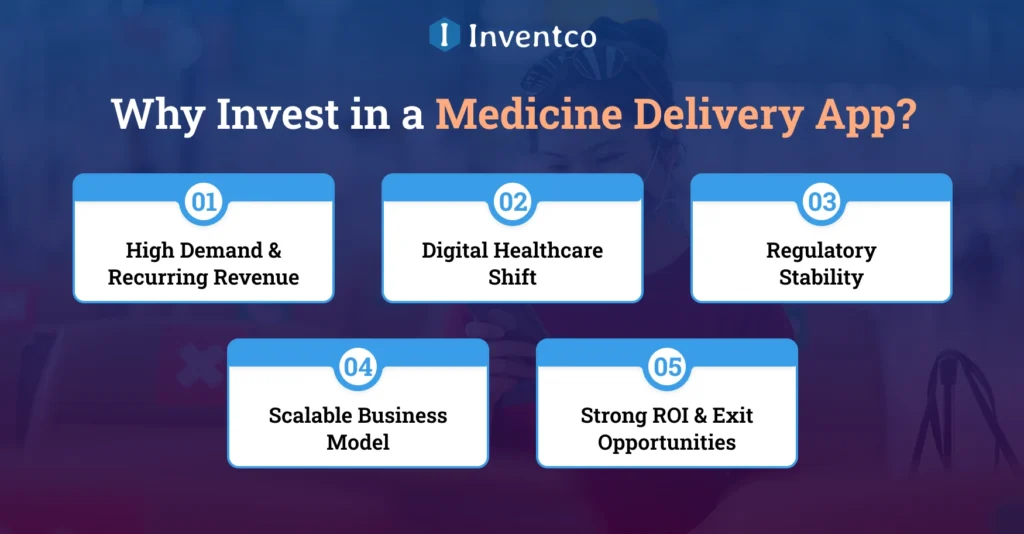
Digital healthcare is likely to grow in the coming years as demand for medicine delivery apps in the USA is driven by the volume of chronic prescriptions, the management of chronic diseases, and consumers’ desire for convenient healthcare solutions, especially the ability to be at home. The prescription is written for the patient and the management of chronic diseases.
1. High Demand & Recurring Revenue
Since the medicine delivery apps are receiving the prescriptions in a repeat fashion, the customer will receive a subscription to the prescription and provide to the delivery app a revenue stream that is reliable and sustainable.
2. Digital Healthcare Shift
Patients are increasingly demanding services on their own schedule. This means that a scalable medicine delivery app will support patients’ and consumers’ goals and ensure healthcare accessibility.
3. Regulatory Stability
HIPAA and the FDA provide guidelines that ensure the software remains within the regulations’ boundaries. This makes the software less risky in the long term and creates barriers to entry, forcing competitors to compete on quality.
4. Scalable Business Model
A well-built delivery medicine app can expand across regions, integrate multiple pharmacies, and support diverse app monetization models.
5. Strong ROI & Exit Opportunities
Medicine delivery apps are attracting significant attention from pharmacy chains and healthcare businesses. This means that medicine delivery apps are likely to have partnerships and acquisition opportunities in the near future.
Conclusion
There are multiple pillars in the United States Healthcare System. One of them is the development of prescription delivery services. Healthcare systems can now serve customers with prescription delivery through multiple platforms, from large enterprise systems that serve insured patients to small digital pharmacy systems that deliver on demand. These all promote accessibility, low cost, and positive medication adherence. With the variety of services available, customers can choose the service that best fits their needs in terms of delivery speed, insurance, compliance with laws, and prices.
To healthcare system professionals, prescription delivery services are not just temporary digital solutions. They are digital solutions that can become permanent and large scaled. As more of the United States’ healthcare system becomes digital, these services will help deliver positive outcomes, accessible care, and innovative, sustainable healthcare solutions.
FAQ’s
Q1. What is a medicine delivery app?
Ans. A medicine delivery app enables users to order prescription and over-the-counter medicines online, upload prescriptions, make secure payments, and receive verified medications at home through licensed, regulated pharmacies across the United States.
Q2. Are medicine delivery apps in the USA safe?
Ans. Yes, reputable medicine delivery apps in the USA comply with federal and state pharmacy regulations, follow HIPAA data protection standards, and implement strong app security measures, including prescription verification and partnerships with licensed pharmacists and approved fulfillment centers.
Q3. Which is the fastest medicine delivery app?
Ans. Fastest medicine delivery apps typically offer same-day or on-demand services in metro areas, using local pharmacy networks, optimized logistics, and real-time tracking to deliver urgent prescriptions within hours of order confirmation windows.
Q4. Do online medicine delivery apps accept insurance?
Ans. Most online medicine delivery apps accept insurance by integrating with pharmacy benefit managers, employer health plans, Medicare, and private insurers, allowing users to check coverage, copays, and pricing before confirming orders digitally.
Q5. What is the best app for medicine delivery in the US?
Ans. The best app for medicine delivery in the US depends on priorities such as speed, affordability, insurance compatibility, customer support, and geographic availability, with platforms optimized for chronic care and low-cost generics.
Q6. Do medicine delivery apps require valid prescriptions?
Ans. Yes, medicine delivery apps require valid prescriptions for regulated drugs, verify them with pharmacists or prescribers, and comply with federal and state laws before dispensing, shipping, or delivering medications to users securely.
Q7. Why are medicine delivery apps attractive to investors?
Ans. Medicine delivery apps attract investors due to recurring prescription demand, high retention, scalable digital infrastructure, regulatory entry barriers, multiple monetization models, and alignment with telehealth and chronic care delivery in the US.
Q8. What is the future of medicine delivery apps in the USA?
Ans. The future of medicine delivery apps in the USA includes deeper telehealth integration, AI-driven prescription management, faster last-mile logistics, improved compliance automation, and expanded access for aging populations and remote communities nationwide.

Jitendra Jain
He is the CEO and Co-founder of Inventco, driving innovation in advanced computing and digital transformation. With deep expertise in modern IT ecosystems, he leads scalable, secure, future-ready solutions. His strategic leadership helps businesses accelerate growth, adopt innovation, and achieve success. You can connect with him on LinkedIn to follow his technology insights.


