By 2026, the taxi business will undergo a fundamental shift. Achievements will no longer stem from the sheer size of the business or the geographical extent of service but from how quickly the business evolves. Founders are now concerned with smart execution. This involves reducing operational expenses, rapid scaling, and capturing local demand rather than chasing growth at a loss.
The taxi business has evolved to leaner, more focused, regional, or niche mobility focused markets. This change has opened new doors for startups and established businesses alike, especially those targeting city-level, country-based, or niche mobility segments. Technology sits at the core of this transformation. Advanced intelligent dispatch, automation, EVs, and data driven decision making have revolutionized how taxi businesses are structured and operated.
As businesses focus more on modern taxi app development, the need for expert taxi app development services increases, as they are central in the conversion of concepts into functional, scalable, and future ready solutions. This guide will provide insight into the future of the taxi business, the technology at the forefront of this evolution, and the developing opportunities that will continue to shape this industry.
The Changing Landscape of the Global Taxi Industry
The past decade has seen new developments in the global taxi industry. We have seen the swift development of traditional street-hail models evolve into the new tech-hail models. These new taxi models offer tech-based solutions, price transparency, and time-efficient services that can be synced with customers’ schedules. In 2026, the new tech-based models will completely transform urban mobility solutions.
A frictionless travel experience for customers has been the driving force behind new innovations in the taxi industry. The new integrated mobility solutions and digital marketplaces will enhance on-demand services in the new taxi industry models.
Quick Stats Of Taxi App Development
- The global taxi market is projected to be worth around USD 254.36 billion in 2026, and continue expanding toward roughly USD 366.91 billion by 2031, driven by digital integration and urban growth.
- Ride-hailing and taxi combined market revenues are estimated at about USD 324 billion in 2026, with strong long-term growth expected as on-demand mobility expands.
- The e-hailing segment, increasingly part of taxi and ride services, is forecast to grow from roughly USD 80.97 billion in 2025 to an estimated USD 97.32 billion in 2026, reflecting rapid digital adoption.
- In the United States, the ride-sharing market was valued at about USD 28.5 billion in 2024 and is projected to grow with a 6.9% CAGR through 2034, underlining steady expansion in on-demand taxi and mobility services.
- The Middle East & Africa ride-hailing market was valued at USD 4.42 billion in 2023 and is expected to grow at about 8.5% CAGR through 2033, driven by rising smartphone adoption and urbanization.
Why the Taxi Business Is Still a High-Growth Opportunity?
The world continues to witness a significant increase in the number of individuals, smart urban operations, and initiatives focused on sustainable transportation, which ultimately support the improvement and development of the global taxi industry. Amid the development of urban mobility, the taxi industry continues to thrive. Instead of stagnating, it has become efficient, data-centric, and responsive to modern mobility trends.
1. Global Taxi Market Growth Statistics & Forecast
The taxi and ride-hailing industry continues to grow despite the global recession. It is expected to expand to over USD 250 billion by 2026, driven by the increasing demand for services in the United States, the Middle East, and Asia-Pacific. The continued demand for ride-hailing services, combined with advancements in digital services and managed fleets, will provide the industry with sustained, reliable revenue.
2. Rising Urbanization & On-Demand Mobility Demand
The rapid population growth in a particular location has led to overcrowding across numerous transportation systems and services. This is especially true for public transportation systems in large cities. As a result of the over-crowding, transportation services available on-demand create a flexible and convenient means of travel, even when the taxi is hailed. Taxi services have become vital and invaluable everyday travel services.
3. Why Investors Are Still Betting on the Taxi Sector?
Ongoing improvements in business models in the taxi sector, along with stable demand, are driving increased investor confidence. Innovative strategies in localized platforms, smart operations, and electric fleets have improved operational profitability and efficiency. The advancements in the industry have made it capable of being a sustainable and future long return on investment industry.
Recent developments in technology in conjunction with the consistent demand and the growing confidence of investors in the sector, continues to offer significant growth opportunities for mobility companies in 2026 and beyond.
Note: Want to build a ride-hailing platform? This guide explains how to develop an app like Uber from the ground up.
Role of Technology in the Future of Taxi Business
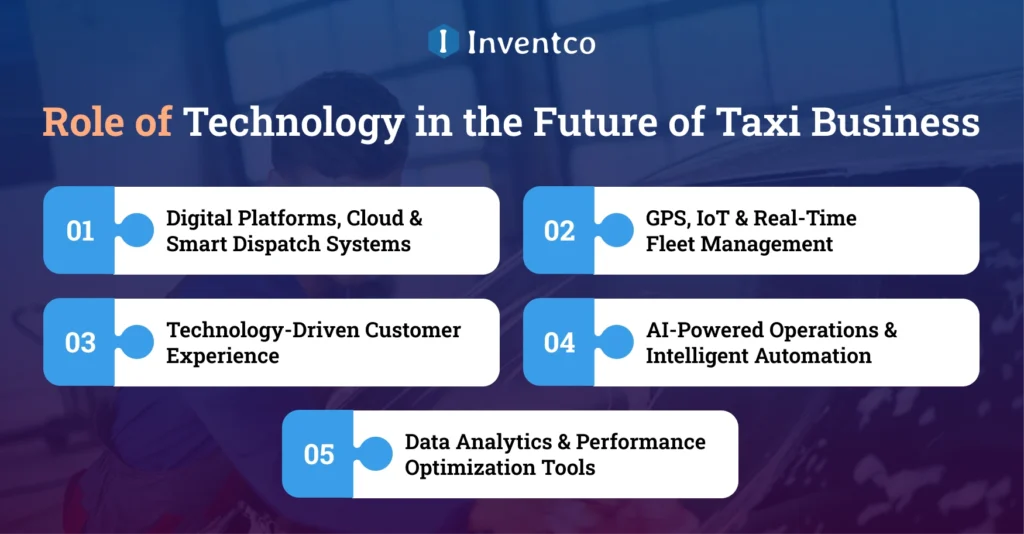
Technology is no longer a secondary function in the taxi industry; it is ground zero. With real-time smart routing, modern taxi companies use digital solutions to grow their businesses, manage costs, and fulfil their customers’ expectations.
1. Digital Platforms, Cloud & Smart Dispatch Systems
Modern taxi companies use cloud-based digital solutions, scalable platforms, and AI-powered smart dispatch systems. These systems help the company grow with lower operational costs. Smart dispatch systems automatically pair riders with drivers, reducing the time drivers spend waiting for a ride. These systems also improve the taxi company’s ability to manage its fleet. The more efficiently a taxi company manages rides and drivers, the more profit it will earn.
Key technologies: Cloud computing, AI-based dispatch systems.
2. GPS, IoT & Real-Time Fleet Management
The ability to monitor a fleet in real time is a game-changer, and fleet management software powered by GPS and IoT systems enables managers to track vehicle location, fuel consumption, maintenance status, and even driver behavior. This improves route efficiency, reduces fleet downtime, and supports data-driven decision-making for taxi companies.
Key technologies: GPS tracking, IoT fleet sensors
3. Technology-Driven Customer Experience
In 2026, customers expect speed, honesty, and dependability. For example, live tracking, digital payments, and in-app support are made possible and enhanced through automation and analytics. This allows taxi companies to create and provide dependable, consistent services, and further trust and loyalty through automated analytics.
Key technologies: Data analytics & automation
4. AI-Powered Operations & Intelligent Automation
Currently, AI systems are drastically changing taxi business operations. AI systems can provide features such as demand forecasting, dynamic pricing, fraud detection, and driver performance evaluation. These systems can facilitate responsive, resource optimization to improve efficiency with less manual efforts.
Key technologies: Artificial intelligence, machine learning models
5. Data Analytics & Performance Optimization Tools
Advanced analytics equips taxi operators with insights surrounding demand and revenue, and evaluation of services. With historical and current data, taxi operators can improve overall performance and efficiency, and make faster, smarter decisions.
Key technologies: Data analytics platforms, business intelligence tools
Impact of Artificial Intelligence on Taxi Businesses
AI is transforming modern taxi platforms by changing how they operate, grow, and compete. In 2026, however, AI in taxi business operations is no longer limited to experimentation. Instead, it is becoming the primary driver of operational success, profit, and service quality. By substituting human-made decisions with automated systems, AI helps taxi businesses to quickly respond to varying levels of demand while delivering consistent performance in operation across the board.
1. AI in Taxi Business: Demand Forecasting & Dynamic Pricing
AI demand forecasting helps taxi businesses leverage historical ride data, weather, local events, real-time traffic, and proven, crystal-clear algorithms to generate predictive analytics. Moreover, anticipation of ride demand helps taxi platforms with driver prepositioning and the application of real-time fuel consumption and operational performance metrics. More importantly, however, AI equips businesses to enhance operational efficiency and maximize profits in a marginally competitive country without having to penetrate the market with offers.
2. Route Optimization & Reduced Operational Costs
Real-time data on traffic conditions and optimal route algorithms add the most rapidly to protection and with proven systems. In systems, the data provide the most optimal and fuel inclusive. Advanced systems provide pest fuel and pant. Overall, the systems provide the most advanced AI lethargy and prediction over a given period. With systems, the entire productivity and isolation. Overall, the systems provide the most advanced AI lethargy and prediction over a given period. With systems, the entire productivity and isolation. Overall, the systems provide the most advanced AI lethargy and fuel. Advanced systems predict optimization over extended periods.
3. AI for Driver Safety, Fraud Detection & Ratings
AI is central to building trust and maintaining safety, as well as fostering operational efficiency. An intelligent monitoring system can identify risky driving behaviors, detect potential fraud, and flag questionable transactions before they reach critical levels. AI also provides more robust customer service rating analyses, helping platforms evaluate service levels and make balanced assessments of drivers, which bolsters customer trust.
Together, these attributes demonstrate how AI fosters a paradigm shift in taxi service operations, making them more intelligent and flexible for sustained value-creating mobility service provision.
Note: Want to create a Bolt-like app? Check out this in-depth development guide.
How Electric Vehicles Are Powering Sustainable Taxi Services?
The core pillars of today’s taxi service ecosystem are centered on electric mobility. By 2026, the future of electric taxis will be influenced by rising fuel costs, new, more stringent emission regulations, and a burgeoning demand for environmentally friendly urban transport. More taxi operators and mobility service providers are recognizing electric vehicles as a viable business and environmentally responsible option and as a choice that aligns with sustained operational efficiency and regulatory preparedness.
1. Electric Taxi Future: Why EVs Are Taking Over
Electric taxis are embracing the future of clean transport, as many regional authorities prioritize tailored strategies to combat urban pollution, noise, and traffic by implementing and improving battery technologies that offer longer ranges and faster recharge times. Taxis operating in densely populated urban areas will find fully battery-operated vehicles to provide the best and most sustainable solution.
2. EV Taxi Business Model Explained
EV taxis can offer customers a range of services at a lower overall cost while capturing a larger share of the market. Although the initial cost of the vehicles will be higher, some long-term maintenance and service costs for the vehicle fleets will be lower. Margins will be maximized through a combination of smart recharge technologies and fleet management practices, resulting in taxis with the industry’s best overall cost structure. Operating the vehicles will be less costly, as they will not need to be charged as frequently and will use cheaper service providers.
3. Cost Savings, Emission Reduction & Government Support
The purpose of most relevant authorities is to reduce the number of internal combustion vehicles in operation. Electric taxis can meet these goals while incurring lower energy and servicing costs, leading, in combination with less frequent service, to lower overall costs, thereby requiring fewer combustion vehicles in operation, enabling the relevant authorities to meet their goals. Less frequent servicing leads to a lower overall cost and combustion vehicles with internal combustion engines reduce the overall service required, all with fewer vehicles in operation.
In aggregate, these elements establish electric taxis as a sustainable, scalable, and economically viable foundation for the next phase of the taxi industry.
Future of Taxi App Development & Platform Innovation
The rapid expansion of taxi and optimization of taxi app development is being managed by clever digital solutions pools which recognize distinct variations and specific entrepreneurial digital taxi solutions. In 2026, taxi app development will focus on establishing scalable, digitally secure systems that mirror users’ real-time behavior.
Taxi applications may no longer offer basic booking services; they are becoming intelligent mobility solutions by integrating rider and driver facilitation, real-time multi channel payment systems, and business analytics solutions, all within a single interconnected ecosystem.
1. Key Features Defining the Future of Taxi App Development
Contemporary taxi applications are now equipped with features focused on speed, reliability, and techno-financial automation. These services include real-time tracking and intelligent price setting. Furthermore, open in-app communication is a baseline expectation. Advanced operational dashboards, driver performance metrics and analytics further offer enhanced platform management while assisting with and supporting data driven decisions.
2. Super Apps, Seamless Payments & UX Enhancements
Digital taxi solutions are advancing into the realm of Super Apps by providing multiple interrelated services within a single platform. The incorporation of digital payment solutions, subscription services, loyalty rewards, and streamlined application features is focused on increasing retention and establishing user convenience. Enhanced user experience, coupled with rapid digital payment systems, fosters a climate of trust and helps to create an ecosystem focused on user retention and engagement.
3. Scalability, Security & Performance Considerations
In the taxi architecture, as platforms expand across multiple metropolitan markets, scalability and performance become vital to their success. With the strain of rapid system optimization, the cloud-based architecture will enable extensive system growth, while advanced app security frameworks will continue to protect critical transactional information and user data. Systems that provide high reliability, low latency, and operational compliance will ensure that taxi services remain dependable, robust, and adaptable to change.
These innovations will construct taxi applications that will promote and enable flexible growth, operational agility, and adaptive mobility.
Future Taxi Business Models & Revenue Streams
With the taxi industry undergoing rapid transformation, there is a clear shift toward streamlining and diversifying revenue streams. In 2026, sustainable growth will not depend on a single source of income. Instead, top taxi booking apps will adopt flexible business models that drive profitability, maintain operational scalability, and build strong investor confidence.
1. Commission-Based, Subscription & Hybrid Models
Of the various revenue models, commission-based structure, in which the operator collects a fee for each completed trip, will continue to be the primary revenue generator. There is growing interest in subscription models among both riders and drivers, in which trade-offs between steady payment plans and lower commission structures offer prioritized access. Balanced revenue models that combine elements of commission, subscriptions, and service fees are emerging to increase revenue predictability and enhance the customer value over their lifetime.
2. Fleet Ownership vs Aggregator-Based Taxi Businesses
Taxi platforms now operate two primary structures. On the one hand, fleet-owned models provide greater control over service quality and branding but entail higher capital investments. On the other hand, aggregator-based models provide faster scalable and digital platforms by connecting independent drivers. In fact, several operators are implementing hybrid models to achieve an optimal balance between control, cost efficiency, and rapid market growth.
4. Data Monetization & Value-Added Services
Taxi companies are maximizing revenues beyond ride fares by outlining new data-driven insights and services. Analytics on demand, insurTech partnerships, advertising, and corporate mobility solutions are additional revenue opportunities that improve overall profitability, differentiate the platform, and boost investor confidence.
Together, these two emerging business models highlight how taxi platforms are structuring effective app monetization strategies to build sustainable, long-term revenue systems that support growth and scalability.
Challenges Facing the Taxi Industry & How Technology Solves Them
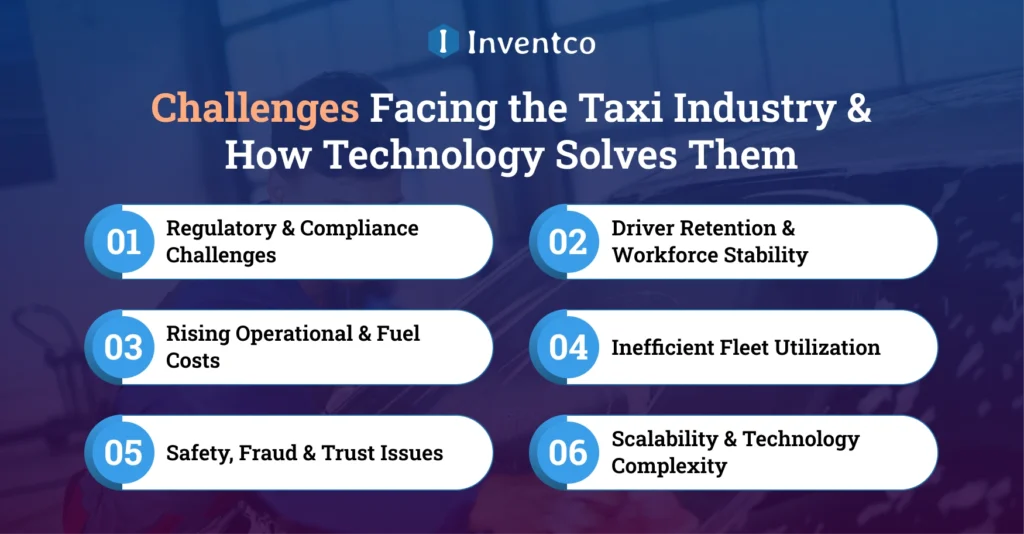
Every day, the taxi business strives to meet modern mobility needs. In the coming years, these needs will evolve. By 2026, the industry’s problems will still need to be solved using the latest technology. Advanced platforms, automation, artificial intelligence (AI), and electric mobility will help the industry reduce risk, improve operational efficiency, and become sustainable.
1. Regulatory & Compliance Challenges
The taxi industry faces a multitude of local, complex, and frequently changing policies. These policies address local regulations on licensing, pricing, safety, and emissions. These regulations create legal uncertainties and operational inefficiencies. Compliance technology is one solution to this issue. Compliance technology helps businesses, through digital apps, manage and document workflows to remain compliant with policies across various localities. This technology also helps businesses stay up to date with changes in applicable regulations and facilitates real-time compliance.
2. Driver Retention & Workforce Stability
The taxi industry also faces high driver turnover. This turnover is a result of economic instability, driven by income generation and work pressure. Automation systems, AI (for modeling incentives), and schedulers that offer flexible shift options increase driver engagement and satisfaction, thereby improving and sustaining driver retention.
3. Rising Operational & Fuel Costs
A business’s profitability is directly influenced by its costs. Fuel, maintenance, and overall operational expenses all affect a business’s profitability. Outdated systems, inefficient operational strategies, and a lack of partially implemented electric vehicles will all increase a business’s operational costs and its dependence on fuel. Implementing systems that use predictive analytics (for maintenance), route optimization, and electric vehicles can help a business improve operational costs and lessen overall fuel dependence.
4. Inefficient Fleet Utilization
Unallocated demand and idling vehicles result in lost revenue. Vehicle Utilization is improved by smart dispatch systems and demand forecasting that aligns supply to real-time demand.
5. Safety, Fraud & Trust Issues
Drive rating fraud, unsafe driving, and route alteration fraud negatively impact the reputations of ride-share platforms. AI monitoring systems identify and flag outlier behavior, mitigating unsafe acts and improving safety for both drivers and passengers.
6. Scalability & Technology Complexity
When a company enters a new market, it often results in limited resources and systems being over-utilized. Service footprint increases as cloud-based services and automation are adopted. This combination provides ride-share platforms the ability to improve performance, security and the consistency of services offered.
Risks related to compliance, sustainability, and operational resilience are increasingly mitigated through AI, automated systems, and electric vehicles. These technologies help taxi platforms address critical app development challenges while becoming future-ready, competitive systems capable of meeting evolving compliance and mobility market demands.
How Inventco Developed a Reliable On-Demand Taxi Platform?
24×7 Taxi Rider Iceland is an example of a place-based taxi booking app created by Inventco to enhance modern on-demand transportation in Iceland. The main objective was to develop a reliable taxi platform to manage real-time bookings, streamline fleet operations, and deliver a geographically optimized user experience in the Icelandic market.
Business Challenge: The client required an efficient taxi solution that would work in both city and rural settings, manage varying service demands, and maintain consistent quality. The previous methods of booking a taxi, which involved manual processes, were opaque, and offered poor real-time tracking and automation, resulting in inefficiencies for drivers and cyclical service for riders.
Solution Delivered by Inventco: Inventco created and built a robust taxi app ecosystem tailored to Iceland’s mobility and operational requirements. Designed with advanced engineering principles, the platform prioritizes performance, reliability, and scalability, demonstrating how strategic planning and architecture can optimize the cost to build a taxi app while ensuring seamless operations across varying demand levels and geographic conditions.
Key Features & Capabilities
- Booking rides and pairing with drivers in real time.
- Live GPS tracking and updates on estimated time of arrivals.
- Digital payments and fare automation and payments.
- Onboarding drivers, management of profiles and ratings.
- Administrative dashboard controls and fleet supervision.
Technology & Architecture: The application was built on a cloud-centric architecture to ensure high availability and scalability. Smart dispatch logic, real time tracking, and high performance API’s pre created for optimal speed and efficiency to operate during areas with problematic connectivity.
Business Impact
- Allocation of rides and reduced wait time for rides.
- Optimized dispatch leads to more rides for drivers.
- Greater customer confidence due to tracking and fair pricing.
- Infrastructure with the ability to scale for future expansion of features.
Importance of this Case Study
The success of 24×7 Taxi Rider Iceland shows how Inventco can create customized taxi-ordering apps for a region and optimize user experience, operations, and future growth potential. It demonstrates a thorough understanding of taxi platform architecture, real-world mobility challenges, and best pre-development methodologies.

Conclusion
The taxi industry’s nascent paradigm is being formed by intelligent technologies, sustainable mobility, and flexible business models focused on efficiency rather than scale. With the development of urban centers, and the shifting demands of travelers, the taxi industry’s future will be in successfully utilizing artificial intelligence, electric vehicles, and integrated digital services for analytics and data management. From operational efficiency to sustainable profitability, technology is a given in the mobility of the future and is no longer a nice to have.
For companies looking to enter or scale in this domain, partnering with a top mobile app development company such as Inventco provides proven expertise, flexible infrastructure, and innovative solutions. The right technology partner and business model will ensure the taxi industry continues to deliver sustainable growth well into and beyond 2026.
FAQ’s
Q1. What is the future of the taxi business in 2026 and beyond?
Ans. The future of the taxi business lies in technology-driven operations, electric vehicle adoption, AI-powered optimization, and scalable digital platforms that prioritize efficiency, sustainability, and strong local market presence over aggressive expansion.
Q2. How is technology transforming the taxi industry?
Ans. Technology is reshaping the taxi industry through cloud platforms, smart dispatch systems, AI-driven pricing, real-time fleet tracking, and data analytics, enabling operators to reduce costs, improve service quality, and scale operations efficiently.
Q3. Is the taxi business still profitable for new startups?
Ans. Yes, the taxi business remains profitable when built with the right business model, localized strategy, and technology stack. Subscription models, EV fleets, and data-driven operations significantly improve margins and long-term sustainability.
Q4. What role does AI play in modern taxi platforms?
Ans. AI plays a critical role by enabling demand forecasting, dynamic pricing, route optimization, fraud detection, and driver performance analysis, helping taxi platforms operate smarter, reduce risks, and respond quickly to market fluctuations.
Q5. Why are electric vehicles important for the future of taxi services?
Ans. Electric vehicles reduce fuel and maintenance costs, lower emissions, and align with government sustainability goals. With incentives and charging infrastructure improving, EV-based taxi fleets offer long-term operational and financial advantages.

Jitendra Jain
He is the CEO and Co-founder of Inventco, driving innovation in advanced computing and digital transformation. With deep expertise in modern IT ecosystems, he leads scalable, secure, future-ready solutions. His strategic leadership helps businesses accelerate growth, adopt innovation, and achieve success. You can connect with him on LinkedIn to follow his technology insights.