One of the most significant shifts in the structure of the global education market is underway. New immersive technologies combined with AI personalisation and mobile-first learning are instructing educators on how to teach and how learners want to learn.
AR and VR in education represent the latest technology trend that has evolved beyond their entertainment and gaming origins, and that is now capable of improving engagement, academic results, and institutional competitiveness in the education sector.
The education market has clearly entered the adoption phase for this technology. MarketsandMarkets indicates that the education AR and VR market will reach USD 52.29 billion by 2032 from USD 14.00 billion in 2025 at a CAGR of 20.7% from 2025 to 2032. In a landscape where institutions are competing for enrollment, investor attention, and accreditation benchmarks, this is not a trend founders can afford to monitor from the sidelines.
The most important question for EdTech investors and founders is not about the trend but rather the practicality of the disruption. What does AR in education provide a solution for? Where has the disruption occurred? What is the cost of constructing and operating a competitive AR educational platform?
This blog offers solutions to the aforementioned questions by providing a comprehensive meaning of AR in education, real-world applications, cost-benefit analysis, AR vs VR, future projections, the restrictions in executing the project, and identifying a good developer. This will provide you with a framework for market entry and/or scaling your AR EdTech solutions.
Key Takeaways
- The global AR and VR in education market is projected to reach $19.6 billion by 2030, growing at a CAGR of over 18%.
- AR in education increases student knowledge retention by up to 75% compared to traditional lecture-based methods.
- AR and VR technologies enable immersive, real-world simulations that bridge the gap between theory and practice.
- Implementation costs for AR/VR education platforms range from $10,000 for basic apps to $100,000+ for enterprise EdTech suites.
- Key challenges include high hardware costs, content development timelines, and teacher training requirements.
- Inventco builds scalable AR VR EdTech platforms tailored to institutional and investor-grade requirements.
AR in Education: Stats and Numbers That Define the Opportunity
Before examining implementation specifics, it’s worth grounding the conversation in the data that institutional decision-makers and capital allocators are already tracking.
- The global AR & VR in Education Market Size was valued at USD 3.8 billion in 2023 and is projected to reach USD 14.2 billion by 2028, growing at a CAGR of 29.6% during the forecast period 2023-2028.
- The global XR in education market was valued at $12.8 billion in 2025 and is projected to reach $89.6 billion by 2034, expanding at a compound annual growth rate (CAGR) of 24.1% over the forecast period from 2026 to 2034
- The education market is projected to reach almost US$ 10 trillion by 2030, growing at a compound annual growth rate (CAGR) of 4.4%, driven by several key factors.
For founders building in this space, these numbers represent both market validation and a competitive window. Institutions that adopt AR VR technology early will establish infrastructure advantages that are difficult to replicate, creating strong moats for platforms that get to scale first.
What Is AR in Education?
Augmented Reality (AR) refers to technology that overlays digital content, 3D models, text annotations, video, audio, or interactive simulations onto the real-world environment in real time.
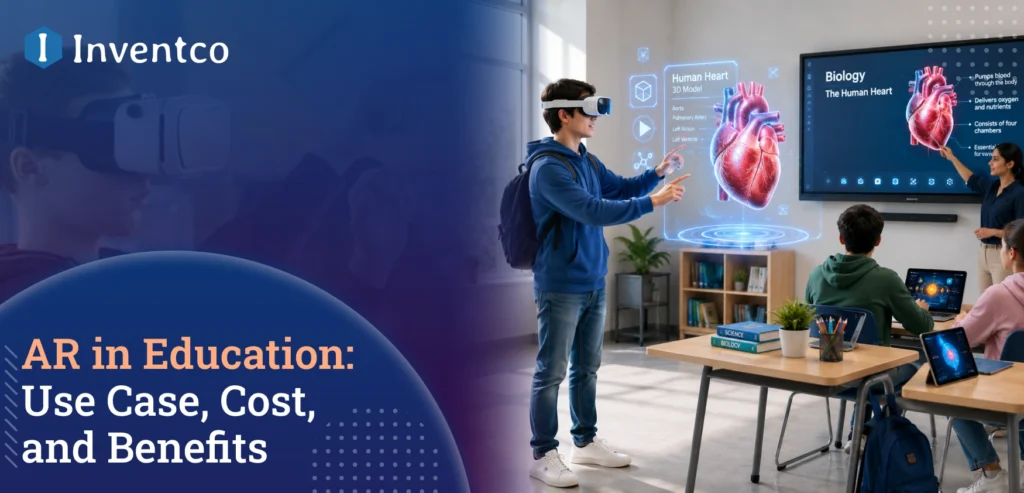
Unlike Virtual Reality, AR does not replace the physical world; it enhances it. A student viewing a biology textbook can point a smartphone at a printed diagram and watch a 3D model of the human heart rotate and animate in front of them.
An example of AR use in a classroom would be a student looking at a rotating model of the human heart in 3D by pointing their smartphone at a diagram in the heart of their biology textbook.
AR in education means more than the technology itself. AR in education describes a changing philosophy in pedagogy from passive, less engaged learning to active and fully engaged learning. One of the many ways AR transforms education is by taking previously passive learning activities and turning them into active learning activities.
AR technology in education operates across three primary delivery modes:
- Marker-based AR: Triggered by specific visual markers (QR codes, printed images) through a device camera.
- Markerless AR: Uses GPS, accelerometer, or digital compass data to overlay content based on location or device orientation.
- Projection-based AR: Projects digital images onto physical surfaces, enabling large-format interactive displays in classroom settings.
The technical architecture incorporated in the mobile application will be impacted by the different uses, costs, and scalability of each of the AR modes. This will inform the decisions your education mobile app development team will make concerning the mobile application they are developing.
How Is AR Used in Education? Real-World Examples
The strongest argument for AR in education is based on empirical evidence from institutions that have implemented AR in the classroom. Here are the examples, use cases, and implementations that illustrate best practices for 2026.
1. Medical and Anatomy Education
Medical and nursing schools can integrate AR technology into their courses by adding anatomical overlays on printed sketches and physical models. Students can rotate a virtual organ, examine tissue layers, and run simulated diagnoses, all without requiring cadavers or surgical access. Stanford Medical School’s AR anatomy curriculum reported a 47% improvement in spatial reasoning scores among first-year students.
2. STEM Laboratory Simulations
AR in EdTech makes virtual science labs a reality. Students can perform chemistry experiments, safely play with physics simulations, and even observe dynamic molecular interactions. This is greatly improving K-12 education, especially where access to a fully outfitted lab is a financial impossibility.
3. Historical and Cultural Immersion
AR helps students walk through past civilizations, archaeological sites, and 3D reconstructions of significant historical events. This offers a tangible way to help students learn history and social studies, which often consist of abstract concepts and timelines.
4. Language Learning and Vocabulary Acquisition
AR Language Apps translate surrounding objects and overlay contexts of usage and pronunciation. For example, an AR app might translate a coffee cup into another language and even provide an audio clip of the pronunciation. Duolingo’s AR modules improved vocabulary retention in its test groups by 38%.
5. Engineering and Architecture Design Review
Using AR technology in higher education has significant value in engineering and architecture. Students can overlay 3D models of design concepts directly onto the built environment, test load scenarios, and participate in design reviews, all in real time. These skills are directly applicable to the profession.
6. Special Education and Adaptive Learning
AR technology is especially beneficial for people with dyslexia, ADHD, and autism. Gamified AR experiences rapidly change the modality of information presentation, decreasing cognitive load by transforming heavily worded text into stepwise visual or spatial structures.
7. Corporate Training and Upskilling
AR VR enterprise EdTech training solutions provide large enterprises with a rapid return on investment due to a multitude of benefits, including significantly reduced travel costs for dispersed teams, fewer mistakes in high-stakes roles, and expedited training. Manufacturing, logistics, and healthcare companies are rapidly adopting AR training solutions.
Benefits of AR and VR in Education
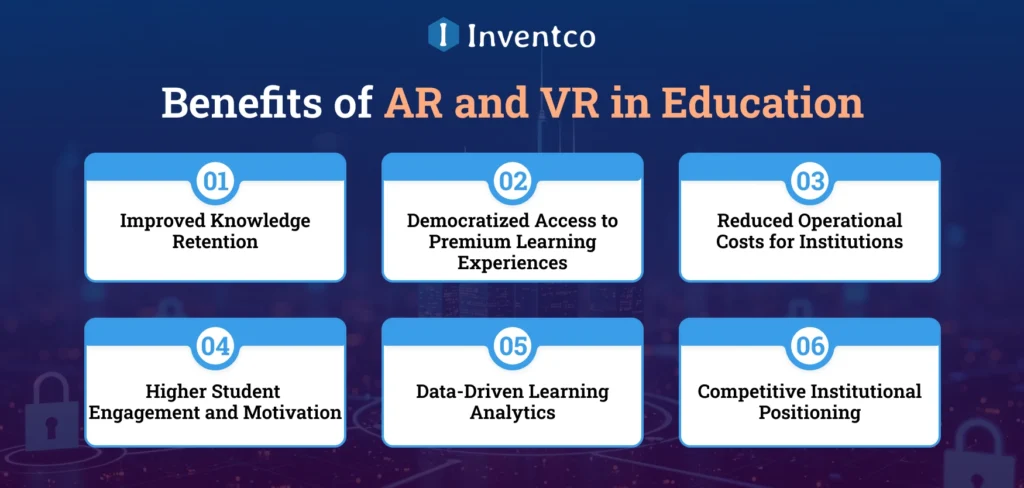
The value proposition for AR and VR technology built for education explains not only an engagement rationale, but also a rationale based on results that are evident in educational outcomes, operational enhancements, and improved competitiveness.
1. Improved Knowledge Retention
Utilizing AR and VR in an education app is immersive and experiential learning at scale. Research concerning the learning pyramid shows that passive learning has a retention rate of 5-10%, while participation has a retention rate of 75-90%.
2. Democratized Access to Premium Learning Experiences
Students in rural districts can now access virtual dissection labs and engineering simulations just as students would at a top-tier university. Augmented reality and virtual reality technologies in education are scalable and, unlike most innovations, are interventions that narrow the educational equity gap instead of widening it.
3. Reduced Operational Costs for Institutions
There are many educational resources that incur high operational costs, such as physical lab equipment, field trips, print materials, and specialist guest instructors. Rather than concentrating costs on lab resources, AR VR in STEM education has shown a 40-60% cost reduction over the course of multiple years.
4. Higher Student Engagement and Motivation
The utility of AR in education increasingly correlates with fewer students dropping out, improved attendance, and higher session completion rates. Gamification layers within AR platforms create intrinsic motivation loops that traditional instruction cannot replicate.
5. Data-Driven Learning Analytics
The Modern AR technologies being deployed in education create a constant stream of learning analytics. With AR, it is possible to measure how long students interact with a module, how many times, and in what order concepts are tackled, and even learning analytics interactions. These offer measurable outcomes and a step beyond traditional metrics for education accreditation.
6. Competitive Institutional Positioning
For founders building EdTech apps, schools that have AR VR technology receive a competitive marketing advantage when recruiting students. The current enrollment data for 2024-2025 estimates that immersive learning program availability in universities has accelerated applications for those institutions by 15-22% for top-tier students compared to universities that do not offer those programs.
AR vs VR: Advantages and Disadvantages
While AR and VR are frequently grouped together as immersive technologies, they serve different educational purposes and carry distinct implementation profiles. Understanding the distinction is essential before committing to a development architecture.
| Parameter | Augmented Reality (AR) | Virtual Reality (VR) |
|---|---|---|
| Definition | Overlays digital content onto the real-world environment. | Creates a fully immersive virtual environment that replaces the real world. |
| Hardware Required | Smartphones, tablets, AR-enabled devices, or AR glasses. | VR headsets such as Oculus, HTC Vive, or PlayStation VR. |
| Level of Immersion | Partial immersion while remaining aware of the surroundings. | Complete immersion in a simulated digital environment. |
| Real-World Interaction | High, as users interact with both physical and digital elements. | Minimal, since the real-world environment is completely replaced. |
| Best Educational Use Cases | Science experiments, anatomy visualization, field trips, language learning, and interactive classrooms. | Medical training, engineering simulations, aviation, military exercises, and historical recreations. |
| Development Cost | $10,000 to $50,000+ per application. | $30,000 to $80,000+ per simulation platform. |
| Student Engagement | High through interactive experiences on familiar devices. | Very high due to fully immersive and realistic simulations. |
| Accessibility | Widely accessible because it works on most modern smartphones and tablets. | More limited because dedicated VR hardware is required. |
| Key Advantages | Affordable, easy to deploy, and blends digital content with real-world learning. | Offers realistic simulations, deeper immersion, and hands-on training without real-world risks. |
| Key Limitations | Less immersive compared to VR experiences. | Higher hardware costs and potential motion sickness for some users. |
Strategic Note: For most institutional EdTech deployments, a hybrid AR/VR approach, AR for day-to-day classroom integration and VR for high-stakes simulation training, delivers the best combination of accessibility, engagement, and measurable ROI. Your mobile app technology stack and infrastructure choices will determine how seamlessly both modalities can coexist on a single platform.
Augmented Reality in Education: Future Trends for 2026 and Beyond
If you’re looking at investing in or developing a mobile app for the future, understanding how technology is evolving in virtual and augmented reality in education is essential.
1. AI-Integrated Adaptive AR Experiences
AI-adaptive Augmented Reality solutions will personalize the AR learning experience. Instead of a single AR module delivery for all students, real-time performance data will drive the AI engine to adapt the complexity, pace, and format of the AR module to the student’s learning.
2. Spatial Computing and AR Glasses Adoption
The upcoming releases of Apple Vision Pro, Meta Quest 3, and AR enterprise glasses from Microsoft and Google will create a shift in how AR is used in education from a smartphone-based model to a spatial computing model. EdTech applications that are the first to be developed and implemented will have a significant advantage when educational institutions procure hardware.
3. Metaverse-Adjacent Collaborative Learning
The next advancement in social learning will be the distributed AR and VR collaborative learning environments, where students from different learning institutions interact in shared virtual spaces. Current pilots are showing that this is feasible for large-scale implementation in the next 3-5 years.
4. AR-Enhanced Assessment and Credentialing
In education, AR is being used to assess skills in a more modern way. There are a variety of virtual environments that can simulate the performance of learners. AR environments that can be used to assess learners’ skills are already being used in vocational education, as well as in medical and engineering education.
5. 5G and Edge Computing Enabling Real-Time AR
Until now, latency has made it difficult to use AR in real-time collaborative situations. The global expansion of 5G and edge computing infrastructure is removing this barrier and allowing multiple real-time users to experience AR in ways that classroom networks have been unable to support.
Implementation Challenges of AR/VR in Education
A credible technology partner will not oversell AR and VR implementation without addressing the real app development challenges that institutions and platform founders must navigate. These are the friction points that determine whether a deployment scales or stalls.
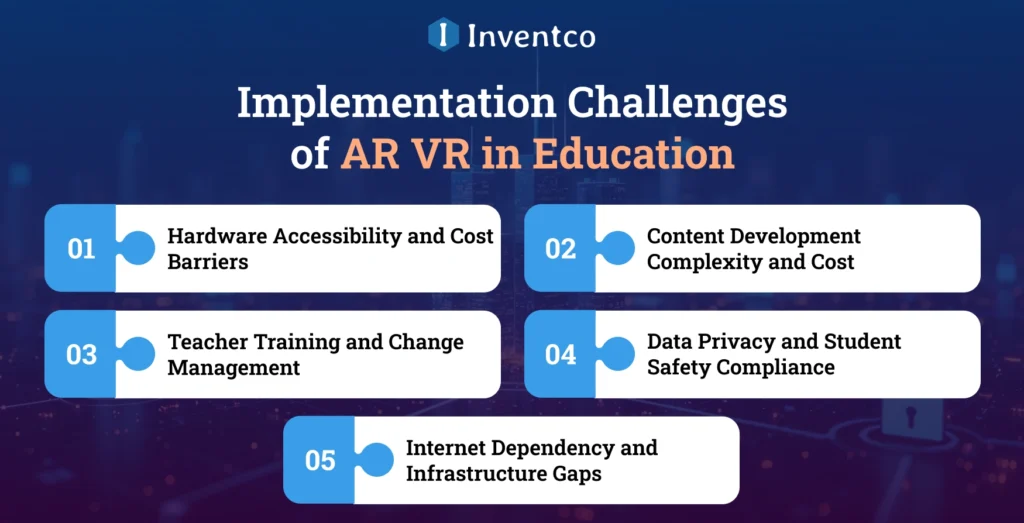
1. Hardware Accessibility and Cost Barriers
Although AR that uses smartphones has made the technology more accessible, the cost of peripherals makes VR more challenging, with an individual cost of $300-$1,500. For large institutions, this makes hardware procurement and maintenance burdensome. Founders of AR/VR platforms must consider both high-end and low-end hardware systems.
2. Content Development Complexity and Cost
AR and VR-enhanced education content is very expensive because of the high level of 3D design and instructional design that is required. The cost for content development accounts for 40-60% of the total platform cost, which is a figure that most early-stage EdTech founders overlook.
3. Teacher Training and Change Management
VR/AR technology use in education poses challenges that extend beyond the technology itself. Utilization of AR platforms with little consideration for the design of training and support for teachers will be of little value. Successful AR deployments dedicate 15-20% of the costs to training and change management.
4. Data Privacy and Student Safety Compliance
AR platforms that target K-12 institutions need to consider FERPA, COPPA, and, increasingly applicable, state-specific student privacy laws. If the platforms operate internationally, compliance with other laws, such as GDPR, will be necessary. Without consideration of these laws and requirements during the design phase, the costs to build a mobile app into a compliant state will rapidly increase.
5. Internet Dependency and Infrastructure Gaps
AR apps that rely on broadband create a large barrier to use in many schools. This is especially true for schools in rural and developing parts of the world and in environments that have limited bandwidth. The best-designed systems include AR content that is usable offline with cloud syncing. This capability should be a design goal of the MVP mobile app.
AR VR in Education: Development Cost Breakdown
One of the most common questions from EdTech founders and institutional technology committees is: What does it actually cost to build an AR or VR education platform? The honest answer depends on scope, platform complexity, and the depth of content library required. Here’s a practical tiered breakdown:
| Solution Tier | What’s Included | Estimated Cost | Development Timeline |
| Basic AR Education App | Core AR features, single-subject learning module, mobile-ready application | $10,000 to $25,000 | 4 to 6 months |
| Mid-Range AR/VR Platform | Multi-subject support, real-time collaboration, LMS integration, enhanced user experience | $25,000 to $50,000 | 6 to 10 months |
| Advanced Immersive Platform | AI-powered personalization, VR simulations, advanced analytics dashboard, interactive assessments | $50,000 to $80,000+ | 10 to 18 months |
| Enterprise EdTech Suite | Multi-institution support, custom content authoring, cloud infrastructure, enterprise-grade security, and scalability | $80,000 to $100,000+ | 12 to 24 months |
From Our Projects: Inventco recently collaborated with a regional university consortium in South Asia to build a hybrid AR/VR platform for engineering education. The project, covering 12 simulation modules, a faculty content authoring tool, and an LMS integration, was delivered in 9 months at a development investment of approximately $65,000.
In the first academic year post-launch, the institution reported a 41% improvement in practical assessment scores and a 28% reduction in physical lab operating costs. The platform is now licensed to three additional institutions, creating a recurring revenue stream that the university had not previously modeled.
How Inventco Can Help You Implement AR and VR in Education
Inventco helps educational institutions and EdTech startups build scalable AR and VR learning platforms that combine immersive technology with practical learning outcomes. From product discovery and UX design to development and deployment, our team creates education-first solutions tailored to students, educators, and institutions. We focus on delivering engaging, interactive experiences rather than adapting generic applications for learning.
Inventco’s development team is skilled in the use of ARKit, ARCore, Vuforia, and WebXR, allowing cross-compatibility on both web and mobile platforms. Additionally, we design and implement safe, cloud-based structures, integrate leading LMS platforms, and provide educators with real-time analytics of learner engagement, learning progress, and learning outcomes through the creation of custom-built dashboards. All solutions are built with security and compliance frameworks in mind.
Beyond mobile app development services, Inventco provides ongoing maintenance, performance optimization, and feature updates to keep your platform future-ready. Whether you’re building an MVP or launching a large-scale educational ecosystem, our experts help transform innovative ideas into reliable, immersive learning experiences.
Conclusion
Augmented reality and virtual reality in education are no longer emerging technologies sitting at the periphery of institutional decision-making, they are actively reshaping how learning is delivered, assessed, and scaled. For founders and investors operating in the EdTech space, the strategic question has shifted from “should we build for AR and VR?” to “how quickly can we build with the right architecture, content depth, and institutional fit?”
The platforms being built and designed today will win the market in 3-5 years, especially if scalable, compliant, and measurable learning is built into the foundation of the product and not added later. Inventco is here to support the organizations that make good tech decisions and are limited by nothing in executing them.
The opportunities in AR and VR exist and have been validated in the educational space, and there is an increasing interest in their use by educational institutions. The only question that determines their successful implementation and use is the skill and quality of the development partner.
FAQ’s
Q. What is AR in education, and how is it different from VR?
Ans. AR overlays digital content onto real-world environments using mobile devices, while VR creates fully immersive virtual experiences through headsets, offering deeper simulation-based learning experiences.
Q. What are the primary benefits of AR and VR in education?
Ans. AR and VR improve engagement, increase knowledge retention, reduce training costs, enable interactive learning, provide measurable analytics, and enhance accessibility across diverse educational environments.
Q. How much does it cost to build an AR VR education app or platform?
Ans. Development costs range from $10,000 for basic apps to $100,000+ for enterprise platforms, depending on features, integrations, content complexity, and scalability requirements.
Q. What are the biggest challenges in implementing AR VR in education?
Ans. Major challenges include hardware costs, content creation, teacher adoption, privacy compliance, connectivity limitations, and ensuring scalable deployment through proper planning and change management.
Q. What future trends will define AR and VR in education through 2030?
Ans. Future trends include AI-powered personalization, spatial computing, collaborative virtual classrooms, competency-based assessments, immersive simulations, and 5G-enabled real-time interactive learning experiences.
Q. What industries beyond K-12 and higher education are adopting AR VR in education?
Ans. Healthcare, manufacturing, aviation, logistics, financial services, and corporate training increasingly use AR and VR for onboarding, compliance, technical training, and workforce skill development.
Q. How do I choose the right technology partner for building an AR VR education platform?
Ans. Choose a partner with AR/VR expertise, LMS integration experience, education compliance knowledge, proven case studies, transparent pricing, and reliable post-launch maintenance and support.

Sandeep Agrawal
Sandeep Agrawal is the visionary CTO at Inventco, bringing innovation to life through his technical expertise. With a passion for cutting-edge technologies, Sandeep leads the team in developing robust solutions. His dedication and continous efforts to pushing the boundaries of what’s possible defines his role as a transformative and innovative force in the tech industry. You can connect with him on LinkedIn to follow insights.