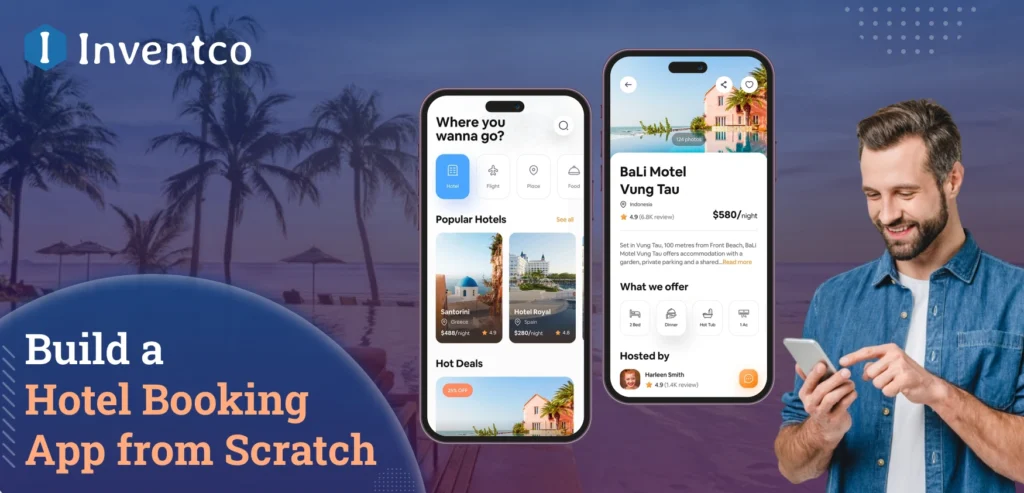
Travel and hospitality businesses are going through a complete digital makeover. They need to integrate mobile technology into every aspect of how users search, compare and book their accommodation. Travel and hospitality app users want to do everything from planning their itinerary and booking their accommodation and transport to accessing online check-in services.
Travel and hospitality app users want to do everything from planning their itinerary and booking their accommodation and transport to accessing online check-in services. Founders and investors should take note of this rapid change. There is a lot more potential in hotel booking services than in simple transactional services.
Hotel booking apps are becoming booking ecosystem services combining users, accommodation services, and multiple revenue streams. To build a digital hotel booking ecosystem, you need a good strategy that goes beyond development. It goes into the details of how to integrate technologies, monetization, and create the best user experience.
In this guide, we lay out the definitive steps in hotel booking app development, outlining the critical features that need to be included, the technology that will be required for the booking app ecosystem, the costs that will be associated with each component, and the strategies that will bring the entire concept to a scalable solution.
Key Takeaways
- The global travel industry is rapidly going digital, creating strong demand for hotel booking app development with high scalability and recurring revenue potential.
- A hotel booking app functions as a two-sided marketplace, connecting users with hotels while generating revenue through commissions, subscriptions, and ads.
- Selecting the right app type (aggregator, dedicated, or on-demand) is crucial, as it defines your business model, features, and monetization approach.
- Core features like real-time booking, secure payments, and reviews are essential, while advanced features like AI recommendations and dynamic pricing drive competitive differentiation.
- A structured mobile app development process ensures better planning, faster execution, and long-term scalability.
- The hotel booking app development cost typically ranges from $10,000 to $100,000+, depending on complexity, features, and integrations.
- Choosing the right mobile app technology stack is key to building a secure, scalable, and high-performance platform.
- A strong mobile app monetization strategy, combined with the right development partner, ensures long-term profitability and sustainable business growth.
Market Stats
The recent digital adoption and mobile-first consumer behavior based online travel market is growing globally and showing a positive, consistent, and strong trend.
- According to Grand View Research, the online travel booking market is expected to reach $1.13 trillion by 2030, highlighting the scale and long-term potential of digital travel platforms.
- In parallel, industry forecasts suggest even higher projections, with some reports estimating the market could exceed $1.5 trillion by 2030, reflecting increasing global travel demand and platform innovation.
- Online booking is now the dominant channel, with reports indicating that over 65% of global travel bookings are expected to be made online by 2026, driven largely by mobile usage and app-based experiences.
The shift to digital and on-demand travel services is accelerating, making it obvious to founders and investors the potential for booking app development in the travel industry, especially with strong growth and repeat revenue expected.
What is a Hotel Booking App?
Booking hotel apps involve discovering, analyzing, and booking real-time hotel accommodations in a web or mobile framework. They offer a digital experience while combining listings of properties, payment systems, availability, and prices.
The entire booking process is simplified for the users. They receive booking confirmations instantly and can clique through options based on budget, location, and even amenities or reviews. It also functions as a large digital marketplace for businesses and streams revenue through promotional listings, subscriptions, and commission.
In the current economy where services are offered on demand, hotel booking apps are not just a simple offer. They enhance user experience, streamline processes, and also provide sustainable revenue models from data for hospitality businesses.
Types of Hotel Booking Apps
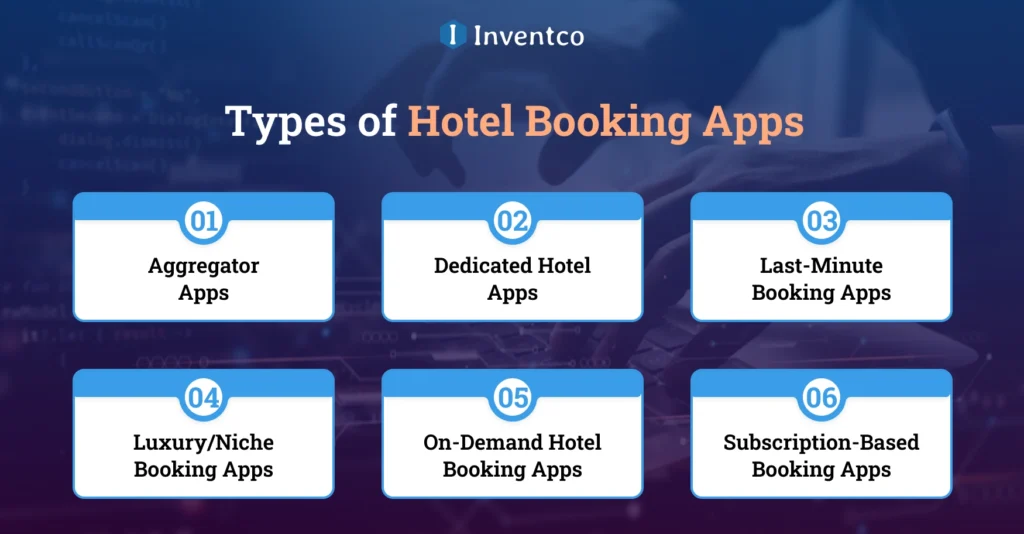
Understanding the various functionalities of hotel booking applications will help in determining the various components of your business model, its features and monetization strategies.
1. Aggregator Apps
In the case of Aggregator Applications, users will be able to view different listings from different hotels, compare prices, view and book amenities from the hotel of their choice. Such applications help the hotel keep their vacancy rates down and make money through commission, adverts and favourable listings.
2. Dedicated Hotel Apps
These applications are directly linked to individual hotels, and hotel chains, that provides the opportunity for users to book the hotel from the app. This is beneficial to the business as it builds up apps and it fosters brand loyalty, lowers reliance on third party apps, and allows for personalization, exclusive offers, and customer engagement.
3. Last-Minute Booking Apps
These applications are suited for customers who make bookings on the same day. They provide cheaper rates on a last minute basis, and help fill up hotels’ low vacancy rates as opposed to a walk in, and offer cheaper options to impulsive and price conscious travelers.
4. Luxury/Niche Booking Apps
These Luxury/Niche applications are suited for specific clientele such as high end travelers, business executives, or people who are looking for specific experiences. These applications offer specific accommodations, services, prioritize value, personalization, and exclusive tailored experiences just as much as quantity.
5. On-Demand Hotel Booking Apps
Apps for real-time booking of hotels and motels are designed for immediate booking of the nearest locations with available rooms. They prioritize speed, location-based services, and seamless user experience, making them ideal for travelers seeking convenience and immediate booking solutions.
6. Subscription-Based Booking Apps
In subscription-based hotel booking apps, members are rewarded with deals, discounts, or other features available at an additional cost. This practice cultivates sustained loyalty or use of the app within membership subscriptions as there is a perceived increase in value from the members who also receive discounts from a selection of hotels or personalized offers.
Top Hotel Booking Apps in 2026
Examining market frontrunners enables founders and investors to isolate the elements of user adoption, retention, and monetization. In terms of design, scalability, and overall user experience, these platforms act as benchmarks and provide the best guidance for venture your hotel booking app development.
1. Booking.com
Booking.com is one of the biggest travel companies in the world. Their website design is user-centric and, in simple terms, helps an indecisive traveler make a decision using booking.com. Travelers can book three different ways, and using powerful search filters, you can find the best deal.
2. Airbnb
Airbnb transformed the entire accommodation industry as they pioneered a model of accommodation booking through peer-to-peer systems. Airbnb holds the top position in the industry of unique and personalized stays, with an exceptional focus on building a strong community of trusted buyers and sellers.
3. Expedia
Expedia combines hotels, flights, and vacation packages into one travel tool, which is why they are winning in the travel industry. Bundled offers, integrated services, and loyalty programs are great additions to those looking for a travel tool that offers everything in one place.
4. Agoda
Agoda is best known for its pricing and for its great accessibility in most Asian countries. Their pricing model is driven by data and focused on buyers traveling internationally, and frequent low-budget travelers.
5. Hotels.com
Hotels.com differentiates itself through its rewards system, which allows customers to earn free nights after a certain amount of bookings. Simplistic design and pricing transparency are essential to capturing customers, but an emphasis on loyalty and retention truly makes Hotels.com a repeat user target.
A combination of cutting-edge mobile technologies and user experience tools, real-time booking, and highly refined personalization drive the success of these platforms. For founders, the aim is not to replicate, but to build on these opportunities to provide a unique and scalable offering.
Key Features of a Hotel Booking App
Creating successful strategies on a given platform involves understanding basic and advanced components for mobile application development. These components help better user experience and assist with future growth in a secure way that increases the likelihood of users returning to the platform.
Core Features (Must-Have)
1. User Registration & Profile Management
The user profile registration feature enables users to create an account, sign in, and modify personal data and preferences, as well as manage previous bookings. Personalization, expedited bookings, and secure account access are made possible through user profile registration. This lays the groundwork for enhanced user interaction and retention.
2. Advanced Search & Filters
In the process of formulating an overall strategy, the advanced search function makes it possible for a user to search for a hotel using a variety of criteria, including location, cost, services, user reviews, and the current status (i.e., booked or available). This enables users to make informed and timely decisions.
3. Real-Time Availability & Booking
Real-time booking ensures users can view updated room availability and instantly reserve accommodations. Real-time booking systems also build trust as they eliminate the possibility of multiple users booking the same accommodation.
4. Secure Payment Integration
The mobile app must be equipped with advanced data protection features in order to secure sensitive financial data. The app must be compliant with secure data protection practices in order to provide users with a sense of security and an array of payment options.
5. Booking History & Notifications
Users can view previous and future bookings. They will also get notifications related to confirmations, cancellations, and reminders. This feature helps organize travel plans and keep users informed throughout their travel journey.
6. Ratings & Reviews System
Reviews and ratings are a form of honest user feedback regarding a hotel and/or hotel service. They help express the level of trust that can be placed in something and can direct the decision of a user to book or not. Feedback can also help in increasing the trust level in a service. It provides real value to the user and to the service provider.
Advanced Features (Differentiators)
1. AI-Based Recommendations
AI-based tools recommend hotels by studying user patterns, individual tendencies, and past bookings. It keeps customers engaged, encourages bookings, and generates an experience that meets the standards of current application design.
2. Dynamic Pricing Engine
Pricing algorithms scan the market and price rooms based on demand, season, and vacancies. It creates a fair pricing system, giving hotels optimal revenue and also filtering value to the consumer.
3. In-App Chat with Hotel Support
Chatting with hotel staff through the app helps customers get their questions answered and offers support directly through the app. It builds trust and enables support staff to assist customers at any moment during the booking and travel process.
4. Multi-language & Multi-currency Support
International customers gain the ability to use the app more conveniently if they can use their own language and currency. It increases accessibility and uplifts the user experience if he/she needs to book a hotel overseas.
5. Voice Search & Smart Assistants
Users conduct searches to find hotels through speech, and each hotel can be found by simply stating a command. Smart assistants are an up-and-coming technology that will help users to search more easily.
6. AR-Based Room Preview (Emerging Trend)
Users can experience virtual walkthroughs of hotel rooms using Augmented Reality before making a booking. Such immersive experiences provide customers with confidence and reduced uncertainty, enhancing the overall decision-making process. creating a competitive advantage.
The ease of these sophisticated features with the new app development trends will allow companies to provide users with personalized, seamless, and high-performing experiences, ultimately increasing engagement and driving retention and revenue.
Step-by-Step Process to Build a Hotel Booking App
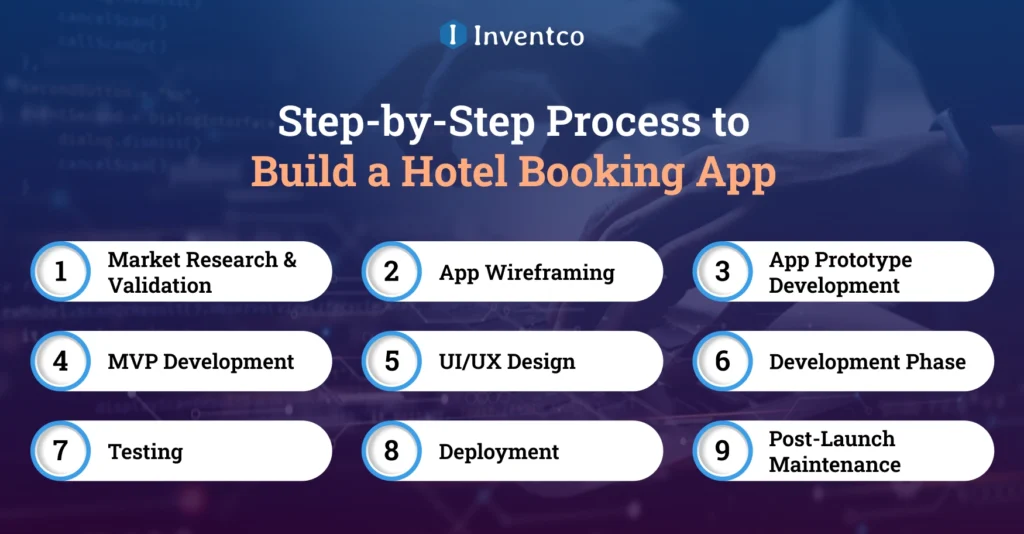
The beginning of any mobile application development is vital to its success. Creating a structure that is clear and allows for the future addition of features and updates. Here is a breakdown for founders and investors:
1. Market Research & Validation
Start by focusing on your potential users, what the market demands, and competitors. Study current hotel booking applications, understand users reviews and how they describe the issues they face. Study the pricing, and identify what features are missing and how your app can solve user issues. This is how you validate your idea, refine your unique value proposition, and mitigate the chance you fail in business. The essence of this research is to give you the best chance to add your hotel booking application to the vast number of travel applications. This is how you increase your chance of attracting investors.
2. App Wireframing
This step is about creating a structure for your application, and how you want the different elements to be organized, and the paths that users can take to complete different actions. Create low-fidelity designs that map how users navigate between features like search, booking, and payments. App wireframes act as a blueprint for developers and designers, ensuring clarity and alignment before development begins. This step minimizes errors, improves planning efficiency, and lays a strong foundation for creating a seamless, user-friendly hotel booking experience across all devices and platforms.
3. App Prototype Development
In the app prototype phase, transform wireframes into interactive, clickable models that simulate real user interactions. Prototypes allow stakeholders to visualize functionality, test usability, and gather early feedback before development. This reduces costly revisions later and improves product accuracy. It also helps validate design decisions, ensuring that navigation, features, and workflows meet user expectations, ultimately leading to a more refined and market-ready hotel booking application.
4. MVP Development
Creating a mobile application MVP means developing and incorporating the essential additional functions that will finalize the application. These functions will include searching, booking, and the integration of payment methods. This method will give you the freedom of launching as quickly as possible, testing the product in real-time market conditions, and receiving feedback from users. Building the MVP means that you eliminate the initial investment and run the risk of validating the business assumptions. Furthermore, it will give you the opportunity to develop other updates that will help you provide the service that will help your users to be manageable and prioritize the goals that you set for the service, all while avoiding the use of too many resources during the initial phases of development.
5. UI/UX Design
Strong UI/UX Design helps to build mobile applications that are appealing to the eye and helps to increase the speed of learning and simplify the process of navigating the app. Devote your resources to touch-friendly designs, use of responsive design and seamless transitions. A well-built interface will enhance the interaction of the user, make it harder for the user to jump off the application and increase the conversion rate. Creating accessibility and uniformity among the devices helps to create a user-friendly system. This process helps to build confidence and provide a premium service, a service that meets the requirements of the contemporary user.
6. Development Phase
During the development stage, the application will be built for the front and back ends using scalable mobile application development technology. This will include the integration of application programming interfaces (APIs), databases, payment processors (gateways), and booking engines. The developer is responsible for facilitating interaction between the user interface and the server side. The primary focus will be on the performance, safety and stability of the application so that it can handle the desired user demand. An efficient development phase ensures that the hotel booking application is in a position to maximize additional mobile app features in the future.
7. Testing
Prior to launch, it’s important to perform mobile app testing on numerous devices to guarantee steady performance results. Key areas to focus on include functional testing, performance testing, security checks, and usability. Early testing can help pinpoint possible issues and limit user complaints and negative app reviews. Booking flows and transaction processes must be tested to ensure user satisfaction. Positive app reviews will help your app build trust and improve user experience. If tested correctly, your app will be ready for the competitive market and a success at launch.
8. Deployment
Deployment refers to the launch of your finished application. This will be dependent on your developed Android vs iOS launch strategy. Be sure to follow the recent guidelines released by the app reviews and be smart when describing your app. Your marketing strategy should be centered around getting your app to the widest audience possible. Efficiency during this phase will set your app up for success to sustain new users as well as build a strong customer retention strategy.
9. Post-Launch Maintenance
For maximum possible success, your app will need to be updated and maintained on an ongoing basis even after the initial launch. Regularly improving and fixing existing functions, as well as introducing new features will also be one of the goals for maintaining competitiveness within the space your app exists in. This ongoing effort will also improve app security and the app’s ability to adapt and grow to meet the changing needs of its users. It is vital to ensure the level of experience remains high.
Hotel Booking App Development Cost in 2026
The cost of developing hotel booking mobile apps can change due to several reasons. The level of complexity of the design features and the functions, and the approach used to develop the app. For founders and investors, understanding cost distribution means better planning, budgeting, and return of investment forecasting.
Basic App ($10,000 – $30,000)
Basic hotel booking apps cost between $10,000 and $30,000. Apps in this range perform the basic functions of user registration, providing hotel listings, search filters, a booking function, and accepting payments. It is suited for a startup that needs to create their MVP to bring their idea to market, and that minimally needs to design the app or create a lot of third party development integrations to reduce the overall development cycle time.
Mid Level App ($30,000 – $70,000)
Mid range apps cost between $30,000 and $70,000, and provide functionality to support real time booking, user reviews, and notifications. Apps in this range have a better overall look and feel, and are designed to maintain better user engagement through the positive impact of using an improved interface. Collectively, these factors provide apps in this range with a better competitive position in the digital travel market.
Advanced App ($70,000 – $100,000+)
Advanced booking apps include AI recommendations, cloud integration, dynamic pricing, and premium UI/UX. For such an app to function seamlessly, it requires a strong backend, extensive scalability, and support to handle a lot of customer traffic. This level is best for companies looking to compete with global companies and provide a great experience to their users.
Cost Factors
Several factors directly influence the overall hotel booking app development cost:
- Features & Complexity: More features mean higher costs as they take longer to develop.
- UI/UX Design: Engaging designs come at a higher price.
- Tech Stack: App technology choices affect performance and scalability.
- Development Team Location: Costs can vary by region and country.
- Third-Party Integrations: Payment processing, map, and analytics APIs increase costs.
Beyond initial development, mobile app maintenance costs, server hosting, security updates, and features upgrades must all be assessed. These recurring costs are needed for performance, scalability over time, and to keep users happy.
Tech Stack Required for Hotel Booking App Development
When developing a hotel booking app, it is of utmost importance to ensure security, scalability, and high performance. Choosing the right tech stack will guarantee fast development, good seamless experiences to the customer, and will provide good scalability options as the customer base continues to grow.
1. Frontend (User Interface Layer)
The Frontend is responsible for the engagement and interaction of the users with the app. React Native and Flutter are two of the top cross-platform app development frameworks available, and because of this, they will allow for a shorter development period, the ability to have a consistent UI/UX experience no matter what device the app is open on, and will help the company to be able to launch faster whilst also providing high efficiency for the cost performance ratio.
2. Backend (Server-Side Logic)
The backend will provide vital functions such as user authentication, payment processing, booking management, and data processing. For an environment that is booking focused and has a real-time high demand, the most suitable and optimized technology choices for speed and seamless high demand real time processing are Django and Node.js.
3. Database (Data Management Layer)
The most vital parts of information flow of any hotel booking app, that includes user information, booking information, transaction history, and hotel listings, are all stored and managed in a database. While PostgreSQL is exceptional in terms of providing reliability to more structured data, to provide better flexibility to be able to work with dynamic data as the app expands will be MongoDB.
4. Cloud & APIs (Infrastructure & Integrations)
Scalability, high availability, and high performance are guaranteed by the infrastructure provided by cloud platforms such as Google Cloud and AWS. Additional features are provided by integrated APIs. These are payment gateways, maps, and geolocation, which allow secure payments, precise geolocation, and improved user experience.
Your mobile app, as well as the technology stack used, must safeguard your mobile app and technology stack. This foundation is your long-term success and cloud integration.
How to Monetize a Hotel Booking App?
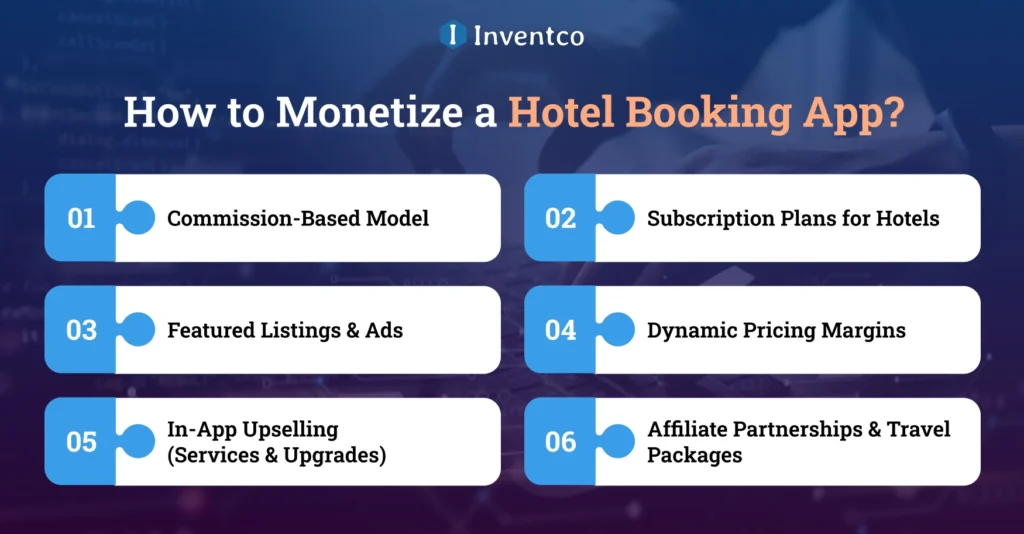
A well-defined monetization strategy services a more streamlined user experience while simultaneously providing a more effective method for the business to grow. Below is a list of the most effective strategies to consider:
1. Commission-Based Model
Success in this model is determined by the number of bookings made via the mobile app. Charges will come to hotels on a completion basis. This model is the most utilized in the industry, resulting in consistent revenue streams, while indirectly establishing your success in correlation to your clientele’s success.
2. Subscription Plans for Hotels
Recurring revenue is generated by providing an upgraded subscription model to your hotel partners. More exposure to potential customers will be a result of improved visibility analytics and advanced features, therefore, making your hotel partners more likely to enhance their listings.
3. Featured Listings & Ads
The most preferable listings will be auctioned and the winners will be showcased the most on the app. Property owners will expect a high traffic booking gain from this as other competing listings will draw traffic to theirs.
4. Dynamic Pricing Margins
If your pricing model is smart and flexible, competitive pricing will still be available to the customers. This is achieved by pricing your markup with demand, season, and availability and smart ample pricing. A flexible pricing model will still be competitive.
5. In-App Upselling (Services & Upgrades)
Present users with additional services and products within the app such as room upgrades, early check-ins, and late check-out, as well as travel bundles. This elevates the customer experience and increases the average transaction value and revenue per booking.
6. Affiliate Partnerships & Travel Packages
Collaborate with flight, car rental, and tour operators to create travel packages. This allows you to earn commissions from affiliate partnerships and offer customers a seamless travel experience, increasing customer satisfaction and the total revenue of the platform.
Why Choose Inventco for Hotel Booking App Development?
Selecting the right hotel booking app development company directly impacts my platform’s scalability, performance, and long-term success. With Inventco, you get proven expertise in building real-world booking solutions that deliver strong user experiences and measurable business outcomes across global markets.
One of the standout platforms developed by Inventco is POODODO, a global rental booking and property management solution. It allows users to search accommodations based on location, travel dates, and pricing, while offering detailed listings, images, and verified reviews. This ensures users can make informed and confident booking decisions.
From an operational perspective, POODODO provides a seamless booking experience with real-time status tracking, secure payment processing, and efficient booking management. As a business owner, you also benefit from advanced property management features like listing customization, flexible pricing, and booking approvals, helping streamline operations and improve efficiency.
Inventco has also developed Shortlet Rental, a platform that connects property owners with travelers across web and mobile. With verified listings, diverse property options, secure local payments, and ongoing mobile app maintenance and performance optimization, I can confidently build a scalable, reliable, and future-ready hotel booking platform.
Conclusion
Developing a hotel booking app in 2026 is more about development than investment. Growing competition in digital booking requires businesses to prioritize scalability, speed, and a focus on overall customer experience at the core of their customer interface.
Market success is dependent on the identification of critical success elements, a defined, scalable mobile app development technology stack, and a well-designed mobile app monetization strategy. From a Minimum Viable Product (MVP) to a fully developed, scalable mobile app, every investment decision should reflect customer wants, market needs and the business’s sustainable growth strategy.
For founders and investors, what matters is execution and adaptive focus. Through constant mobile app innovation, a customer-focused interface, and, consistent mobile app updates, a business can maintain competitive advantage and develop a hotel booking app that can sustain high traffic and ultimately, high business profitability.
FAQs
Q1. How long does it take to build a hotel booking app?
Ans. Typically, developing a hotel booking app takes around 3–9 months, depending on complexity, features, and team size. MVP versions launch faster, while advanced apps with integrations require more development and testing time.
Q2. What is the cost to build a mobile app like Airbnb?
Ans. The cost to build a mobile app like Airbnb ranges from $10,000 to $100,000+, depending on features, design complexity, development region, and integrations such as payments, real-time booking systems, and analytics tools.
Q3. Which platform should I choose: Android or iOS?
Ans. Choosing between Android and iOS depends on your target audience, budget, and market goals. Many startups adopt a cross-platform approach to reach wider users while optimizing development costs and time efficiently.
Q4. What are the biggest app development challenges?
Ans. Key app development challenges include ensuring scalability, maintaining strong security standards, managing real-time data synchronization, delivering seamless user experience, and integrating third-party services without affecting performance or reliability.
Q5. How can I improve app visibility?
Ans. To improve app visibility, focus on app store optimization, keyword-rich descriptions, high-quality visuals, positive user reviews, regular updates, and performance improvements that enhance rankings and user engagement across app marketplaces.
Q6. What features are essential in a hotel booking app?
Ans. Essential features include user registration, advanced search filters, real-time booking, secure payment integration, reviews, and notifications. These features ensure seamless user experience and build trust, improving engagement and conversion rates effectively.

Ajay Bhal
He is an on-demand app solutions expert with 11+ years of experience in business consulting and building scalable, user-centric digital products. He specializes in robust on-demand platforms across industries, combining technical expertise with business-focused strategy to deliver efficient, top notch solutions that drive growth and enhance user experience. You can connect with him on LinkedIn to follow insights.