Every day, delivery drivers take inefficient routes. Field service technicians spend more time driving than servicing. Logistics managers stare at spreadsheets trying to figure out how to sequence 40 stops across 12 vehicles. The result? Wasted fuel, missed delivery windows, frustrated customers, and shrinking margins.
This is not a niche problem. It is one of the most expensive operational inefficiencies in modern business, cutting across retail, logistics, healthcare, field services, and transportation. And it is exactly the problem that a well-built route planning app solves.
The global route optimization software market is experiencing rapid expansion, with recent reports indicating it was valued between $5.6 billion and $9.56 billion in 2024, projections suggesting it will exceed $14.2 billion and reach $24 billion by 2030–2033. Businesses that have adopted route planning technology report an average reduction of 20-30% in fuel costs and a 25-40% improvement in delivery efficiency. These are not incremental improvements; they are business-transforming outcomes.
If you are a founder exploring this opportunity or an investor evaluating it, this guide provides everything you need to make informed decisions. We cover market dynamics, core features, technology architecture, development process, cost structures, real-world case studies, and the future of route planning.
This guide is built on Inventco’s direct experience delivering route-planning and logistics applications to clients across three continents. Every recommendation here comes from real projects, real challenges, and real outcomes.
Key Takeaways
- Route planning apps address major inefficiencies in logistics, significantly reducing fuel waste, delays, and operational costs.
- The global market is rapidly growing, projected to exceed $20 billion with a sustained double-digit CAGR.
- Businesses adopting route optimization report 20–30% in fuel savings and up to 40% improvement in delivery efficiency.
- E-commerce growth, rising delivery expectations, and labor shortages are driving global demand for advanced route-optimization platforms.
- A strong MVP with core routing features should be prioritized before scaling into advanced analytics and integrations.
- Technology choices, including mapping APIs, backend architecture, and optimization engines, directly impact scalability, cost, and performance.
- Route planning platforms are evolving into strategic infrastructure, enabling data-driven decisions, operational efficiency, and long-term competitive advantage.
Market Stats and Data: Why Route Planning Apps Are a Strong Investment
Understanding why route planning platforms are attracting serious investment requires a data-backed view of market growth, adoption, and operational impact.
- The global route optimization software market was valued at $8.51 billion in 2023 and is projected to reach $21.46 billion by 2030, growing at a CAGR of 14.4%, driven by rising demand for efficient transportation and logistics systems.
- Another industry report estimates the market reaching $16.25 billion by 2030, reinforcing consistent double-digit growth fueled by e-commerce, ride-hailing, and last-mile delivery expansion.
- Regionally, markets like India are growing even faster, with a projected 16.5% CAGR, highlighting strong adoption across emerging logistics ecosystems.
What is driving this growth? Several converging forces:
- E-commerce expansion has dramatically increased last-mile delivery volumes, putting pressure on logistics operators to optimize every route.
- Fuel price volatility has made route efficiency a boardroom-level concern. A 20% reduction in miles driven translates directly to the bottom line.
- Consumer expectations around delivery windows have tightened. Same-day and next-day delivery is now a baseline expectation in many categories.
- Labor shortages in logistics have made driver productivity a critical KPI. Optimized routes mean more deliveries per driver per day.
- Sustainability mandates from enterprise clients are pushing logistics operators to reduce their carbon footprint, and route optimization is one of the fastest ways to do it.
Types of Route Planning Applications
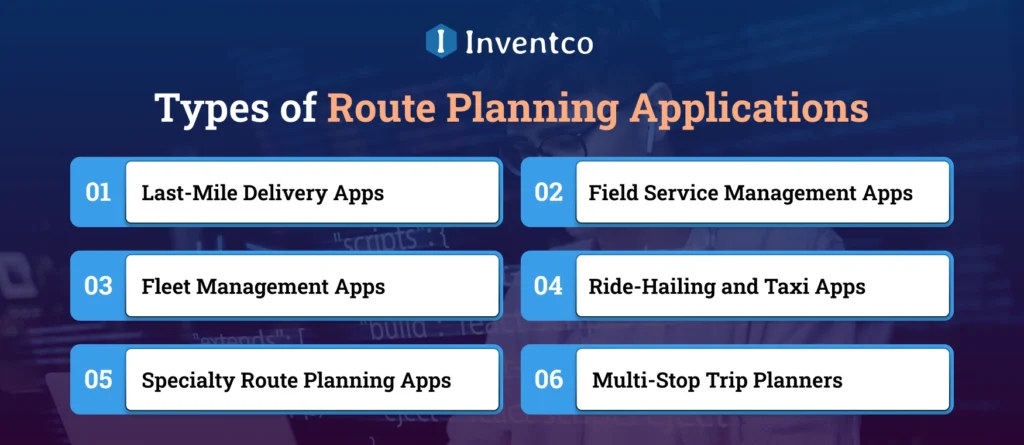
Not all route planning apps serve the same market. Before you build a mobile app for a route-planning platform, it is critical to understand which category your product fits into, because the feature set, technology stack, and go-to-market strategy differ significantly across categories.
1. Last-Mile Delivery Apps
These are purpose-built for businesses managing high-volume deliveries from a central hub to end consumers. Think e-commerce fulfillment companies, courier services, and grocery delivery platforms. The defining challenge is dynamic re-routing, handling cancellations, new orders, and traffic in real time.
2. Field Service Management Apps
Used by businesses with mobile workforces, HVAC technicians, utility repair crews, and medical equipment installers. The routing logic here is more complex because each stop has specific time windows, skill requirements, and job durations. Integration with CRM and dispatch systems is essential.
3. Fleet Management Apps
Enterprise-grade platforms that sit at the center of a business’s vehicle operations. These include real-time GPS tracking, driver behavior monitoring, fuel management, and compliance reporting alongside route optimization. The buyer is typically a VP of Operations or a Fleet Manager.
4. Ride-Hailing and Taxi Apps
Consumer-facing apps that match riders with drivers and optimize routes in real time, accounting for traffic, surge pricing zones, and driver availability. This category is highly competitive globally but offers significant opportunities in regional markets, as demonstrated by the 24×7 Taxi Rider Iceland case study later in this guide.
5. Specialty Route Planning Apps
This includes EV fleet route planning (accounting for charging stations), bike route planning apps for cycling enthusiasts, motorcycle route apps for touring riders, and running route planners for fitness applications. These are niche products with loyal, high-engagement user bases.
6. Multi-Stop Trip Planners
Consumer apps for travelers and tourists planning complex itineraries. The logic here focuses on point-of-interest sequencing, travel mode optimization, and time-based scheduling rather than operational efficiency.
Key Features of a Route Planning App
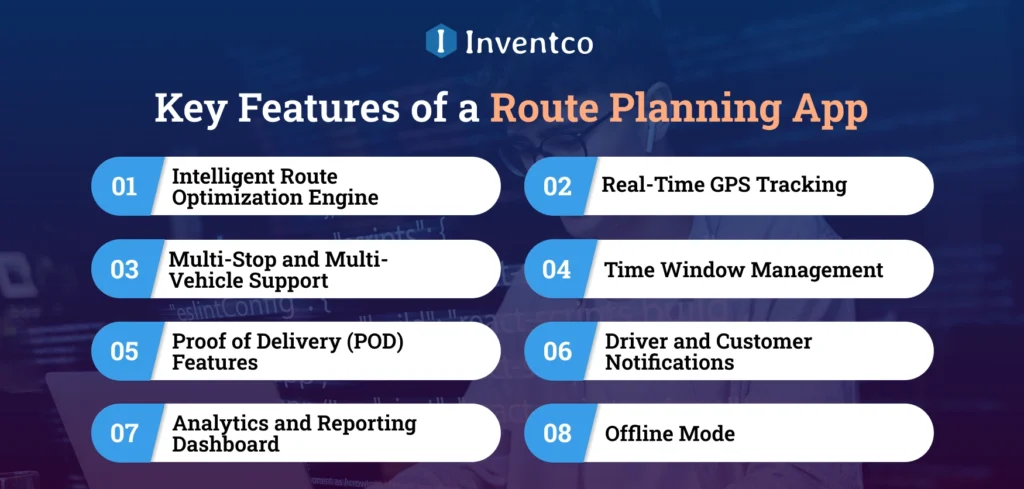
Feature decisions directly determine your app development costs, time-to-market, and product-market fit. Here is how to think about the core feature set for a route planning app.
1. Intelligent Route Optimization Engine
This is the product’s core value. The engine must solve the Traveling Salesman Problem (or its more complex variants, like the Vehicle Routing Problem with Time Windows) in real time. For most commercial applications, you will use a combination of heuristic algorithms and ML based optimization rather than brute force computation. The quality of your optimization engine is what separates a route planning app from a simple mapping tool.
2. Real-Time GPS Tracking
Users need to see vehicle locations updated in near real time (typically every 5-15 seconds). This requires a solid WebSocket architecture and integration with a mapping provider. For fleet operators, this is often the single most-requested feature after route planning itself.
3. Multi-Stop and Multi-Vehicle Support
A route-planning app that can handle only single vehicles is rarely useful for commercial clients. Enterprise buyers need to plan routes across entire fleets simultaneously, with the ability to rebalance loads between vehicles dynamically.
4. Time Window Management
Customers often specify delivery windows (“deliver between 2 PM and 4 PM”). Your routing engine must respect these constraints while still optimizing overall route efficiency. This is a significantly harder algorithmic problem than simple distance optimization.
5. Proof of Delivery (POD) Features
For delivery applications, drivers need to capture electronic proof of delivery, photos, signatures, barcodes, or QR codes. This data needs to be time-stamped, geo-tagged, and synced back to the dispatch system in real time.
6. Driver and Customer Notifications
Automated SMS and push notifications keep customers informed of ETAs and allow them to track their delivery in real time. This feature alone has a measurable impact on customer satisfaction scores and reduces inbound customer service calls by 30-50%.
7. Analytics and Reporting Dashboard
Operations managers need to understand route performance over time, average miles per stop, on-time delivery rates, idle time, fuel consumption, and driver performance. A well-designed analytics dashboard turns your app from a routing tool into a strategic operations platform.
8. Offline Mode
Drivers often work in areas with poor connectivity. Your app needs to cache route data locally and sync changes when connectivity is restored. This is a non-negotiable feature for any commercial delivery or field service application.
Advanced Features to Include in Route Planning Apps
Once your core product is stable, these advanced app features are what drive expansion revenue and enterprise contract wins.
1. AI-Powered Dynamic Re-Routing
ML models that predict traffic patterns based on historical data and automatically re-sequence routes before drivers even encounter delays. This is different from reactive re-routing based on live traffic, it is predictive optimization.
2. EV Fleet Support
As commercial EV adoption accelerates, route-planning apps need to account for vehicle range, charging-station locations, charging times, and battery state. This is becoming a must-have for enterprise fleet clients with sustainability mandates. The best EV route planning apps also factor in elevation changes and weather conditions that affect battery consumption.
3. Voice-Guided Navigation Integration
Turn-by-turn voice navigation integrated directly into the app reduces driver distraction and eliminates the need for drivers to switch between your app and Google Maps or Waze. Platforms like Mapbox offer SDKs that make this achievable without building navigation infrastructure from scratch.
4. Geofencing and Automated Alerts
Automatically trigger actions when vehicles enter or leave defined geographic zones, customer notifications, time-stamp logging, or dispatcher alerts. This is particularly valuable for high-value cargo or time-sensitive deliveries.
5. API Integration Ecosystem
Enterprise clients will demand integration with their existing systems, Salesforce, SAP, NetSuite, and WMS platforms. Building a clean, well-documented API is not optional if you are targeting mid-market and enterprise buyers. Your integration story is part of your sales conversation.
6. Predictive ETAs Using Machine Learning
Static ETAs based purely on distance and speed limits are notoriously inaccurate. ML-driven ETA prediction models that incorporate weather, driver behavior patterns, historical stop durations, and traffic data deliver meaningfully better accuracy, and that accuracy directly impacts customer satisfaction.
7. Carbon Footprint Tracking
Enterprise clients with ESG reporting requirements are increasingly asking vendors to provide carbon emission data by route, vehicle, and time period. Building this feature positions you well for enterprise procurement cycles, where sustainability is a vendor-evaluation criterion.
Technologies Used in Route Planning App Development
Technology choices should be driven by your product requirements, your team’s expertise, and your scalability roadmap, not by trends.
Here is how experienced development teams approach the tech stack for a route planning application.
Mapping and Geospatial Infrastructure
Google Maps Platform still provides the leading service with developer-friendly tools and an outstanding global service offering, but is expensive when scaled and its licensing is constraining. Mapbox offers flexible options, lower prices for larger organizations, and better styling and offline mapping capabilities. OpenStreetMap and OpenRouteService, amongst others, can be viable options for projects with limited budgets if an effective, technically sound team is on hand.
For the routing engine, self-hosted OSRM (Open Source Routing Machine) and Valhalla, open-source offerings, provide immense routing power and flexibility with complete control over the routing logic and data.
Backend Architecture
There are limitations on backends for route optimization. However, Node.js and Python are the most popular programming languages for application programming interfaces. Python has more advanced and better optimization algorithms (Google OR-Tools, SciPy, PuLP). For real-time features, including maintaining the driver and user tracking status, SysML architectures with Socket.io libraries are sufficient.
For route planning applications, a combination of PostgreSQL (with PostGIS for geospatial queries) and Redis (for caching and real-time data) is a popular database architecture. At the enterprise level, a microservices architecture is required that decouples the optimization, tracking, and notification services.
Frontend and Mobile
For mobile app development, the leading cross-platform technology is React Native. It has the most support for ensuring platform-specific features while using a single codebase for both iOS and Android apps. An alternative is Flutter. It can create a customizable app, but the development team should also have experience with Dart. For the development of a web dashboard, the combination of React and a mapping library, Leaflet, or Mapbox GL JS, is the optimal choice.
Cloud Infrastructure
When it comes to cloud computing services, both AWS and GCP are the best options. However, AWS is particularly effective because it offers an array of development services specifically designed for logistics. This includes the Amazon Location Service. GCP also offers distinct advantages through its BigQuery services, particularly if your project is ML-driven. For most projects, especially those in their beginning stages, a combination of cloud computing services and Kubernetes is advised for simplicity and support.
Key Third-Party Integrations
- Google OR-Tools or OptaPlanner for Vehicle Routing Problem solving
- Twilio or AWS SNS for SMS and push notifications
- Stripe or Braintree for in-app payments (applicable for consumer-facing apps)
- Firebase for real-time database and push notifications in mobile apps
- Segment or Amplitude for product analytics
Step-by-Step Route Planning App Development Process
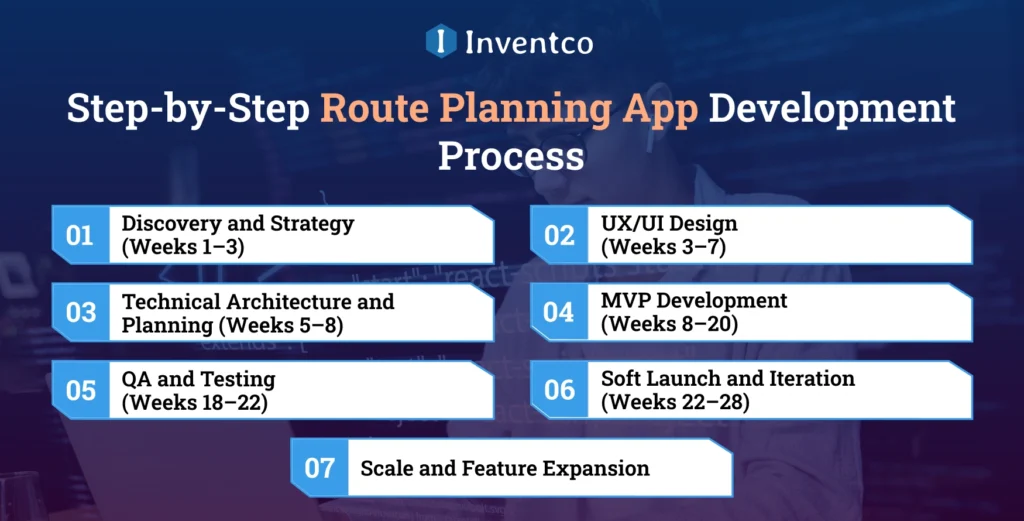
A well-structured mobile app development process is the difference between a product that ships on time and budget and one that runs over by 40% and still has critical gaps at launch. Here is how Inventco approaches route planning app development.
Step 1: Discovery and Strategy (Weeks 1–3)
Before any design or code, you need clarity on the problem you are solving and for whom. This phase involves stakeholder interviews, competitive analysis, user research with your target operators and drivers, and definition of your core user flows. The output is a product brief that aligns your team on scope, priorities, and success metrics.
A common mistake at this stage is trying to build too much. The best route planning apps solve one problem exceptionally well before expanding. Define your MVP app tightly.
Step 2: UX/UI Design (Weeks 3–7)
Route planning apps have two primary user interfaces: the dispatcher’s web dashboard and the driver’s mobile app. These serve very different user needs. The dispatcher needs information density and control. The driver needs simplicity, large touch targets, and a UI that works with gloves on, in sunlight, at a glance.
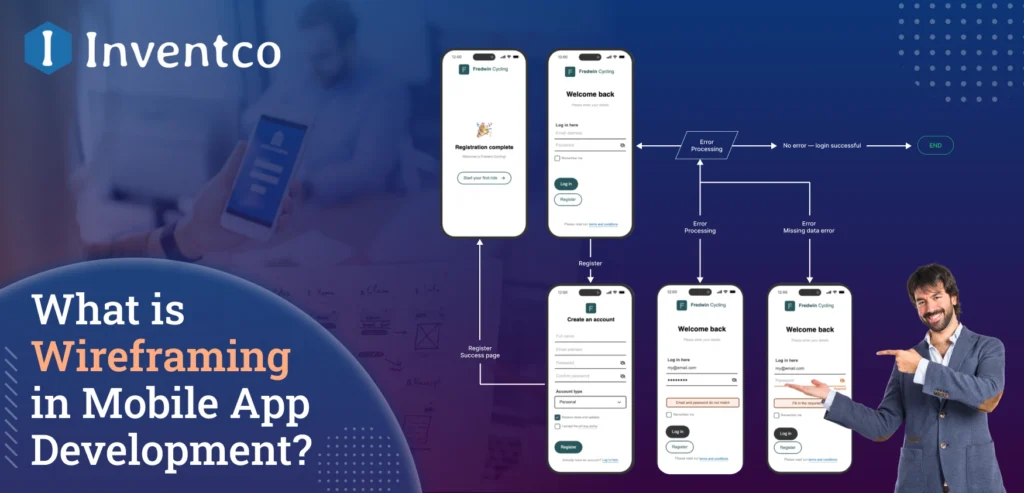
Mobile app wireframing, usability, and prototyping are tested with actual drivers and dispatchers before a single line of code is written, saving enormous costs downstream. Inventco’s UX team typically spends 2 weeks on wireframes and 1 week on an interactive prototype to test with real users before finalizing designs.
Step 3: Technical Architecture and Planning (Weeks 5–8)
Your technical architect should define the database schema, API contracts, third-party integrations, and infrastructure architecture before development begins. This is also when you make your technology stack decisions and set up your CI/CD pipeline. Cutting corners here is one of the most expensive mistakes in app development.
Step 4: MVP Development (Weeks 8–20)
Development progresses in agile sprints with continuous delivery. The MVP typically includes route optimization, GPS tracking, a dispatch dashboard, a driver app, and proof of delivery. The focus is on building a functional, reliable product quickly. Advanced capabilities like multi-vehicle optimization and analytics are intentionally deferred to post-launch phases.
Step 5: QA and Testing (Weeks 18–22)
App testing ensures reliability in real-world conditions. This includes unit testing for algorithms, load testing for real-time systems, GPS accuracy validation, and end-to-end user testing. Given operational risks, rigorous QA minimizes failures, improves system stability, and ensures the platform performs consistently under peak demand and diverse environments.
Step 6: Soft Launch and Iteration (Weeks 22–28)
A controlled launch with a limited number of users helps identify real-world issues. Teams analyze usage data, refine routing logic, and fix edge cases. Continuous iteration improves performance and usability. Real-world feedback is essential, especially for optimization engines that require live data to achieve accuracy and operational efficiency.
Step 7: Scale and Feature Expansion
After launch, growth is driven by user behavior and feedback. High-impact features are prioritized based on usage data. Continuous updates, performance improvements, and new capabilities ensure long-term scalability. A strong feedback loop transforms the product into an evolving platform aligned with customer needs and market demands.
Cost of Route Planning App Development
Cost is one of the most common questions founders and investors ask. The honest answer is that it depends on scope, but here is an app framework for thinking about it.
| Scope | Estimated Cost Range | Timeline |
| MVP (Single platform, core features) | $10,000 – $30,000 | 3–5 months |
| Mid-Tier (Multi-platform, multi-vehicle, basic analytics) | $30,000 – $70,000 | 5–8 months |
| Enterprise-Grade (AI optimization, EV support, API ecosystem) | $70,000 – $100,000+ | 8–14 months |
These figures are for product development only and exclude ongoing infrastructure costs, App Store fees, mapping API usage (which scales with volume), and post-launch app maintenance. Inventco recommends budgeting 15-20% of the initial development cost annually for maintenance and iterative improvements.
The most cost-effective approach for most founders is to begin with a well-scoped MVP, validate with paying customers, and raise a subsequent round to fund the expansion roadmap. Trying to build the full enterprise vision upfront is the fastest way to run out of runway.
Key Cost Drivers
- Complexity Of The Routing Algorithm: Multi-vehicle, time window, and capacity constraints add significant engineering complexity.
- Number of Integrations: Each third-party integration (WMS, ERP, CRM) adds development and testing time.
- Real-Time Features: Live tracking and dynamic re-routing require a more complex backend architecture.
- Geographic Scope: Serving multiple countries adds complexity to mapping, compliance, and localization.
- Team Location: Development teams in North America and Western Europe command higher rates than teams in Eastern Europe, India, or Southeast Asia with equivalent skill levels.
Challenges in Route Planning App Development
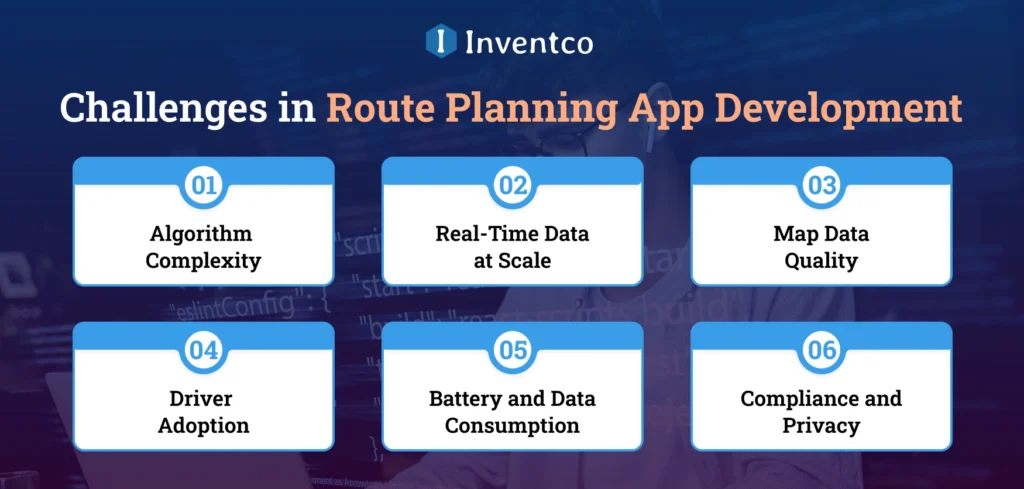
Understanding the app development challenges upfront allows you to plan around them, and it is one of the clearest markers of an experienced development partner versus a junior shop.
1. Algorithm Complexity
The Vehicle Routing Problem is NP-hard in its general form, meaning exact solutions are computationally infeasible at scale. Real-world route-planning apps use heuristic and metaheuristic approaches, such as genetic algorithms, simulated annealing, and ant colony optimization, to find high-quality solutions quickly without guaranteeing mathematical optimality. Building an optimization engine that performs well across diverse real-world scenarios requires significant expertise and testing.
2. Real-Time Data at Scale
A fleet of 500 vehicles updating GPS positions every 10 seconds generates 50 location updates per second. At 1,000 vehicles, you are at 100 updates per second, before accounting for route recalculation requests. Designing a backend architecture that handles this load without degrading performance requires careful attention to database design, caching strategy, and horizontal scaling.
3. Map Data Quality
Routing accuracy is only as good as the underlying map data. In many emerging markets, road network data is incomplete or outdated. Building in mechanisms for drivers to report road issues and for the system to learn from historical routing data is essential for improving accuracy over time.
4. Driver Adoption
Even the most technically perfect route planning app fails if drivers do not use it correctly. Driver UX must be a first-class design concern. Large touch targets, voice-guided prompts, minimal required interactions, and clear offline mode indicators all contribute to adoption. Launching with a driver training program is not optional, it is part of your product launch strategy.
5. Battery and Data Consumption
Continuous GPS tracking and map rendering are two of the most battery-intensive operations a mobile app can perform. Optimizing your app’s battery consumption is not just a nice-to-have, drivers will uninstall apps that drain their battery or exceed their data plan. This requires careful architecture of your location-tracking service and map-tile caching strategy.
6. Compliance and Privacy
Driver location data is personally identifiable information in many jurisdictions. GDPR in Europe, CCPA in California, and various regional privacy laws impose specific requirements on how you collect, store, and process this data. Legal compliance needs to be built into your data architecture from day one, not retrofitted.
Best Route Planning Apps in the Market
Understanding the competitive landscape is essential for product positioning. Here are the leading route planning applications as of 2026.
1. OptimoRoute
OptimoRoute’s strength lies in its last-mile delivery and field service management software. It’s primarily recognized for its easy-to-use user interface with solid multi-vehicle optimization. It has also been mainly adopted by SMB delivery operations. The only weakness is the lack of customization for enterprise buyers with more complex integration needs.
2. Route4Me
Route4me considers itself one of the most inclusive route planning apps. Their platform supports single-vehicle routing and complex, enterprise-level fleet management. Their API is also very robust and well-documented, making it extremely popular among logistics operators that embrace technology.
3. Circuit for Teams
Circuit has built its product for businesses with delivery operations. They have strong driver applications, proof-of-delivery functionality, and automated customer updates. They are also gaining market presence in the mid-markets.
4. Routific
Routific was a strongly optimized algorithm with a clean UI. Well-regarded in the grocery and meal delivery verticals. Focused on simplicity over feature breadth, which resonates with operations teams that want to deploy quickly.
5. Google Maps Platform (for Developers)
While Google Maps Platform is not a standalone route-planning product, it is the foundation for the infrastructure on which other custom route-planning applications have been built. For custom applications, Google also offers enterprise mapping capabilities through its Directions API and Route Optimization API.
The competitive landscape shows that no single player is leading across all domains and verticals. Niche positioning remains a valuable strategy for new entrants with differentiated products, whether by market, industry, or a particular use case.
Benefits of Route Planning App Development for Businesses
The business case for route planning technology is clear and measurable. Here is how it translates across the P&L.
1. Direct Cost Reduction
Among the many direct costs of field service delivery operations, fuel is often the highest variable cost. Route optimization reduces fuel consumption and eliminates redundant miles. For bigger companies and mid-size fleets, this represents a savings of over seven figures annually.
2. Revenue Capacity
Optimized routes enable field service representatives and drivers to complete more tasks. Tasks per route and, thus, the total number of routes can be increased by up to 20%. This directly correlates with increased revenue for the company. Alternatively, the company can maintain the same revenue while reducing the total number of drivers.
3. Customer Experience
With more accurate Estimated Time of Arrival (ETA) estimates and the ability to track deliveries and receive notifications of changes, the customer experience improved. Many companies that have implemented these features report a 20% to 30% reduction in customer service calls about delivery status, thereby also reducing their operational burden.
4. Data-Driven Operations
Route planning platforms generate rich operational data. Which routes are consistently delayed? Which drivers have the highest on-time rates? Which vehicle types perform best in specific geographies? This data enables continuous operational improvement and informs strategic decisions about fleet composition and service area expansion.
5. Competitive Differentiation
In many logistics markets, harnessing technology is now a prerequisite for bidding on enterprise-sized contracts. The largest shippers and retailers require their logistics partners to provide technology integration, such as real-time tracking, EDI, and performance reporting. A competitive route-planning platform not only improves your operational efficiency, it also helps you gain more customers.
Future Trends in Route Planning App Development
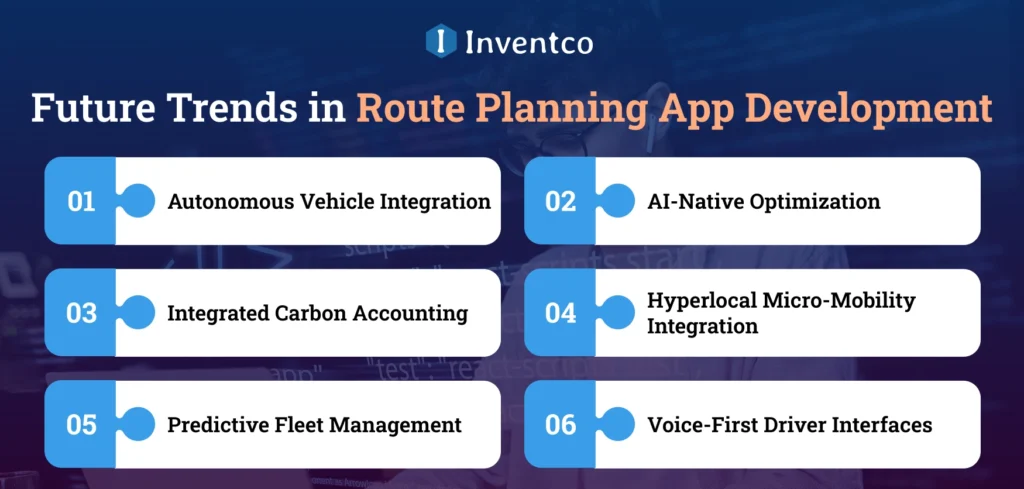
The route planning app landscape is evolving rapidly. Here are the app development trends that will define the next generation of products.
1. Autonomous Vehicle Integration
The commercial deployment of autonomous vehicles (AVs) requires integrating advanced route-planning software with AV control systems. Unlike human drivers, AVs are constrained by different routing logic, continuous driving, turning radius restrictions, and lane-type-compatible routing. Development teams targeting the 2027+ market should consider the AV readiness of their software.
2. AI-Native Optimization
The shift from heuristic algorithms to neural networks is well underway. Google DeepMind’s research on combining reinforcement learning with neural networks has shown enhanced, expedited results compared to legacy neural networks in vehicle routing systems. One of the biggest and most influential changes in routing systems in the next two to three years will be the integration of deep learning.
3. Integrated Carbon Accounting
The tracking of carbon has gone from a ‘nice to have’ status for procurement to a requirement. Enterprise shippers and logistics service providers are establishing and documenting the efficiency of their carbon-emissions reduction efforts to meet Scope 3 emissions targets. As route planning applications provide more in-depth carbon reporting for each delivery, they gain a competitive advantage in enterprise sales.
4. Hyperlocal Micro-Mobility Integration
Urban last-mile delivery is increasingly being served by e-cargo bikes, e-scooters, and on-foot couriers in addition to vehicles. Next-generation route planning platforms will need to optimize multimodal delivery networks, routing some deliveries to traditional vehicles and others to micro-mobility assets based on package size, delivery window, and urban density.
5. Predictive Fleet Management
An emerging frontier is the combination of route planning and predictive maintenance. Say your fleet management system, based on telematics, knows that a certain vehicle will most likely need maintenance in 48 hours. The route planning engine should take that into account as a constraint in the dispatch planning for the next day. To achieve this, a consolidated data platform is necessary with maintenance, fleet management, and route optimization.
6. Voice-First Driver Interfaces
Due to stricter safety regulations on the use of certain devices while driving, voice-controlled driver interfaces will become the norm. The updated driver applications will be voice-based, with a visual user interface serving as a reference for the majority. This will change how information is communicated to the driver, as dispatch information, live route changes, and Pod capture will all be delivered via voice.
How Inventco Can Help You Build a Route Planning App?
Inventco brings valuable skills to address route planning beyond maps, including the operational benefits of a system that enhances productivity and delivers cost savings, even at small scale. Inventco’s model prioritizes strategy over scaled systems to align design that integrates the route-planning system with your logistics.
Inventco develops a scalable, cloud-native app architecture built on APIs, enabling real-time, unrestricted connections to GPS, IoT, and 3rd-party systems. Inventco’s route planning app offers a slew of Route Optimization features, including real-time traffic adaptation and dynamic, sequential re-routing. This gives our app users more access points and ensures our apps have the highest functionality.
Beyond the aforementioned, Inventco creates cross-platform apps for drivers and dispatchers and manages analytics that transform users’ raw operating data into actionable plans. More than anything, Inventco aims to help its clients transform their apps from business-use tools into Competitive Assets.
Case Study: Building a Scalable Route Planning & Dispatch Platform with Inventco
Developing real world knowledge is far more insightful than learning theory alone. Inventco partnered with 24×7 Taxi Rider Iceland to design and implement a taxi and dispatch platform with a strong focus on reliability and scalability.
The Challenge
The company operates in Iceland 24 hours a day. They must manage bookings and driver availability, as well as dispatch and optimize routes across a complex, highly seasonal geography. Manual dispatching is intensive and uncoordinated. It diminishes output and creates slow response times.
The Solution
Inventco built a multi-layered platform that integrated all the necessary components – strategy, UX/UI, backend, and cross-platform apps. A phased roadmap was created, emphasizing real-time booking and dispatch capacity, followed by analytics and enterprise features. The server-side components in the system were Node.js microservices hosted on AWS, enhanced dispatch with real-time updates via WebSockets, and used Mapbox for intelligent route optimization. Using React Native meant that both the driver and customer apps were developed with a single codebase.
The Results
The platform reduced dispatch time by 50%, improved fleet utilization by 35%, and enabled scalable growth, transforming operations into a data-driven, high-efficiency system.
Conclusion
Developing a route planning app is a complex undertaking. It requires expertise across various areas, including geospatial algorithms, real-time systems architecture, mobile user interfaces, and logistics. Although difficult, the business case for these apps is strong. Demand in this market is growing rapidly, and the return on investment for high-quality apps is large and obvious.
Apps like these may serve different purposes, such as last-mile deliveries, field service optimization, or transport planning. Regardless of the app’s purpose, your approach must always be the same: understand the user’s problem, wrap a minimum viable product (MVP) around it, and iteratively develop the product using data from user activity to make critical improvements.
Achieving long-term operational and economic objectives requires making a business trade-off. Users in this market want high precision on a technical level. The real user may not need this level of technical detail or want anything close to it, and each app in this market must accommodate that need to be minimally competitive.
FAQ’s
Q1. How long does it take to develop a route planning app?
Ans. A well-defined MVP typically takes 4–6 months to launch. Enterprise-grade platforms with AI optimization, multi-vehicle support, and integrations require 10–14 months, depending on routing complexity and dependencies.
Q2. What is the minimum budget to build a route planning app?
Ans. A realistic MVP costs $10,000–$30,000 and covers core routing, GPS tracking, and dispatch. Lower budgets often compromise architecture, testing, and scalability, resulting in higher long-term costs after launch.
Q3. Should I build or buy?
Ans. Use white-label or Route4Me APIs for standard needs. Build custom solutions if your routing involves unique constraints, proprietary data, or differentiated operational logic.
Q4. How do I monetize a route planning app?
Ans. Common models include SaaS subscriptions per driver or vehicle, usage-based pricing per route, enterprise licensing, and freemium tiers for consumer apps, depending on your target market and product complexity.
Q5. What mapping API should I use?
Ans. Mapbox offers flexibility and pricing control. Google Maps Platform suits global coverage needs. OpenStreetMap works for cost-sensitive, self-hosted solutions.
Q6. How do I handle route planning in areas with poor map data?
Ans. Combine frequent map updates, driver feedback loops, and machine learning on historical routes. Over time, this builds a proprietary dataset that improves routing accuracy in challenging regions.

Jitendra Jain
He is the CEO and Co-founder of Inventco, driving innovation in advanced computing and digital transformation. With deep expertise in modern IT ecosystems, he leads scalable, secure, future-ready solutions. His strategic leadership helps businesses accelerate growth, adopt innovation, and achieve success. You can connect with him on LinkedIn to follow his technology insights.